




Bathroom Renovation Ideas for Vancouver Homes: Designs, Trends, and What Works in 2026
Vancouver homeowners are investing more in their bathrooms than ever before. In a city where rain falls for eight months of the year and the average detached home trades at over $2 million, the bathroom has become the room where Vancouverites splurge — and where smart renovation dollars go furthest. Whether you are gutting a dated 1970s ensuite in Kitsilano, updating a narrow condo bathroom in Yaletown, or designing a powder room that makes a statement in a North Shore craftsman, the principles are the same: quality materials, thoughtful layout, and trades who know what they are doing.
This guide covers every angle of bathroom renovation ideas Vancouver homeowners ask VGC about most — from the tile trends dominating 2026 to the realistic costs of a curbless walk-in shower, from small condo bathrooms that feel twice their size to luxury ensuites that rival boutique hotels. We have included pricing ranges based on real Vancouver projects, a step-by-step look at how VGC manages the renovation process, and a 15-question FAQ at the end covering the questions we get asked on almost every call.
If you are ready to talk specifics, visit our renovation guide or contact us to schedule a consultation. Otherwise, read on — this is everything you need to know before spending a dollar.
 kitchen renovation with white quartz island in Vancouver” class=”wp-image-12765″ />
The curbless shower — also called a wet room or barrier-free shower — has been the most requested feature in Vancouver bathroom renovations for three consecutive years
Vancouver General Contractors
Vancouver Bathroom Design in 2026: Trends That Are Worth the Investment
Not every trend deserves your renovation budget. Some age quickly; others represent genuine functional upgrades that will still feel relevant in fifteen years. Below are the design choices VGC is installing most frequently in 2026 — and the ones we are confident will hold their value in the Vancouver resale market.
Curbless Walk-In Shower: The Number One Most Requested Feature
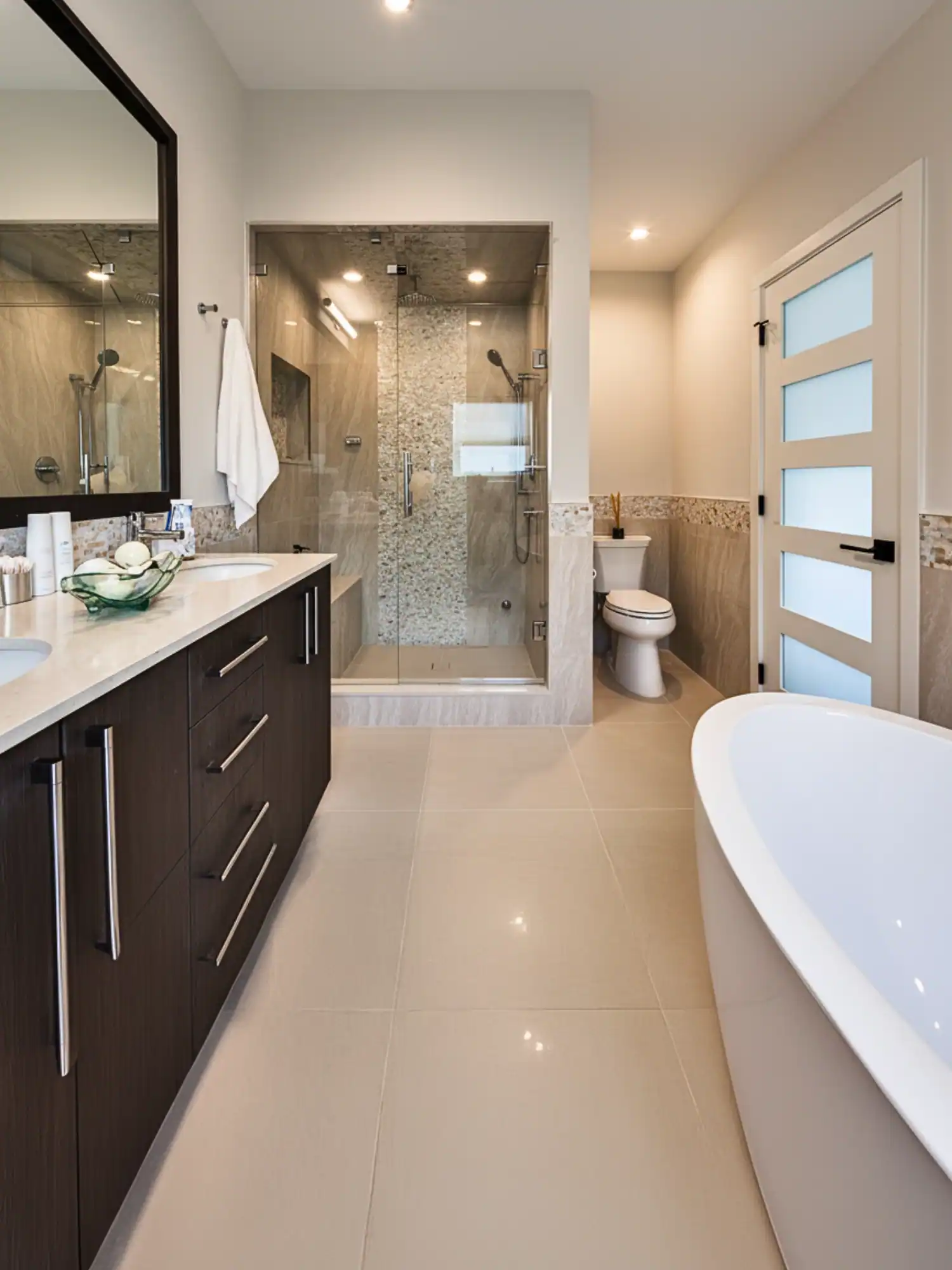
The curbless shower — also called a wet room or barrier-free shower — has been the most requested feature in Vancouver bathroom renovations for three consecutive years. The appeal is immediate: no curb to step over, a seamless floor transition that makes the entire room feel larger, and a clean visual line that photographs beautifully. For aging-in-place clients, the accessibility benefit is also significant. A properly built curbless shower requires a floor sloped toward a linear drain at no less than 1/4 inch per foot, a fully waterproofed substrate (VGC uses the Schluter KERDI system as standard), and tile installed with precision to maintain consistent slope. Done correctly, it is one of the most durable and functional upgrades a Vancouver bathroom can receive.
Large Format Tile (24×48 Inches or Larger): Fewer Grout Lines, Luxurious Look
The shift to large format porcelain tile — 600×1200mm (roughly 24×48 inches) being the dominant size in 2026 — is driven by both aesthetics and practicality. Fewer grout lines mean a cleaner visual field and dramatically easier ongoing maintenance. A shower tiled in 24×48 panels has a fraction of the grout surface area of a classic 4×4 subway tile installation, which means less mildew, less scrubbing, and a look that stays pristine much longer. In terms of aesthetics, large format tile reads as a premium material even at mid-range price points — it simply looks more expensive than it costs.
Matte Black Fixtures: Sharp Contrast, Timeless Finish
Matte black tapware, showerheads, linear drains, towel bars, and toilet paper holders have replaced polished chrome as the default finish choice in Vancouver bathroom renovations. The reasons are functional as well as aesthetic: matte black does not show water spots or fingerprints the way polished chrome does — a meaningful advantage in Vancouver’s hard-water zones. Against white tile or light stone porcelain, the contrast is clean and sophisticated. Against darker tile, the result is more monolithic and dramatic. Both work. Budget approximately $1,500–$4,000 for a full matte black fixture package (tapware, showerhead, drain, towel bars, toilet paper holder) depending on brand and specification.
Freestanding Soaker Tub: Statement Piece for Ensuites With Space
The freestanding soaker tub has become the default statement piece for Vancouver ensuites with enough square footage to accommodate one. Positioned ideally beneath a window — or against a feature tile wall where privacy does not allow glazing — a freestanding tub serves as the room’s focal point. The most popular profiles in 2026 are matte white acrylic in clean oval or rectangular forms, though cast iron options (heavier, better heat retention, more expensive) remain popular among clients prioritising longevity. Floor-mounted fillers in matte black or brushed gold complete the look. Budget $3,500–$8,000 for tub plus filler, not including installation.
Floating Vanity: Airy, Modern, and Easier to Clean
Wall-mounted floating vanities have replaced floor-standing furniture-style vanities as the dominant choice in Vancouver bathrooms across all price points. The functional advantages are real: mopping the floor is easier when there is no cabinet base to work around, the visual floor space reads as continuous and larger, and the profile is inherently cleaner. In small bathrooms, a floating vanity is close to mandatory from a design standpoint. In large ensuites, a double floating vanity at 60–72 inches wide creates a spa-like presence. Custom millwork vanities in painted MDF or white oak veneer are the premium choice; semi-custom options from local suppliers cover the mid-range effectively.
Smart Mirror: LED Lighting, Demisting, Bluetooth
The smart mirror market has matured significantly and the products are genuinely useful. LED-lit mirrors with integrated demisting elements solve two persistent Vancouver bathroom problems simultaneously: the dim, shadow-casting light of a standard vanity bulb, and the condensation that fogs mirrors in a city where temperature differentials are frequent. Bluetooth speakers, colour-temperature adjustment (from warm bath mode to cool daylight for makeup), and touch dimming are standard features in mid-range models. Budget $800–$2,500 depending on size and feature set. The electrical rough-in (a switched circuit to the mirror location) should be planned at the framing stage.
Heated Floors: Practically Mandatory in Vancouver’s Climate
Radiant heated tile floors are, in VGC’s view, the highest value-per-dollar upgrade in a Vancouver bathroom renovation. The installation cost during a full renovation is modest — $1,200–$2,500 to install a mat system under the tile, plus an additional $300–$500 for the thermostat and electrical connection — and the comfort benefit on a November morning at 6 a.m. is difficult to overstate. Installing heated floors after tiling is prohibitively expensive (full tile removal required). The time to install is always during the renovation, never after.
Main Bathroom Ideas: Transforming the Family Bathroom
The typical Vancouver main bathroom is a 5×8 foot space — approximately 40 square feet — with a tub/shower combo, single vanity, and tile that was last updated sometime before smartphones existed. These bathrooms are functional but joyless. A well-executed renovation transforms the most-used room in the house into something that actually feels good to be in. Here is how VGC approaches main bathroom upgrades, ranked by visual and functional impact per dollar spent.
Upgrade Priority Ranking for Main Bathrooms
| Upgrade | Impact | Typical Cost (Vancouver) |
|---|---|---|
| Convert tub to walk-in shower | Highest visual transformation | $6,000–$12,000 |
| New tile — floor to ceiling | Total room refresh | $4,000–$10,000 |
| New vanity, mirror, and lighting | Daily-use upgrade | $2,500–$6,000 |
| New toilet | Functional + hygiene | $500–$1,500 |
| Heated floor | Comfort, best ROI per dollar | $1,200–$2,500 |
Converting the tub/shower combo to a dedicated walk-in shower is the single most impactful change in a main bathroom. For most Vancouver families with children who still need a tub, the calculus is different — in those cases, retiling the tub surround and upgrading the valve and showerhead delivers meaningful improvement at lower cost. But for adults-only households or buyers targeting the renovation market, removing the tub in favour of a full-width shower transforms how the space reads and functions.
A complete main bathroom renovation — new shower or tub surround, full tile, new vanity, toilet, lighting, and heated floor — runs $18,000–$35,000 in Vancouver depending on material selections and the complexity of any plumbing moves. Keeping plumbing in its existing location is the single biggest lever for controlling cost.
Master Ensuite Ideas: Creating a Spa-Level Experience
The master ensuite is where Vancouver homeowners are willing to invest most aggressively — and where the investment is most justified. A luxury ensuite renovation not only transforms daily quality of life but adds demonstrable value in the Vancouver resale market, where buyers at the $2M+ price point have elevated expectations for primary bathroom quality.
The Curbless Walk-In Shower: The Core Investment
A fully specified ensuite walk-in shower includes a linear drain, large format tile on floor and walls, a ceiling-mounted rainfall showerhead, a handheld wand, recessed niche shelving (at least two niches), a fold-down teak or stainless bench, frameless glass enclosure (10mm glass minimum), and all fixtures in a matching finish. Built to this specification in a Vancouver ensuite, the shower alone costs $15,000–$28,000 — the wide range reflecting tile selection, glass configuration, and whether any plumbing relocation is required. This is not a place to cut corners. A shower built wrong requires full demolition to fix; a shower built right lasts thirty years without issue.
Soaker Tub: Focal Point and Architectural Statement
For ensuites with 80 square feet or more, a freestanding soaker tub is both practical and architecturally significant. Placement matters enormously: a tub positioned in front of a large window (with exterior privacy maintained by obscure glazing or appropriate landscaping) creates a genuinely spa-like effect that is difficult to achieve any other way. Where window placement is not possible, positioning the tub against a book-matched porcelain feature wall achieves a similar focal-point effect. Budget $3,500–$8,000 for tub plus floor-mounted filler, supply only.
Double Vanity: Minimum 60 Inches for Two Sinks
A double vanity — minimum 60 inches wide to provide usable space at each sink — is functionally essential in a shared primary ensuite and aesthetically anchors the space. VGC specifies undermount sinks (not vessel sinks, which are impractical for daily use at 5:30 a.m.) with quartz countertops as the standard. Allow 18–24 inches of counter width per person plus the sink basin. Custom millwork in painted white or natural wood tones is the predominant choice in 2026; semi-custom options provide good value at lower cost. Budget $3,500–$8,000 for double vanity supply, depending on specification.
Ensuite Expansion: Finding Square Footage
Many Vancouver ensuites simply are not large enough to achieve a spa-level result without physical expansion. The most common approach is borrowing from the adjacent walk-in closet — converting closet space to bathroom square footage and relocating clothing storage to the bedroom or a reorganised closet elsewhere. Where structural conditions allow, borrowing from a bedroom corner is also viable. For homes with garages, additions above the garage can create new ensuite space without footprint expansion. A full luxury ensuite renovation, including design, permits, and construction, runs $65,000–$120,000 at current Vancouver labour and material costs.
Small Bathroom Ideas for Vancouver Condos
Vancouver condo bathrooms are typically 35–55 square feet — genuinely small spaces that feel even smaller when cluttered or dated. The good news is that the design principles for maximising small bathrooms are well-established, and the right moves produce results that are strikingly effective. Here is what VGC recommends for condo bathroom renovations.
Design Moves That Make Small Bathrooms Feel Larger
- Floor-to-ceiling tile: Vertical tile lines draw the eye upward and create an illusion of height. Using the same tile on floor and walls reduces visual interruption and makes the space read as a unified, larger field.
- Large format tile on the floor: Counterintuitively, larger tiles make small floors look bigger — fewer grout lines means fewer visual breaks, and the eye reads the floor as a single continuous surface.
- Floating vanity: The visual floor space continuing under the vanity is the simplest way to add perceived square footage to a small bathroom.
- Recessed medicine cabinet: A surface-mounted cabinet projects into the room; a recessed cabinet lives in the wall and takes zero floor or visual space while providing meaningful storage.
- Frameless shower screen instead of full enclosure: A single frameless glass panel instead of a framed two-panel enclosure reduces visual weight dramatically. The shower reads as part of the room rather than a box within a box.
- Back-to-wall toilet with concealed tank: Hiding the cistern in a wall-framed chase saves 6–8 inches of bathroom depth — meaningful in a 35 square foot space — and creates a cleaner visual line.
A complete small condo bathroom renovation in Vancouver — new shower, tile, vanity, toilet, and lighting — runs $18,000–$32,000. Permit requirements vary by strata; VGC handles all permit coordination as part of the project.
Tile Ideas for Vancouver Bathrooms
Tile selection is the most consequential design decision in a bathroom renovation. The tile sets the room’s character, determines maintenance requirements for years to come, and represents a significant portion of material cost. Here is a breakdown of the tile categories VGC is working with most in 2026.
Large Format Porcelain: The Dominant Choice
600×1200mm (24×48 inch) large format porcelain tile — often in concrete, stone, or marble looks — is the most-specified tile in Vancouver bathroom renovations in 2026. The format works in any bathroom size, from a 35 square foot condo bathroom to a 120 square foot luxury ensuite. Porcelain is fully vitrified (water absorption below 0.5%), frost-resistant, and extremely durable under daily use. Italian and Spanish manufacturers produce the best product at competitive price points; VGC sources through established local distributors who maintain inventory of the most popular SKUs.
Zellige Tile: Handmade Texture and Reflective Character
Zellige is a handmade Moroccan glazed tile with a slightly irregular surface that catches light differently than machine-made tile — the reflective variation across a zellige wall is genuinely beautiful and impossible to replicate industrially. In Vancouver, zellige is popular in East Van craftsman renovations (where its handmade quality fits the aesthetic) and in boutique ensuite feature walls where clients want something distinctive. It requires more experienced tile setters due to its irregular thickness, and grout joints need to accommodate surface variation. Budget a premium of 30–50% over equivalent machine-made tile for material and installation combined.
Book-Matched Porcelain Slabs: Dramatic and Seamless
Book-matching — positioning two tiles that are mirror images of each other, cut from the same slab batch — creates a dramatic, continuous veining effect on shower feature walls. The result looks like a single continuous stone surface and photographs exceptionally well. This technique requires careful layout planning before installation begins and experienced tile setters who understand the matching sequence. It is most effective on a single feature wall — the shower back wall or the wall behind a freestanding tub — rather than throughout the entire bathroom.
Terracotta and Warm Earth Tones: A Reaction to All-White
After a decade of white-everything bathrooms, warm earth tones — terracotta, blush, warm taupe, and ochre — are appearing with increasing frequency in powder rooms and eclectic ensuite designs. Terracotta tile (both traditional fired clay and the porcelain-bodied versions that offer better moisture resistance) brings warmth and tactile character that white tile simply cannot. It works best in powder rooms, where the smaller canvas allows a bolder commitment, or as a floor tile in an ensuite where warmer tones are balanced by cooler wall tile or plaster finishes.
Grout Colour: The Detail That Changes Everything
Dark or charcoal grout with white tile — instead of the traditional matching white grout — is one of the highest-impact, lowest-cost design decisions in a bathroom renovation. The contrast creates a graphic grid effect that reads as intentional and modern. Practically, dark grout also maintains its appearance better over time; white grout in a shower shows staining quickly despite sealing. The cost difference between a standard grout colour and a premium dark colour is negligible — typically $50–$150 in material cost — making this one of the best value-per-dollar design choices available.
Shower Ideas for Vancouver Homes
The shower is the most-used element of any bathroom and deserves proportional investment. VGC builds showers across the full spectrum — from functional tub/shower retiles in family bathrooms to full wet-room steam showers in luxury ensuites. Here is the full landscape of options.
Curbless Shower: Best for Accessibility and Aesthetics
As described above, the curbless shower is VGC’s most frequently installed shower type. The critical technical requirements are proper floor slope (1/4 inch per foot minimum toward the linear drain), a fully waterproofed substrate extending at least 6 inches up all walls, and tile installation that maintains the slope without creating lippage. When built correctly, a curbless shower is maintenance-free and functionally superior to a curbed shower in almost every way. The cost premium over a curbed shower is $1,000–$3,000, primarily for the linear drain and additional waterproofing complexity.
Steam Shower: Spa Experience at Home
Adding a steam generator to a walk-in shower converts it into a full steam room — and in Vancouver’s climate, this is an investment many clients find genuinely life-improving. A steam shower requires a steam-tight door seal (no gap at the bottom, as standard showers have), a generator sized to the shower volume (typically 7–12 kW for a residential shower), a bench for comfortable use, and optionally an eucalyptus oil reservoir integrated into the generator. The electrical load requires a dedicated 240V circuit. Budget $3,500–$8,000 for the generator and seal upgrades, with total steam shower project costs running $8,000–$18,000 depending on whether the steam upgrade is part of a broader shower build or added to an existing space.
Multiple Shower Heads: Rainfall, Handheld, and Body Jets
A ceiling-mounted rainfall showerhead (200mm–300mm diameter) paired with a handheld wand on a slide bar is the standard specification for a quality Vancouver ensuite shower. Body jets — typically mounted in two or three pairs on the side wall — add a hydrotherapy element that requires additional plumbing rough-in and a thermostatic valve capable of handling the flow rate. Budget $800–$2,500 for the fixture package (rainfall head, handheld, body jets, thermostatic valve) and $1,500–$3,000 for the additional plumbing work to supply the jets, depending on pipe routing complexity.
Shower Niche: Required in Any Quality Renovation
A recessed shower niche — a framed opening in the shower wall, typically 12×24 inches or 12×36 inches, tiled to match the surround — is standard in every VGC shower build. The niche provides a clean, waterproof storage location for shampoo, soap, and razors without the visual clutter of a surface-mounted caddy. Two niches are better than one (his and hers in a shared shower). The cost during a full renovation is $300–$600 per niche including framing, waterproofing, and tile. Like heated floors, niches are trivially inexpensive during construction and prohibitively expensive to add afterward.
Vanity Ideas for Vancouver Bathrooms
The vanity is the room’s functional centrepiece — used twice a day by every household member. Getting the vanity right (size, storage, sink type, counter material, and lighting) makes an outsized difference in day-to-day bathroom satisfaction. Here is VGC’s breakdown of vanity options for Vancouver bathrooms.
Floating Vanity: The Default Choice in 2026
Wall-mounted floating vanities are the standard specification for Vancouver bathroom renovations in 2026, at all price points and in all bathroom sizes. The key installation requirement is blocking in the wall framing during the rough-in stage — floating vanities carry significant weight when loaded and require proper backing. Mount height is typically 34–36 inches from finished floor to top of counter, slightly higher than the 32-inch standard of floor-standing vanities, which many clients find more comfortable.
Double Vanity Configuration for Shared Bathrooms
For shared ensuites, a double vanity at 60–72 inches provides genuine daily usability — two people can use the bathroom simultaneously without conflict. The key specification decisions are sink placement (undermount centred in each section), counter material (quartz in 2cm or 3cm thickness is standard; 3cm is more substantial visually), and whether the two-sink run includes a separate makeup section at a lower height (28–30 inches). Supply cost for a quality double floating vanity runs $3,500–$8,000 depending on material and degree of customisation.
Custom Millwork Vanity: Maximum Storage, Fully Customised
Custom millwork vanities — built by a local cabinetmaker to the exact dimensions and configuration of the bathroom — offer storage options that off-the-shelf vanities cannot match. Integrated electrical outlets inside drawers, custom drawer dividers sized for specific products, pullout hampers, and integrated laundry chutes are all achievable. The visual result is also uniquely tailored to the space. Budget $3,000–$8,000 for custom millwork supply only, not including counter and installation. Lead time is typically 4–8 weeks, which must be accounted for in project scheduling.
Vanity Lighting: Sconces for Shadow-Free Illumination
The most effective vanity lighting is wall-mounted sconces positioned on either side of the mirror at face height (approximately 60 inches from finished floor to centre). This flanking arrangement eliminates the shadows cast by overhead lighting and provides even, flattering illumination for grooming tasks. A single overhead bar light above the mirror — the standard in most older Vancouver bathrooms — creates harsh downward shadows that make functional tasks difficult and unflattering. Switching to flanking sconces is one of the highest-impact, most underrated bathroom upgrades available. Budget $300–$800 per sconce plus electrical rough-in if new wall circuits are required.
Powder Room Ideas: High Impact, Low Cost
The powder room is VGC’s favourite bathroom renovation project. The reasons are straightforward: the space is small (typically 18–25 square feet), the scope is limited (no shower, no tub, no waterproofing beyond the immediate floor area), and the design opportunity is enormous. Because visitors see the powder room rather than live in it, you can commit to dramatic tile, bold colour, and statement fixtures that would feel overwhelming in a daily-use bathroom. The return on investment is also exceptional — a beautifully renovated powder room adds perceived value to a home far beyond its actual renovation cost.
Statement Tile: Go Bold
The powder room is the appropriate canvas for tile patterns and colours you would hesitate to commit to in a main bathroom. Encaustic cement tile in geometric patterns, large-scale graphic black and white, rich jewel-tone zellige, oversized terracotta hexagons — all of these work beautifully in a powder room and would feel too intense in a 5×8 family bathroom used every morning. The small area also means that dramatic tile costs a fraction of what it would in a larger space — a $30/square foot tile in a 20 square foot powder room adds $600 in material versus $3,000+ in a full bathroom.
Designer Wallpaper: Instant Transformation
Waterproof or vinyl-coated wallpaper is a legitimate and increasingly popular finishing choice for powder rooms. A bold botanical print, a graphic geometric pattern, or a moody dark floral — all of these create a dramatically different atmosphere than tile alone and can be installed in a day. Budget $400–$1,200 for supply of a quality vinyl wallpaper in a standard powder room, plus $500–$1,000 for professional installation. The result can be stunning and is achievable at a total cost far below what equivalent drama in tile would require.
Vessel Sink on Floating Shelf: Architectural Statement
A vessel sink — a basin that sits above rather than within the counter surface — is impractical in a daily-use bathroom (water splashes more easily, and the height is awkward for washing hands multiple times a day) but works beautifully in a powder room that sees occasional use. Mounted on a minimal floating shelf in white oak or marble, a vessel sink becomes a sculptural element that elevates the room’s entire character. The plumbing for a vessel sink is slightly more complex than for an undermount (the drain standpipe must be exposed or concealed elegantly), but the visual result justifies the effort.
A complete powder room renovation in Vancouver runs $8,000–$22,000 depending on material selections and the degree of drama involved. At the lower end, new tile, vanity, and fixtures; at the upper end, custom millwork, statement tile throughout, designer wallpaper, and wall-mounted toilet.
Lighting Ideas for Vancouver Bathrooms
Vancouver’s long, dark winters make bathroom lighting more important than it would be in a sunnier climate. Eight months of grey skies mean the bathroom is frequently the first and last room lit artificially each day. Getting the lighting right — in terms of placement, colour temperature, and dimming capability — transforms the room’s character across different times of day and different uses.
The Three-Layer Lighting System
Ambient lighting provides the room’s base illumination: recessed pot lights on a dimmer, positioned to cover the room evenly without creating shadows. Colour temperature of 2700K–3000K (warm white, not cool blue) is the correct choice for bathrooms — it is flattering to skin tone and creates a warmer, more relaxing atmosphere. Minimum two pot lights in a small bathroom; four or more in an ensuite. Always on a dimmer.
Task lighting at the vanity: wall-mounted sconces flanking the mirror at face height, as described above. This is non-negotiable for a bathroom used for grooming. A lighted smart mirror (LED perimeter lighting) can substitute if sconces are not feasible.
Accent lighting adds depth and atmosphere: LED strip under the floating vanity creates a gentle night-light glow that is practical for 3 a.m. without requiring overhead lights. LED lighting inside shower niches, illuminating the shower floor from within, is a premium touch that photographs exceptionally well and is genuinely useful in a deep shower space.
Heated Towel Bar: Functional and Visually Warm
An electric heated towel bar is a low-cost upgrade (typically $300–$800 installed) that provides two genuine benefits: towels dry quickly between uses (reducing mildew and the associated odour that is common in Vancouver’s humid climate), and the bar adds a visual warmth to the room that a standard towel ring cannot. In a bathroom with matte black fixtures, a matte black heated towel bar ties the fixture palette together while adding function.
Bathroom Renovation Process in Vancouver: What VGC Does
Understanding the renovation process before you start saves time, manages expectations, and helps you make better decisions when choices arise mid-project. Here is how VGC runs a bathroom renovation from first call to final walkthrough. For more on the full renovation process, see our renovation guide.
Step-by-Step: The VGC Bathroom Renovation Process
- On-site measurement and consultation: VGC visits the site before quoting. We measure the space, assess existing plumbing and electrical locations, identify any structural constraints, and discuss your priorities, budget, and timeline. This visit is what allows us to quote accurately rather than speculatively.
- Design selection: All tile, fixtures, vanity, and hardware are specified before permit application. This is critical — changes during construction are expensive and delay the project. VGC’s project coordinator guides clients through selections with preferred suppliers who offer trade pricing.
- Permit application (if required): Bathroom renovations involving plumbing or electrical changes require City of Vancouver (or relevant municipality) permits. VGC handles all permit applications. Permit timelines range from 2 weeks for straightforward applications to 10 weeks for complex projects in older homes.
- Demolition: Strip to studs in a single day. VGC protects adjacent spaces with temporary barriers and handles all debris removal. The demolition phase also reveals any hidden conditions — rot, mould, plumbing issues — that must be addressed before proceeding.
- Waterproofing: VGC’s standard is liquid-applied membrane using the Schluter KERDI system. All shower walls and floors, and the floor area immediately outside the shower, are fully waterproofed before any tile is installed. This is the step that determines whether a shower lasts five years or thirty.
- Rough-in: Plumbing rough-in (new valve locations, drain relocation if applicable, supply lines), electrical rough-in (new circuits for heated floor, sconces, exhaust fan, mirror), and heated floor mat installation under the pre-tile substrate.
- Tile work: Floor, walls, shower enclosure, and niches. Large format tile installation requires a flat substrate (VGC uses self-levelling compound where needed) and experienced setters who understand lippage control and pattern layout.
- Vanity installation, fixtures, and glass enclosure: Vanity mounting, counter and sink installation, tapware, toilet, showerhead, and frameless glass enclosure installation.
- Lighting, accessories, and final touches: Sconces, pot lights, heated towel bar, mirror, accessories, caulking, and final inspection walkthrough with the client.
Total timeline for a typical Vancouver bathroom renovation is 3–6 weeks from demolition to completion. Permit waiting periods are in addition to construction time. VGC provides a detailed project schedule at the outset and updates it weekly throughout construction.
Materials Sourcing in Vancouver: Where VGC Gets Our Tile and Fixtures
Vancouver has excellent access to quality tile, fixtures, and bathroom products — but navigating the landscape of suppliers and making informed decisions about where to invest and where to save requires experience. Here is how VGC approaches sourcing for our projects, and what we recommend for homeowners doing their own research.
Tile
For large format porcelain, VGC works with established local distributors carrying Daltile, Emser, and Italian and Spanish manufacturers including Marazzi, Ragno, and Atlas Concorde. Centura Tile has multiple Metro Vancouver locations and is an excellent starting point for homeowners wanting to see large format options in person. For specialty tile — zellige, handmade encaustic cement, or book-matched slabs — Vancouver has a handful of specialty importers worth visiting; VGC can direct you based on your specific aesthetic.
Fixtures
For plumbing fixtures, Kohler is well-represented locally with strong warranty support. Grohe and Hansgrohe (German manufacturers) offer excellent quality at mid-range price points and have parts availability that matters for long-term maintenance. Riobel is a Canadian brand with local support and a wide matte black offering that has become popular on VGC projects. For the premium segment, Fantini, Watermark, and Brodware offer fixture quality that justifies their price points in a luxury ensuite context.
Vanities and the Budget Principle
For stock and semi-custom vanities, Foremost (available through local dealers) covers the mid-range competently. For custom millwork, VGC works with several Vancouver-area cabinetmakers whose product quality and lead times we have verified on past projects. The core budget principle VGC recommends: spend on the visible and save on the invisible — but never cut corners on waterproofing. Beautiful tile on a poorly waterproofed substrate is a leak and a mould problem waiting to happen. The Schluter KERDI system costs more than Redgard or basic vapour barrier; it is worth every dollar and VGC will not substitute it.
For a broader look at renovation budgeting and planning across all project types, see our home renovation page. When you are ready to discuss your specific bathroom project, contact VGC to schedule a consultation.
More Bathroom Renovations Guides
Frameless vs. Semi-Frameless Shower Door in Vancouver: Which is Worth the Cost?
Freestanding vs. Alcove Bathtub in Vancouver: Design, Space, and Cost Comparison
Porcelain vs. Natural Stone Tile for Vancouver Bathrooms: The Complete Comparison
Electric vs. Hydronic Heated Bathroom Floor in Vancouver: Which is Better?
Bathroom Renovation in Richmond: 2026 Planning and Cost Guide
Ready to start your renovation?
Frequently Asked Questions: Bathroom Renovation in Vancouver
What is the best tile for a Vancouver bathroom?
Large format porcelain (600×1200mm or 24×48 inches) in a concrete, stone, or marble look is the most practical and aesthetically versatile choice for Vancouver bathrooms in 2026. It is fully vitrified (near-zero water absorption), easy to maintain, available in a wide range of aesthetics, and works at any scale. For floors specifically, a matte or textured finish (slip resistance rating R10 or higher) is important — polished porcelain on a shower floor is a safety hazard. For feature walls or powder rooms where drama is the goal, zellige, patterned encaustic cement tile, and book-matched porcelain slabs are all excellent choices.
How much does a curbless walk-in shower cost in Vancouver?
A curbless walk-in shower built to VGC’s standard specification — linear drain, KERDI waterproofing, large format tile, frameless glass enclosure, rainfall showerhead, handheld wand, and recessed niche — costs approximately $12,000–$22,000 as a standalone scope item in a main bathroom renovation. In a luxury ensuite context with book-matched tile, body jets, steam generator, and premium glass, the range extends to $28,000 or more. The single biggest variable is tile selection; the second biggest is whether plumbing relocation is required.
How much does a heated floor cost to install?
Installing an electric radiant heated floor mat during a full bathroom renovation costs $1,200–$2,500 in most Vancouver bathrooms, including the mat, thermostat, electrical rough-in, and connection. This is the cost when installed as part of a complete renovation where the floor is being tiled anyway. Retrofitting heated floors after the fact — requiring full tile removal, mat installation, and re-tiling — adds $5,000–$10,000+ in labour and materials, making the case for installing during the renovation overwhelming.
How do you make a small bathroom look bigger?
The most effective techniques for making small Vancouver bathrooms feel larger are: (1) floor-to-ceiling tile in a continuous run that eliminates the visual break between floor and wall tile, (2) large format tile on the floor with minimal grout joints, (3) a floating vanity that lets floor space continue visually beneath it, (4) a frameless glass shower screen instead of a framed enclosure, (5) a recessed medicine cabinet instead of a surface-mounted one, and (6) a back-to-wall toilet with concealed cistern to save 6–8 inches of depth. Mirrors — a large format single mirror or a mirror spanning the full vanity width — also amplify perceived space significantly.
What are the best fixtures for Vancouver’s hard water?
Vancouver’s municipal water supply varies in hardness by area — the North Shore and some Burnaby areas have harder water than central Vancouver. For hard water areas, matte black and brushed nickel finishes are significantly more forgiving of mineral deposit buildup than polished chrome, which shows deposits immediately. Brands with ceramic disc cartridge valves (Grohe, Hansgrohe, Kohler) hold up better to mineral-rich water than lower-quality alternatives. A whole-home softener or point-of-use shower filter is worth considering in high-hardness areas — VGC can advise based on your specific location.
Steam shower versus regular shower: is a steam shower worth it?
A steam shower adds $8,000–$18,000 to a shower build and requires a dedicated 240V electrical circuit, a steam-tight door seal, and proper ventilation. Whether it is worth it depends entirely on use pattern. Clients who use their steam shower 3–5 times per week consistently report it as one of the best investments in their home. Clients who use it occasionally — a few times a year — typically feel the investment was excessive. VGC’s recommendation: if you currently use a steam room at a gym or spa regularly, the home steam shower will be used and valued. If you are buying it as a luxury concept rather than a genuine daily habit, the money is better spent elsewhere in the renovation.
What are the space requirements for a freestanding soaker tub?
A freestanding tub requires approximately 24 inches of clear space on all sides to be functionally and visually effective — less than that and the tub feels crowded. Most freestanding tubs are 55–70 inches long and 28–32 inches wide. Add the clearance requirements and you are looking at a minimum ensuite footprint of approximately 100–110 square feet before a freestanding tub reads as a statement piece rather than an obstacle. In ensuites smaller than this, a freestanding tub is possible but requires careful layout planning and is typically positioned against a wall rather than floating free in the space.
Do I need a permit to add a heated floor in my Vancouver bathroom?
Yes, in most cases. Installing a radiant heated floor mat requires a new electrical circuit and connection to the home’s panel, which requires an electrical permit from the City of Vancouver (or relevant municipality) and inspection by a licensed electrical contractor. As part of a full bathroom renovation, VGC includes all necessary permit applications and inspections. Pulling permits protects homeowners: unpermitted electrical work can create insurance complications and must be disclosed in a home sale.
How long does a bathroom renovation take in Vancouver?
Construction time for a typical Vancouver bathroom renovation is 3–6 weeks from demolition to final walkthrough. Permit waiting periods (2–10 weeks depending on complexity and municipality) are in addition to construction time. Material lead times — particularly for custom vanities (4–8 weeks) or specialty tile imported from Europe — must also be accounted for. VGC provides a full project schedule before construction begins. Total elapsed time from initial consultation to project completion is typically 8–16 weeks.
What is the ROI of a bathroom renovation in Vancouver?
Bathroom renovations consistently rank among the highest-ROI renovation projects in Vancouver’s real estate market. A well-executed main bathroom renovation typically returns 60–80% of cost in added home value at resale, while a luxury ensuite in a home at the appropriate price point can return 70–90%. Powder rooms often return more than 100% of renovation cost because the price is low (relative to other bathroom scopes) and the visual impact on buyers is disproportionately high. These figures vary with market conditions and the quality of the renovation — a beautifully executed renovation returns more than a functional but aesthetically neutral one.
Should I keep or remove the bathtub in a main bathroom renovation?
This depends on two factors: household composition and resale horizon. If you have young children who bathe in the tub, keeping it is practically necessary. If all household members shower and the tub is used rarely, removing it in favour of a larger walk-in shower creates a dramatically better daily experience and photographs better for eventual sale. From a resale perspective, most Vancouver real estate agents advise keeping at least one tub in a home — buyers with children typically want it. If the home has two or more bathrooms, removing the tub from one (typically the ensuite) while keeping the tub/shower combo in the main bathroom is a common and sensible approach.
What causes bathroom tile to crack after renovation?
Tile cracking after installation is almost always caused by one of three issues: inadequate substrate (tile installed over a substrate that flexes under load), improper adhesive coverage (back-buttering not done or done inadequately, leaving voids under large format tile), or movement at plane changes (tile installed continuously across an inside corner without proper movement joints). Large format tile is particularly unforgiving of substrate issues because a small amount of flex that would not crack a 4×4 tile will crack a 24×48 panel. VGC uses self-levelling compound where needed, back-butters all large format tiles, and installs movement joints at all inside corners and every 2–3 metres in field runs.
How do I choose between a frameless glass shower enclosure and a semi-frameless?
Frameless glass enclosures (10mm glass, no aluminium frame around the perimeter, minimal hardware) are the premium choice and are worth the additional cost in most contexts — typically $1,500–$3,000 more than a semi-frameless enclosure. The visual difference is significant: frameless glass reads as a transparent barrier that barely exists, keeping the tile as the visual focus, while framed or semi-framed enclosures introduce aluminium lines that compete visually with the tile design. Semi-frameless (frame at top and sides only, frameless door) is a reasonable compromise in budget-conscious renovations. Fully framed enclosures are not recommended in new bathroom builds — the dated aesthetic undercuts the renovation investment.
What ventilation is required in a Vancouver bathroom renovation?
BC Building Code requires mechanical ventilation (exhaust fan) in all bathrooms without operable windows, and recommends it even where windows exist. Minimum fan capacity is typically 50 CFM for a standard bathroom, 100+ CFM for an ensuite. VGC installs quiet fans (Panasonic WhisperCeiling series is our standard — 0.3–0.8 sones, quiet enough to forget they are running) on a timer switch so the fan runs for 20 minutes after the bathroom is vacated, removing residual moisture effectively. In Vancouver’s humid climate, adequate ventilation is the primary defence against mould and moisture damage behind walls and in the ceiling cavity.
What questions should I ask a contractor before hiring for a bathroom renovation?
The most important questions are: (1) Are you licensed with the BC Contractor Licensing Registry? (2) Do you carry liability insurance and WorkSafeBC coverage? (3) Who specifically will be on site daily — the owner, a foreman, or subcontractors you have not met? (4) What waterproofing system do you use in showers, and can you show me examples of your waterproofing work before tile installation? (5) What is your payment structure — VGC uses milestone-based payments tied to completed phases, never more than 10% upfront? (6) Can you provide references from bathroom renovations completed in the past 12 months? Contractors who cannot answer these questions clearly and confidently are worth avoiding, regardless of price.
Ready to start your bathroom renovation? Contact VGC to schedule an on-site consultation. We serve Vancouver, Burnaby, North Vancouver, West Vancouver, Richmond, Coquitlam, and throughout Metro Vancouver. You can also visit our renovation guide for a comprehensive overview of how to plan a renovation project from start to finish.
Get a Free Renovation Quote
Metro Vancouver’s trusted general contractors. Free consultations across Vancouver, Burnaby, Richmond, North Shore & beyond.
Get Your Free Quote →Ready to start your project? Vancouver General Contractors (VGC) provides free, fixed-price quotes for homeowners across Metro Vancouver. Learn more about our bathroom renovation Vancouver services or request a free quote today.
VGC serves Vancouver and surrounding areas. View all renovation services in Vancouver →

Comments are closed