




Build vs. Renovate in Vancouver: Which Makes More Financial Sense in 2026?
If you own a home in Metro Vancouver, you have almost certainly asked yourself this question at some point: should I renovate what I have, or tear it down and build new? It sounds straightforward. In most North American cities, the answer is nearly always “renovate — it’s cheaper and faster.” Vancouver is not most cities. The arithmetic here is fundamentally different, and the answer depends on a tangle of land economics, municipal policy, heritage rules, energy codes, and financing structures that most homeowners never fully untangle before committing to one path.
This guide gives you the full 2026 picture: real cost ranges, permit realities, hidden surprises, energy performance comparisons, financing structures, and a clear framework for deciding which path makes sense for your specific property. Whether you are sitting on a 1960s bungalow in Burnaby, a pre-war character house in Kitsilano, or a dated split-level in North Vancouver, the factors covered here will help you make a financially sound decision.
Before you speak to an architect, before you call a contractor, read this first.
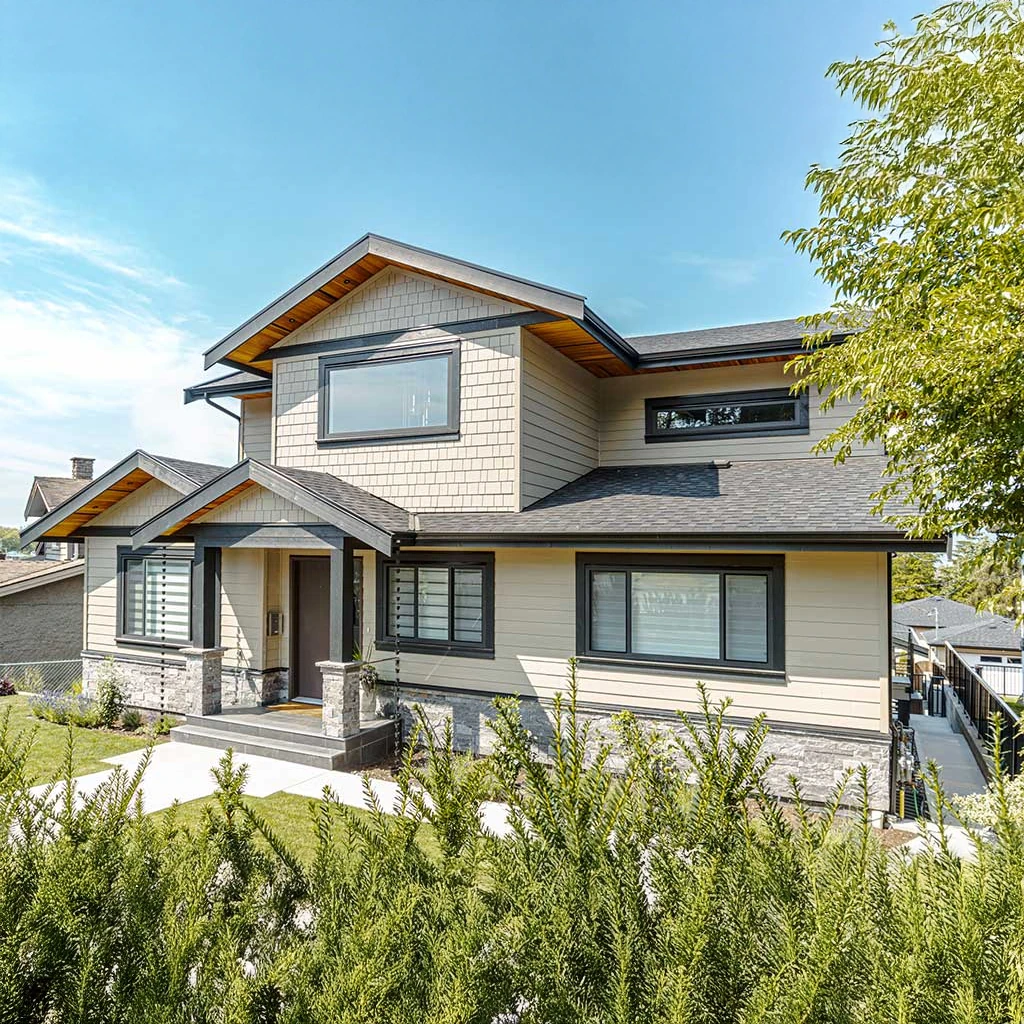
In Vancouver, the math is inverted. On a typical single-family lot in East Vancouver, Burnaby, or Coquitlam, the land itself is worth $1.5 million to $3 million
Vancouver General Contractors
The Vancouver Dilemma: Why This Decision Is Harder Here Than Anywhere Else
In Calgary, Edmonton, or most Ontario cities, the question of build versus renovate is largely a question of construction costs versus renovation costs. Land is relatively affordable, so the structure sitting on it represents a meaningful share of total property value. Deciding to demolish and rebuild means writing off a significant asset.
In Vancouver, the math is inverted. On a typical single-family lot in East Vancouver, Burnaby, or Coquitlam, the land itself is worth $1.5 million to $3 million. The structure sitting on it — a 1960s, 1970s, or 1980s house that has been patched and updated over the decades — contributes perhaps $200,000 to $600,000 of that total assessed value. When the land is worth five to ten times more than the house, demolishing the house to make way for something better is not irrational. You are not discarding a valuable asset. You are clearing a site to make better use of an extremely valuable one.
This is why Vancouver sees proportionally more custom home builds and teardown-rebuilds than almost any other Canadian city. The economics, at a base level, support it.
But the economics do not exist in a vacuum. Vancouver is also in the middle of a severe and prolonged housing crisis. City policy increasingly discourages the demolition of sound, habitable housing. Heritage overlay rules, character house policies, demolition permit review processes, and development cost levies all add friction and cost to the tear-down path. The City of Vancouver has explicitly stated that demolishing livable homes to build larger replacements contributes to the housing affordability problem by removing affordable stock and replacing it with luxury product.
The result is a decision that is more genuinely complex than in any other Canadian city. This guide works through that complexity systematically, starting with the one thing that matters most: what each path actually costs.
The Real Cost of a Custom Home Build in Vancouver (2026)
When a contractor quotes you a construction cost per square foot, that number covers the physical build. It does not cover demolition, design, permits, carrying costs, or the disruption of living elsewhere for two years. Understanding the full all-in cost is essential before comparing options.
Here is a complete breakdown of what a custom home build costs in Metro Vancouver in 2026, using a 2,500 square foot home as the reference point.
Demolition and Hazmat Remediation
Demolishing a typical single-family home in Metro Vancouver costs $15,000 to $35,000 for the mechanical demolition itself. However, most homes built before 1990 contain some form of asbestos-containing materials — vermiculite insulation in the attic, floor tiles and mastic adhesive, pipe insulation, drywall joint compound, and exterior stucco are all common sources. A pre-demolition hazardous materials survey is mandatory. Remediation, depending on the scope of contamination found, adds $5,000 to $25,000 on top of demolition costs. Budget $20,000 to $60,000 for this phase.
Design: Architect, Engineers, and Consultants
A custom home requires a full design team. Your architect will design the home and manage the permit process; structural engineering is mandatory for any new residential build; mechanical and electrical engineers are typically required for homes meeting Step Code requirements. Expect to pay $50,000 to $150,000 for a complete design package on a 2,500 square foot custom home, depending on the complexity of the design and the scope of consultants required.
Permits and Development Fees
The permit cost for a new single-family home in Metro Vancouver includes the development permit, building permit, utility connection fees, and development cost levies (DCLs). DCLs alone typically run $50,000 to $120,000 for a Metro Vancouver single-family home — they fund community infrastructure and are charged per square metre of new floor space. Total permit costs range from $25,000 to $60,000, though properties in certain municipalities or with specific DCL schedules can push higher.
Construction Cost
Hard construction costs in Metro Vancouver run $400 to $700 per square foot for a custom single-family home in 2026. The low end applies to builder-grade finishes, straightforward designs, and suburban municipalities. The high end applies to high-specification finishes, architectural complexity, and City of Vancouver lots where labour costs are highest. A 2,500 square foot home therefore costs $1,000,000 to $1,750,000 to build.
Carrying Costs and Temporary Accommodation
A custom home build takes 18 to 30 months from demolition to occupancy. During this time you are either renting temporary accommodation or staying elsewhere. Rental costs in Metro Vancouver for a comparable home run $3,000 to $5,000 per month. Add the construction mortgage interest during the build phase — typically $2,000 to $4,500 per month on a $1.5 million construction loan — and carrying costs add $30,000 to $60,000 per year, or $45,000 to $90,000 over an 18-month build timeline.
Complete Cost Breakdown: Custom Build (2,500 sq ft)
| Component | Cost Range |
|---|---|
| Demolition + hazmat remediation | $20,000–$60,000 |
| Design (architect + engineers) | $50,000–$150,000 |
| Permits and DCLs | $25,000–$60,000 |
| Construction (hard costs) | $1,000,000–$1,750,000 |
| Landscaping and site work | $20,000–$60,000 |
| Temporary accommodation | $30,000–$60,000 |
| Contingency (10%) | $115,000–$214,000 |
| Total All-In | $1,260,000–$2,354,000 |
The midpoint of this range — approximately $1.8 million — is the realistic budget for a well-specified 2,500 square foot custom home on a Metro Vancouver lot in 2026. If your budget is below $1.2 million for a build of this size, you are not yet in a position to build new in this market.
The Real Cost of a Full Home Renovation in Vancouver (2026)
A full gut renovation — stripping the home to its structural skeleton, keeping the foundation, framing, and roof structure, then rebuilding everything within — is the most comprehensive renovation option short of a teardown. It produces a home that feels new in most respects while retaining the existing structure.
In Metro Vancouver, full gut renovations cost $350 to $550 per square foot in 2026. On a 2,500 square foot home, that is $875,000 to $1,375,000 for the construction scope alone. Add soft costs and the total is comparable in some respects to a new build — but with meaningful differences in both directions.
What Full Gut Renovation Includes
At this price point, a full gut renovation includes complete removal of all interior finishes down to framing, replacement of all mechanical systems (plumbing, electrical, HVAC), insulation upgrade, new windows and exterior cladding, full kitchen and bath fit-out to a high standard, and new flooring and millwork throughout. Structural improvements — shear wall upgrades for seismic, beam replacements, floor levelling — are included where required.
What is not included is a new foundation, new structural framing (beyond repairs), or a new roof structure. These elements are retained from the existing home.
Design and Permit Costs for Renovation
A full gut renovation still requires drawings and permits. Expect $15,000 to $40,000 for architectural drawings and engineering, and $12,000 to $35,000 for permits. This is meaningfully less than a new build because no development permit or full DCL assessment is triggered for a renovation — you are improving, not creating new floor space.
The Contingency Premium on Renovations
Renovations carry more inherent uncertainty than new builds. Until walls are opened, no one fully knows what is inside them. A 15% contingency is appropriate for a full gut renovation of a pre-1990 Vancouver home, compared to 10% for a new build. This is not pessimism — it reflects the statistical reality of what contractors find in Vancouver walls (covered in detail in a later section).
Complete Cost Breakdown: Full Gut Renovation (2,500 sq ft)
| Component | Cost Range |
|---|---|
| Design drawings and engineering | $15,000–$40,000 |
| Permits | $12,000–$35,000 |
| Full gut renovation (hard costs) | $875,000–$1,375,000 |
| Landscaping and exterior work | $10,000–$40,000 |
| Temporary accommodation | $20,000–$50,000 |
| Contingency (15% for unknowns) | $135,000–$215,000 |
| Total All-In | $1,067,000–$1,755,000 |
Before you move to the next section, it is worth noting what a $1.7 million renovation delivers: a modernized home inside a retained structure. The bones are old. The layout is constrained by where the original builder put load-bearing walls and stairwells. The energy performance, even after insulation upgrades, will not match a new build to Step Code 3 or 4. These are real differences in what you receive for comparable expenditure.
Side-by-Side Financial Comparison
Placing both options side by side across all the dimensions that matter to a homeowner — not just cost — gives a clearer decision framework than cost alone.
| Factor | Custom Build | Full Gut Renovation |
|---|---|---|
| All-in cost (2,500 sq ft) | $1.26M–$2.35M | $1.07M–$1.76M |
| Timeline | 18–30 months | 10–18 months |
| Layout flexibility | Complete — design from scratch | Limited by existing structure |
| Energy performance | Step Code 3–4 achievable | Retrofit challenges; rarely Step 3 |
| Heritage/character constraints | Major factor in City of Vancouver | Less constrained; often preferred |
| Construction surprises | Fewer — all new | Significant risk in older homes |
| Property tax during construction | Full tax + empty home tax risk | Full tax during reno |
| Financing mechanism | Construction mortgage | HELOC or renovation loan |
| GST on construction | 5% GST on build value | No GST (service, not new supply) |
| Resale premium | Higher (new build premium) | Lower (even full gut discounted) |
| Environmental impact | Higher (demolition waste) | Lower (structure retained) |
The financial summary: a custom build typically costs 15% to 30% more in total outlay than a comparable full gut renovation. However, the custom build delivers a new home — one with no inherited constraints, full Step Code energy compliance, zero structural unknowns, and a new build premium at resale. The renovation delivers a modernized older home at a lower upfront cost and shorter timeline, but with retained structural limitations and a meaningful discount in the luxury resale market.
Neither answer is universally correct. The right choice depends on your specific property, your specific goals, and the specific municipal rules that apply to your address.
When a Custom Build Makes More Sense in Vancouver
There are situations where the premium cost of a custom build is justified — or where renovation is genuinely not a viable path. If any of the following apply to your property, the teardown-rebuild calculation deserves serious consideration.
Significant Structural or Contamination Issues
If your existing home has major foundation cracks requiring underpinning, severe seismic deficiencies requiring whole-building structural remediation, or pervasive mould or asbestos contamination that has spread through wall cavities, the cost of renovation approaches or exceeds the cost of rebuilding. In these cases, you are paying renovation prices to fix problems that a new build avoids entirely. The structural remediation budget is often better spent on demolition and a fresh start.
Layout Requirements Incompatible with Existing Structure
A single-storey bungalow on a standard lot has limited potential for vertical expansion without major structural work. If your program requires significantly more floor space than the existing footprint or height permits, and that space cannot be added within the existing structural envelope without essentially replacing the structure anyway, rebuilding delivers more for comparable cost.
Energy Performance Goals
Achieving BC Energy Step Code Level 3 or 4 in a 1960s Vancouver home requires addressing thermal bridging at the framing level, installing a continuous air barrier that is extremely difficult to achieve in an occupied or partially gutted structure, and upgrading windows to triple-pane — all simultaneously. In practice, retrofitting an older home to Step Code 3 costs $80,000 to $150,000 more than a standard renovation and still rarely achieves true Step Code compliance. A new build achieves Step Code 3 for a $25,000 to $50,000 premium over minimum code. For climate-motivated homeowners, the economics of new construction are compelling.
No Heritage or Character Overlay
If your property is not subject to a character overlay or heritage designation — common in Burnaby, Surrey, Coquitlam, New Westminster, and parts of Vancouver outside the pre-1940 character areas — the demolition path faces fewer policy barriers. The permit process is more straightforward, and you have maximum flexibility on design.
Unused FSR Allowance
Many older Vancouver properties were built at far less than the maximum allowable floor space ratio (FSR) under current zoning. A 1,200 square foot bungalow on a lot that now allows 4,000 square feet of floor space is leaving enormous value on the table. Rebuilding to maximum allowable FSR dramatically increases the value of the completed home relative to the land cost — often the most financially productive thing you can do with a Vancouver property.
Targeting the $3M+ Resale Market
Buyers in the $3 million and above price segment in Metro Vancouver are purchasing lifestyle and quality, not just square footage. At this level, buyers heavily discount renovated homes — even full gut renovations — relative to purpose-built custom homes. The fit, finish, technology integration, warranty position, and certainty of a new build command a premium that is real and material in this segment. If your end goal is sale at the top end of the market, a custom build maximizes the return on your investment.
When Renovation Makes More Sense in Vancouver
Renovation is not the default inferior option. For many Vancouver properties and many homeowner situations, it is the superior choice — financially, practically, and from a policy perspective.
Heritage or Character House Overlay
If your property is covered by a character overlay or carries a heritage designation, demolition may not be feasible. The City of Vancouver actively uses the development permit process to discourage demolition of pre-1940 homes in character areas. Even where demolition is technically possible, the approval timeline and conditions attached can make the rebuild path far less attractive than working within the existing structure. Renovation — including sympathetic exterior restoration and complete interior modernization — is both the path of least resistance and often the aesthetically superior outcome.
Budget Ceiling
If your all-in renovation budget is $1.2 million or less, a comparable custom build is likely out of reach. Renovation delivers significantly more home per dollar at budget levels below $1.5 million. The quality of finish and the extent of modernization achievable within a renovation scope at this price point is genuinely high — a well-executed full gut renovation at $1.1 million all-in produces a home that is indistinguishable from new construction to most buyers and occupants.
Shorter Timeline Priority
If getting back into your home within 12 months is a priority — whether for family reasons, financial carrying costs, or simply the exhaustion of extended displacement — renovation is the right path. A full gut renovation of a 2,500 square foot home, well-managed, takes 10 to 14 months. A comparable custom build takes 18 to 30 months. That is a real and meaningful difference in quality of life and financial carrying cost.
Excellent Existing Bones
Some Vancouver homes — particularly those from the 1950s through 1970s — were built with exceptional structural quality. Post-and-beam construction, clear-grain Douglas fir framing, poured concrete foundations, and well-maintained rooflines are worth keeping. If your home has sound structure, a functional layout, and no major system failures, demolishing it to build new is waste — both literally and financially. A high-quality renovation preserves what is excellent and modernizes what is not.
Tax Considerations: PRE and GST
Two significant tax factors favour renovation for owner-occupiers. First, the principal residence exemption (PRE) continues uninterrupted through a renovation — your capital gains exemption is unaffected by how extensively you renovate. A new build, however, is treated as a new supply for GST purposes. You will owe 5% GST on the construction value of a new home. On a $1.5 million construction cost, that is $75,000 in GST. A new housing rebate is available for primary residences, but the rebate phase-out applies below $450,000 in construction value — essentially inapplicable at Vancouver construction costs. This GST differential is real and often underweighted in the build-versus-renovate calculation.
If you are considering either path and want a detailed, property-specific assessment of your options, our renovation planning guide and our home renovation services page are useful starting points. You can also contact our team directly for a consultation on your specific property.
Vancouver Heritage and Character Rules: The Demolition Barrier
Vancouver has more than 10,000 single-family homes subject to character overlay policies. These are primarily homes built before 1940 in neighbourhoods designated as character retention areas — Kitsilano, Grandview-Woodland, Mount Pleasant, Strathcona, the West End, and significant portions of Kerrisdale and Shaughnessy among them.
A character overlay does not automatically prohibit demolition, but it creates significant policy pressure against it. Any development permit application to demolish a character home triggers a City review process. The City’s position is that character houses contribute to neighbourhood identity and affordable housing stock, and it will require applicants to demonstrate why demolition is justified over retention. This process adds months to the development timeline and introduces uncertainty about approval.
The Heritage Retention Incentive
The City of Vancouver has created a positive incentive structure for character retention: if you retain and restore the exterior character elements of a qualifying home — original roofline, cladding, windows, and front porch — you may qualify for a heritage density bonus or floor space variance that allows you to build more than you otherwise could. In practice, this means you can often achieve your desired floor space program through a retain-and-restore approach that costs less than a full demolition-rebuild, faces fewer policy barriers, and produces a home with genuine heritage character.
Designated Heritage Buildings
A small number of Vancouver homes carry formal heritage designations — typically Class A or B on the Vancouver Heritage Register. For these properties, demolition is effectively prohibited except in extraordinary circumstances. If you own a designated heritage building, renovation is your only path. The good news is that the City’s heritage programs provide financial tools — including density transfers and heritage revitalization agreements — that can fund extensive interior modernization while preserving the protected exterior.
The Hybrid Strategy: Retain the Shell, Gut the Interior
The most financially efficient response to character overlay constraints is the hybrid approach: retain and restore the character exterior, completely gut and modernize the interior. This strategy satisfies heritage policy, qualifies for potential density bonuses, and delivers a modernized interior that is functionally equivalent to new construction. The cost of a hybrid heritage retention project typically runs within 20% of a full rebuild — and in many cases, with the density bonus applied, delivers more total floor space than a demolition-rebuild would have permitted.
Vancouver’s Demolition Permit Reality (2026)
Obtaining a demolition permit in Vancouver and Metro municipalities is more complex than most homeowners assume. Understanding the process before you commit to the teardown path is essential.
The Demolition Permit Process
A demolition permit is required for any full demolition of a residential building in the City of Vancouver. The application must include a hazardous materials survey (asbestos, lead paint, PCBs), a utility disconnection confirmation, a tree protection plan where applicable, and a completed demolition permit application with site plan. Review time is typically 4 to 8 weeks for straightforward residential demolitions, but can extend to 3 to 6 months where character overlay review or heritage assessment is required.
Bylaw 11837: Rental and Tenant Protections
Vancouver’s Tenant Relocation and Protection Policy (related to Bylaw 11837) requires property owners to provide 90 days’ notice to tenants, pay relocation assistance, and offer the right of first refusal to return at pre-demolition rent if the home contains any rental suites. If your property has a legal secondary suite or laneway home tenant, this adds both time and direct cost to the demolition path. Factor this into your timeline and budget before proceeding.
Empty Home Tax During Construction
Vancouver’s Empty Homes Tax (currently 3% of assessed value per year) applies to properties that are not a principal residence and not rented. During the construction phase of a rebuild — which can last 18 to 30 months — your property is technically empty. An exemption exists for properties undergoing construction with an active building permit, but you must apply for the exemption annually and maintain the building permit in good standing. Missing the exemption application deadline triggers a tax bill that could reach $60,000 to $90,000 on a $2 million assessed property.
Development Cost Levies
Development cost levies (DCLs) are charged by municipalities on new construction to fund community infrastructure — parks, roads, utilities, community centres. For a new single-family home in Metro Vancouver, DCLs typically range from $50,000 to $120,000 depending on the municipality and the square footage of the new structure. These levies apply to new construction only — a renovation does not trigger DCLs. This is a significant and often overlooked cost differential between building new and renovating.
The Hidden Cost of Full Gut Renovation: What Contractors Find in Vancouver Walls
Every experienced renovation contractor in Vancouver has stories about what they found once the walls were opened. These are not exceptional cases — they are the statistical norm for homes built before 1980. Understanding what is commonly discovered, and what it costs to address, is essential for budgeting a renovation accurately.
The realistic “surprise budget” for a full gut renovation of a 1960s Vancouver home is $80,000 to $200,000 in additional scope beyond the original quote. This is why experienced contractors and homeowners use a 15% contingency rather than the 10% typical for new builds.
Asbestos
Asbestos-containing materials were used extensively in Canadian residential construction until the mid-1980s. In a typical Metro Vancouver home from this era, asbestos is commonly found in vermiculite attic insulation, vinyl floor tiles and the mastic adhesive beneath them, pipe insulation on hot water and steam heating systems, drywall joint compound, exterior stucco, and textured ceiling coatings. Even if a pre-renovation hazmat survey is conducted, the survey samples — it does not comprehensively test every material. Discovery of additional asbestos once walls are open requires work stoppage, re-sampling, and certified abatement. Budget $5,000 to $40,000 for asbestos remediation depending on what is found.
Knob-and-Tube Wiring
Homes built before approximately 1950 — and some built into the early 1960s in certain neighbourhoods — may retain original knob-and-tube wiring. This cannot remain in place in a renovated home: it is incompatible with modern insulation (it requires air space around conductors), uninsured by most insurers, and a genuine fire risk. Full replacement of a knob-and-tube electrical system in a 2,500 square foot home costs $20,000 to $40,000. If this is not discovered until demolition has already begun, it becomes an unavoidable scope addition.
Galvanized Plumbing
Galvanized steel water supply pipes were standard in Metro Vancouver homes built through the 1950s and into the 1960s. After 50 to 70 years of service, galvanized pipes are typically corroded internally to the point where flow is severely restricted and water quality is compromised. Complete replacement with copper or PEX costs $15,000 to $25,000 for a typical single-family home. Again — this may not be apparent until walls are opened.
Inadequate Seismic Anchorage
Vancouver sits in a moderate-to-high seismic zone. Homes built before the mid-1990s were constructed to seismic standards that are significantly below current requirements. A full renovation provides the opportunity — and in many cases triggers the requirement — to upgrade seismic resistance. Shear wall additions, mudsill anchoring, and cripple wall bracing in a typical Vancouver home cost $15,000 to $45,000 depending on scope. In homes with significant soft-storey conditions (garage below living space, large window openings), the cost can exceed $60,000.
Undisclosed Structural Modifications
Previous owners removing load-bearing walls without permits, adding structural loads without engineering, or making foundation alterations that were never inspected are common discoveries in Vancouver renovations. Remediating these issues — re-installing proper structural support, addressing concentrated loads, repairing foundation modifications — typically costs $15,000 to $50,000. A new build has none of these legacy problems: everything is built to current code under current inspection.
Our home renovation team conducts thorough pre-construction assessments specifically to identify these issues before work begins — minimizing surprises and improving the reliability of renovation budgets.
Energy Efficiency: Build vs. Renovate
BC’s Energy Step Code is transforming new residential construction in the province. For homeowners with strong energy efficiency goals — whether motivated by operating cost, climate values, or long-term resale — the Step Code creates a significant and often underappreciated divergence between the build and renovate paths.
What the Step Code Requires
The BC Energy Step Code establishes a tiered performance scale from Step 1 (minimum code) through Step 5 (net-zero ready). As of 2026, most Metro Vancouver municipalities require new single-family construction to meet Step Code Level 3, which delivers approximately 40% better energy performance than the old prescriptive minimum code. Step 4 is net-zero energy ready — the building envelope is so well-sealed and insulated that the home’s energy needs can be entirely met by on-site generation.
Why Step Code Is Easy for New Builds
Achieving Step Code 3 in new construction is primarily a design and specification exercise. The builder installs continuous exterior insulation on the building envelope, a carefully detailed air barrier, triple-pane windows, and a heat recovery ventilator as part of the normal construction sequence. The incremental cost over code minimum is approximately $25,000 to $50,000 for a 2,500 square foot home — a modest premium that delivers substantial long-term energy savings.
Why Deep Retrofit Is Expensive and Difficult
Achieving comparable energy performance through retrofit in an existing home requires addressing thermal bridging at the structural framing — which means either adding exterior insulation (affecting siding, trim, window depths, and all exterior penetrations) or installing thick interior insulation (losing floor space). The air barrier must be continuous and intact — extremely difficult to achieve in an existing structure where penetrations have accumulated over decades. Achieving near-Step Code 3 performance through retrofit costs $80,000 to $150,000 above a standard renovation scope, and even then may not achieve fully equivalent measured performance.
CleanBC Incentives
BC’s CleanBC Better Homes program offers incentives for energy-efficient construction and retrofits. New construction to Step Code 4 or higher may qualify for rebates on heat pump systems, mechanical ventilation upgrades, and EV charging infrastructure. Homeowners pursuing deep energy retrofits can access the CleanBC Home Renovation Rebate program. Check the current program offerings at the time of your project — these programs are updated regularly and may meaningfully offset the premium cost of high-performance construction.
Financing Build vs. Renovate
The financing structures for a custom build and a major renovation are meaningfully different, and understanding them before you commit to a path will help you access the right product and avoid financial strain during construction.
Renovation: HELOC and Renovation Loans
For most renovation projects, the primary financing tool is a home equity line of credit (HELOC). A HELOC allows you to borrow against your existing home equity at a variable rate, with interest-only payments available during the construction period. For Vancouver homeowners who purchased even five to ten years ago, available equity is often sufficient to fund a substantial renovation without a full refinancing.
Major Canadian banks — TD, RBC, Scotiabank, and BMO — offer renovation-specific loan products for larger projects, typically up to $500,000 to $750,000 unsecured or secured against the improved value of the property. These can be structured with staged draws that align with renovation milestones, reducing total interest cost.
Custom Build: Construction Mortgage
A construction mortgage is a specialized product that funds a new build through staged draws — typically at lot purchase (or existing equity), foundation completion, framing and lock-up, mechanical rough-in, and substantial completion. During construction you pay interest only on the amount advanced. At substantial completion, the construction mortgage converts to a standard amortizing mortgage. Lenders require a fixed-price contract with a qualified contractor, a complete set of approved drawings, and often a cost-to-complete certificate from a quantity surveyor at each draw stage.
GST: A Significant Differentiator
This deserves emphasis because it is frequently overlooked until the final accounting. A full gut renovation is a service — you are hiring contractors to improve your existing home. No GST applies to the improvement itself (though GST is embedded in the cost of materials). A custom build creates a new residential complex, which is a taxable supply under the Excise Tax Act. You owe 5% GST on the fair market value of the completed home or the construction cost, whichever is higher. The New Housing Rebate offsets a portion of this for primary residences, but the rebate phases out completely above approximately $450,000 in construction value — a threshold that Metro Vancouver new builds cross on the first day of framing. On a $1.5 million construction cost, 5% GST is $75,000. This is money that renovation does not cost you.
Insurance During Construction
Both paths require proactive communication with your insurer. For a major renovation, your existing homeowner’s policy may not cover the construction period — a builder’s risk or renovation rider is typically required. For a new build, course-of-construction (COC) insurance covers the structure and materials during the build. Your contractor should carry their own commercial general liability insurance, but the owner is responsible for COC coverage on the structure itself. Budget $3,000 to $8,000 for construction-period insurance on a project of this scale.
More Home Additions & Custom Homes Guides

Accessible Kitchen Renovation in Vancouver: Design for Aging-in-Place and Mobility

Home Safety Renovation for Seniors in Metro Vancouver: What to Prioritize and What It Costs
In-Law Suite Addition in Vancouver: Design Options, Permits, and Cost Guide
Wheelchair Accessible Home Renovation in Vancouver: ADA Clearances and BC Code
Grab Bar Installation in Vancouver: Types, Placement, and What the BC Code Requires
Ready to start your renovation?
Frequently Asked Questions: Build vs. Renovate Vancouver
Is it cheaper to renovate or build new in Vancouver?
In most cases, a full gut renovation is 15% to 30% cheaper than a comparable custom build in Metro Vancouver. A 2,500 square foot full renovation runs $1.07M to $1.76M all-in; a comparable custom build runs $1.26M to $2.35M. However, the renovation cost does not include GST (which a new build triggers), and renovation carries higher contingency risk from structural unknowns. The gap narrows significantly once GST, surprises, and DCLs are factored in.
When does it make sense to tear down and rebuild in Vancouver?
Teardown-rebuild makes sense when: (1) the existing structure has major irreparable deficiencies, (2) your desired program significantly exceeds what the existing structure can accommodate, (3) the property has substantial unused FSR allowance, (4) no heritage or character overlay applies, and (5) your target is the $3M+ resale market where new build commands a premium. If none of these factors apply, renovation is usually the better financial decision.
Do I need a permit to demolish my house in Vancouver?
Yes. A demolition permit is required for any full residential demolition in the City of Vancouver and all Metro municipalities. The application requires a hazardous materials survey, utility disconnection confirmation, and site plan. If the property has a character overlay, additional heritage review is required. Review times range from 4 weeks to 6 months depending on complexity.
How much does a custom home cost to build in Vancouver?
All-in cost for a custom home build in Metro Vancouver in 2026 runs $1.26 million to $2.35 million for a 2,500 square foot home. This includes demolition, design, permits, construction, landscaping, temporary accommodation, and contingency. Construction cost alone is $400 to $700 per square foot, with design, permits, and other soft costs adding a further $200,000 to $400,000 on top.
What is the cost per square foot to build in Metro Vancouver?
Hard construction cost in Metro Vancouver runs $400 to $700 per square foot for a custom single-family home in 2026. The lower end applies to builder-grade specifications in suburban municipalities; the upper end applies to high-specification finishes, architectural complexity, and City of Vancouver sites. Full gut renovation costs $350 to $550 per square foot for comparable quality.
Can I demolish a character house in Vancouver?
It depends. Homes with a character overlay (pre-1940, in designated character retention areas) face significant policy barriers to demolition. The City will require a heritage impact assessment and may deny or condition the demolition permit. Designated heritage buildings (Class A or B on the Vancouver Heritage Register) cannot practically be demolished. For character overlay homes, the hybrid retain-and-restore approach is usually more feasible and often delivers equivalent floor space through density bonuses.
How long does it take to build a custom home in Vancouver?
From decision to occupancy, a custom home build in Metro Vancouver takes 18 to 30 months. This includes approximately 3 to 6 months for design and permit approvals, 1 to 2 months for demolition and site preparation, and 12 to 18 months for construction. Permit review times in the City of Vancouver have historically run longer than suburban municipalities. A full gut renovation of comparable scope takes 10 to 18 months from start to completion.
Does a new home pay GST in Vancouver?
Yes. New residential construction triggers 5% GST on the construction value or fair market value of the completed home, whichever is higher. A New Housing Rebate is available for primary residences, but the rebate phases out fully above approximately $450,000 in construction value — a threshold that Metro Vancouver homes cross immediately. On a $1.5 million construction cost, GST liability is approximately $75,000. Renovation does not trigger GST on construction services (though materials purchased for the renovation include embedded GST).
Is a renovation or new build better for resale?
In the $2M to $3M price range, well-executed full gut renovations and custom builds are competitive in Metro Vancouver’s resale market. Above $3M, new builds command a significant premium — buyers at this level heavily discount renovated homes relative to purpose-built custom construction. Below $2M, the renovation-versus-new-build distinction matters less; quality of finish and location dominate. If resale is a primary motivation, your target price point determines which path is more appropriate.
What is the Vancouver demolition permit process?
The Vancouver demolition permit process involves: (1) commissioning a hazardous materials survey, (2) obtaining utility disconnection confirmations from BC Hydro, FortisBC, and the City water/sewer departments, (3) submitting the demolition permit application with site plan and hazmat survey, (4) City review (4 to 8 weeks standard; longer for character overlay properties), and (5) permit issuance followed by physical demolition. An arborist report may be required if protected trees are on or adjacent to the site. Total timeline from application to demolition completion: 2 to 4 months minimum.
Can I live in my home during a full renovation?
Generally no, for a full gut renovation. A full gut strips the home to its structure — no livable finishes, no functional kitchen or bathrooms, no heating system. Occupancy during a full gut renovation is not possible and typically not permitted by the building permit. A phased renovation approach — completing one floor or zone while occupying another — can allow partial occupancy in some cases, but this significantly extends the construction timeline and increases cost. Budget for full temporary accommodation for the duration.
What are development cost levies (DCLs) in Vancouver?
Development cost levies are fees charged by municipalities on new residential construction to fund community infrastructure — parks, transportation improvements, utilities, and community facilities. They apply to new construction only (not renovation) and are calculated per square metre of new floor space. In Metro Vancouver, DCLs for a single-family new home typically run $50,000 to $120,000 depending on the municipality and the size of the new structure. City of Vancouver DCLs are among the highest in the region. DCLs are a significant and often underestimated cost of the teardown-rebuild path.
How do I finance a custom home build in Vancouver?
Custom home builds are financed through a construction mortgage — a product that advances funds in stages (draws) as construction milestones are met. During construction you pay interest only on the amount advanced. At substantial completion, the construction mortgage converts to a standard amortizing mortgage. You need: a fixed-price contract with a qualified contractor, approved drawings and building permit, sufficient equity or cash contribution, and lender approval based on projected completed value. Alternative: if you own the land free and clear, some homeowners use a combination of HELOC on the land plus conventional construction mortgage for the build costs.
What is the Step Code and how does it affect construction?
The BC Energy Step Code is a performance-based energy standard for new residential construction, established in five tiers from Step 1 (minimum code) to Step 5 (net-zero energy ready). As of 2026, most Metro Vancouver municipalities require new single-family homes to meet Step Code Level 3, delivering approximately 40% better energy performance than the former prescriptive minimum. Step Code applies to new construction only — renovations are subject to different (typically prescriptive) energy requirements. The Step Code is one reason custom builds deliver superior long-term energy performance compared to even deeply renovated existing homes.
Are there any grants for building energy-efficient homes in Vancouver?
Yes. BC’s CleanBC Better Homes program offers rebates for high-efficiency heat pumps, heat pump water heaters, EV charging equipment, and insulation upgrades in both new construction and renovation contexts. New construction meeting Step Code 4 or higher may qualify for additional incentives. The Canada Greener Homes Grant (federal program) has offered up to $5,000 for retrofit projects meeting specific energy improvement thresholds — check current program availability, as federal programs are subject to annual budget decisions. A registered energy advisor must conduct pre- and post-renovation EnerGuide evaluations to access most grant programs.
The Bottom Line: Making the Right Decision for Your Vancouver Property
The build-versus-renovate decision in Vancouver is genuinely complex — more so than anywhere else in Canada. The land economics can support either path. Municipal policy creates barriers to one. Heritage rules can preclude the other. Energy codes favour new construction. GST and DCLs add costs to the build path that renovation avoids. Timeline and carrying costs favour renovation. Resale in the upper market favours new construction.
The right answer for your property depends on: your property’s specific location and heritage status, the condition of the existing structure, your total budget, your timeline, your energy performance goals, and your end-use intention (owner-occupy versus resale). No rule of thumb replaces a property-specific assessment.
For most Metro Vancouver homeowners in 2026, full gut renovation — properly scoped, properly budgeted with contingency, and executed by an experienced contractor who knows what to look for in Vancouver walls — delivers the better combination of value, timeline, and financial risk profile. Custom builds are the right answer for a specific subset of properties and programs where the renovation path genuinely cannot deliver what the homeowner needs.
If you are at this decision point with a specific Vancouver property, our team has helped hundreds of Vancouver homeowners work through exactly this analysis. We offer honest assessments — including telling you when renovation is the better path, and when it is not. Explore our home renovation services, learn more through our renovation planning guide, see what we offer for laneway homes, or contact us directly to discuss your property.
Get a Free Renovation Quote
Metro Vancouver’s trusted general contractors. Free consultations across Vancouver, Burnaby, Richmond, North Shore & beyond.
Get Your Free Quote →Ready to start your project? Vancouver General Contractors (VGC) provides free, fixed-price quotes for homeowners across Metro Vancouver. Learn more about our home additions Vancouver services or request a free quote today.
VGC serves Vancouver and surrounding areas. View all renovation services in Vancouver →

Comments are closed