




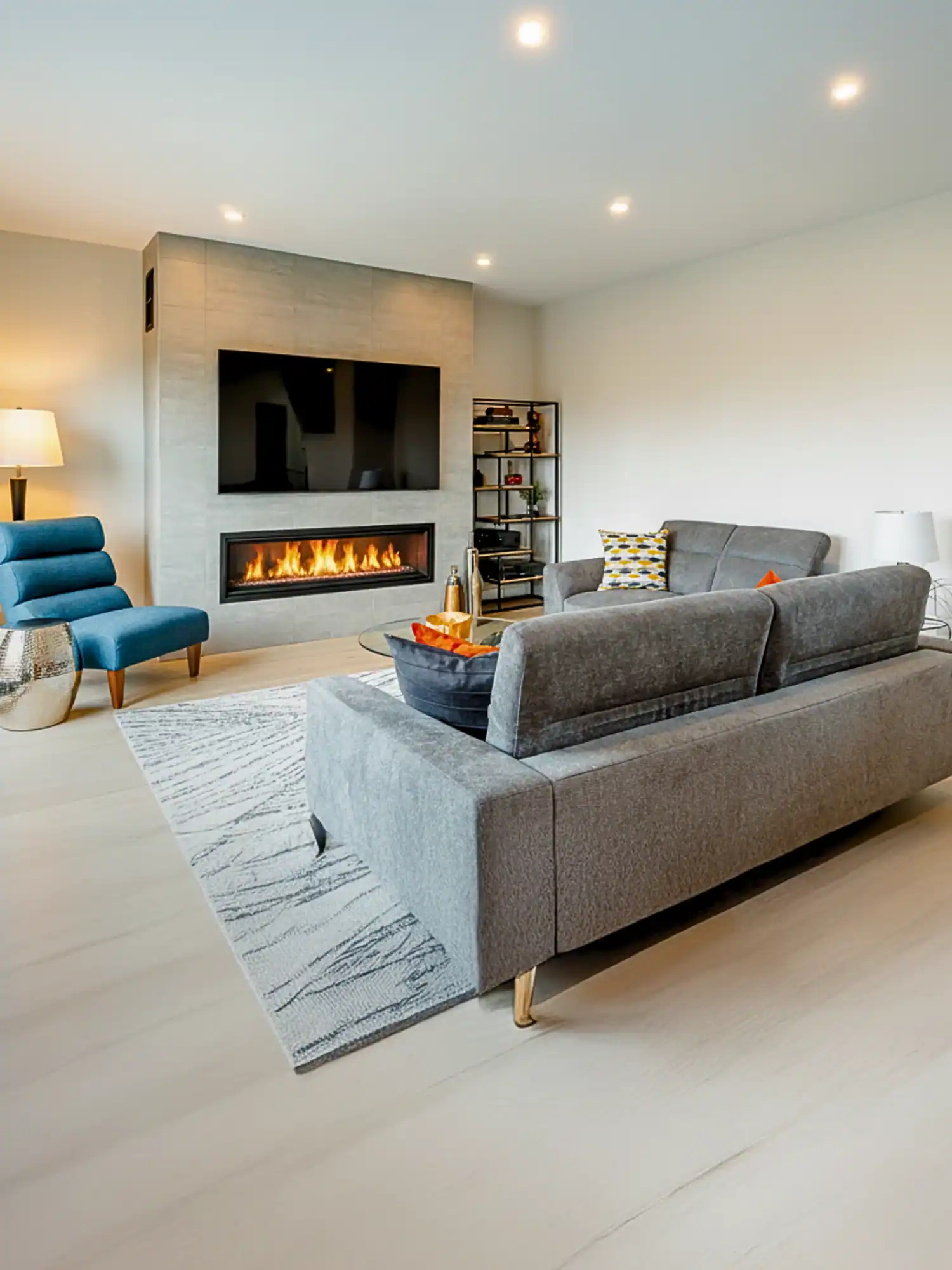
Fireplace Renovation Vancouver: Gas Conversion, Surround Ideas & Metro Van Rules (2026)
Your Vancouver living room has a fireplace — and it looks exactly like every other 1980s fireplace in the neighbourhood. Brown brick, a scratched brass surround, a mantel shelf that was never quite level. It functions, technically. But it dominates the room in the worst way: as a reminder of when builder-grade finishes were the only option.
Fireplace renovation in Vancouver is one of the highest-ROI projects in residential renovation. The fireplace is the focal point of the living room in most homes. Transform it and you transform the entire space. But Vancouver fireplaces come with a regulatory layer that most homeowners don’t discover until they’re deep into planning: Metro Vancouver’s Airshed Management Zone restricts wood-burning on high-pollution days, new wood-burning installations are banned in most municipalities, and any gas work must be done by a TSSBC-licensed gas fitter with a building permit. Get the rules right first, then design your dream fireplace.
This guide covers everything: Metro Vancouver wood-burning restrictions, gas conversion costs and process, fireplace surround materials from zellige tile to slab marble, statement fireplace wall design, electric options for condos, and a 15-question FAQ. Whether you’re updating a 1970s brick surround or installing a new 72-inch linear gas fireplace, here’s what you need to know in 2026.
 Laneway house construction in Vancouver” class=”wp-image-12762″ />
Metro Vancouver's Airshed Management Zone covers the Lower Mainland and is one of the most actively managed air quality zones in Canada
Vancouver General Contractors
Why Vancouver Fireplace Renovations Are More Complex Than They Look
Most renovation projects involve a contractor, a permit if structural, and a finish trade or two. Fireplace renovations in Metro Vancouver involve all of that — plus a layer of air quality regulation that directly affects what you’re allowed to build, burn, and install.
Metro Vancouver’s Airshed Management Zone covers the Lower Mainland and is one of the most actively managed air quality zones in Canada. Wood smoke is a significant source of fine particulate matter (PM2.5), and Metro Vancouver’s Air Quality Management Division issues Burn Bans on days when atmospheric conditions trap pollutants. On those days — typically 15 to 30 per year — burning wood in fireplaces and stoves is prohibited, with fines of $500–$1,000 for violations. Some years see more ban days; the fall and winter inversion seasons are the most common trigger.
Beyond Burn Bans, the City of Vancouver and most Metro Vancouver municipalities have moved to restrict or ban new wood-burning fireplace installations in new construction. A 1970s or 1980s home with an existing masonry wood-burning fireplace is grandfathered — but the moment you renovate significantly or want to install a new wood-burning appliance, you encounter the current regulatory environment. The City of Vancouver requires WETT (Wood Energy Technology Transfer) certification for any wood-burning appliance, and many insurers now require a WETT inspection before they’ll cover a home with a wood-burning fireplace.
This regulatory context is the primary reason most Vancouver homeowners converting a wood-burning fireplace choose gas. Gas fireplaces are not subject to Burn Bans (they burn clean-burning natural gas), they don’t require WETT certification, and they’re far more convenient — on-demand heat with a remote or smart home integration, no wood storage, no ash cleanup, no chimney sweep every year.
The opportunity is enormous. The fireplace is the architectural centrepiece of most Vancouver living rooms. A dated brick surround with a builder mantel holds the entire room back. A renovated fireplace — new stone surround, updated gas insert or linear fireplace, integrated millwork — elevates the room completely. It’s one of the few renovation projects where spending $8,000–$15,000 genuinely transforms how the space looks and feels every single day.
Fireplace Renovation Costs in Vancouver: Full Price Guide (2026)
Vancouver renovation costs reflect local labour rates, permit fees, and the complexity of working in occupied homes — often with limited access, existing masonry, and gas line requirements. The following table gives realistic 2026 ranges for the most common fireplace renovation scopes.
| Renovation Scope | Cost Range (CAD, installed) | Notes |
|---|---|---|
| Surround and mantel replacement only | $3,500 – $12,000 | Removing existing brick, new stone/tile surround, new mantel. Does not include gas work. |
| Wood-to-gas conversion (insert) | $4,000 – $10,000 | Gas insert unit + TSSBC gas fitter + permit. Existing masonry firebox used. |
| Gas insert in existing masonry firebox | $3,500 – $8,000 | Unit + liner + gas connection. No new surround. |
| New linear gas fireplace (built-in) | $8,000 – $25,000 | 36″–72″ unit, full surround, framing, gas line. High design impact. |
| Double-sided / see-through gas fireplace | $10,000 – $30,000 | Structural assessment may be needed. Two-room installation. |
| Outdoor gas fireplace | $4,000 – $12,000 | Requires gas line to patio, permit, weatherproof enclosure. |
| Gas fire table (outdoor) | $1,200 – $3,500 | Simpler gas connection, no surround framing needed. |
| Masonry chimney restoration | $2,000 – $8,000 | Repointing, damper replacement, cap replacement, firebox repair. |
| Full statement fireplace wall (surround + built-ins + gas) | $15,000 – $45,000+ | Floor-to-ceiling treatment, flanking millwork, new gas unit. |
| Electric fireplace insert + surround | $2,000 – $8,000 | No gas line, no permit. Limited to condo/strata or supplemental heat. |
These ranges assume Vancouver labour rates and typical permit fees. Projects at the lower end of each range use standard materials and existing framing; projects at the upper end involve premium stone, complex millwork, or significant structural or gas line work. For a detailed estimate on your project, contact Vancouver General Contractors for a consultation.
Metro Vancouver Wood-Burning Restrictions: What You Need to Know
If you’re planning to keep or restore a wood-burning fireplace in Metro Vancouver, you need to understand the Airshed Management Zone rules before you spend a dollar on renovation.
Burn Bans
Metro Vancouver’s Air Quality Management Division monitors atmospheric conditions across the Lower Mainland. On days when temperature inversions or weather patterns trap fine particulate matter near ground level, Metro Vancouver issues an Air Quality Advisory and activates a Burn Ban. During a Burn Ban, burning wood in residential fireplaces, woodstoves, and fire pits is prohibited across the Airshed Management Zone. This typically includes all Metro Vancouver municipalities: the City of Vancouver, Burnaby, Surrey, Richmond, North Vancouver (City and District), West Vancouver, Coquitlam, Port Coquitlam, Port Moody, New Westminster, Langley (City and Township), Delta, White Rock, Maple Ridge, and Pitt Meadows.
Burn Bans are announced on the Metro Vancouver website and through AirCare alerts. They typically run for one to three days per event. In a typical year, there are 15–30 Burn Ban days, concentrated in November through February. In years with strong fall inversions, the number can be higher. Fines for burning during a Burn Ban range from $500 to $1,000 for residential violations, enforceable by municipal bylaw officers.
New Wood-Burning Installation Restrictions
Most Metro Vancouver municipalities no longer permit new wood-burning fireplace installations in new construction or major renovations. The City of Vancouver’s Building Bylaw restricts new solid-fuel burning appliances. This means that if you’re renovating a home and your plans include a new wood-burning fireplace where none existed before, you will almost certainly be denied the permit.
Existing wood-burning fireplaces in older homes are generally grandfathered — you can continue using them (subject to Burn Bans), and you can renovate the surround and mantel without affecting the appliance status. But if you change the appliance itself — replace the firebox, add a new woodstove insert — you’re triggering current code requirements and may need to bring the installation up to current standards, which in many cases means converting to gas or certified solid fuel.
EPA Phase 2 and CSA B415 Exceptions
There is a narrow exception for EPA Phase 2 certified or CSA B415 certified wood-burning stoves and inserts. These certified appliances burn significantly cleaner than conventional wood fireplaces — they use advanced combustion technology that reduces PM2.5 emissions by 70–90% compared to an open masonry fireplace. Some Metro Vancouver municipalities allow the installation of certified woodstoves as a replacement for non-certified wood-burning appliances (an upgrade, not a new installation).
The rules vary by municipality, so check with your local building department before assuming the exception applies to your project. In the City of Vancouver specifically, the bylaw is more restrictive. In outlying municipalities like Maple Ridge or Langley Township, there may be more flexibility for certified stove installations on larger lots. Always verify current bylaws — they evolve, and this guide reflects rules as of early 2026.
WETT Inspection Requirement
If you own a home with a wood-burning fireplace in Metro Vancouver, you should know that most home insurers now require a WETT inspection as a condition of coverage. A WETT (Wood Energy Technology Transfer) inspection is conducted by a WETT-certified technician and evaluates the firebox, chimney, clearances, and combustion air supply for code compliance and safety. Cost is typically $250–$450. Real estate transactions also commonly require a WETT inspection for homes with wood-burning appliances. If you’re renovating before selling, getting a WETT inspection early can surface issues that need remediation before they become a deal condition.
Gas Fireplace Conversion: Converting Wood to Gas in Vancouver
Converting a wood-burning masonry fireplace to gas is the most common fireplace renovation scope in Metro Vancouver. It solves the Burn Ban problem, eliminates wood storage and chimney maintenance, and gives you on-demand heat with a remote or app. Here’s how it works.
Direct Vent Gas Insert (Most Recommended)
A direct vent gas insert is a self-contained combustion chamber that slides into your existing masonry firebox. It uses a sealed double-pipe liner — one pipe draws outside air for combustion, the other vents exhaust gases — routed through your existing chimney. Because it’s a sealed combustion system, it does not draw conditioned air from your living room, making it significantly more energy-efficient than older B-vent designs.
Efficiency ratings for direct vent gas inserts range from 75–90% AFUE, making them a legitimate heat source (not just ambiance). They come in a wide range of styles — traditional log sets, modern linear flame beds, contemporary glass bead media — and most include remote controls, programmable thermostats, and smart home integration (with optional upgrades). They fit into existing masonry fireboxes with a decorative face frame that covers the gap between the insert and the existing opening.
Cost for a direct vent gas insert, including the unit, stainless liner, gas connection by a TSSBC-licensed gas fitter, and permit: $4,000–$8,000. If you’re also replacing the surround and mantel at the same time, budget an additional $3,500–$8,000 for materials and labour.
B-Vent Gas Insert
A B-vent gas insert uses an open combustion system — it draws room air for combustion and vents through an existing chimney. B-vent units are less efficient (typically 60–75% AFUE) because they exhaust heated room air up the chimney. They require an open, functioning chimney in good condition. In most cases, a direct vent insert is the better choice — higher efficiency, no room air requirement, and less dependence on existing chimney condition. B-vent inserts are appropriate when existing chimney configuration makes direct vent liner installation impractical.
No-Vent (Ventless) Gas Fireplaces: Not Recommended in Canada
Ventless (unvented) gas fireplaces are common in the United States but are generally not code-compliant in British Columbia and are not recommended by Canadian gas codes. They vent combustion byproducts — including moisture and trace CO — directly into the living space. While the combustion is technically “complete” and CO levels are low, the moisture load can cause condensation issues in BC’s climate, and there are ongoing health concerns about indoor air quality. If a contractor proposes a ventless gas unit for your Vancouver home, ask specifically whether it is CSA-certified and BC code-compliant. In most cases, a direct vent insert is a superior solution.
The Gas Conversion Process
Here’s what the gas conversion process looks like in practice for a Vancouver home:
- Assessment: Chimney sweep and WETT inspection to assess existing masonry condition ($250–$450). Any needed repairs (cracked firebox, deteriorated mortar, rusted damper) are identified before proceeding.
- Unit selection: Choose a direct vent gas insert sized for the existing opening. Most Vancouver homes have standard 36″ x 28″ masonry openings, and most inserts are designed to fit these dimensions.
- Permit application: A building permit is required for new gas appliance installation in the City of Vancouver and most Metro Vancouver municipalities. Your contractor handles this.
- Gas line rough-in: A TSSBC-licensed gas fitter extends the gas line from the nearest branch point (often in the basement or utility room) to the fireplace location. This may require opening walls or running line through a crawlspace.
- Insert installation and liner: The stainless steel liner is dropped through the chimney and connected to the insert. The insert slides into the masonry firebox and the decorative face frame is secured.
- Gas connection and commissioning: The TSSBC gas fitter makes the final gas connection, pressure-tests the line, and commissions the appliance. This is the step that legally requires a licensed gas fitter — no exceptions.
- Final inspection: The city inspector verifies the installation against the permit drawings.
- Surround and finish: After gas work is inspected, the finish trades complete the surround, mantel, and any millwork.
Total timeline from permit application to completed installation: typically 3–6 weeks for a straightforward conversion. More complex projects with new surrounds and millwork take 4–8 weeks.
Gas Fireplace Designs: What Vancouver Homeowners Are Installing in 2026
The gas fireplace market has evolved dramatically in the past decade. The “fake log” gas insert of the 1990s is no longer the only option. Today’s Vancouver homeowners are choosing from a range of designs that match contemporary interiors — from clean-lined linear fireplaces to dramatic double-sided features that open between two rooms.
Linear Gas Fireplaces
The linear gas fireplace is the dominant design trend in Vancouver renovations through 2024–2026. These are wide, low, horizontal fireplace units — typically 36″ to 72″ wide and 12″–18″ tall — with a long, uninterrupted flame view. The aesthetic is contemporary and architectural: the fireplace reads as a design element integrated into the wall, not a traditional hearth.
Linear gas fireplaces are most commonly installed in new framed walls (not retrofitted into existing masonry, though some units can be adapted). They use direct vent technology and require a gas line and vent run. Top brands in the Vancouver market include Napoleon, Valor, Heat & Glo, Regency, and Ortal — all available through local fireplace dealers. Cost installed: $8,000–$25,000 depending on unit size, brand, and complexity of the surround and vent run.
Traditional Gas Fireplace Inserts
For homes with existing masonry fireplaces that homeowners want to update rather than gut, a traditional direct vent gas insert remains the most practical and cost-effective option. Modern log-set inserts are visually convincing — LED ember beds, realistic ceramic log sets, and layered flame effects have improved substantially. If your home has a traditional aesthetic (heritage character home, craftsman bungalow, transitional interior), a quality gas insert with a new stone or brick surround achieves the traditional look without the operational hassle of real wood. Cost: $3,500–$8,000 installed.
Double-Sided and See-Through Fireplaces
A double-sided (see-through) gas fireplace opens to two rooms simultaneously — a living room and dining room, a master bedroom and ensuite, or a living room and exterior patio. These are among the most dramatic fireplace design moves in residential renovation and are increasingly popular in Vancouver open-concept homes.
The structural requirement: double-sided fireplaces built into partition walls require that the wall not be load-bearing (or that a structural engineer design the opening if it is). Gas vent runs also need careful planning. Cost is higher — typically $10,000–$30,000 depending on unit size and structural complexity. The visual payoff is significant: a double-sided fireplace in a dining-room-to-living-room opening creates a spatial feature that reads as custom architecture.
Outdoor Gas Fireplaces and Fire Features
Vancouver’s outdoor living culture — driven by mild winters and a strong patio renovation market — has made outdoor gas fireplaces and fire features a significant part of the fireplace renovation landscape. Options range from full outdoor masonry gas fireplaces ($4,000–$12,000) to gas fire pits and fire tables ($1,200–$3,500). All require a gas line extended to the patio, a permit, and work by a TSSBC-licensed gas fitter. Gas fire tables are the most accessible entry point — they require a relatively simple gas connection and no surrounding structure.
Fireplace Surround and Mantel Renovation: The Highest-Impact Update
If there’s one truth about fireplace renovation, it’s this: the surround and mantel do most of the visual work. A beautiful new stone or tile surround with a custom millwork mantel can transform a 1985 fireplace entirely — even if the gas insert behind it is a straightforward unit. Conversely, a beautiful new gas fireplace presented in a tired dated surround will always look unfinished.
Surround renovation is also the most accessible renovation for homeowners who want to update the look of their fireplace without a full gas conversion. Removing dated brick, installing new stone or tile, and upgrading the mantel costs $3,500–$12,000 and can be done without touching the gas appliance or chimney (provided the existing appliance is code-compliant and in good condition).
Surround Material Options
Porcelain stone-look slabs ($3,000–$8,000 installed): Large-format porcelain panels with natural stone veining are one of the most popular Vancouver fireplace surround choices in 2024–2026. They come in 24″x48″ or larger slabs, are non-combustible (required near the firebox), easy to clean, and available in marble, travertine, concrete, and slate looks. The seamless slab look is very contemporary.
Marble or quartzite slab ($5,000–$15,000 installed): Natural stone slabs — Calacatta marble, Statuario, Taj Mahal quartzite, White Fantasy — deliver the most luxurious fireplace surround look. The continuous veining across the surround face and hearth is genuinely distinctive and cannot be replicated in tile. Marble requires sealing and is more maintenance-intensive than porcelain. Quartzite is harder and more stain-resistant while maintaining the natural stone aesthetic.
Precast concrete ($2,500–$6,000 installed): Precast concrete surrounds are popular in contemporary and industrial-aesthetic homes. They can be custom-cast to size, arrive in one piece (no grout lines), and have a distinctive material quality — slightly rough, heavy, genuinely architectural. They can be sealed and left natural or stained.
Plaster and Venetian plaster ($2,000–$5,000 installed): Lime wash and Venetian plaster fireplace surrounds are having a major moment in 2025–2026 interiors. The texture is organic and layered — it looks like an old European villa fireplace, not a tract home. Venetian plaster can be applied directly over existing brick (with proper bonding) or over new drywall framing. It’s one of the few materials that looks better with slight imperfections.
Mantel Options
Custom millwork mantel ($3,000–$10,000): A custom mantel built to fit your specific fireplace opening, ceiling height, and design aesthetic is the definitive upgrade. It can incorporate fluted pilasters, a proper entablature, integrated shelving, or a clean floating shelf — whatever your interior calls for. Custom millwork is typically painted (Benjamin Moore White Dove or Chantilly Lace are the dominant Vancouver choices in 2026) and provides a built-in, architectural look that off-the-shelf mantels cannot match.
Floating shelf mantel: A single thick floating shelf (solid oak, walnut, or painted MDF) in place of a traditional mantel is a clean contemporary option. Often paired with a floor-to-ceiling stone or tile surround, the floating shelf reads as a design detail rather than a traditional architectural element. Cost: $800–$2,500 installed depending on material and size.
Hearth Design
The hearth pad (the floor-level surround in front of the fireplace opening) is a code requirement for wood-burning fireplaces — it must be non-combustible and extend a minimum distance in front of the opening. For gas inserts and fireplaces, hearth pad requirements depend on the specific unit’s installation instructions. Design options include: continuing the surround tile material onto the hearth (seamless look), a contrasting hearth material (marble slab hearth with tiled surround), or a flush-to-floor design that eliminates the raised hearth entirely. The flush hearth is the most contemporary option and eliminates a trip hazard, but it requires careful coordination with the fireplace unit’s clearance requirements.
Tile Surround Options: From Subway to Zellige
Tile remains the most common fireplace surround material in Vancouver homes — it’s durable, non-combustible, heat-resistant, and available in a huge range of styles and price points. The tile market for fireplace surrounds has evolved significantly in the past three years.
Subway Tile Surround
The classic subway tile surround — 3″x6″ or 4″x8″ white or off-white ceramic — is a timeless choice that works in virtually any interior. It reads as clean and unfussy, photographs well, and ages gracefully. It’s also the most affordable tile option: a full surround in subway tile runs $1,500–$4,000 installed, depending on the complexity of the layout and the height of the surround. Herringbone and vertical stack patterns cost more than standard horizontal brick bond. If you’re updating a dated brick fireplace and want a reliable, high-quality result without betting on a trend, a well-executed subway tile surround with a painted millwork mantel is hard to beat.
Zellige Tile
Zellige tile is the dominant design trend in Vancouver fireplace surrounds for 2024–2026. These are handmade Moroccan glazed terracotta tiles with irregular surfaces, slightly varied colours within each tile, and luminous depth that results from the multiple glaze layers applied in traditional production. Each tile is genuinely different — the variation is the point. Installed on a fireplace surround, zellige creates a surface that catches light differently throughout the day and looks richer the more closely you look at it.
Zellige is not cheap. Authentic zellige from producers like Cle Tile or Popham Design runs $25–$60 per square foot for the tile itself, before installation. Installation requires an experienced tile setter who understands the material — the variation in tile thickness means setting requires ongoing adjustment. A full zellige fireplace surround, floor-to-ceiling, runs $3,000–$8,000 installed depending on height and layout. The result is genuinely bespoke and will not look dated — the material is ancient and the quality reads as such.
Large-Format Stone or Porcelain Floor-to-Ceiling
A floor-to-ceiling large-format tile or stone surround — running from hearth to ceiling in 24″x48″ or 48″x48″ slabs — is the most architecturally impactful tile option. It requires a flat, plumb substrate (drywall or cement board, not brick — brick must be removed or furred out), careful large-format tile setting technique, and a design that accounts for grout joint width and layout starting points. Cost: $4,000–$12,000 installed, depending on material (porcelain vs. natural stone), height, and width. This is the look that photographs best on Instagram and in real estate listings — and it’s the look that most elevates the room value.
Black Slate
Natural black slate is a classic material for fireplace surrounds — it’s been used for this purpose for centuries and for good reason. It’s heat-tolerant, non-combustible, and has a naturally matte surface that absorbs rather than reflects. It works well in transitional, craftsman, and contemporary homes. Split-face slate adds texture; honed slate adds refinement. Cost for a natural slate surround: $2,500–$6,000 installed. It requires sealing and periodic resealing but is extremely durable.
What’s Trending vs. What’s Timeless
Trending in 2026: zellige tile, limewash plaster, Calacatta marble slab, linear gas fireplaces with no mantel, integrated wall panelling flanking the fireplace. Timeless: white subway tile, natural slate, painted millwork mantel, simple slab stone. If you’re planning to sell within 3–5 years, a clean and neutral approach — quality subway tile or large-format porcelain, painted millwork mantel — will have the broadest buyer appeal. If this is your long-term home, a design that expresses your aesthetic — zellige, dramatic marble slab, Venetian plaster — will give you years of satisfaction.
The Statement Fireplace Wall: Floor-to-Ceiling Design
The most significant shift in Vancouver fireplace renovation design over the past five years is the move from a standalone fireplace surround to a full fireplace wall treatment. Instead of a fireplace with a mantel against drywall, the entire wall — floor to ceiling, full width — becomes a designed element. The fireplace is embedded in it, not appended to it.
Elements of a Statement Fireplace Wall
Floor-to-ceiling stone or tile: The primary design move. Running the stone or tile surround material from the floor to the ceiling line (or to a coffered ceiling break) turns the fireplace wall into an architectural feature. This works best with large-format materials — a floor-to-ceiling field of 3″x6″ subway tile is labour-intensive and reads as “tiled wall” rather than “architectural statement.”
Built-in shelving flanking the fireplace: Flanking built-ins — bookshelves, media storage, display niches — integrate the fireplace into the room’s storage and display architecture. This is a classic approach (see: mid-century modern living rooms with fireplace flanked by wall-to-wall bookshelves) that translates well to contemporary interiors with cleaner millwork profiles. The built-ins should be designed to the same height as the fireplace surround’s upper terminus so the entire wall reads as a unified composition.
TV above the fireplace: The TV-above-fireplace placement is the most debated topic in fireplace design. The practical concern: most fireplaces, when mounted at standard height, place a 65″–75″ TV well above comfortable eye level for seated viewing — leading to neck strain and a poor viewing experience. The design concern: large black TV screens are visually dominant and at odds with the warmth of a fireplace. The counter-arguments: it consolidates the room’s two focal points into one wall, and in rooms where the TV is only occasionally watched (living rooms vs. family rooms), the viewing angle compromise may be acceptable. The best solution when TV-above-fireplace is desired: lower the fireplace in the wall (linear gas fireplace installed lower), or use a motorised TV lift that drops the TV to eye level from above the mantel. If you’re committed to TV above fireplace, use a swiveling mount that allows the screen to tilt downward and position seating no more than 10 feet from the screen.
Floating millwork shelf vs. traditional mantel: In contemporary fireplace walls, the traditional mantel (pilasters, entablature, surround frame) is often replaced by a single floating shelf in stone or wood — or eliminated entirely in favour of a purely architectural fireplace opening with no mantel at all. The right choice depends on the home’s overall design language. Traditional and craftsman homes read better with a proper mantel; contemporary and transitional interiors often look cleaner with a floating shelf or no mantel.
Designing a Custom-Looking Fireplace Wall
The difference between a fireplace wall that looks custom and one that looks like it was assembled from parts is in the proportion and integration. Key principles: the fireplace opening size should be proportional to the wall width (a small insert in a large wall reads as an afterthought); the surround material should relate to other materials in the room (matching the stone on the kitchen island, coordinating with the floor tile); and the millwork profile should match the rest of the home’s millwork (same reveals, same door profiles). When in doubt, simpler is better — a beautifully proportioned opening in a clean stone surround outperforms a busy composition with mismatched elements. For a design consultation on your fireplace wall, visit our renovation guide or reach out to our team.
Masonry Chimney Assessment and Repair
If your Vancouver home has an existing masonry wood-burning fireplace — almost certain if you’re in a home built between 1960 and 1995 — the chimney and firebox need to be assessed before you spend anything on renovation. A beautiful new surround installed over a deteriorating masonry chimney is money poorly spent.
What a Chimney Inspection Covers
A chimney sweep and WETT inspection ($250–$450) by a WETT-certified technician covers: firebox condition (cracked firebrick, damaged mortar joints, deteriorated refractory panels), smoke chamber condition, damper operation (many 1970s–1980s dampers are rusted and ineffective), flue liner condition (clay tile liners can crack — this is a safety concern if you’re continuing to use wood), chimney cap and crown condition, flashing integrity where the chimney meets the roof, and clearances from combustibles.
Common Repair Needs and Costs
| Repair | Cost Range |
|---|---|
| Damper replacement (throat damper) | $300 – $600 |
| Chimney cap replacement | $200 – $600 |
| Firebox mortar repointing | $400 – $1,200 |
| Firebox firebrick repair/replacement | $800 – $2,500 |
| Smoke chamber parging | $500 – $1,500 |
| Clay tile liner repair (point-up) | $600 – $2,000 |
| Chimney crown repair/rebuild | $800 – $2,500 |
| Flashing replacement | $600 – $2,000 |
| Stainless steel liner installation (for gas insert) | $800 – $1,800 |
| Chimney partial rebuild (top section) | $3,000 – $8,000 |
When to Rebuild vs. Insert
In many cases, a masonry chimney with moderate deterioration does not need to be rebuilt — it needs a gas insert installed with a new stainless liner that bypasses the existing clay tile flue. The insert’s direct vent system uses its own liner, making the condition of the original clay tile liner largely irrelevant. This is the key advantage of gas insert conversion: it often resolves chimney condition concerns without the cost of masonry reconstruction. If the chimney’s exterior masonry is structurally compromised — horizontal cracking in the brickwork above the roofline, severe spalling, leaning or separation — then rebuilding the chimney (or capping it and installing a different vent run) may be necessary regardless of the fireplace conversion plan.
Electric Fireplaces: The Condo and Strata Option
Not every Vancouver fireplace renovation involves gas. In condos, strata-title townhouses, and apartments — which make up a large portion of Vancouver’s housing stock — there is typically no gas line to the living room, and strata bylaws may prohibit modifications to the building envelope required for a gas vent run. Electric fireplaces are the practical alternative.
What Electric Fireplaces Offer in 2026
The quality of electric fireplace flame simulation has improved dramatically in the past five years. The best current units — from brands like Dimplex Revillusion, Napoleon CLEARion, and Orion — use backlit 3D fuel bed technology with multiple depth layers, water vapour flame effects (on some premium models), and realistic ember beds with colour variation. They still don’t look exactly like a real flame, but the gap has narrowed considerably, and in a well-designed surround at normal living room viewing distance, they are convincing.
Electric fireplaces do not require a gas line, chimney, or vent run. They plug into a standard 120V outlet (smaller units) or require a 240V circuit (larger or higher-output units). No permit is required in most cases for the fireplace unit itself, though a new electrical circuit requires an electrical permit. They produce no combustion byproducts and have zero air quality impact. They are also significantly cheaper to purchase and install than gas: an electric insert or built-in unit runs $300–$5,000 for the unit, with full surround installation bringing the total to $2,000–$8,000.
Limitations
Heat output is the primary limitation of electric fireplaces. Most units produce 4,000–5,000 BTU (roughly equivalent to a 1,200-1,500W space heater) — enough to take the chill off a room but not a meaningful primary heat source. Compare that to a gas fireplace insert at 20,000–35,000 BTU, and the difference is significant. Electric fireplaces are supplemental heat at best, and in Vancouver’s climate, supplemental heat is often sufficient — the gas bills for running a gas fireplace are real, and many homeowners use their fireplace primarily for ambiance rather than heat.
Where electric fireplaces look cheap: in inadequate surrounds, with visible cords, mounted on a blank wall without design context. Where electric fireplaces look excellent: in a custom built-in millwork surround with proper proportions and concealed wiring, perhaps flanked by bookshelves, in a well-lit room where the fireplace is a design element rather than a heat source. The quality of the surround and installation determines the result far more than the unit itself.
Permits and Gas Fitter Requirements for Vancouver Fireplace Renovations
The regulatory requirements for fireplace renovation in Vancouver are non-negotiable. Understanding them upfront prevents project delays, failed inspections, and insurance coverage gaps.
TSSBC-Licensed Gas Fitter: Mandatory for All Gas Work
In British Columbia, all gas appliance connections — including fireplace inserts, linear fireplaces, gas line extensions, and gas appliance commissioning — must be performed by a gas fitter licensed by the Technical Safety BC (TSSBC). This is not optional and cannot be delegated to a general contractor, plumber, or homeowner. The gas fitter must pull the gas permit, perform the work, and call for the Technical Safety BC inspection. Unlicensed gas work is illegal, voids appliance warranties, invalidates your home insurance, and creates serious safety risk. Any contractor who suggests they can handle the gas connection without a TSSBC-licensed gas fitter should be disqualified immediately.
Building Permit Requirements
In the City of Vancouver, a building permit is required for:
- New gas fireplace installation where none previously existed
- Conversion from wood-burning to gas (change of appliance type)
- Installation of a new gas insert in an existing masonry fireplace
- Any structural work associated with fireplace renovation (new opening, chimney modification)
A building permit is generally not required for surround and mantel replacement only (no gas or structural work). Check with the City of Vancouver Development and Building Services or the relevant municipal permit office to confirm requirements for your specific project. Permit fees in Vancouver for fireplace work typically run $250–$800 depending on scope and declared construction value.
WETT Inspection: When Required
A WETT inspection is required in the following scenarios for Metro Vancouver homes:
- Home sale with existing wood-burning fireplace (most insurers and mortgage lenders require it)
- New home insurance application on a property with a wood-burning fireplace
- Renovation that involves modifying an existing wood-burning appliance
- Some municipalities require WETT inspection before issuing a renovation permit that involves the fireplace
WETT inspections are performed by WETT-certified technicians, typically chimney sweeps with WETT certification or WETT-certified home inspectors. Cost: $250–$450. A WETT inspection is a documented safety assessment — not a pass/fail certification for legal operation. It identifies issues that need correction and provides a report. If the inspection identifies deficiencies, they need to be corrected before you can get insurance or a satisfactory sale condition.
Working With a General Contractor on Fireplace Renovation
A general contractor coordinates the permit applications, sequences the trades (masonry demolition, gas fitter, tile setter, millwork carpenter), and ensures the inspection sequence is correctly managed — gas inspection before finish trades, building inspection before drywall close-in if applicable. For projects that involve both gas conversion and surround renovation, working with an experienced general contractor who has established relationships with TSSBC-licensed gas fitters and tile setters familiar with fireplace surround work is significantly more efficient than owner-coordinating the trades independently. For a full home renovation that includes fireplace renovation as part of a larger scope, the fireplace work is typically sequenced after rough mechanical and before finish trades.
More Vancouver Housing Types Guides

Townhouse vs. Detached Home Renovation in Vancouver: What Strata Changes About Your Project

Vancouver Special vs. Character Home Renovation: Key Differences in Approach and Cost

Condo vs. House Renovation in Vancouver: What's Different About Strata?

Strathcona Heritage District Renovation Rules

Vancouver Heritage Register A Vs B Vs C Listings
Ready to start your renovation?
Frequently Asked Questions: Fireplace Renovation Vancouver
1. Is wood-burning allowed in Vancouver?
Yes, with restrictions. Existing wood-burning fireplaces in Metro Vancouver homes can be used on days when no Burn Ban is in effect. Metro Vancouver issues Burn Bans on high air quality alert days — typically 15–30 days per year, concentrated in fall and winter. During a Burn Ban, burning wood in residential fireplaces is prohibited across the Airshed Management Zone (all Metro Vancouver municipalities) and subject to fines of $500–$1,000. New wood-burning fireplace installations are generally not permitted in most Metro Vancouver municipalities. Check Metro Vancouver’s Air Quality website for current Burn Ban status before burning.
2. How much does it cost to convert a wood-burning fireplace to gas in Vancouver?
A wood-to-gas conversion using a direct vent gas insert in an existing masonry firebox costs $4,000–$10,000 installed in Vancouver in 2026. This includes the insert unit, stainless steel liner, gas line rough-in, TSSBC-licensed gas fitter labour, permit fees, and commissioning. Projects at the lower end of the range involve straightforward gas line runs and standard unit selection. Projects at the upper end involve longer gas line runs, premium units, or complex liner installations. The surround and mantel are separate costs ($3,500–$12,000) if you want to update those at the same time.
3. Can I install a new wood-burning fireplace in Vancouver?
In most Metro Vancouver municipalities, new wood-burning fireplace installations are not permitted in new construction or additions. The City of Vancouver Building Bylaw restricts new solid-fuel-burning appliances. Some municipalities permit the installation of EPA Phase 2 or CSA B415 certified wood stoves as replacements for non-certified wood appliances (an upgrade, not a brand-new installation). If you want a wood-burning fireplace in a new build or renovation in Metro Vancouver, check with your specific municipality’s building department — rules vary and are updated periodically. In most cases, the realistic alternative is a high-quality gas fireplace with a realistic log set.
4. Gas fireplace vs. electric fireplace — which is better for a Vancouver home?
For detached homes with an existing gas service, a gas fireplace is superior in almost every respect: significantly higher heat output (20,000–35,000 BTU vs. 4,000–5,000 BTU for electric), more realistic flame effect, and a comparable running cost. Gas fireplaces work during power outages (many have battery-backup ignition). Electric fireplaces are the right choice when there’s no gas line available (condos, strata units), when strata bylaws prohibit vent runs, or when the budget is constrained and supplemental ambiance heat is all that’s needed. The quality of electric flame simulation has improved, but gas remains the standard for primary fireplace installations in Vancouver houses.
5. How can I update a 1970s brick fireplace cheaply?
The most cost-effective approach for a dated brick fireplace is limewash or Venetian plaster applied over the existing brick. This costs $1,500–$3,500 — far less than removing the brick and installing new tile or stone. Limewash paint (German Schmincke or Portola Paints Roman Clay) creates a soft, layered texture that reads as an intentional design choice. Add a new painted millwork mantel ($800–$2,000 for a standard pre-made mantel) and you have a dramatically updated fireplace for $3,000–$5,000 total. If you want to keep the wood-burning function and the brick removal is purely cosmetic, this is often the best approach.
6. Do I need a permit for a gas fireplace installation in Vancouver?
Yes. Any new gas fireplace installation, gas fireplace insert installation, or wood-to-gas conversion in the City of Vancouver (and most Metro Vancouver municipalities) requires a building permit. Additionally, all gas work requires a gas permit pulled by a TSSBC-licensed gas fitter — this is separate from the building permit and is required by Technical Safety BC provincial regulation. Permit fees for fireplace work typically run $250–$800 in Vancouver, depending on the scope and declared construction value. Do not proceed with gas fireplace work without permits — unpermitted gas work voids insurance and creates resale complications.
7. What does a WETT inspection cover and what does it cost?
A WETT (Wood Energy Technology Transfer) inspection covers: firebox condition (cracked brick, mortar joints), smoke chamber and smoke shelf condition, damper operation, flue liner condition (clay tile or stainless), chimney cap and crown, flashing, clearances from combustibles, and overall installation compliance with current standards. Cost in Metro Vancouver: $250–$450. The inspection produces a written report documenting the condition and any deficiencies. A WETT inspection is required by most home insurers for properties with wood-burning fireplaces, commonly required in real estate transactions, and advisable before any fireplace renovation on an existing wood-burning system.
8. What’s the difference between a fireplace insert and a new fireplace?
A fireplace insert is a self-contained appliance designed to slide into an existing masonry firebox. It uses the existing masonry structure as the surround, and its own liner runs through the existing chimney. It’s less expensive because it leverages existing infrastructure. A new built-in fireplace (such as a linear gas fireplace) is installed into a new framed wall chase — no existing masonry required, but the vent run and framing must be built from scratch. A new fireplace gives more design flexibility (custom size, placement anywhere in the room) but costs more. An insert is the right choice when you have a good existing masonry fireplace and want to modernise the appliance and surround at minimum disruption and cost.
9. Can I install a double-sided fireplace in my home?
Yes, in most cases — but it requires careful assessment. A double-sided fireplace is typically installed in a partition wall between two rooms. If that wall is load-bearing, a structural engineer must design the opening and a beam or header must carry the load. The gas vent run for a double-sided unit also requires a clear path to an exterior wall or roof penetration. Not all unit sizes fit all wall thicknesses. Realistic cost: $10,000–$30,000 depending on unit, structural work, and finishes on both sides. The visual impact is exceptional and the project is highly feasible in most Vancouver living-room-to-dining-room configurations. A pre-renovation structural assessment ($300–$600) is a good first step.
10. Do I need a permit for an outdoor gas fireplace in Vancouver?
Yes. Outdoor gas fireplaces and fire features require a gas permit (TSSBC-licensed gas fitter required to connect the gas line) and typically a building permit in the City of Vancouver, particularly if the feature involves structural framing. Gas fire tables with a simple flexible gas connection may have a simpler permit path — check with your municipal building department for the specific scope. All outdoor gas features must use weatherproof-rated appliances and gas connections. Note: Metro Vancouver Burn Bans apply only to wood-burning; gas-fuelled outdoor fire features are not subject to Burn Bans.
11. How long does a gas fireplace installation take?
For a straightforward gas insert conversion (existing masonry fireplace, standard gas line run, no surround renovation): 3–4 weeks from permit application to operational fireplace. This includes permit processing (typically 5–10 business days in Vancouver), gas line rough-in and insert installation (1–2 days of labour), and Technical Safety BC inspection (usually within a week of booking). If you’re adding a new surround and mantel at the same time, add 1–3 weeks for tile or stone installation and millwork. A full statement fireplace wall with linear gas fireplace, floor-to-ceiling stone, and flanking built-ins: 6–10 weeks from permit to completion.
12. Should I put my TV above the fireplace?
The honest answer: it depends on the room and how you use it. The main problems are viewing angle (most standard fireplace mantels place a TV 10–18 inches above the optimal eye-level viewing height, causing neck strain over long viewing sessions) and heat (though modern gas fireplace inserts direct heat outward and forward, not upward, and most TVs are rated to handle ambient heat — confirm with the specific TV and fireplace manufacturer’s specs). If you have the budget, a motorized TV lift above the mantel (TV drops to viewing height when in use) solves the angle problem. If your living room is used primarily for conversation with TV viewing secondary, the placement trade-off may be acceptable. If you’re a dedicated TV-watcher, consider a different wall for the TV entirely.
13. How much does a zellige tile fireplace surround cost in Vancouver?
A zellige tile fireplace surround — surround face and hearth in authentic handmade Moroccan zellige tile — costs $3,000–$8,000 installed in Vancouver in 2026. This includes tile material ($25–$60 per square foot for authentic zellige), installation by an experienced tile setter familiar with the material (zellige’s variable thickness requires more time to set than factory-made tile), and any substrate preparation. Floor-to-ceiling zellige surround with a generous width runs toward the upper end of the range. The material cost is the dominant factor — authentic zellige is not cheap, but it is genuinely beautiful and has no equivalent in mass-produced tile.
14. What are the best gas fireplace brands available in Vancouver?
The top gas fireplace brands sold through Vancouver dealers in 2026: Napoleon (Canadian brand, excellent warranty, wide product range, strong dealer network in Metro Vancouver), Valor (British Columbia-based, high-efficiency radiant gas fireplaces, excellent for heating efficiency), Regency (BC-based manufacturer, good quality inserts and linear units), Heat & Glo (American, strong on linear gas designs and realistic flame effects), Ortal (Israeli, ultra-premium linear gas, the brand specified in high-end Vancouver architectural projects, $10,000–$30,000+ for units alone). For most renovation budgets, Napoleon and Regency offer the best combination of quality, availability, and local service support. Valor is the choice when heating efficiency is the priority.
15. Does a fireplace add value to a Vancouver home?
Yes — a renovated, functional gas fireplace in a well-executed surround adds measurable value to a Vancouver home. Industry data consistently shows that fireplaces are among the top features buyers value in living rooms. In Vancouver’s market, a gas fireplace (convenient, no Burn Ban restrictions, on-demand heat and ambiance) is more valuable than a wood-burning fireplace, which comes with operational restrictions and a required WETT inspection. A dated brick fireplace in its original state may actually be a neutral or slightly negative feature for design-conscious buyers. A beautifully renovated fireplace wall — new gas insert, stone surround, integrated millwork — is a genuine selling point that photographs well, shows well, and accelerates the sale. For a realistic assessment of ROI on a specific fireplace renovation scope for your home, speak with our renovation consultants.
Get a Free Renovation Quote
Metro Vancouver’s trusted general contractors. Free consultations across Vancouver, Burnaby, Richmond, North Shore & beyond.
Get Your Free Quote →Fireplace renovation is one of Vancouver’s most rewarding renovation investments — transforming the focal point of your living room, eliminating wood-burning operational headaches, and creating a space that reflects how you actually want to live. The Metro Vancouver regulatory context (Burn Bans, gas permits, WETT requirements) means doing it right requires experience and the right licensed trades. Vancouver General Contractors manages the full scope: permit applications, TSSBC-licensed gas fitter coordination, tile and stone installation, and custom millwork — so your fireplace renovation is completed correctly, inspected, and built to last. Get in touch for a consultation or explore our renovation guide for more Vancouver renovation resources.
VGC serves Vancouver and surrounding areas. View all renovation services in Vancouver →

Comments are closed