




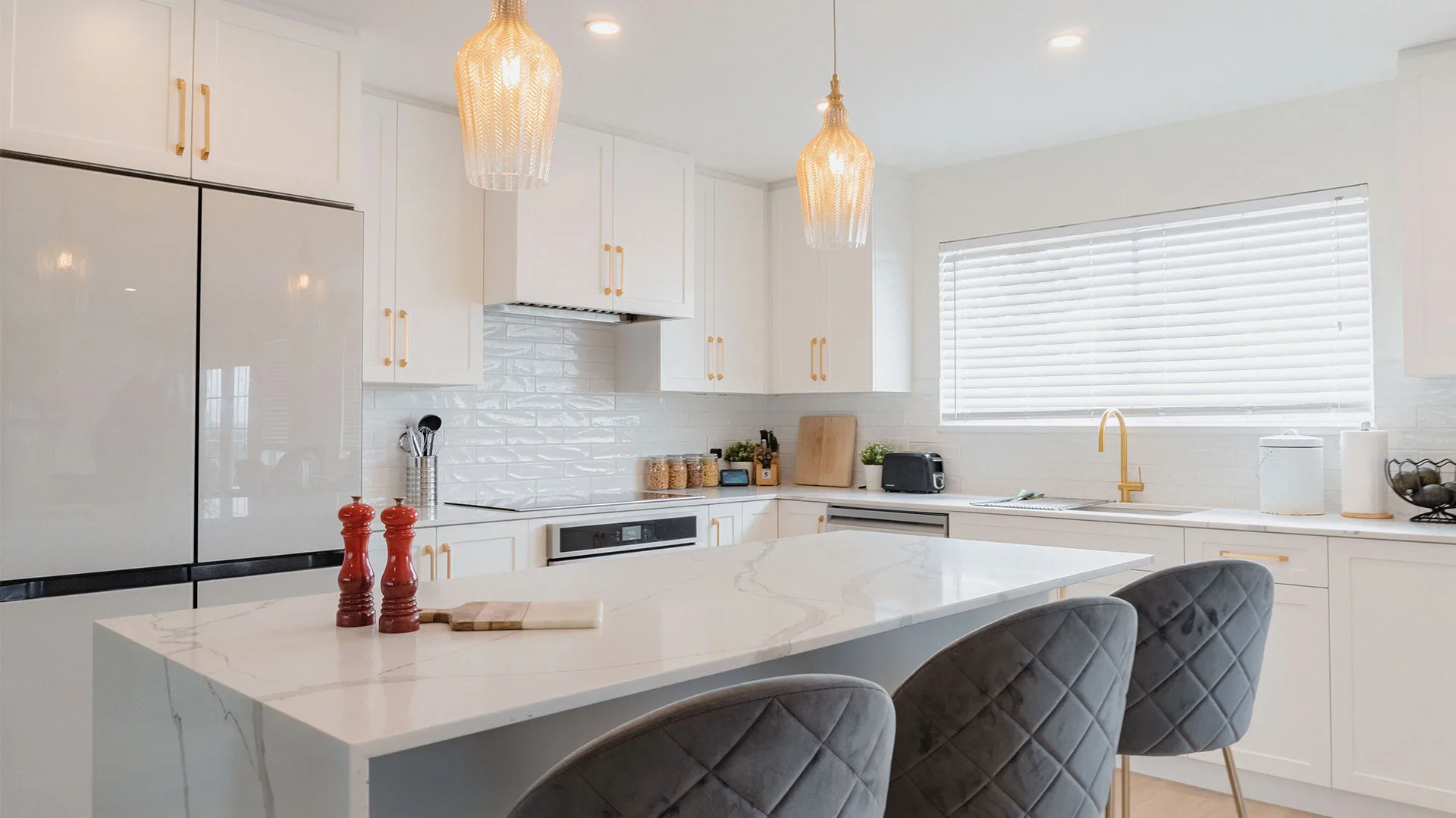
Kitchen Cabinets Vancouver: Costs, Types & How to Choose (2026 Guide)
Kitchen cabinets are the single most consequential decision you will make in a kitchen renovation — and in Vancouver, they are also the single largest line item. Whether you are planning a full gut renovation in a Mount Pleasant heritage home or refreshing a dated kitchen in a Burnaby condo, your cabinet choices will shape the final look, the long-term function, and roughly 35 to 45 percent of your total renovation budget. This guide covers every tier, every material, and every trade-off so you can spend your money where it counts.
Why Cabinets Dominate Your Kitchen Renovation Budget
Most homeowners are surprised to learn how much of a kitchen renovation budget goes to cabinetry. The cabinets are not just boxes on a wall — they are the structural skeleton of the kitchen. They determine the layout, they are the first thing every visitor sees, they are touched dozens of times per day, and they need to hold up for 15 to 25 years. When you buy cabinets, you are buying the frames, the doors, the drawer boxes, the hinges, the drawer slides, the interior shelving, the trim pieces, the paint or stain finish, and the delivery and installation labour. That is a lot of material and a lot of skilled labour packed into one line item.
In a mid-range Vancouver kitchen renovation costing $55,000 to $75,000, it is normal for cabinets to account for $20,000 to $35,000 of that total. In a high-end renovation at $120,000 and above, custom cabinetry alone can exceed $60,000 before you touch countertops, flooring, or appliances. Understanding what drives those numbers — and where you can spend less without sacrificing quality — is what separates homeowners who are happy with their renovation from those who are not.
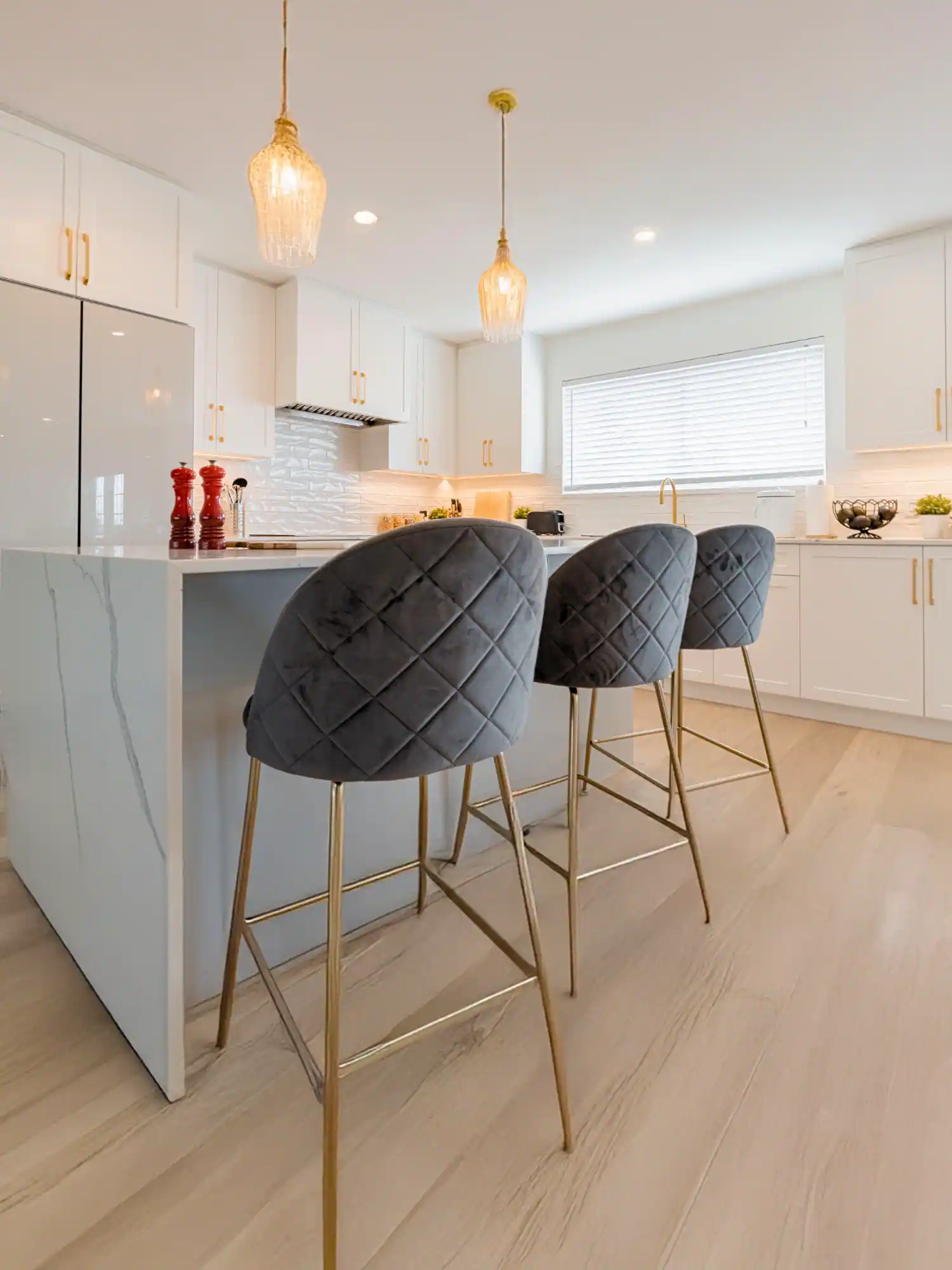
Stock cabinets are pre-built in standard sizes, typically in 3-inch increments from 9 to 36 inches wide
Vancouver General Contractors
The three cabinet tiers are stock, semi-custom, and full custom. Each serves a different buyer, a different timeline, and a different quality expectation. We will cover all three in detail, but the summary is simple: stock is fastest and cheapest; full custom is slowest and most expensive; semi-custom hits the sweet spot for most Vancouver homeowners doing a serious renovation.
Kitchen Cabinet Costs in Vancouver: Full Price Breakdown for 2026
The ranges below reflect typical installed costs in Metro Vancouver in 2026, including supply, delivery, and professional installation for an average-size kitchen (approximately 150 to 200 square feet of floor space, 25 to 35 linear feet of cabinetry). Costs rise significantly for larger kitchens, islands, pantry columns, or unusually complex layouts.
| Cabinet Tier | Installed Cost Range | Lead Time | Best For |
|---|---|---|---|
| IKEA SEKTION (flat-pack, contractor-installed) | $8,000 – $16,000 | 1 – 3 weeks | Rentals, tight budgets, DIY-friendly projects |
| Stock box cabinets (Home Depot, Lowes, Cabico entry) | $12,000 – $22,000 | 1 – 4 weeks | Budget renovations, standard layouts |
| Semi-custom cabinets (Cabico, Fieldstone, Aristokraft mid-range) | $22,000 – $42,000 | 4 – 8 weeks | Most mid-range Vancouver renovations |
| Full custom cabinetry (local cabinet makers, imported European) | $42,000 – $85,000+ | 8 – 16 weeks | High-end renovations, non-standard layouts |
These ranges assume a competent installation crew and standard site conditions. In older Vancouver homes — pre-1970 construction with unlevel floors and out-of-square walls — installation labour can run 20 to 30 percent higher than in a newer condo because of the shimming, scribing, and problem-solving required. We will cover that in the section on older Vancouver homes below.
What drives the price within each tier? Four main factors: material quality of the cabinet box, door style and material, hardware included in the package, and finishing options. A semi-custom cabinet with plywood boxes, soft-close hardware, and a painted finish will cost considerably more than a semi-custom cabinet with particleboard boxes and basic hinges — even from the same manufacturer. When comparing quotes, make sure you are comparing the same specifications, not just the same tier label.
Stock vs. Semi-Custom vs. Full Custom: Which Is Right for Your Kitchen?
Stock cabinets are pre-built in standard sizes, typically in 3-inch increments from 9 to 36 inches wide. They are available immediately or within a few weeks, and because they are mass-produced, the price per linear foot is the lowest of any option. The trade-off is inflexibility. If your kitchen has an odd dimension — an 11-inch filler space, a soffit at an unexpected height, or a peninsula that requires a non-standard depth — stock cabinets will require filler strips and workarounds that can look awkward if not handled carefully. Stock is the right choice for rental properties, flips, tight budgets, and kitchens with straightforward rectangular layouts.
Semi-custom cabinets are manufactured to order in a much wider range of sizes, typically in 1.5-inch or even 1-inch increments, with more door style choices, more finish options, and more interior upgrade options than stock. Most semi-custom manufacturers also offer non-standard heights, depths, and specialty pieces like angled cabinets for peninsula ends and tall pantry units. Lead time is typically four to eight weeks from order confirmation. For most Vancouver homeowners doing a $50,000 to $90,000 kitchen renovation, semi-custom represents the best balance of quality, customization, and value.
Full custom cabinetry is built from scratch to your exact specifications by a cabinet maker, either locally in Metro Vancouver or imported from Europe (primarily Germany and Italy). Every dimension, every detail, every material choice is yours. Full custom is the only option for truly unusual layouts — a kitchen in a converted Victorian home with no square corners, a luxury penthouse where the cabinets need to run floor to ceiling with integrated appliances and custom millwork, or a client who simply refuses to compromise on anything. Lead times of 8 to 16 weeks are standard; high-end European imports can take longer. The premium over semi-custom is real and significant. Whether it is worth it depends entirely on your priorities and your budget.
One important note for Vancouver buyers: local custom cabinet makers vary enormously in quality and price. Some produce work that rivals or exceeds the best European imports. Others are producing work at a price point that overlaps with good semi-custom but without the quality control that comes from an established manufacturer. If you are spending custom money, visit the shop, ask to see finished kitchens in person, and ask for references from jobs completed in the last 12 months.
Cabinet Box Construction: The Quality Difference Nobody Talks About
The door is what you see every day. The box is what determines whether your cabinets last 15 years or 25. Most homeowners spend all their attention on door styles and finishes and almost none on box construction — which is exactly backwards from a durability standpoint.
The two primary box construction systems are frameless (also called European or full-access) and face-frame (traditional North American construction). Frameless cabinets have no face frame — the doors and drawers attach directly to the box sides, providing full access to the interior and a more modern, clean look. Face-frame cabinets have a solid wood frame attached to the front of the box, which adds rigidity but reduces interior access slightly. Most semi-custom and custom cabinet lines available in Vancouver offer both systems; stock cabinets at big-box stores are almost exclusively face-frame. The Vancouver market has shifted heavily toward frameless construction over the past decade, particularly for modern and transitional kitchen styles.
The box material is the other major construction variable. The three options are:
- Plywood: The best option. Stronger, more screw-holding capacity, more resistant to moisture, and will not sag under heavy loads. Expect to pay a premium of $1,500 to $4,000 over MDF/particleboard for a full kitchen. Worth it in almost every case for a kitchen you plan to keep for 15+ years.
- MDF (Medium-Density Fiberboard): Denser than particleboard, machines cleanly, and is excellent for painted door faces. Less ideal for box construction because it is heavier, has lower screw-holding capacity, and is more vulnerable to moisture at cut edges. Common in mid-range semi-custom lines.
- Particleboard (melamine-coated): The most common material in stock and entry-level semi-custom cabinets. Perfectly functional when kept dry and not overloaded, but swells and deteriorates significantly if water is introduced (as commonly happens under sinks). IKEA SEKTION uses a dense particleboard with a melamine coating that performs better than typical particleboard but is still not plywood.
Drawer box construction follows the same hierarchy. Dovetail solid wood drawer boxes with full-extension undermount soft-close slides are the gold standard. Stapled or glued MDF drawer boxes with basic slides are the minimum. In the Vancouver market in 2026, soft-close hinges and soft-close drawer slides should be considered baseline — any cabinet line that does not include them as standard is charging you to cut costs.
Door Styles and Materials: What Works in Vancouver Kitchens
The cabinet door is the single most visible element in your kitchen. It sets the style direction for the entire space. In Vancouver in 2026, the market is dominated by three door styles: shaker, slab, and transitional variations that blend elements of both.
Shaker doors remain the most popular choice across all price points and all neighbourhoods in Metro Vancouver. The five-piece construction — four rails and stiles surrounding a recessed centre panel — is clean, versatile, and ages well. Shaker works in traditional farmhouse kitchens in East Vancouver, transitional kitchens in North Vancouver, and modern takes in Vancouver condos. The reason shaker dominates is that it photographs well, appeals to the broadest pool of buyers at resale, and is available at every price point from IKEA to full custom.
Slab doors (also called flat-panel or full-overlay flat) are the defining feature of a true modern kitchen. A single flat panel with no profile, no reveal, and no decorative detail. Slab doors look sleek and uncluttered, particularly in a two-tone kitchen with upper cabinets in a light colour and lowers in a dark accent. The trade-off is that slab doors show every smudge, fingerprint, and imperfection in the finish. Painted slab MDF requires careful maintenance and is more prone to chipping at corners than a shaker door. If you are drawn to the look of slab, discuss finish durability with your cabinet supplier before committing.
Raised panel doors have the centre panel sitting proud of the frame rather than recessed. This was the dominant style in Vancouver kitchens through the 1990s and early 2000s and is still common in traditional and formal kitchens. It is less common in new renovations today, but if you are renovating a home in Shaughnessy, Dunbar, or other established neighbourhoods where the architecture is traditional, raised panel may be the most contextually appropriate choice.
Door material choices have their own hierarchy:
- Thermofoil (vinyl-wrapped MDF): Lowest cost, available in many colours, no painting required. The failure mode is delamination, particularly near heat sources like dishwashers and ovens. Not recommended for a kitchen you plan to keep for 15+ years.
- Painted MDF: The most popular finish for shaker and slab doors in Vancouver. Clean, contemporary, and available in any colour. Paint quality matters enormously — factory spray finishes are far more durable than brush-applied field paint. Ask whether the doors are primed, sanded, and topcoated with a catalyzed lacquer or conversion varnish, not just basic latex.
- Solid wood (stained): Traditional, durable, and beautiful. Wood moves with humidity, so solid wood doors in a coastal climate like Vancouver need proper sealing and some tolerance for seasonal movement. Stained finishes require more maintenance than painted.
- Veneer: A thin layer of real wood bonded to an MDF or plywood substrate. Provides the wood grain look with less movement and more dimensional stability than solid wood. Common in high-end European cabinetry.
On the question of paint versus stain: painted kitchens currently dominate the Vancouver market. White, off-white, warm greige, sage green, and navy are the top colours in 2025 and 2026. Two-tone kitchens — typically white uppers and a dark or coloured lower — are popular in mid-range to high-end renovations. Stained wood kitchens are having a moment in the design press but remain a smaller share of actual projects, partly because a stained finish is harder to refresh if you want to update the look in five years.
Cabinet Hardware: The Finishing Detail That Changes Everything
Hardware is one of the highest-return line items in a kitchen renovation. The right pulls transform the look of your cabinets. The wrong pulls — or no pulls at all on a door that needs them — make an otherwise good kitchen feel unfinished. Budget $400 to $2,500 for hardware on an average-size kitchen depending on the quantity of pieces and the quality of the hardware.
The main hardware choices in the Vancouver market in 2025–2026:
- Matte black: Still the most popular hardware finish in Vancouver. Works with white, greige, wood-tone, and two-tone kitchens. Shows water spots less than chrome or nickel. Easy to source at every price point.
- Brushed gold / satin brass: Growing rapidly in popularity, particularly in higher-end renovations and in kitchens with warm-toned cabinets, wood elements, or earthy colour palettes. Aged brass and unlacquered brass are popular in more traditional kitchens.
- Brushed nickel / satin nickel: The default finish of the 2000s to 2015. Still relevant, particularly in transitional and traditional kitchens. More forgiving of water spots than polished chrome.
- Integrated pulls / push-to-open: Common on slab-door modern kitchens where hardware would disrupt the clean lines. Router-carved integrated pulls in the top edge of lower doors and drawer faces, or push-to-open mechanisms (Blum Tip-On is the most common). These eliminate the risk of hardware mismatch but make the kitchen harder to update later without new doors.
On style: bar pulls (long horizontal pulls, sometimes called “D-ring” or “cup” for a curved profile) are the most popular choice on both shaker and slab doors in Vancouver. Standard lengths are 128mm, 160mm, and 192mm centre-to-centre. Longer “appliance pulls” (300mm to 480mm) are increasingly used as the single hardware element on large drawer faces and slab doors to create a dramatic linear look. Knobs are less common in current renovations but still have a place in traditional kitchens where a more furniture-like feel is appropriate.
Hardware installation is typically not included in cabinet supply costs and may or may not be included in installation labour — confirm this with your contractor before signing. A kitchen with 40 to 60 pieces of hardware takes two to four hours to install and is often billed separately.
Upper Cabinets vs. Open Shelving: The Vancouver Trade-Off
Few renovation decisions generate more debate than whether to remove upper cabinets in favour of open shelving. The Instagram-driven open shelving trend has been a fixture of kitchen design content for over a decade, and it does produce genuinely beautiful kitchens — in photographs. The day-to-day reality is more complicated.
Open shelving costs less than upper cabinets — floating shelves in wood or a wood-look material typically run $200 to $600 installed per shelf, versus $800 to $2,500 per linear foot of upper cabinet depending on the tier. So if you are replacing two full runs of upper cabinets (say, 12 to 16 linear feet) with floating shelves, you can save $5,000 to $15,000 on supply alone. That is real money.
The trade-offs are equally real:
- Storage loss: Upper cabinets with doors conceal an enormous amount of kitchen kit — small appliances, stockpiles of pantry items, rarely-used equipment. Open shelves require you to curate what is visible, which means either having fewer things or finding storage elsewhere.
- Maintenance: Everything on open shelves gets a fine coating of kitchen grease and dust over time. Plates, glasses, and decorative items need regular cleaning. This is not a minor consideration in a busy family kitchen.
- Resale: Vancouver resale buyers are generally more conservative than design media would suggest. Kitchens with generous upper cabinet storage tend to appeal to a broader pool of buyers than kitchens with open shelving. If you are renovating to sell within five years, full upper cabinets are the safer choice.
- Visual weight: The strongest argument for open shelving is that it makes a smaller kitchen feel more open and airy. In a galley kitchen or a kitchen that is short on natural light, removing the visual mass of upper cabinets can genuinely transform the feel of the space.
The hybrid approach — open shelves on one wall or in one section, closed uppers everywhere else — is the most practical solution for most kitchens. It captures the aesthetic benefit of open shelving without sacrificing meaningful storage capacity. This is what we see working best in actual Vancouver kitchens rather than the all-or-nothing approaches shown in design publications.
Interior Cabinet Organization: What Is Worth the Premium
Cabinet interior organization upgrades are the accessories that cabinet manufacturers and showrooms love to upsell — and some of them are genuinely transformative while others look great in a showroom and collect dust in real kitchens. Here is an honest assessment of what is worth spending on.
Worth the investment:
- Pull-out shelves in base cabinets ($150 – $350 each installed): Base cabinet storage is almost unusable without pull-outs. The ability to pull a shelf fully out and see everything in the cabinet is transformative for daily use. Budget for pull-outs in every base cabinet that is not a drawer base. This is one upgrade that virtually every homeowner says they wish they had done on every cabinet.
- Pull-out waste and recycling bins ($400 – $900 installed): Vancouver requires multi-stream recycling — garbage, organics, recyclables — and a pull-out bin system that handles all three under the sink or in a dedicated base cabinet makes this manageable. Soft-close mechanisms on bin frames are worth the small premium.
- Drawer dividers for utensil drawers ($80 – $200 each): A pegboard-style or adjustable divider in a utensil drawer costs very little and dramatically improves daily function. Basic peg drawer inserts can be added at any time, but factory-installed inserts tend to fit more precisely.
- Blind corner pull-outs or lazy Susans ($400 – $900 installed): Dead corner space is the greatest inefficiency in most kitchen layouts. A proper pull-out system — either a full-extension blind corner pull-out (LeMans or Magic Corner type) or a classic lazy Susan — converts wasted space into genuinely usable storage. Magic Corner systems are more expensive but more functional than a standard lazy Susan.
Lower priority or situation-specific:
- Spice pull-outs ($200 – $450): Narrow pull-out spice racks are genuinely useful if you cook frequently and have a lot of spices, but they are not essential in every kitchen.
- Pots and pans drawers: A wide, deep drawer for pots and pans is often better than a pull-out shelf in a base cabinet. Consider using 3-drawer base cabinets instead of door-and-shelf base cabinets wherever possible.
- Plate peg organizers: Useful in some kitchens, unnecessary in most where deep drawers handle plates fine.
- Built-in knife blocks: More of a showroom feature than a daily-use essential. A magnetic strip on the wall or a countertop block works as well for most people.
The general principle: invest in pull-outs and organization for base cabinets, where the depth makes things hard to access without them. Upper cabinets, with their shallower depth and eye-level visibility, need organization less urgently. And remember that many organization inserts can be added after the fact — you do not have to decide everything at once.
Kitchen Cabinet Layout Optimization: Getting the Plan Right
The layout of your cabinets determines how functional your kitchen is every day. A beautifully built set of cabinets in a poor layout will frustrate you for years; a thoughtfully planned layout in mid-range cabinets will feel like a pleasure to use. These are the layout principles that matter most.
The work triangle — the path between the refrigerator, the sink, and the range — remains the foundation of kitchen layout planning, even as kitchen design has evolved toward larger, more complex spaces. The total distance of the three legs of the triangle should ideally fall between 12 and 26 feet, with no single leg shorter than 4 feet or longer than 9 feet. More importantly, the paths between these three work zones should not be interrupted by traffic lanes, islands, or doors. In a galley kitchen, the triangle becomes a corridor; in an L-shape or U-shape, it defines where your landing zones need to be.
Upper cabinet height is one of the decisions that feels like a detail but has a major visual and functional impact. In a home with 8-foot ceilings, the conventional approach is to run upper cabinets to the ceiling — or stop them 18 inches below ceiling and add a soffit — and to set the upper cabinet bottom at 18 inches above the countertop. In a home with 9 or 10-foot ceilings, running cabinets to the ceiling requires taller cabinet boxes (42 to 54 inches high instead of the standard 30 to 36 inches) or stacking standard boxes with a glass or solid upper section. Ceiling-height cabinets have become the dominant design preference in higher-end Vancouver renovations because they eliminate the dust-collecting ledge above standard cabinets and create a more finished, built-in look.
Base cabinet depth is standard at 24 inches for kitchen base cabinets and 12 inches for upper cabinets and pantry columns. Where you have the space, a 27-inch or even 30-inch base cabinet depth can make a big difference for baking and food prep, but this is uncommon and adds cost. More useful is ensuring that your base cabinet layout allows for a 42-inch minimum aisle in a single-cook kitchen and a 48-inch minimum aisle in a kitchen where two people cook simultaneously. Islands should be placed to preserve these clearances.
Island cabinet configuration: A kitchen island is essentially a base cabinet run on all four sides, with a countertop. The working side of the island — the side facing the main kitchen — should have drawers and cabinets oriented toward the cook. The seating side should have a knee-space overhang of at least 12 inches (15 inches is better for bar-stool seating at counter height). Islands in Vancouver kitchens are increasingly being built as furniture-style pieces with legs and open lower sections rather than a solid bank of doors, which reduces visual mass and adds flexibility.
Vancouver Kitchen Cabinet Suppliers: Local Landscape in 2026
The Metro Vancouver cabinet supplier landscape is more varied than in many Canadian cities, partly because of the high renovation volume and partly because of proximity to the Port of Vancouver, which makes importing European cabinetry more cost-effective than it is in landlocked cities.
IKEA SEKTION: The Richmond IKEA remains the busiest flat-pack kitchen supplier in the Lower Mainland. SEKTION cabinets offer remarkably good value when installed by a contractor experienced with IKEA kitchens. The system is well-engineered with a consistent rail-mounted installation system that speeds installation. The limitations are the standard stock-size constraint, the particleboard boxes, and the fact that you are responsible for planning and ordering correctly. The IKEA kitchen planning service can help, but mistakes in the order are your responsibility. IKEA kitchens work best in straightforward rectangular layouts and for homeowners who want a stylish, functional kitchen without a major investment. For rental properties and income suites, IKEA is often the most sensible choice.
Big box retailers: Home Depot and Lowes carry stock cabinet lines (Hampton Bay, Thomasville at Home Depot; Style Selections and Project Source at Lowes) that are competitively priced and immediately available. The quality ceiling on these lines is lower than semi-custom brands, but for budget renovations they are a legitimate option. Home Depot also sells and installs Cabico kitchens, which is a significantly better product than their own-brand stock lines.
Cabico: A Quebec-based cabinet manufacturer with a strong presence in the BC market, available through multiple dealers in Metro Vancouver. Cabico offers a semi-custom and custom product that is well-regarded for quality, consistency, and the range of options available. Lead times in 2025 to 2026 have normalized to four to six weeks after the supply chain disruptions of 2021 to 2023. Cabico is frequently the choice of general contractors doing mid-range to upper-mid-range kitchen renovations in Vancouver.
Local custom cabinet makers: Metro Vancouver has a strong cohort of independent cabinet shops, many concentrated in the Fraser Valley (Langley, Abbotsford, Chilliwack) where industrial land is more affordable. These shops range from small two-person operations to mid-size manufacturers with CNC equipment and full finishing facilities. Quality varies significantly. The best local makers can match or exceed the quality of imported European cabinetry at a similar price point. The advantage of a local maker is the ability to do site visits, to iterate on designs, and to handle problems quickly if something does not fit correctly during installation.
European imports: German and Italian cabinet manufacturers — Nobilia, Leicht, Alno, Snaidero, Valcucine, and others — are available through Metro Vancouver showrooms, primarily in the downtown, Yaletown, and North Shore markets. European cabinetry is engineered to tight tolerances, uses excellent hardware (Blum is the dominant system), and offers finishes and materials not widely available from North American manufacturers. The trade-offs are longer lead times (8 to 16 weeks minimum, sometimes 20+ weeks for full custom), higher cost, and the fact that if something is wrong with a delivered cabinet, the replacement process takes weeks rather than days.
One Vancouver-specific consideration: post-COVID lead times have improved significantly from the 2021 to 2022 peak when some semi-custom lines were running 20+ weeks. In 2026, most semi-custom lines are back to four to eight weeks and most stock lines are immediate or within two to three weeks. European imports remain longer. Always get a confirmed lead time commitment in writing before your renovation start date.
Installing Cabinets in an Older Vancouver Home: What to Expect
Vancouver has a large stock of pre-1970 housing — character homes in Kitsilano, Grandview-Woodland, Mount Pleasant, and East Vancouver; bungalows in Marpole and Renfrew; older co-ops and apartments throughout the city. Renovating the kitchen in one of these homes almost always involves surprises that do not appear in new-build or post-1990 renovation projects.
Unlevel floors: Pre-1970 floors are rarely level. A run of base cabinets that is perfectly plumb and square will have a visible gap at one end if the floor is out of level across the kitchen. The solution is shimming at the base and scribing the toe kick to follow the floor line. This adds time and skill to the installation — expect a longer installation timeline and potentially 15 to 25 percent more installation labour than in a new kitchen.
Out-of-square walls: Wall corners in older Vancouver homes are rarely 90 degrees. When you run a cabinet into a corner and the wall is 88 degrees instead of 90, the cabinet sticks out by an inch at the front. Proper scribing and filler management is essential and requires a skilled installer who has done it many times. This is not the job for a contractor who primarily does new construction.
Plumbing and electrical in cabinet locations: In a full gut renovation, the mechanical is relocated before cabinets go in. In a partial renovation where you are keeping the existing layout, the existing supply lines, drain, and electrical may need to be adjusted to accommodate new cabinet dimensions and configurations. This is normal and expected — budget $500 to $2,500 for minor plumbing and electrical adjustments as part of a kitchen renovation in an older home.
Moving a window: It is common in older Vancouver kitchens to find a window that sits at an odd height above the sink, or a window that blocks where you want to place an upper cabinet run. Moving a window in an older home requires a building permit, a structural header (if the window is in a load-bearing wall, which it usually is), framing work, exterior cladding repair, and interior finishing. Budget $3,000 to $8,000 to move a standard window — more if it involves load-bearing elements or heritage facade restrictions (common in some Vancouver character retention zones). The trade-off is usually worth it if the window position is genuinely compromising the kitchen function and layout.
Asbestos and lead paint: In Vancouver homes built before 1980, assume that asbestos-containing materials may be present — in vinyl floor tiles, in drywall compound, in insulation around pipes — and that painted surfaces may contain lead paint. Before any demolition work in a pre-1980 home, a qualified hazardous materials assessment is advisable. The cost of the assessment ($500 to $1,500) is small relative to the cost of a remediation order if a problem is discovered after demolition has started. Your general contractor should be familiar with BC’s WorkSafeBC requirements for hazardous materials handling.
If you are planning a kitchen renovation in an older Vancouver home, we recommend reading our comprehensive renovation guide and visiting our home renovation services page to understand the full scope of what a kitchen project in a heritage-era home involves. When you are ready to discuss your specific project, contact us for a no-obligation consultation.
More Kitchen Renovations Guides
Kitchen Cabinet Replacement in Vancouver: Stock vs Semi-Custom vs Custom Cabinets

Countertop Replacement in Vancouver: Quartz vs Granite vs Butcher Block Compared

Kitchen Backsplash Installation in Vancouver: Tile Options, Costs, and Design Guide
Galley Kitchen Renovation in Vancouver: Making the Most of a Narrow Kitchen Layout
Kitchen Lighting Renovation in Vancouver: Under-Cabinet, Pendants, and Recessed Lighting Guide
Ready to start your renovation?
Frequently Asked Questions About Kitchen Cabinets in Vancouver
1. Is IKEA really worth it for a Vancouver kitchen renovation?
IKEA SEKTION is genuinely good value for straightforward kitchens, particularly in rental properties, suites, or first renovations where budget is the primary constraint. The system is well-designed, the finishes are attractive, and the hardware (Blum soft-close hinges and drawer slides are standard) is the same hardware found in semi-custom cabinets. The limitations are the particleboard box construction, the fixed size increments, and the fact that you carry the risk of ordering errors. For a family home you intend to keep for 15 to 20 years, mid-range semi-custom is a better long-term investment — but for a rental unit or a condo flip, IKEA installed by an experienced contractor is often the right call.
2. How long does it take to get semi-custom cabinets in Vancouver?
In 2026, most semi-custom cabinet manufacturers are running four to six weeks from approved shop drawings to delivery. Allow an additional one to two weeks for shop drawing approval after your final selections are confirmed. From the day you finalize your choices, budget six to eight weeks before cabinets arrive on site. Full custom cabinetry — either from a local cabinet maker or European import — typically runs 10 to 16 weeks minimum. Stock cabinets can be ordered and delivered in one to three weeks.
3. Plywood vs. particleboard cabinet boxes — does it really matter?
Yes, it matters significantly for longevity. Plywood boxes hold screws better, resist moisture better, and do not sag under the weight of dishes, pots, and pantry items the way particleboard can over time. The under-sink base cabinet is the most critical location — this is where leaks happen and where moisture is most likely to be present. A particleboard box under a sink that has had even one slow leak will be compromised. Plywood survives this. The price premium for plywood boxes across a full kitchen is typically $1,500 to $4,000 — worthwhile in a kitchen you plan to keep.
4. Shaker vs. slab doors — which should I choose?
Choose shaker if you want a style that will look current for 15 to 20 years, appeals to the broadest range of buyers at resale, and works across both traditional and modern interpretations. Choose slab if you are committed to a true modern aesthetic, are willing to maintain the finish carefully, and are either staying in the home long-term or are targeting the luxury market where slab cabinets are expected. For most Vancouver homeowners, shaker is the safer and more versatile choice.
5. Should I paint or stain my kitchen cabinets?
Painted cabinets dominate the Vancouver market in 2026. They are easier to touch up, easier to change (you can repaint a painted door; you cannot un-stain a stained one), and align with the contemporary colour palettes most prevalent in Vancouver design. Stained cabinets are beautiful in wood-forward interiors and have a warmth that paint cannot replicate, but they require more maintenance, show more wear over time, and are harder to update. If in doubt, paint. If you have a genuine love of natural wood in a traditional kitchen setting, stain is worth the commitment.
6. What are the real pros and cons of open shelving?
Pros: lower cost than upper cabinets, makes smaller kitchens feel more open, creates an opportunity for a styled display of attractive kitchenware. Cons: everything gets dusty and greasy over time, requires rigorous curation of what is stored there, reduces total storage capacity, and is less appealing to conservative resale buyers. The hybrid approach — open shelves in one section, closed cabinets everywhere else — captures the visual benefit without the full commitment. Full open shelving works best in large, high-ceilinged kitchens with a genuine storage solution elsewhere in the home.
7. What should I budget for cabinet hardware?
Budget $400 to $800 for hardware in a mid-range kitchen using quality hardware from suppliers like Richelieu, Top Knobs, or Amerock. Budget $800 to $2,500 for higher-end hardware (Emtek, Hafele, European brands) or for kitchens with more than 50 pieces. The number of pieces adds up quickly in a full kitchen — it is common to need 40 to 70 pulls and knobs total once you count every door and drawer. Buy extras: hardware gets discontinued, and being short two pulls a year later is an annoying problem.
8. How long do kitchen cabinets last?
Quality semi-custom or custom cabinets with plywood boxes and good hardware should last 20 to 30 years with normal use and maintenance. The first things to fail are typically the finishes (paint chips and scratches) and the hardware. Drawer slides and hinges can be replaced inexpensively if needed. Stock cabinets and IKEA with particleboard boxes typically have a functional life of 10 to 15 years under normal use, less if they are subjected to moisture. The longevity of any cabinet is also partly a function of daily use — a kitchen used by a large family will show more wear than a cabinet in a seldom-cooked-in condo.
9. Should I reface or replace my existing cabinets?
Refacing — replacing doors, drawer faces, and hardware while keeping the existing cabinet boxes — makes sense when the existing boxes are structurally sound (plywood, no water damage, still level and square) and the layout works. It costs roughly 40 to 60 percent of full replacement and can dramatically change the look of the kitchen. Replacement makes sense when the boxes are damaged, when the layout needs to change, or when the existing cabinets are stock/IKEA-quality particleboard that will not last another 15 years. If you are unsure, have a contractor inspect the existing boxes before deciding — the condition of the box interiors will tell you whether refacing is a sensible investment.
10. What is included in cabinet installation cost?
Standard cabinet installation typically includes: delivery to site, uncrating and staging, shimming and levelling, installation of all wall and base cabinet boxes, installation of doors and drawer fronts, adjustment of hinges and drawer slides, installation of interior shelving, scribing of fillers and trim pieces, and basic toe-kick installation. It typically does not include: countertop installation, plumbing or electrical work, painting or touch-up finishing, hardware installation (often billed separately), or custom modifications like fitting cabinets around a radiator or structural post. Always confirm the scope in writing before work begins.
11. Do I need a permit to replace kitchen cabinets in Vancouver?
In Metro Vancouver, replacing kitchen cabinets in the same location — a like-for-like cabinet replacement without moving walls, plumbing, or electrical — does not typically require a building permit. However, if your renovation involves moving the sink (which requires moving the drain and supply lines), moving the range hood duct, altering electrical outlets or adding circuits, or moving a wall, a permit is required. Any structural work — removing a wall, moving a window, creating an opening — absolutely requires a permit. Work done without a required permit can create serious complications when you sell the home. When in doubt, ask your contractor or contact the City of Vancouver or your municipal building department.
12. What is the difference between full-overlay and partial-overlay cabinet doors?
In a full-overlay door (also called European-overlay), the door covers almost the entire face of the cabinet box, with only a small gap between adjacent doors. This is the dominant style in modern and contemporary kitchens and is standard in frameless (European) cabinet construction. In a partial-overlay door, the door covers only a portion of the cabinet opening, leaving more of the face frame visible. This is the traditional North American style and is still common in more traditional kitchen designs. Most semi-custom and custom cabinets offer both; stock cabinets are typically partial-overlay.
13. How do I know if a cabinet quote is fairly priced?
Get a minimum of three quotes and make sure you are comparing the same specifications: box material (plywood vs. MDF vs. particleboard), door material and finish, hardware included, and installation scope. A quote that is 30 percent lower than the others is either missing something or using inferior materials — ask for clarification. A quote that is 30 percent higher should come with a clear explanation of what justifies the premium (better box material, superior finish process, more comprehensive warranty, more experienced installation crew). The right price is typically in the middle range of quotes from reputable contractors with verifiable references.
14. Can I install kitchen cabinets myself to save money?
IKEA SEKTION cabinets are designed for DIY installation and many homeowners successfully install them. Standard stock or semi-custom cabinets can also be installed DIY by a skilled and patient homeowner with good carpentry skills, proper tools, and time. The challenges are ensuring the cabinets are level and plumb (this requires careful measurement and shimming), managing filler pieces and trim (this requires cutting skill), and handling the scribing required in older homes with unlevel floors. The risk of DIY installation is that mistakes are expensive to correct — a cabinet that is not level, or a run that is not properly secured to studs, creates ongoing problems. For most homeowners, the $3,000 to $8,000 saved on installation is not worth the risk of a poor result. For confident, experienced DIYers in a straightforward new-build kitchen, it is a reasonable option.
15. How do I choose between a local cabinet maker and a national manufacturer for a custom kitchen?
The choice comes down to what you prioritize. A national semi-custom manufacturer (Cabico, Fieldstone, Aristokraft) offers consistent quality, tested product lines, warranty support, and predictable lead times — but less flexibility than truly custom work. A local cabinet maker offers full customization, direct communication with the person building your kitchen, and the ability to do complex one-off details. The risk with a local maker is quality variability — there is no production QC department, no standardized testing, and no corporate warranty behind the product. Mitigate this by visiting the shop, seeing finished work in person, and talking to recent clients. The best local makers in Metro Vancouver are extraordinary craftspeople; the worst produce work that does not justify custom pricing. References and site visits are non-negotiable if you are spending custom money.
Get a Free Renovation Quote
Metro Vancouver’s trusted general contractors. Free consultations across Vancouver, Burnaby, Richmond, North Shore & beyond.
Get Your Free Quote →Planning a kitchen renovation in Metro Vancouver? Vancouver General Contractors has been helping homeowners navigate cabinet choices, contractor selection, and full kitchen renovations across the Lower Mainland for years. Visit our renovation planning guide for a comprehensive overview of the full renovation process, explore our kitchen and home renovation services, or contact us directly to discuss your project with no obligation.
Ready to start your project? Vancouver General Contractors (VGC) provides free, fixed-price quotes for homeowners across Metro Vancouver. Learn more about our kitchen renovation Vancouver services or request a free quote today.
VGC serves Vancouver and surrounding areas. View all renovation services in Vancouver →

Comments are closed