




Kitchen Countertops Vancouver: Materials, Costs & How to Choose (2026)
Walk into any kitchen in Vancouver and your eyes go straight to the countertops. Before you notice the cabinet colour, the backsplash tile, or the appliances, you register the countertops. They set the material tone for the entire room, and they take more daily abuse than any other surface in your home. Choosing the right countertop material is the single highest-leverage decision in a kitchen renovation — and in a Vancouver market where buyers and sellers are both sophisticated about finishes, getting it right matters enormously.
This guide covers everything you need to know: how much countertops cost in Vancouver across every popular material, the honest maintenance story for each one, what Vancouver buyers actually prefer in 2025–2026, and how to navigate the installation process from template to backsplash. Whether you’re renovating a Kitsilano craftsman, a Coal Harbour condo, or a North Shore family home, the information here will help you spend your countertop budget wisely.
Why Countertops Define a Kitchen Renovation
Countertops occupy more visual real estate than any other element in a kitchen. They span the length of your perimeter cabinets, wrap around the island, and sit at eye level when you’re standing at the sink. They’re the surface you touch hundreds of times a day — prepping meals, setting down groceries, leaning against while the coffee brews. No other renovation element combines that level of visual prominence with that much physical interaction.
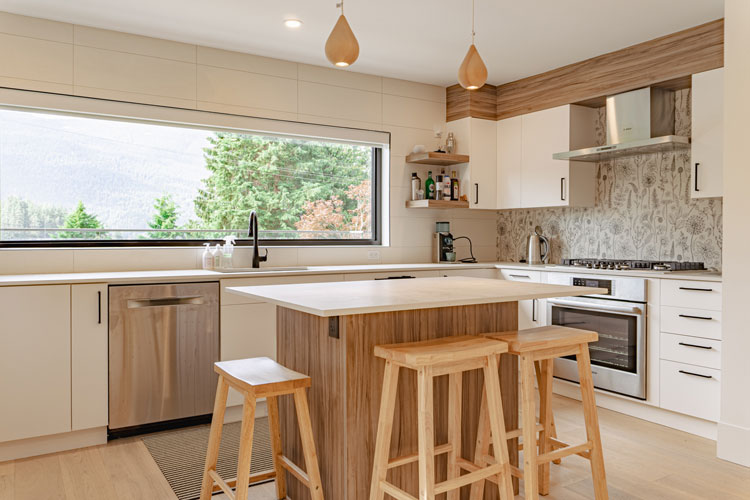
Total installed countertop costs for a typical Vancouver kitchen (roughly 30 square feet of perimeter plus a 15-square-foot island
Vancouver General Contractors
In a typical Vancouver kitchen renovation budget, countertops account for 15 to 25 percent of total spend. On a $60,000 mid-range kitchen renovation, that’s $9,000 to $15,000 for countertops and installation. On a $120,000 high-end renovation, you might be looking at $18,000 to $30,000 for premium stone across an expansive island and perimeter. That proportion holds across price points because the countertop is doing so much work — both functionally and aesthetically.
Countertops also mediate between every other element in the kitchen. The stone or material you choose has to work with your cabinet colour, your backsplash tile, your flooring, and your hardware. A warm-toned quartzite with gold veining demands different cabinet colours than a cool, white quartz with grey veining. Getting the countertop decision right first — or at minimum, making it a primary decision rather than an afterthought — gives you a foundation to build the rest of the design around.
The Vancouver market has specific preferences worth understanding. Buyers on the West Side, West Vancouver, and in newer Eastside renovations have moved away from the beige-and-brown granite era of the 2000s. The 2025–2026 market strongly favours quartz for its practicality, quartzite and porcelain slab for their premium look, and honest materials like butcher block for the right kitchen style. Laminate has staged a real comeback in rental suites and budget-conscious flips where cost efficiency matters more than prestige.
Total installed countertop costs for a typical Vancouver kitchen (roughly 30 square feet of perimeter plus a 15-square-foot island, so about 45 square feet total) range from just under $2,000 for basic laminate to over $25,000 for book-matched marble or premium quartzite with a waterfall island edge. Most Vancouver renovations land between $5,000 and $12,000 for countertops and installation combined.
Countertop Costs in Vancouver: Complete Price Guide by Material
All prices below are installed costs in the Vancouver Metro area, including material, fabrication, templating, delivery, and standard installation. Prices reflect 2025–2026 market rates. Significant variables include slab grade/origin, edge profile, cutouts (sinks, cooktops), and site-specific conditions. Always get three quotes — price variance between fabricators can be 20 to 30 percent for identical material.
| Material | Installed Cost (30 sq ft kitchen) | Per Sq Ft Installed | Sealing Required | Durability |
|---|---|---|---|---|
| Laminate (HPL) | $1,800 – $3,500 | $60 – $120 | No | Moderate |
| Butcher Block / Wood | $2,500 – $5,000 | $85 – $170 | Oil every 3–6 months | Moderate (water-sensitive) |
| Granite | $4,000 – $8,500 | $130 – $280 | Every 2–3 years | High |
| Quartz (Engineered) | $4,500 – $9,000 | $150 – $300 | None | Very High |
| Porcelain Slab | $5,000 – $11,000 | $165 – $360 | No | Very High |
| Quartzite | $5,500 – $12,000 | $180 – $400 | Annually | High |
| Marble | $6,000 – $14,000 | $200 – $450 | Every 6–12 months | Low–Moderate (etches) |
| Concrete | $6,000 – $15,000 | $200 – $500 | Annually | Moderate (sealer-dependent) |
Within each material category, several factors drive price variation. For natural stone (granite, quartzite, marble), slab origin and rarity matter enormously — a common Brazilian granite costs a fraction of a rare book-matched Italian marble. Movement and veining density push prices up; plain, consistent stones are less expensive. Thickness matters too: 2cm slabs are less expensive than 3cm, and 3cm is the standard for Vancouver residential installations.
For engineered materials like quartz, brand and series drive pricing. Entry-level quartz from a Chinese manufacturer and premium Cambria quartz both perform well, but the brand premium is real — Caesarstone and Cambria charge 20 to 40 percent more than comparable no-name quartz. For porcelain slab, Dekton and Lapitec command premiums over generic sintered stone. For laminate, the high-pressure laminate (HPL) products like Formica 180fx genuinely look better than standard laminate and cost more accordingly.
Edge profiles add cost on top of material pricing. Eased or straight edges are typically included at no premium. Ogee, dupont, and other decorative edges add $150 to $300 for a standard kitchen perimeter. Waterfall edges — where the countertop material cascades down the side of the island — add $1,500 to $4,000 or more depending on material and run length. More on edge profiles in a dedicated section below.
Quartz Countertops: Why They Dominate Vancouver Kitchens
Engineered quartz is the most popular countertop material in Vancouver by a significant margin, and the reasons are straightforward: it requires zero maintenance, resists staining and scratching better than natural stone, comes in a consistent and predictable appearance, and performs beautifully in the busy family kitchens that make up the majority of Vancouver renovations. For a city where most homeowners want a premium look without premium upkeep, quartz hits the sweet spot.
Quartz countertops are manufactured from approximately 90 percent crushed quartz aggregate and 10 percent polymer resin binders and pigments. The result is a non-porous surface — meaning liquids, oils, and bacteria cannot penetrate it. Unlike natural stone, quartz never needs sealing. Red wine, coffee, turmeric, and lemon juice can all be wiped clean without staining. The surface is also highly scratch-resistant, though not scratch-proof — ceramic knives and extremely hard abrasives can mark it.
One important limitation: quartz is not heat-resistant. The polymer resin can discolour or crack when exposed to sustained heat above approximately 150°C. Hot pots directly from the stove can cause thermal shock damage. Trivets are non-negotiable with quartz countertops, and this is the primary real-world complaint from homeowners who didn’t know this going in. It is also sensitive to prolonged UV exposure, which is relevant for outdoor kitchens or countertops near large windows — the colour can shift over years of direct sun.
The major quartz brands available in Vancouver each have distinct strengths. Caesarstone (Israeli-origin, manufactured globally) offers the widest range of styles and has the deepest dealer network in the Lower Mainland — it’s available through most kitchen cabinet showrooms. Silestone (Cosentino, Spanish) introduced HybriQ technology with higher recycled content and added antibacterial properties; their Eternal series convincingly mimics natural stone movement. Cambria (American-made) is premium-positioned, with American manufacturing and a strong warranty — their designs tend toward bold movement and natural stone mimicry, and they’re popular in West Side and North Shore renovations. HanStone (Korean-origin, Canadian distribution) offers strong value at the mid-range price point and is widely used in new construction and developer projects across Metro Vancouver.
Installed costs for quartz in Vancouver run $150 to $300 per square foot, putting a standard 30-square-foot kitchen perimeter at $4,500 to $9,000. Island additions add to that. The price range within quartz reflects brand, series complexity, and edge profile choices rather than durability differences — even entry-level quartz performs well.
For Vancouver families with children, renters who want low maintenance, and anyone renovating to sell — quartz is the safe, high-performing choice. The only reason to look elsewhere is if you want the organic variability and character of natural stone, which quartz, despite its best efforts, doesn’t fully replicate.
Quartzite Countertops: Natural Stone Without the Marble Headaches
Quartzite is one of the most misunderstood materials in kitchen design, and the confusion starts with the name. Many homeowners — and even some showroom staff — conflate quartzite with quartz. They are completely different materials. Quartz is an engineered product manufactured in a factory. Quartzite is a natural metamorphic stone, formed when sandstone is subjected to extreme heat and pressure deep in the earth, transforming the sand grains into interlocking quartz crystals. It is mined in slabs just like granite or marble.
Why does the distinction matter? Because quartzite is dramatically harder than marble, significantly more resistant to etching, and has the kind of organic, flowing veining that engineered quartz can only approximate. The look is extraordinary — particularly the white and soft-gold varieties that have become the signature material of high-end West Side and West Vancouver kitchen renovations over the last three years.
The most sought-after quartzite varieties in the Vancouver market include Super White (Brazilian origin, bright white background with delicate grey veining — frequently mistaken for marble), Sea Pearl (grey and white with subtle movement, a workhorse of mid-to-high renovations), Taj Mahal (warm cream and gold tones, spectacular veining, extremely popular in West Van homes), and Calacatta Macaubas (bold dramatic veining, ultra-premium pricing).
Unlike marble, quartzite does not etch easily. Acidic foods and cleaners that would immediately leave dull marks on marble generally leave quartzite unaffected. However, quartzite is still a natural porous stone and does require annual sealing to prevent oil and liquid penetration. Without sealing, staining is possible — particularly with cooking oils on lighter varieties. The sealing process takes about 30 minutes once a year and is straightforward for a homeowner to do independently.
Quartzite is harder than granite on the Mohs scale, meaning it’s extremely scratch-resistant. It handles heat better than quartz. These properties, combined with its natural beauty, make it the choice for homeowners who want the visual drama of marble without accepting marble’s maintenance reality.
Installed pricing for quartzite in Vancouver runs $180 to $400 per square foot, with the most popular and exotic varieties at the high end. A 30-square-foot kitchen perimeter in mid-grade quartzite costs $5,400 to $9,000 installed; premium varieties on a larger kitchen can easily reach $15,000 to $20,000. The material cost at the slab yard is only part of the picture — quartzite is also harder to fabricate than quartz, and experienced stone fabricators charge accordingly. Choose a fabricator with specific quartzite experience, not just a generic countertop shop.
Granite Countertops: The Proven Mid-Range Choice
Granite dominated Vancouver kitchen renovations for nearly two decades, and while it has lost some ground to quartz and quartzite at the top of the market, it remains a strong and practical choice for mid-range renovations. The market has matured — homeowners now understand granite better than they did during the height of its popularity, and that familiarity works both for and against it. For renovations targeting the $500,000 to $900,000 resale range, granite still commands respect from buyers and delivers genuine value.
Granite is a natural igneous stone — formed from slowly cooled magma — quarried primarily in Brazil, India, Norway, and Italy. No two slabs are identical. The colour and pattern range is enormous: from plain black (Absolute Black) to dramatic movement pieces (Blue Bahia, Azul Aran, Van Gogh) to warmer earth tones that work well with traditional cabinetry. This variation is both granite’s appeal and its management challenge — you must view and select the actual slab you’re buying, not a sample chip, because slabs from the same quarry lot can vary significantly.
Granite is porous and requires sealing every two to three years. The sealing interval is much more forgiving than marble, and many modern granite varieties have become dense enough that sealing can stretch to every three to five years with a quality impregnator sealer. A simple water test tells you when resealing is needed: if water dropped on the surface beads up, the seal is intact. If it soaks in and darkens the stone, it’s time to reseal. A DIY resealing job costs about $30 in materials and takes 45 minutes.
Granite is very hard and scratch-resistant. It handles heat well — a hot pan directly from the stove won’t damage it the way it can damage quartz. It does chip on edges if struck sharply, which is why edge profiles matter for granite: a rounded or bevelled edge is more chip-resistant than a sharp straight edge.
Installed granite pricing in Vancouver runs $130 to $280 per square foot. Entry-level granite (consistent colours, common varieties, domestic or South American origin) sits at the lower end. Exotic granites with dramatic movement, Italian or Scandinavian origin, or rare colourways push toward $280 per square foot and beyond. A standard 30-square-foot kitchen in mid-grade granite runs $4,000 to $7,000 installed — making it competitive with entry-level quartz while offering the character of natural stone.
How to identify quality granite at the slab yard: look for consistent thickness (3cm slabs are more stable than 2cm for kitchen applications), minimal hairline fissures (natural in stone but excessive fissuring is a weakness), and a clean, uniform finish on the surface. Check the edges of the slab for chipping, which indicates brittle stone. Ask the fabricator whether the variety you’re considering requires mesh backing — some highly figured granites require fibreglass mesh on the back to hold them together, which isn’t a defect but should inform how they’re handled.
Marble Countertops: Beautiful, Demanding, and Worth Understanding Before You Commit
Marble is the most visually stunning countertop material available, and it comes with the most demanding maintenance requirements of any stone used in kitchens. The honest contractor’s perspective: marble is appropriate for specific applications in a kitchen, but committing to marble across your entire countertop surface is a decision that requires clear-eyed understanding of how it will age. Many homeowners love their marble kitchen countertops. Some regret them. The difference is almost always whether they knew what they were agreeing to.
Marble is calcium carbonate — calcite. Acidic substances chemically react with calcite and etch the surface, leaving dull, cloudy marks. Lemon juice, vinegar, wine, tomato sauce, coffee, and even some natural stone cleaners will etch marble on contact. Etching is not a stain — it’s a physical change to the surface, and it cannot be wiped away. Over time, marble develops a patina of micro-etches and stains that some owners find deeply beautiful (the aged look, the “character”) and others find maddening. This is not a sealable problem — no sealer prevents etching, because etching is a chemical reaction, not a penetration issue.
The three main marble grades available in Vancouver: Carrara (Italian, white to grey background, soft grey veining, the most common and least expensive — $200–$300/sq ft installed), Calacatta (Italian, bright white background, bold gold or grey veining, significantly more expensive and more dramatic — $300–$450/sq ft installed), and Statuario (Italian, ultra-white background, very bold and graphic dark veining, rare and premium — $350–$450+ installed). There is also a category of Turkish white marbles that offer Calacatta-like appearance at lower prices, but quality and consistency vary.
Finish choice matters for marble maintenance. A polished finish is the bright, mirror-like surface most people picture — it shows etching and scratches more clearly. A honed finish is matte or satin — it hides etching better (the surface is already matte, so the dull etch marks are less visible) and is generally more practical for kitchen use. If you’re committed to marble, a honed finish is the more liveable choice for the kitchen perimeter.
Where marble makes genuine sense in a kitchen: as a dedicated baking surface (it stays cool, which is ideal for pastry work), as a backsplash where it won’t be subject to etching, as an island surface in a second kitchen or wet bar where food prep is minimal, or as part of a mixed-material approach where the perimeter countertop is quartz or quartzite and the island is marble. If you see a stunning white veined countertop in a Vancouver showroom or on Instagram and want that look without the marble anxiety, quartzite Super White and engineered quartz in a Calacatta style both deliver similar aesthetics with less maintenance.
Porcelain Slab Countertops: The Material Vancouver Designers Are Embracing
Porcelain slab countertops — sometimes called ultra-compact sintered stone — represent one of the most significant material shifts in kitchen design over the last five years. If you’re not familiar with them, you almost certainly have seen them without knowing it: the perfectly consistent large-format stone-look surfaces appearing in high-end Vancouver kitchen renovations and design magazine features are increasingly porcelain slab, not natural stone or quartz.
Porcelain slab is manufactured by sintering — applying extreme heat and pressure to a mixture of minerals and pigments until they fuse into an ultra-dense ceramic mass. The result has properties that no other countertop material matches: it is completely non-porous, requires no sealing, is extremely hard (harder than quartz), is highly scratch-resistant, resists heat without any concern (pots directly from the oven are fine), is UV-stable (unlike quartz, it won’t fade or shift in colour near windows or outdoors), and is essentially impervious to all common kitchen stains and chemicals.
The major porcelain slab brands in Vancouver: Dekton (by Cosentino, Spanish) is the market leader — widely available through local stone distributors, comes in large format slabs up to 3.2m x 1.4m, thicknesses of 4mm, 8mm, and 12mm. Their design range covers realistic stone looks, concrete looks, and abstract/solid colours. Lapitec (Italian) occupies the ultra-premium tier with some of the most refined stone-look designs available. Neolith (also Spanish) offers strong designs with broad distribution in Metro Vancouver. Generic sintered stone products from Chinese and other manufacturers are available at lower price points but with less consistent quality control.
The practical advantages for Vancouver kitchens are compelling. Outdoor kitchens — a growing category in Vancouver’s mild climate — strongly favour porcelain slab because UV stability means no fading and freeze-thaw performance is excellent. The lack of sealing requirements and total stain resistance make it ideal for busy family kitchens. The large format means seamless countertops without the grout lines of tile or the join lines of smaller slabs.
The trade-off: porcelain slab is the most unforgiving material to fabricate. It is brittle and can crack during cutting if not handled by an experienced fabricator with appropriate tooling. Finding a skilled porcelain slab fabricator in Vancouver is essential — this is not a material for a discount countertop shop. The brittleness also means sharp impacts on edges can chip the material, which is why bevelled edge profiles are more common on porcelain than sharp straight edges.
Installed pricing in Vancouver runs $165 to $360 per square foot for porcelain slab, putting it in a similar bracket to quartzite and upper-range quartz. A standard kitchen at $200/sq ft installed represents $6,000 for a 30-square-foot perimeter — a meaningful investment, but one that delivers genuinely superior performance across almost every practical measure.
Butcher Block and Wood Countertops: Warmth for the Right Kitchen
Wood countertops bring something no stone or engineered material can replicate: warmth. In a Kitsilano craftsman with white shaker cabinets, or a Strathcona farmhouse kitchen with open shelving and raw steel hardware, butcher block creates an aesthetic that feels genuinely authentic rather than designed. When used thoughtfully — typically as an island top paired with stone perimeter countertops — wood can be the defining element of a kitchen’s character.
Butcher block is typically constructed from end-grain or edge-grain hardwood strips laminated together. End-grain (where the wood fibers run vertically, like the face of a chopping block) is the most durable and most visually interesting orientation but costs more to manufacture. Edge-grain (fibers running horizontally along the length) is the standard for most butcher block countertops and performs well in kitchen applications. Face-grain is the least expensive and least durable — not recommended for kitchen countertops where regular wetting and drying will cause movement.
Species choice affects both aesthetics and durability. Hard maple is the classic and most practical choice — extremely hard, light colour, tight grain, resists denting well. Walnut is the premium option in Vancouver’s current design climate — the rich brown tones work beautifully with white oak flooring and natural linen cabinetry, and it ages gracefully. White oak bridges the warmth of walnut with the practicality of maple and aligns with the broad white oak trend in Vancouver interiors. Softer woods like pine and cherry are more prone to denting and scratching and are less suitable for high-use kitchen surfaces.
Wood countertops require oiling every three to six months with food-safe mineral oil or a purpose-made butcher block conditioner. Oiling prevents the wood from drying out and cracking, keeps the surface water-resistant, and deepens the colour of the wood. This is a 20-minute maintenance task, but it is a recurring one — homeowners who aren’t willing to do it should choose a different material. Neglected wood countertops dry out, crack, and harbour bacteria in the cracks.
The biggest practical limitation of wood countertops is water sensitivity, particularly near the sink. Standing water, repeated wetting from a leaky tap, or a poorly sealed undermount sink edge will cause the wood to warp, crack, and discolour over time. The professional approach is to use wood as the island surface only — away from the primary work sink — and stone for the sink run and perimeter countertops. This combination approach is extremely popular in current Vancouver renovations: quartz or quartzite perimeter, walnut or white oak island top, and the contrast between warm wood and cool stone creates a sophisticated, magazine-worthy kitchen.
Installed pricing for wood countertops in Vancouver runs $85 to $170 per square foot. Walnut and white oak at the high end, maple at the lower end. Custom end-grain butcher block pushes toward $200/sq ft. A 15-square-foot island top in walnut costs $1,275 to $2,550 installed — very affordable as a feature element, even in a premium renovation.
Laminate Countertops: The Budget Option That Has Genuinely Improved
Laminate gets dismissed in premium renovation conversations, but that dismissal is increasingly outdated. Modern high-pressure laminate — particularly the Formica 180fx series, Wilsonart’s HD range, and comparable European HPL products — has evolved significantly. Today’s best laminate products use high-resolution photographic processes to create surface patterns that genuinely resemble stone, concrete, and wood at casual glance. The gap between laminate and entry-level quartz, visually, has narrowed considerably in the last decade.
The practical limitations of laminate remain. It is not heat-resistant — hot pots will scorch and permanently damage the surface. It cannot be repaired if damaged significantly. The substrate underneath is typically particle board, which swells and deteriorates if it gets wet — a failed edge seal or a scratch that penetrates through the surface layer can begin a cascade of substrate damage. And at the edges and seams, laminate looks unmistakably like laminate, which becomes obvious on close inspection.
Where laminate makes genuine sense in the Vancouver market: secondary suites and basement suites where durability and low maintenance matter and a $15,000 stone countertop is an inappropriate investment for rental property. Investment properties and flips where the renovation budget must deliver a presentable kitchen at the lowest cost. Starter homes where the owner plans to do a full kitchen renovation in five to seven years and wants a functional interim solution. Kids’ craft rooms or laundry rooms that benefit from a durable, easy-clean work surface.
Where laminate is not appropriate: any kitchen renovation targeting a resale premium in the Vancouver market. Buyers at the $800,000+ home price point in Vancouver notice countertop materials, and laminate signals a budget renovation regardless of how good it looks in listing photos. If you’re renovating to sell and your target buyer expects premium finishes, laminate will cost you more in resale value than you saved in renovation cost.
Installed laminate costs in Vancouver run $60 to $120 per square foot, making it by far the lowest-cost option. A 45-square-foot kitchen (perimeter plus island) in quality HPL laminate runs $2,700 to $5,400 installed — roughly half the cost of entry-level quartz. That cost difference can be significant in the right project context. For a rental suite renovation targeting $2,500/month rent, saving $3,000 on countertops makes excellent financial sense.
Edge Profiles: The Detail That Changes Everything
The edge profile of your countertop is a finishing detail that most homeowners don’t think about until they’re at the fabricator’s showroom looking at samples. It deserves earlier consideration, because the wrong edge profile can undermine an otherwise excellent material choice, and the right one can elevate it. In Vancouver’s current design climate, edge profile preference has shifted dramatically toward cleaner, simpler lines — and understanding why helps you make a better decision.
The standard edge profiles and their place in Vancouver kitchens:
Eased edge: A straight 90-degree edge with the top corner very slightly softened to prevent chipping. This is the default — included at no premium by most fabricators. It looks clean, contemporary, and works well on quartz, porcelain, and quartzite. For premium materials, it is the correct choice in most Vancouver kitchens today.
Bevelled edge: A flat angled cut on the top edge, typically at 45 degrees. Adds subtle visual interest without the decorative weight of more complex profiles. Works well on granite and is safer on porcelain slab than a pure straight edge (reduced chipping risk). A light bevel is often included at minimal or no premium; a wider bevel adds $50 to $100 to a standard kitchen.
Bullnose: Fully rounded top edge. Common on granite from the mid-2000s renovation era. Still appropriate for traditional or transitional kitchens. Feels slightly dated in contemporary Vancouver renovations but pairs well with traditional or shaker-style cabinetry. No premium on most materials.
Ogee: An S-curve profile with a classic, ornate look — common in more traditional or formal kitchens. Pairs well with raised-panel or decorative cabinetry. Entirely wrong for contemporary or transitional kitchens. Adds $150 to $300 for a standard perimeter. Rarely specified in new Vancouver renovations today.
Mitered / stacked edge: Two pieces of stone laminated together at the edge, creating the appearance of an extra-thick slab (typically 4cm or more visible thickness) from a single 2cm slab. This achieves the monumental, heavy look of a thick slab at lower material cost. Very popular on islands in contemporary kitchens. Adds $200 to $500 to an island edge run.
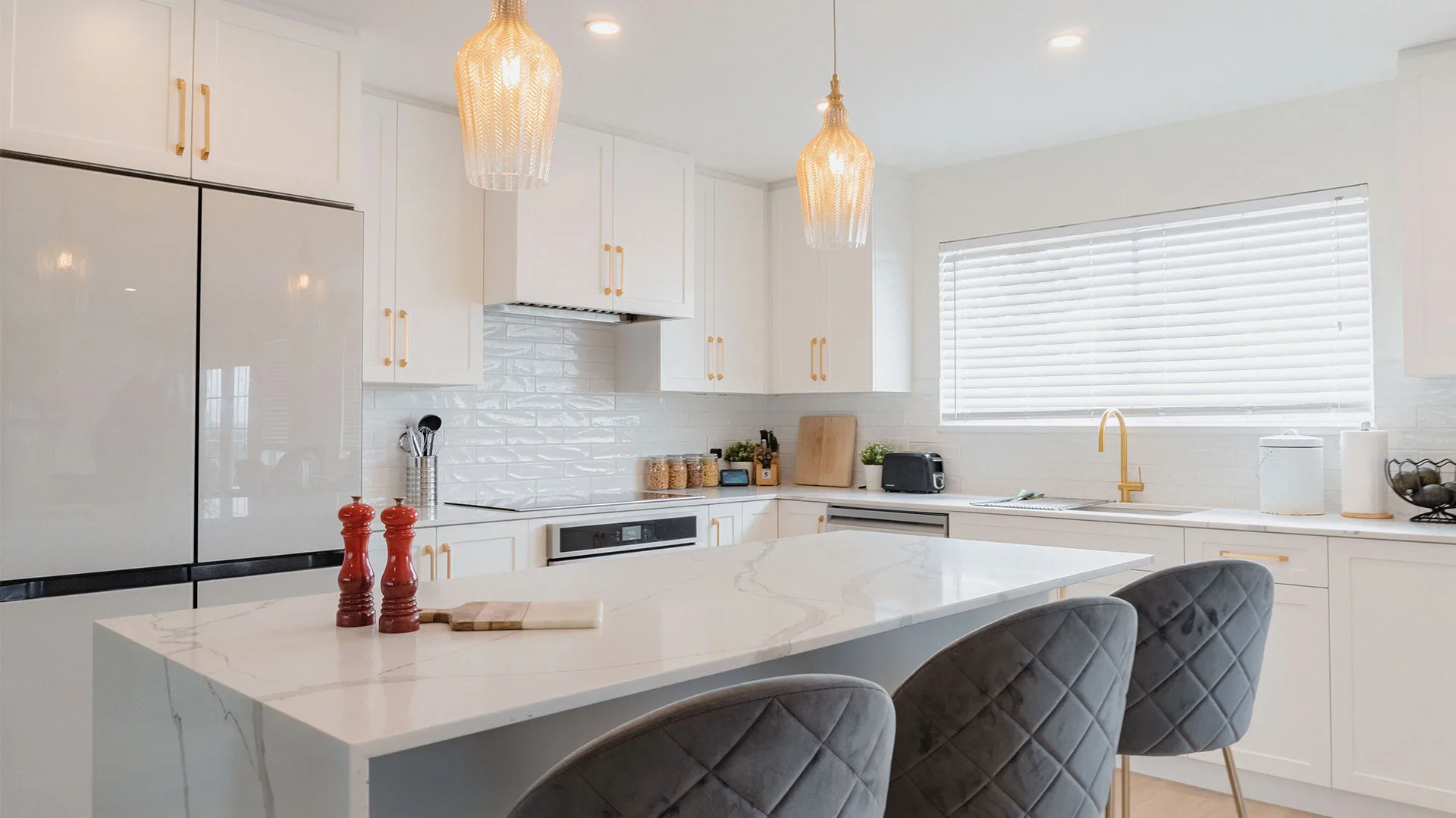
Waterfall edge: The countertop material wraps down the side of the island, creating a continuous surface from the top down to the floor. This is currently one of the most requested design features in Vancouver kitchen renovations. It works best with book-matched stone (where two sequential slabs are opened like a book so the veining mirrors across the seam) or with consistent engineered materials like quartz and porcelain. Waterfall edges add $1,500 to $4,000 or more to the total cost, depending on material, island dimensions, and whether book-matching is involved. Quartz and porcelain are the most practical materials for waterfall edges because their consistency makes the seam between horizontal top and vertical panel less visible.
The trend in Vancouver’s premium renovation market: square/straight eased edges on contemporary kitchens, with waterfall islands as the feature statement. Decorative profiles like ogee are specific to traditional kitchens and shouldn’t be specified outside that context. When in doubt, simpler is better — an eased edge on beautiful quartzite lets the material speak rather than competing with it.
The Countertop Installation Process: What to Expect
Understanding the countertop installation sequence prevents the most common project management mistakes — particularly the timing errors that cause delays and added costs. Countertops are mid-project critical path: too early and there’s nothing to template, too late and the kitchen completion date slips by weeks.
The template visit: Countertops cannot be measured or fabricated until the cabinets are fully installed, levelled, and shimmed. This is non-negotiable. Templating before cabinets are set is a fabrication error waiting to happen — any subsequent adjustment to cabinet height or position changes the countertop dimensions. The template visit involves either a physical cardboard/luan template or a digital laser template (increasingly common with CNC fabricators) that captures every dimension, angle, cutout location, and edge detail. Allow 1 to 2 hours for a standard kitchen template visit.
Lead times by material: After templating, fabrication and delivery timelines vary significantly by material. Laminate: 5 to 7 business days — the fastest option, as it’s largely pre-manufactured and requires minimal custom fabrication. Quartz: 10 to 15 business days (2–3 weeks) — CNC fabrication from a measured template. Natural stone (granite, quartzite, marble): 15 to 20 business days (3–4 weeks) — natural stone requires careful slab selection, allocation, and fabrication with more manual involvement. Porcelain slab: 15 to 20 business days — similar to natural stone fabrication timeline but requiring specialized tooling. Plan your kitchen renovation schedule around these lead times, because countertop delays are one of the most common causes of kitchen completion slippage.
Day of installation: Countertop installation day requires preparation. All cabinets must be clear — nothing stored inside them that could be damaged. The existing countertops (if doing a replacement, not new construction) are removed by the installation crew in most cases, but confirm this in advance. Appliances should be accessible — the cooktop opening, sink base, and dishwasher area need to be clear. If your project includes a new undermount sink, the sink should be on-site for the installers to use for the cutout template. Undermount sinks are adhered to the underside of the countertop with construction adhesive and mechanical clips; this work happens during installation, not separately.
Seams and backsplash timing: Most standard-width kitchen countertops (base cabinets running 8 to 12 feet in a single direction) can be installed in a single slab without seams. Longer runs, L-shaped kitchens, and large islands may require seam planning. Seam placement is a fabrication decision — discuss seam locations with your fabricator before finalizing the order, as placement affects both function (seams near the sink are more water-risk) and aesthetics. Backsplash installation should always happen after countertops are set — the tile installer needs the countertop surface to establish the bottom row of tile, and attempting to tile before the countertop is a coordination error that leads to gaps, improper spacing, or having to redo work.
Plumbing reconnection: If you’re doing a full kitchen renovation with new plumbing fixtures, the plumber reconnects the sink drain and supply lines after the countertop is installed and the sink is set. Budget for a plumber half-day visit on countertop installation day, or the following day if you’re using an undermount sink that needs adhesive cure time (typically 24 hours before full use). Dishwasher reconnection is typically done at the same time.
If you’re planning a Vancouver kitchen renovation and want to understand how countertops fit into the full renovation timeline and budget, our renovation guide covers the complete project process from planning through completion. For a detailed overview of kitchen renovation scope, our home renovation services page covers what a full-service general contractor handles on your behalf. When you’re ready to discuss your specific project, contact us for a consultation.
More Kitchen Renovations Guides

Kitchen Backsplash Installation in Vancouver: Tile Options, Costs, and Design Guide
Galley Kitchen Renovation in Vancouver: Making the Most of a Narrow Kitchen Layout
Kitchen Lighting Renovation in Vancouver: Under-Cabinet, Pendants, and Recessed Lighting Guide
IKEA vs. Custom Cabinets in Vancouver: Which is the Better Choice for Your Kitchen?
Quartz vs. Granite Countertops in Vancouver: Which is Better for Your Kitchen?
Ready to start your renovation?
Frequently Asked Questions About Kitchen Countertops in Vancouver
1. What is the difference between quartz and quartzite?
Quartz is an engineered material — manufactured from crushed quartz aggregate and polymer resin in a factory. Quartzite is a natural metamorphic stone quarried from the earth. They look nothing alike in their most typical expressions: engineered quartz tends toward consistent, controlled appearance, while quartzite has the organic, flowing movement of natural stone. Quartzite requires annual sealing; quartz requires none. Quartzite handles heat better than quartz. Both are hard and scratch-resistant. Quartz is non-porous and immune to etching; quartzite can etch, though much less than marble. If a showroom says “quartzite” but the price is as low as quartz, ask questions — there are products marketed as quartzite that are actually marble, which have very different maintenance requirements.
2. Will marble countertops work in a busy Vancouver family kitchen?
Honestly, for most busy family kitchens, no — not without significant lifestyle adjustment. Marble etches with lemon juice, vinegar, wine, and many common kitchen foods. This etching cannot be sealed away; it’s a chemical reaction that physically changes the stone surface. Marble also stains if unsealed and can be scratched. Some homeowners embrace the patina that develops over time and genuinely love the lived-in look of aged marble. If that’s you — and you go in with clear expectations — marble can work. But most homeowners who want the white-veined stone look are better served by quartzite (particularly Super White or Taj Mahal varieties) or by high-quality engineered quartz in a Calacatta style, both of which deliver similar aesthetics without marble’s maintenance demands.
3. Which countertop material adds the most resale value in Vancouver?
In the current Vancouver market, quartz and natural stone (quartzite or granite) provide the strongest return on countertop investment at resale. Buyers in the $800,000 to $2,000,000+ price range expect stone or premium engineered stone countertops, and these materials read as quality finishes on listing photos and in-person viewings. Quartzite and premium quartz (Cambria, Caesarstone, Silestone) tend to photograph particularly well. Laminate will not contribute to a resale premium regardless of its current quality — buyers in the premium market know what they’re looking at. The highest-performing combination for resale is typically quartz or quartzite perimeter with quartz or quartzite island, a clean eased or bevelled edge, and undermount sinks.
4. How much does a waterfall edge cost to add to an island?
A waterfall edge typically adds $1,500 to $4,000 to the total countertop cost, depending on material, island length, and whether you’re book-matching the stone. For quartz and porcelain slab (consistent materials), waterfall panels are at the lower end of that range because the seam line between top and panel is less visible. For natural stone with pronounced veining — particularly book-matched quartzite or marble — the waterfall panel requires precise layout of the book-match, adding fabrication complexity and cost. A single waterfall panel (one end of the island) is less expensive than a full waterfall (both ends). The additional material cost is typically one slab panel; the premium includes material, additional fabrication, and more complex installation.
5. Undermount sink vs. drop-in (overmount) sink: which is better?
Undermount sinks are strongly preferred for any natural stone or engineered stone countertop. With an undermount, the sink is mounted below the countertop surface, and the counter edge overhangs the sink opening — this means crumbs and water wipe directly from the counter into the sink rather than catching on a rim. Undermount sinks also look cleaner and more integrated with the countertop. Drop-in (overmount) sinks sit on top of the counter with a visible rim — the rim collects grime and is harder to clean around. The practical limitation of undermount sinks is that they require a solid countertop material that can support the weight; they’re not appropriate for laminate countertops. For a kitchen renovation with any stone or quartz countertop, always specify undermount.
6. Does quartz need to be sealed?
No. This is one of quartz’s primary practical advantages over natural stone. Engineered quartz is non-porous — the polymer resin binders fill all voids between the quartz particles, leaving no pathway for liquids, oils, or bacteria to penetrate. Sealing is not necessary and not recommended by any major quartz manufacturer. A quartz surface from day one of installation is in its optimal sealed state and remains so indefinitely under normal use. This distinguishes quartz from granite (seal every 2–3 years), quartzite (seal annually), and marble (seal every 6–12 months). If a showroom or contractor tells you quartz needs sealing, that’s incorrect information.
7. How do I get an accurate countertop quote in Vancouver?
For a meaningful quote, you need three things: approximate square footage of your countertop area (measure the cabinet top length × depth for each run, including island, and sum them), your preferred material (or a shortlist of two or three), and any known special features (waterfall edge, cooktop cutout, number of sink cutouts). With those inputs, a fabricator can give you a reliable range. Most reputable fabricators in Metro Vancouver will provide a written quote after a showroom visit — some will also quote from measurements and photos without a site visit for standard kitchens. Get at least three quotes from different fabricators: price variation of 25 to 30 percent for identical material and scope is common. Note that quotes from kitchen designers at cabinet showrooms are typically sourced through their preferred fabricator and may carry a markup over going directly to the fabricator.
8. What are typical countertop lead times in Vancouver?
After the template visit (which can happen only after cabinets are fully installed), expect: laminate 5–7 business days; quartz 10–15 business days; granite 15–20 business days; quartzite 15–20 business days; marble 15–20 business days; porcelain slab 15–20 business days. These are standard lead times during normal business conditions — during peak renovation season (April–June and September–October) fabricators get busy and lead times can stretch by one to two weeks. If your project has a firm move-in or completion deadline, factor lead time into your scheduling from the beginning of the project and confirm timelines with your fabricator when you place the order, not when you’re ready to template.
9. Should my island countertop match the perimeter countertop?
Not necessarily, and in many cases, a deliberately different island countertop creates a more sophisticated result. Mixed-material combinations that work well in Vancouver kitchens: quartz perimeter with a quartzite island (complementary stone-look with the island as a feature piece), stone perimeter with a butcher block island (warm and cool contrast, very popular in transitional and craftsman kitchens), or matching material with a different colour or veining pattern on the island (same product family but a bolder, more dramatic slab for the island). The constraint is coherence — the two materials should relate to each other in colour temperature and visual weight. Avoid combinations that clash: cool white quartz perimeter with a warm red-toned granite island, for example, typically doesn’t work. When in doubt, bring samples of both to the fabricator showroom and evaluate them side by side under similar lighting.
10. Porcelain slab vs. quartz: which should I choose?
Both are excellent non-porous engineered materials with low maintenance requirements. The key differences: porcelain handles heat with no limitation (quartz cannot handle heat above 150°C and requires trivets), porcelain is UV-stable for outdoor use (quartz fades outdoors), porcelain is harder and more scratch-resistant than quartz, and porcelain has essentially unlimited resistance to all stains and chemicals. Quartz is more flexible in terms of appearance consistency — engineered quartz slabs are more uniform and predictable, making them easier to match across seams. Quartz is less brittle than porcelain and more forgiving of edge impacts. Porcelain fabrication requires specialized tooling and experienced fabricators. For indoor kitchens with normal use, either is an excellent choice; porcelain’s advantages over quartz matter most in outdoor kitchens, high-heat cooking environments, and applications where edge chipping risk is low.
11. What countertop materials are outdated in the Vancouver market?
Tile countertops — ceramic or porcelain tile with grout lines — have been out of favour in Vancouver for over a decade. The grout lines are difficult to keep clean and the surface is impractical for kitchen use. Solid surface materials like Corian had their moment in the 1990s and are no longer relevant in the Vancouver renovation market. The beige and brown granites that dominated renovations from roughly 1995 to 2010 (Santa Cecilia, Venetian Gold, Uba Tuba in their most common expressions) read as dated to current buyers. The issue isn’t that granite is outdated — it’s that those specific colours and patterns are strongly associated with a renovation era. A dramatic, unusual granite can still be contemporary; it’s the specific popular varieties from that period that have aged poorly.
12. Can I put hot pots directly on my countertop?
This depends entirely on the material. Quartz: no — polymer resin can discolour or crack from sustained heat over 150°C. Always use trivets. Laminate: no — will scorch and permanently damage the surface. Granite: yes — natural stone handles heat well, though thermal shock from extreme temperature differentials can theoretically cause cracking in rare cases. Quartzite: yes — similar to granite, handles heat without concern. Marble: yes — though not relevant, as you shouldn’t be putting hot pots on marble for other reasons. Porcelain slab: yes — outstanding heat resistance, no limitations. Butcher block: no — will scorch. Bottom line: trivets are a good habit regardless of material, cost nothing, and eliminate the risk entirely. If you never want to think about trivets, granite, quartzite, or porcelain slab are your best options.
13. How do I care for and clean quartz countertops?
Daily cleaning: warm water and mild dish soap with a soft cloth. For dried food, a non-scratch scrubbing pad. Avoid harsh abrasives (steel wool, scouring powder), bleach, and high-pH cleaners — these can dull the surface over time. For stubborn stains, a small amount of isopropyl alcohol on a cloth is safe and effective. Never use oven cleaner or paint stripper on quartz — these can cause irreversible damage. Avoid prolonged exposure to standing water at seams, though quartz itself is non-porous. No sealing, no oiling, no special products required. Quartz is genuinely one of the lowest-maintenance countertop materials available, which is a major part of its appeal.
14. What is the best countertop material for a Vancouver rental suite?
For rental suites and investment properties in Metro Vancouver, the best balance of cost, durability, and tenant appeal is typically quality laminate (HPL) or entry-level quartz. Modern HPL laminate (Formica 180fx, Wilsonart HD) is durable, easy to clean, and visually acceptable for suite applications at $60–$120/sq ft installed. Entry-level quartz from domestic or Korean manufacturers (HanStone, etc.) costs $150–$200/sq ft installed and looks more premium — this is the right choice for suites targeting higher-end rental price points ($2,500+ per month in Vancouver). Natural stone in a rental suite is an over-investment that returns little in additional rent. The goal for rental suite countertops is durability, easy tenant cleaning, and a clean appearance that photographs well for rental listings.
15. How do I choose between all these countertop options?
Start with two questions: what is your lifestyle (how busy is the kitchen, how much maintenance are you willing to do, do you have children?), and what is the primary purpose of the renovation (personal enjoyment vs. resale value vs. rental investment)? From there: busy family, no maintenance → quartz. Want natural stone character, willing to seal annually → quartzite or granite. Outdoor kitchen or high-heat cooking → porcelain slab or granite. Tight budget, rental or suite → laminate or entry-level quartz. Craftsman or farmhouse aesthetic → butcher block island with stone perimeter. Maximum visual drama, willing to maintain → quartzite or marble (marble only if you understand the etching reality). Future resale focus in premium market → quartz or quartzite. For a project-specific recommendation based on your kitchen layout, design direction, and budget, we’re happy to walk you through the options in person — reach out to start the conversation.
Get a Free Renovation Quote
Metro Vancouver’s trusted general contractors. Free consultations across Vancouver, Burnaby, Richmond, North Shore & beyond.
Get Your Free Quote →Ready to start your project? Vancouver General Contractors (VGC) provides free, fixed-price quotes for homeowners across Metro Vancouver. Learn more about our kitchen renovation Vancouver services or request a free quote today.
VGC serves Vancouver and surrounding areas. View all renovation services in Vancouver →

Comments are closed