




Kitchen Flooring Vancouver: Best Options, Costs & What Works in BC (2026)
Kitchen flooring is one of the highest-impact decisions in any renovation — it sets the tone for the entire space, takes more abuse than almost any other surface in your home, and in Vancouver’s open-concept floor plans, it often flows directly into the living and dining areas. Get it wrong and you’re looking at a premature replacement. Get it right and it adds meaningful value to your home at resale.
This guide covers everything Vancouver homeowners need to know in 2026: the best flooring materials for kitchens, all-in installed costs, what works in BC’s damp climate, how to handle open-concept continuity, subfloor preparation, and what local buyers actually expect at different price points. Whether you’re renovating a Burnaby rancher, a Kitsilano character home, or a North Shore family house, the information here is grounded in what we see on the job every week.
Kitchen Flooring in Vancouver Homes: The Local Context
Vancouver kitchens face a specific set of conditions that don’t apply the same way in drier climates. Wet boots and umbrellas tracking in moisture from October through April, humidity swings between our mild winters and warm summers, and the near-universal open-concept layout in homes built or renovated since 2005 all shape what flooring actually performs well here.
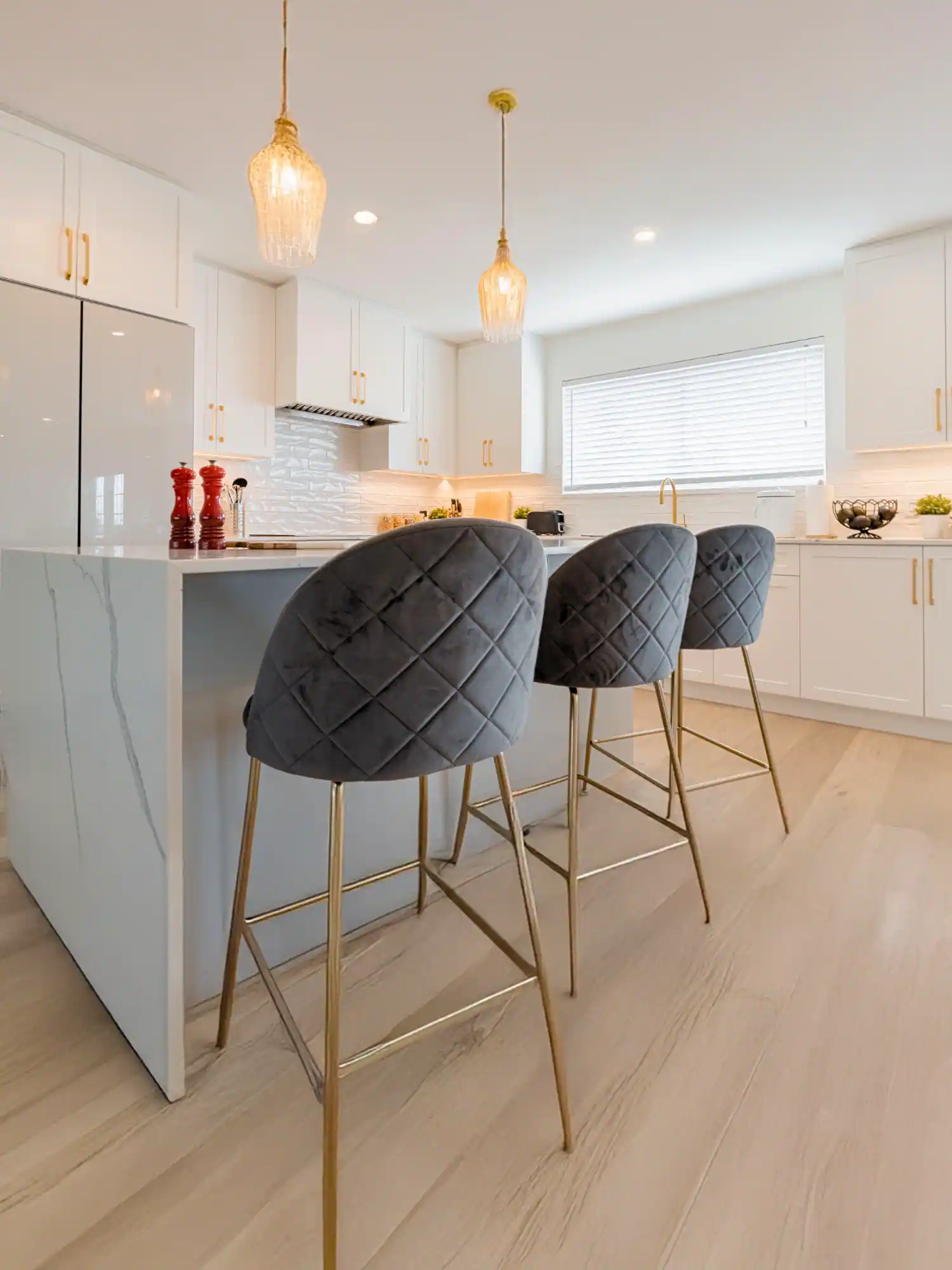
At the entry level ($3,000–$5,000 for a 200 sq ft kitchen), laminate and budget LVP are common. Mid-range buyers ($5,500–$9,000) gravitate toward quality LVP or entry-level engineered hardwood
Vancouver General Contractors
The moisture reality is real but often overstated. Vancouver doesn’t have the freeze-thaw cycling of Eastern Canada, and most kitchens are on above-grade wood subfloors — not concrete slabs. What does matter is the everyday spill environment: cooking splashes, dishwasher condensation, a dog’s water bowl, and the wet groceries that get dropped on the floor in a hurry. Your kitchen floor needs to handle surface moisture reliably without swelling, warping, or developing mould under the seams.
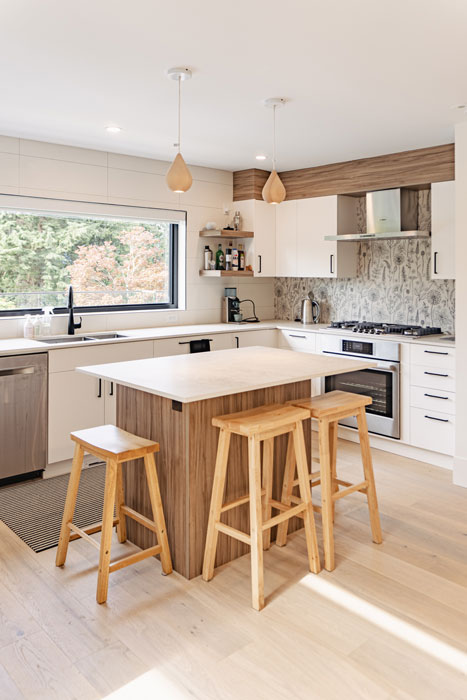
Open-concept design is the dominant format in Metro Vancouver renovations. When your kitchen, dining, and living areas share one continuous space — as they do in the majority of the homes we work in — flooring continuity across all three zones matters enormously for flow and perceived square footage. Installing different materials creates visual interruptions that make the space feel smaller and often look dated within a few years.
At the entry level ($3,000–$5,000 for a 200 sq ft kitchen), laminate and budget LVP are common. Mid-range buyers ($5,500–$9,000) gravitate toward quality LVP or entry-level engineered hardwood. Upper-end and luxury renovations ($10,000–$12,000+) typically use premium engineered hardwood, large-format porcelain tile, or a combination of tile in the wet zone with hardwood continuing into the living space. Vancouver’s West Side and North Shore resale market rewards the latter investment clearly at appraisal time.
If you’re planning a broader kitchen project, our Vancouver renovation guide walks through the full scope and sequencing of a kitchen renovation from structural work through finishes.
Kitchen Flooring Costs in Vancouver: Full 2026 Breakdown
Costs below reflect Metro Vancouver pricing in early 2026, including materials and professional installation on a standard above-grade wood subfloor in good condition. These are all-in installed figures — supply and labour combined. Subfloor preparation, old floor removal, and heated floor systems are separate line items covered later in this guide.
| Flooring Type | Material Cost (per sq ft) | Installation (per sq ft) | All-In Installed | 200 sq ft Kitchen Total |
|---|---|---|---|---|
| Laminate (AC4/AC5) | $3 – $6 | $4 – $7 | $7 – $13 | $1,400 – $2,600 |
| Luxury Vinyl Plank (LVP/LVT) | $4 – $9 | $4 – $7 | $8 – $16 | $1,600 – $3,200 |
| Engineered Hardwood | $8 – $18 | $5 – $9 | $13 – $27 | $2,600 – $5,400 |
| Solid Hardwood | $10 – $22 | $6 – $10 | $16 – $32 | $3,200 – $6,400 |
| Porcelain Tile | $5 – $18 | $8 – $16 | $13 – $34 | $2,600 – $6,800 |
Important notes on these figures: The wide ranges reflect real variation in product quality and project complexity — not padding. A 12-mil wear layer LVP at $4/sq ft performs very differently from a 28-mil commercial-grade product at $9/sq ft. Porcelain tile installation cost varies dramatically based on tile size (large format 24″x24″ costs more to set than 12″x12″), substrate condition, and whether a heated mat is being installed underneath.
For a typical Vancouver open-concept renovation covering kitchen plus living and dining (roughly 550 sq ft total), budget as follows:
| Scenario | Material | 550 sq ft Estimated Total |
|---|---|---|
| Budget | AC4 laminate or entry LVP | $4,000 – $7,000 |
| Mid-range | Quality LVP (20-mil wear layer) | $6,000 – $9,000 |
| Upper-mid | Engineered hardwood | $8,000 – $14,000 |
| Luxury | Premium engineered or tile hybrid | $12,000 – $20,000+ |
These ranges do not include subfloor preparation, which is the single biggest variable in kitchen flooring cost. See the subfloor section below for typical add-on costs.
Luxury Vinyl Plank (LVP): The Most Popular Choice in Metro Vancouver
Luxury vinyl plank has dominated Metro Vancouver kitchen renovations from roughly 2020 through 2026, and for good reason. It is genuinely 100% waterproof throughout its entire thickness — not just water-resistant at the surface — which means a flooded dishwasher or a standing puddle near the sink won’t damage it. It installs over minor subfloor imperfections that would telegraph through thinner materials. It comes in formats that convincingly mimic hardwood. And it costs a fraction of engineered hardwood while outlasting laminate in wet environments by a significant margin.
The key spec that separates entry-level from quality LVP is the wear layer thickness:
- 12-mil wear layer: Adequate for low-traffic residential use (bedrooms, rental suites). Scratches more easily, shorter lifespan. Typically $4–$5/sq ft material.
- 20-mil wear layer: The residential workhorse. Appropriate for kitchens with normal family traffic, pets, and light commercial use. Our standard recommendation. Typically $5–$7/sq ft material.
- 28-mil wear layer: Heavy-duty commercial-grade. Effectively scratch-proof under normal residential use. Appropriate for high-traffic family kitchens or rental properties with back-to-back tenants. Typically $7–$9/sq ft material.
Total thickness also matters — a 6mm plank feels noticeably hollow and cheap underfoot, while an 8mm or 12mm plank with attached underlay feels substantially more solid. For kitchens where you stand for extended periods, the added thickness reduces fatigue.
Brands we install regularly in Vancouver:
- COREtec Plus (USFloors): Cork underlayment attached, excellent acoustic dampening, available in wide plank formats. Premium tier.
- LifeProof (Home Depot): Consistent quality, good warranty, widely available, easy to source replacement planks. Mid-range.
- Shaw Floorté: Commercial-grade wear layers available in residential formats. Good for rental or high-traffic.
- Karndean: Higher-end glue-down format, excellent dimensional stability, popular in custom renovations.
Floating vs. glue-down installation: Most residential LVP in Vancouver is installed floating — the planks click together and rest on the subfloor without adhesive. This makes future replacement straightforward and accommodates minor subfloor irregularities. Glue-down is used in commercial applications or in rooms with in-slab radiant heat, where thermal cycling could cause floating planks to buckle. For standard Vancouver kitchen-over-wood-subfloor situations, floating click-lock is the right choice.
For open-concept homes, LVP’s biggest advantage is seamless continuity. You can run the same plank from the kitchen, through the dining area, and across the living room without any transition strips, giving the entire floor plan a clean, unified look. This is a significant aesthetic benefit that engineered hardwood also offers but laminate and tile cannot match as cleanly.
Engineered Hardwood: The Premium Kitchen Flooring Choice
Engineered hardwood is the material that most Vancouver homeowners who can stretch the budget ultimately choose — particularly on the West Side, North Shore, and in higher-end Burnaby and Coquitlam renovations. It delivers the warmth and character of real wood, can be refinished when it eventually shows wear, and holds its value at resale in a way that LVP does not.
The construction of engineered hardwood is the key to its kitchen suitability. A real hardwood veneer — typically 3mm to 6mm thick — is bonded to a plywood core of five to nine cross-directional layers. This cross-ply construction makes it dimensionally stable in ways solid hardwood is not. When Vancouver humidity swings between a dry February (35–40% RH) and a humid August (65–75% RH), engineered hardwood expands and contracts far less than solid wood. That stability is what allows it to be used in kitchens, whereas solid hardwood installed across a full kitchen will frequently develop gaps, cupping, or crowning within a few years.
Hardwood layer thickness matters for longevity:
- 2mm veneer: Cannot be refinished. This is essentially a wood-look product with limited lifespan improvement over LVP.
- 3mm veneer: Can be lightly refinished once, carefully. Adequate for most applications.
- 4–6mm veneer: Can be refinished 2–3 times. The tier that justifies “engineered hardwood” as a distinct category. Look for this in products priced $10/sq ft and above.
Species and finish choices in Vancouver 2025–2026: White oak is the clear favourite — its open grain takes wire-brushed and matte finishes beautifully, and the pale, warm tone works with the grey-and-white colour palettes that have dominated Vancouver interior design for the past several years. Walnut remains popular in luxury applications. Maple has lost market share due to its tendency to show scratches under satin finishes. Hickory offers a rustic character that suits certain aesthetic directions.
Finish matters enormously: A matte or satin UV-cured factory finish hides scratches far better than a high-gloss finish. Wire-brushed textures add another layer of scratch concealment. If you’re installing engineered hardwood in a kitchen with dogs, children, or both, choose a wire-brushed white oak in a matte finish and your floor will look presentable for years.
At $13–$27 all-in installed, engineered hardwood is roughly double the cost of quality LVP. The premium is justified in homes where you are staying long-term, where the resale market will reward it, and where the aesthetic of real wood matters. For rental properties, secondary suites, or homes where you expect to sell within five years, the LVP value proposition is harder to beat.
One practical note: engineered hardwood is not fully waterproof. It will tolerate a spill that gets wiped up promptly, but standing water — a dishwasher leak, a pet bowl left to overflow — will eventually damage it if left for more than 20–30 minutes. In kitchens, we recommend running a continuous bead of silicone at the toe-kick transition and ensuring the dishwasher has a water sensor shutoff. These are not extraordinary measures; they are standard practice in quality kitchen installations.
Porcelain Tile: The Right Choice for Wet Zones
Porcelain tile is genuinely waterproof, unaffected by temperature extremes, resistant to scratches, and will last indefinitely if the installation is done correctly. It is also cold underfoot in the morning, hard on legs during long cooking sessions, and unforgiving to dropped glassware. Whether it’s the right choice for your kitchen depends on which of those factors matters most to you.
In Vancouver kitchen renovations, we typically see porcelain tile used in three scenarios: as the sole flooring material in kitchens with heated floor systems (which address the cold and fatigue issues), in combination with hardwood where tile covers the wet zone around the sink and dishwasher while hardwood continues through the dining and living areas, or in renovation projects where the existing tile substrate is in good condition and the homeowner wants to stick with tile for maintenance simplicity.
Critical spec: slip resistance. Kitchens are wet environments and kitchen floors must meet a minimum R10 coefficient of friction rating for safety. Many beautiful large-format tiles that would look stunning in a bathroom are too slick for kitchen use. Always verify the COF (coefficient of friction) rating before ordering kitchen tile — your installer should be flagging this automatically, but many homeowners purchase tile independently and discover the issue after delivery. Matte and lightly textured finishes are the safest choices for kitchen floors.
Large format tile considerations: The trend toward 24″x24″ and 24″x48″ tiles in kitchen floors has been strong in Metro Vancouver for several years. Large format minimizes grout lines, which means less grout maintenance and a cleaner visual. However, large format tile requires a very flat substrate — within 3mm over a 3-metre span as a general rule — which means subfloor preparation costs are typically higher. Rectified tiles (precision-cut to exact dimensions) allow tighter grout joints (1–2mm) that look cleaner than non-rectified tile with standard 3mm joints.
Wood-look porcelain: A significant percentage of Vancouver kitchen tile projects now use wood-look porcelain — tiles printed with realistic wood grain patterns, typically in 6″x36″ or 8″x48″ plank formats. These offer the visual warmth of hardwood with the durability and water resistance of tile. They are particularly effective in bathrooms adjacent to kitchen spaces in open-plan layouts, where you want visual continuity but true waterproofing in the bathroom portion. The grout lines remain visible (unlike real wood), which some homeowners prefer and others find unconvincing on close inspection.
Grout maintenance reality: Grout is porous and stains over time, particularly in kitchens where cooking oils and food colouring compounds are present. Epoxy grout is highly stain-resistant but more difficult to work with and significantly more expensive. Porcelain-cement grout with a quality sealer applied annually is more common and performs adequately. If you choose porcelain tile for your kitchen floor, budget 30 minutes per year for grout resealing — it is genuinely maintenance-light when done consistently, and a significant reclamation project when it hasn’t been done for five years.
All-in installed cost for porcelain tile ranges from $13 to $34/sq ft in Metro Vancouver, with the wide range driven primarily by tile cost (basic 12″x12″ vs. premium 24″x48″ large format) and substrate preparation requirements. Add $1,200–$2,400 for a heated floor mat system in a 200 sq ft kitchen.
Solid Hardwood: Premium Aesthetic, Significant Caveats
Solid hardwood is the most traditional and aesthetically prestigious flooring material available — and in kitchen applications, it is also the most demanding to install correctly and the most likely to cause problems if it isn’t. We want to be direct with clients about this: we do not recommend solid hardwood as the primary flooring material across a full kitchen in most Vancouver homes. We do install it, and we install it well, but we want homeowners to understand the tradeoffs before committing.
The core issue is moisture movement. Solid hardwood is a hygroscopic material — it absorbs and releases moisture from the surrounding air and expands or contracts in response to relative humidity changes. In kitchens, where humidity levels spike during cooking and dishwashing and where the occasional spill is inevitable, this movement creates long-term challenges. Wide plank solid hardwood (5″ and above) is particularly susceptible because wider boards have more cross-grain surface area to move across. Solid hardwood also cannot be installed over in-slab radiant heat, which eliminates it from consideration in a growing number of Vancouver slab-on-grade homes and many condo renovations.
Where solid hardwood makes practical sense in kitchen contexts is at the island — particularly a large island that functions as a central feature of an open-concept space, where you want the prestige of solid wood but it’s not directly in the sink and dishwasher wet zone. Some designers also use solid hardwood in the kitchen area of an open-concept space when the kitchen is truly well-ventilated, has a consistently controlled indoor humidity environment, and the cabinetry installation includes proper expansion gaps.
Acclimation is mandatory and non-negotiable. Solid hardwood must acclimate to the interior environment for a minimum of one to two weeks before installation. Boxes should be opened and stacked with spacers in the room where they will be installed, with the HVAC running at normal operating conditions. Skipping acclimation — or rushing it to meet a schedule — is one of the most common causes of solid hardwood installation failures we are called to remediate.
At $16–$32 all-in installed in Metro Vancouver, solid hardwood is at the top of the cost range. The premium over engineered hardwood reflects both material cost (solid boards cost more per linear foot than engineered plank) and installation cost (solid hardwood is typically nail-or-staple-down, requiring more labour than floating LVP). For the full kitchen application, the money is better spent on premium engineered hardwood. The refinishing longevity argument — solid hardwood can be sanded and refinished many more times than engineered — is valid over a 50-year horizon but rarely the deciding factor in practice.
Laminate: Budget-Conscious but Know the Limitations
Laminate flooring has improved enormously since the thin, hollow-sounding products of the early 2000s. Modern AC4 and AC5 rated laminate — the ratings that indicate kitchen and commercial durability respectively — looks good, installs quickly, and holds up reasonably well under normal residential kitchen use. It is also significantly less expensive than LVP and offers a wide variety of realistic wood and stone visual options.
The limitation that every laminate buyer needs to understand is this: laminate is not waterproof. The decorative layer and wear layer are water-resistant, but the HDF (high-density fibreboard) core is not. If water infiltrates the seams between planks — from a repeated minor spill that isn’t wiped promptly, from a dishwasher leak, or from condensation under a refrigerator — the core will swell. Once the core swells, the plank is permanently damaged. It cannot be dried and restored. The affected planks must be replaced, and if the damage has spread beneath adjacent planks, the entire floor may need to come up.
For kitchens, this means laminate is best suited to lower-risk environments: secondary suites in strata buildings where plumbing is well-maintained, budget renovations in investment properties with careful tenants, or kitchens where the homeowner is extremely consistent about wiping spills immediately. It is not the right material for homes with dogs, young children, or any history of appliance leaks.
Wear ratings explained:
- AC3: Residential moderate traffic. Fine for bedrooms and light-use living spaces. Not adequate for kitchens.
- AC4: Residential heavy traffic / light commercial. Appropriate for kitchens. Look for this minimum rating in any laminate you’re considering for kitchen use.
- AC5: Heavy commercial. The most durable laminate option. Overkill for most residential kitchens but the right choice for high-traffic rental units.
At $7–$13 all-in installed, laminate is the most affordable professional kitchen flooring option in Metro Vancouver. If budget is the primary constraint, quality AC4 laminate installed by a professional (proper underlayment, correct expansion gaps, careful seam management) will give you a functional, attractive kitchen floor for years provided the moisture limitations are respected.
Open Concept Flooring Continuity: The Vancouver Standard
The single most common mistake we see in kitchen flooring decisions is treating the kitchen as an isolated room when it is functionally part of an open-concept great room. If your kitchen flows directly into a dining and living area without walls separating them, you are not buying kitchen flooring — you are buying flooring for your main living space, and the kitchen happens to be one zone within it.
Transition strips between different flooring materials — the metal or wood threshold pieces that bridge a change from tile in the kitchen to hardwood in the living room, for example — are a visual and functional compromise that was common in homes from the 1990s and early 2000s. In contemporary Vancouver renovations, they look dated and interrupt the visual flow of an open-concept space. They also create a minor trip hazard and a maintenance problem (debris accumulates in the channel).
The right approach in an open-concept space is continuous flooring from wall to wall across all three zones. This means your flooring decision needs to be evaluated against the full square footage — not just the kitchen portion — and the material needs to work aesthetically and functionally in all three contexts.
What works for full open-concept installation:
- LVP: Excellent choice for full open-concept. 100% waterproof throughout. Available in wide plank formats that look good at scale. Easy to source matching planks years later if replacement is needed.
- Engineered hardwood: The premium choice for open-concept continuity. The warmth and character of real wood across the entire living space is a significant aesthetic upgrade over any other option.
- Porcelain tile: Technically viable but uncommon across full open-concept spaces due to hardness and cold feel in the living and dining zones. More commonly used as a hybrid — tile in kitchen, hardwood in living/dining with a designed transition.
- Laminate: Viable for budget open-concept if the entire living space is laminate, though the moisture limitations become more significant when the same material runs through the kitchen.
Cost impact of open-concept continuity: A typical Vancouver open-concept main floor includes roughly 200 sq ft of kitchen, 150 sq ft of dining area, and 200 sq ft of living room — approximately 550 sq ft total. At mid-range LVP pricing of $11/sq ft all-in, that is $6,050 for the floor. At mid-range engineered hardwood of $18/sq ft, that is $9,900. The open-concept continuity premium over “kitchen only” is real but the per-square-foot cost is the same — you are simply buying more floor.
When planning a flooring project that includes open-concept continuity, factor in 10–15% overage for cuts, waste, and pattern matching — and order all material from the same batch (dye lot) to ensure consistent colour across the entire floor. This is particularly important with wood-look products, where slight colour variations between batches can be visible under certain lighting conditions.
Subfloor Preparation: The Hidden Cost Driver
The most consistent cause of cost overruns in kitchen flooring projects is subfloor preparation — work that has to be done before the new floor goes down, which cannot be fully assessed until the old flooring is removed. We build contingency into our estimates for subfloor work, but every contractor who tells you they can give you a fixed-price flooring estimate before seeing what’s under your existing floor is either very optimistic or not accounting for the full scope.
Common subfloor issues in Vancouver homes and their costs:
| Subfloor Issue | Typical Add-On Cost | Notes |
|---|---|---|
| Old vinyl tile / sheet vinyl removal | $1.50 – $3.00/sq ft | Pre-1990 vinyl may contain asbestos — testing required ($300–$500) |
| Old ceramic/porcelain tile removal | $3.00 – $6.00/sq ft | Tile set in mortar bed adds cost and subfloor height |
| Self-levelling compound (minor) | $500 – $1,000 | For humps and dips up to 10mm over 3m span |
| Self-levelling compound (major) | $1,000 – $1,500 | Larger areas or significant grade changes |
| Plywood overlay (tile over wood subfloor) | $800 – $1,500 | Required to stiffen subfloor and prevent tile cracking |
| Joist repair / sister joists | $500 – $2,500 | Soft spots from old leaks — common in older Vancouver homes |
| Subfloor replacement (partial) | $800 – $2,000 | Where rot or mould damage is present |
Asbestos in old vinyl: This is a Vancouver-specific issue worth addressing directly. Homes built before approximately 1990 have a meaningful probability of containing vinyl floor tiles or sheet vinyl with asbestos in the backing or adhesive. We cannot identify asbestos visually — it requires lab testing. If you have resilient flooring from that era, we will require testing before proceeding with any removal. Abatement of confirmed asbestos-containing vinyl adds $1,500–$4,000+ to the project cost but is not optional from a legal or health standpoint. Do not let any contractor tell you “it’s probably fine” and proceed without testing.
What to check before ordering flooring:
- Age and composition of existing flooring (especially pre-1990 vinyl)
- Moisture testing on concrete subfloors (calcium chloride test or relative humidity probe) — concrete slabs in below-grade areas of Vancouver homes frequently exceed the moisture limits for LVP and hardwood adhesive
- Subfloor flatness: use a long straightedge to check for high spots and dips — LVP and laminate typically require within 3/16″ over 10 feet, tile requires within 1/8″ over 10 feet
- Soft spots that indicate rot or structural issues
- Total floor height implications: adding new flooring raises your finished floor elevation, which can affect door clearances, appliance trim heights, and transition to adjacent rooms
The best approach to subfloor uncertainty is to build it into your budget as a contingency rather than discovering it mid-project. We recommend adding $800–$1,500 as a subfloor contingency line on any kitchen flooring estimate, and being pleasantly surprised if it isn’t needed rather than scrambling to fund unexpected work after demolition has started.
For a comprehensive look at renovation project sequencing and how flooring fits into a full kitchen project, visit our home renovation services page.
Pattern, Layout Direction, and Installation Details
The direction and pattern you install your flooring has a measurable impact on how large and well-proportioned your kitchen looks — and how much material you will use. These decisions should be made before material is ordered, not after it arrives on the job site.
Plank direction: The standard recommendation is to run flooring planks parallel to the longest wall in the room, or parallel to the primary sight line as you enter the space. This elongates the visual impression of the room. In open-concept spaces, run planks parallel to the longest dimension of the combined space rather than making a decision based on the kitchen alone.
Running planks perpendicular to the longest wall (across the short dimension of the room) will make the room feel shorter and is generally avoided unless there is a specific design intent behind it. Running planks parallel to natural light sources (windows) is a secondary consideration — parallel installation minimizes the visual emphasis on the seam lines.
Diagonal installation: Running planks at 45° to the walls creates a visual widening effect and can make awkward room proportions feel more balanced. It also looks excellent in herringbone and chevron patterns when budget allows. The tradeoff is material waste (typically 15–20% more material required due to angle cuts at walls) and additional labour cost (roughly 15–20% more installation time). For a 550 sq ft open-concept space at mid-range engineered hardwood pricing, that waste can add $500–$1,000 to material cost alone.
Herringbone and chevron: These patterns have been popular in high-end Vancouver renovations since approximately 2019 and remain relevant in 2026. Herringbone (rectangular planks set at 90° to each other in a V pattern) requires specific plank dimensions for the pattern to work correctly, more precise layout, and significantly more installation time. Expect to add 20–30% to both material and labour cost over a straight-lay installation. Chevron (planks cut at angles to create a continuous V) is even more demanding in terms of both material precision and labour.
Tile layout: For large-format kitchen tile, a centred layout — starting from the centre of the room and working toward the walls — is standard practice. This ensures that tile cuts at the perimeter are even on opposite walls, avoiding the unattractive result of a small sliver tile on one side and a full tile on the other. Diagonal tile installation in kitchens is less common than it was in the 2000s but remains appropriate in certain traditional or transitional design styles.
Grout joint width: For large format rectified tile (24″x24″+), a 1/16″ to 1/8″ grout joint is appropriate and creates a near-seamless look. For standard non-rectified tile, 3/16″ to 1/4″ is typical. Wider grout joints on large format tile — a mistake we occasionally see on DIY and some contractor installations — look amateurish and draw attention to dimensional variations in the tile.
Heated Floors Under Kitchen Tile: What You Need to Know
Electric in-floor heating under kitchen tile is one of the most consistently appreciated upgrades in Vancouver kitchen renovations. It addresses the two biggest complaints about tile floors — cold underfoot in the morning and fatigue from standing on hard surfaces during cooking — and the operating cost is lower than most homeowners expect.
What heated floors work under:
- Porcelain and ceramic tile: Ideal. Tile conducts heat efficiently and retains it. The most effective heated floor combination available.
- Stone tile: Also excellent, with even better thermal mass than porcelain.
- LVP and laminate: Some products are marketed as compatible with in-floor heating, but the maximum surface temperature limit (typically 27°C) severely restricts the practical warmth achievable. The heated floor experience under vinyl is noticeably inferior to tile. We do not recommend heated floor systems primarily as a motivation to choose LVP.
- Hardwood (solid or engineered): Generally not compatible. The heating element cycles cause repeated expansion/contraction that damages wood over time. Specialty engineered hardwood products rated for radiant heat exist but are expensive and require precise temperature controls.
System specs for a 200 sq ft kitchen:
- Electric mat heating: 12 watts per square foot is standard. 200 sq ft = 2,400W (2.4kW) load.
- A dedicated 20-amp, 240-volt circuit is required. If your panel does not have capacity, this adds $500–$1,200 for the electrical circuit, on top of the heating system cost.
- The mat itself costs $800–$1,500 for 200 sq ft, depending on brand and features (programmable thermostat, wi-fi control, anti-freeze mode).
- Installation of the mat within the tile setting process adds $400–$900 in labour.
- Total added cost for heated floors in a 200 sq ft kitchen: $1,200–$2,400 (assuming circuit capacity exists; add $500–$1,200 if not).
Operating cost: Running a 2.4kW mat for 6 hours daily at BC Hydro’s Step 1 rate of approximately $0.103/kWh (2026 rates) costs roughly $0.62/day, or $18/month. This is genuinely inexpensive for the comfort delivered. Running it 8 hours/day raises that to approximately $24/month. Most homeowners with kitchen heated floors report that they use it October through April and turn it off in the summer months.
Permit requirement: In Metro Vancouver municipalities, a building permit is not required for the heated mat itself (it is typically considered a minor electrical installation), but the dedicated electrical circuit requires an electrical permit and inspection. Your electrician will handle this. Do not skip the permit — uninspected electrical work can create insurance issues and complications at resale.
If you are already tiling your kitchen and have the budget, adding heated floors at the same time has minimal additional disruption cost compared to retrofitting later (which requires removing the tile). We recommend homeowners at least rough in the dedicated electrical circuit during any kitchen renovation, even if they defer the mat installation — the marginal circuit cost is small relative to the disruption of adding it later.
More Kitchen Renovations Guides

Kitchen Backsplash Installation in Vancouver: Tile Options, Costs, and Design Guide
Galley Kitchen Renovation in Vancouver: Making the Most of a Narrow Kitchen Layout
Kitchen Lighting Renovation in Vancouver: Under-Cabinet, Pendants, and Recessed Lighting Guide
IKEA vs. Custom Cabinets in Vancouver: Which is the Better Choice for Your Kitchen?
Quartz vs. Granite Countertops in Vancouver: Which is Better for Your Kitchen?
Ready to start your renovation?
Frequently Asked Questions: Kitchen Flooring in Vancouver
1. Should I choose LVP or engineered hardwood for my Vancouver kitchen?
It depends on your budget, timeline, and priorities. LVP ($8–$16 all-in) is 100% waterproof, more affordable, faster to install, and appropriate for rental properties, budget renovations, and homes where moisture risk is a genuine concern. Engineered hardwood ($13–$27 all-in) delivers the warmth and character of real wood, can be refinished when worn, and commands a better return at resale in Vancouver’s mid-to-upper market. If your home is on the West Side or North Shore and you plan to stay 5+ years, engineered hardwood is usually the better investment. For everything else, quality 20-mil LVP is the workhorse choice.
2. Is waterproof flooring really necessary in a kitchen?
Fully waterproof flooring (LVP or tile) is not strictly necessary in a kitchen, but it eliminates a category of risk that you are otherwise managing carefully. If you install engineered hardwood or laminate, you are not doomed to failure — millions of kitchens have these materials and perform fine. What you are taking on is the responsibility to wipe spills promptly, address appliance leaks immediately, and accept that a significant plumbing failure will damage your floor. For rental properties, vacation properties, or homes with high moisture-risk occupants (young children, large dogs), fully waterproof flooring is strongly recommended.
3. Can I put heated floors under LVP in my kitchen?
Technically yes, with compatible products, but the practical result is underwhelming. LVP has a maximum surface temperature limit of approximately 27°C, which is not warm enough to meaningfully heat a kitchen on a cold Vancouver morning. Heated floors only deliver their full benefit under tile or stone, where the thermal mass retains and radiates heat effectively. If heated floors are important to you, plan for tile and budget for the heating system accordingly.
4. How do I match new kitchen flooring to my existing living room floor?
In a true open-concept space, the ideal solution is to replace the entire connected area with the same material at the same time, eliminating the matching challenge entirely. If your living room floor is in good condition and replacing it isn’t in the budget, bring a sample of your existing floor to the flooring supplier and try to find a species, tone, and finish that is close enough that any variation reads as intentional rather than mismatched. Note that exact matching across different manufacturer batches is rarely achievable, and many homeowners end up using a designed transition (a wood or metal threshold strip) as a deliberate design element rather than trying to achieve a seamless match.
5. What does subfloor preparation add to the cost of kitchen flooring?
Plan for $800–$1,500 in subfloor preparation as a contingency on any kitchen flooring project. If your existing floor is ceramic tile that needs removal, add $3–$6/sq ft for demolition. If the subfloor has moisture damage or soft spots from an old leak, repair costs range from $500–$2,500 depending on extent. Tile installation over a wood subfloor typically requires a plywood or cement board overlay ($800–$1,500) to provide the rigidity tile needs to prevent cracking. The subfloor condition cannot be fully assessed until the existing floor is removed, which is why we build contingency into our estimates rather than fixed-pricing subfloor work before demolition.
6. Should flooring go in before or after kitchen cabinets?
For tile and floating floors (LVP, laminate): install cabinets first, then floor up to the cabinet base. This reduces material cost (no flooring under the cabinets), protects the floor during cabinet installation, and makes future cabinet replacement easier. For nail-down hardwood: either sequence works, but running hardwood under cabinets first gives the cleanest look if cabinets are ever moved. The practical standard in Metro Vancouver kitchen renovations is cabinets first, flooring last, regardless of material — it protects the finished floor from cabinet installation damage and reduces total material quantity.
7. Is wood-look porcelain tile a good substitute for real hardwood in a kitchen?
Wood-look porcelain is a genuinely good product with real advantages: fully waterproof, extremely durable, and visually convincing from normal standing height. The tradeoffs are visible grout lines (which real hardwood doesn’t have), a harder and colder surface underfoot, and a look that most buyers in the Vancouver resale market identify as tile rather than wood. For bathrooms adjacent to kitchen spaces where waterproofing is essential, or for kitchens where maintenance simplicity is the top priority, wood-look porcelain is an excellent choice. For buyers who want the warmth and feel of real wood and are prioritizing resale value, engineered hardwood delivers something porcelain cannot replicate.
8. How long does kitchen floor installation typically take?
A 200 sq ft kitchen floor in LVP or laminate, on a prepared subfloor, typically takes one to two days for installation. Porcelain tile installation is three to four days (including setting time before grouting). Engineered hardwood is two to three days. Add one to two days for old floor removal and subfloor preparation before these installation timelines begin. Full kitchen flooring projects from demolition through finished installation typically run three to five business days for most materials, with tile projects at the longer end due to cure times.
9. What is the best kitchen flooring for homes with dogs?
For dog owners, the priorities are scratch resistance, water resistance, and ease of cleaning. Porcelain tile is the most scratch-resistant and waterproof option available. LVP with a 28-mil wear layer is the best wood-look option — the thicker wear layer resists claw scratches well, and the 100% waterproof construction means dog water bowls and occasional puddles are not a concern. Wire-brushed engineered hardwood hides scratches better than smooth-finish hardwood, but no hardwood competes with LVP or tile on scratch resistance. Laminate is a poor choice for dog households — paw moisture at feeding stations and play areas creates exactly the edge-seam moisture infiltration that damages the HDF core.
10. How far in advance do I need to order kitchen flooring material?
For standard LVP and laminate products stocked at local suppliers, lead time is typically immediate to one week. For specific colours or wide plank formats that are special order, plan for two to four weeks. Engineered hardwood in popular species and finishes (white oak, wire-brushed, wide plank) is frequently in stock at Vancouver-area suppliers, but custom or imported products can take six to ten weeks. Porcelain tile in standard formats is generally in stock; large format or specialty imported tile can take four to eight weeks. Plan material ordering as early as possible — supply chain delays continue to affect flooring availability in 2026, and we have seen popular engineered hardwood products go out of stock during busy renovation seasons.
11. Does kitchen flooring affect resale value in Vancouver?
Yes, and the effect is more pronounced in Vancouver than in most Canadian markets because of the price points involved. At the entry and mid-range resale level ($900K–$1.4M for a typical three-bedroom in Burnaby or Coquitlam), quality LVP throughout an open-concept main floor is expected and unremarkable. Engineered hardwood in the same segment is a selling point. At the upper market ($1.5M–$2.5M+, West Side, North Shore, premium Burnaby), quality engineered hardwood is expected — laminate and budget LVP are noticeable negatives. At the luxury level ($2.5M+), premium engineered hardwood or a tile/hardwood hybrid is the baseline; anything less signals a renovation that cut corners. The return on flooring investment is estimated at 70–80 cents on the dollar at the mid-range, and closer to 90 cents on the dollar at the premium tier where buyers have high expectations.
12. What grout maintenance does porcelain kitchen tile require?
Standard cement-based grout should be sealed once at installation and resealed approximately once per year in kitchen environments. The sealing process takes about 30 minutes for a 200 sq ft kitchen floor — it involves wiping sealer onto the grout joints with an applicator bottle, waiting 10 minutes, and buffing off the excess from the tile surface. Epoxy grout does not require sealing and is the right choice for homeowners who want zero grout maintenance, though it is more expensive (add approximately $2–$4/sq ft to tile installation cost) and more difficult to rework if repairs are needed. Keeping grout clean is straightforward with pH-neutral tile cleaner — avoid vinegar and citrus-based cleaners, which etch cement grout over time.
13. Can I install new flooring over my existing kitchen tile?
Sometimes, with caveats. LVP can be installed over existing tile if the tile is fully bonded (no hollow spots), the surface is flat enough, and the added floor height is acceptable (LVP adds 6–12mm). Laminate can similarly be installed over flat, bonded tile. New tile over existing tile is possible but adds weight, raises the floor height significantly, and voids many tile manufacturer warranties — most contractors do not recommend it. Hardwood should not be installed directly over tile. In most kitchen renovations, removing the existing tile is the better approach: it allows proper subfloor inspection, levelling, and gives the best substrate for the new floor. The removal cost ($3–$6/sq ft for tile) is usually worth the clean start.
14. What Vancouver kitchen flooring trends are popular heading into 2026?
Wide plank (7″–9″ wide) LVP and engineered hardwood in light-toned, wire-brushed white oak finishes dominate the current Vancouver market. Matte and satin finishes have almost entirely replaced gloss in new installations. Large format porcelain (24″x24″ and 24″x48″) in light grey tones or concrete looks remains popular for full-tile kitchens. Herringbone LVP pattern is increasingly common in higher-end installations. The grey palette that defined 2015–2022 is gradually giving way to warm neutral tones — beige, taupe, warm brown — which is shifting wood species preference toward warmer oak tones and away from the cool ashy greys that were dominant. For flooring that will still look current at resale in five to ten years, we recommend staying within the warm neutral spectrum rather than making an aggressively trendy material choice.
15. How do I get an accurate quote for kitchen flooring in Vancouver?
An accurate kitchen flooring quote requires an in-person assessment of the existing conditions — specifically the subfloor condition, existing floor material and its removal requirements, the room dimensions, and any specific challenges like steps, transitions to adjacent rooms, or plumbing access points in the floor. Phone and online quotes can give you a directional range, but they cannot account for subfloor preparation costs that may only become apparent after demolition begins. We recommend getting at least two in-person quotes from contractors who have looked at your actual kitchen and can explain what their subfloor contingency covers. Our team provides free assessments and detailed quotes throughout Metro Vancouver — visit our contact page to schedule a time.
Get a Free Renovation Quote
Metro Vancouver’s trusted general contractors. Free consultations across Vancouver, Burnaby, Richmond, North Shore & beyond.
Get Your Free Quote →Choosing the right kitchen flooring in Vancouver is ultimately about matching the material to your household, your timeline, and the resale market you are selling into — or not. Quality LVP installed well will serve most Vancouver households excellently. Engineered hardwood rewards the investment in homes where it matters. Porcelain tile with heated floors is the premium functional choice. The common thread across all of them is proper subfloor preparation and professional installation — materials that are installed correctly on a properly prepared substrate will last decades; the same materials rushed onto a poor substrate will disappoint within years.
If you have a kitchen flooring project in mind and want a realistic assessment of what it will cost and what material makes sense for your situation, our team works throughout Metro Vancouver and the Lower Mainland. Reach out through our contact page or explore our complete renovation guide for a broader view of what a kitchen project involves from start to finish.
Ready to start your project? Vancouver General Contractors (VGC) provides free, fixed-price quotes for homeowners across Metro Vancouver. Learn more about our kitchen renovation Vancouver services or request a free quote today.
VGC serves Vancouver and surrounding areas. View all renovation services in Vancouver →

Comments are closed