




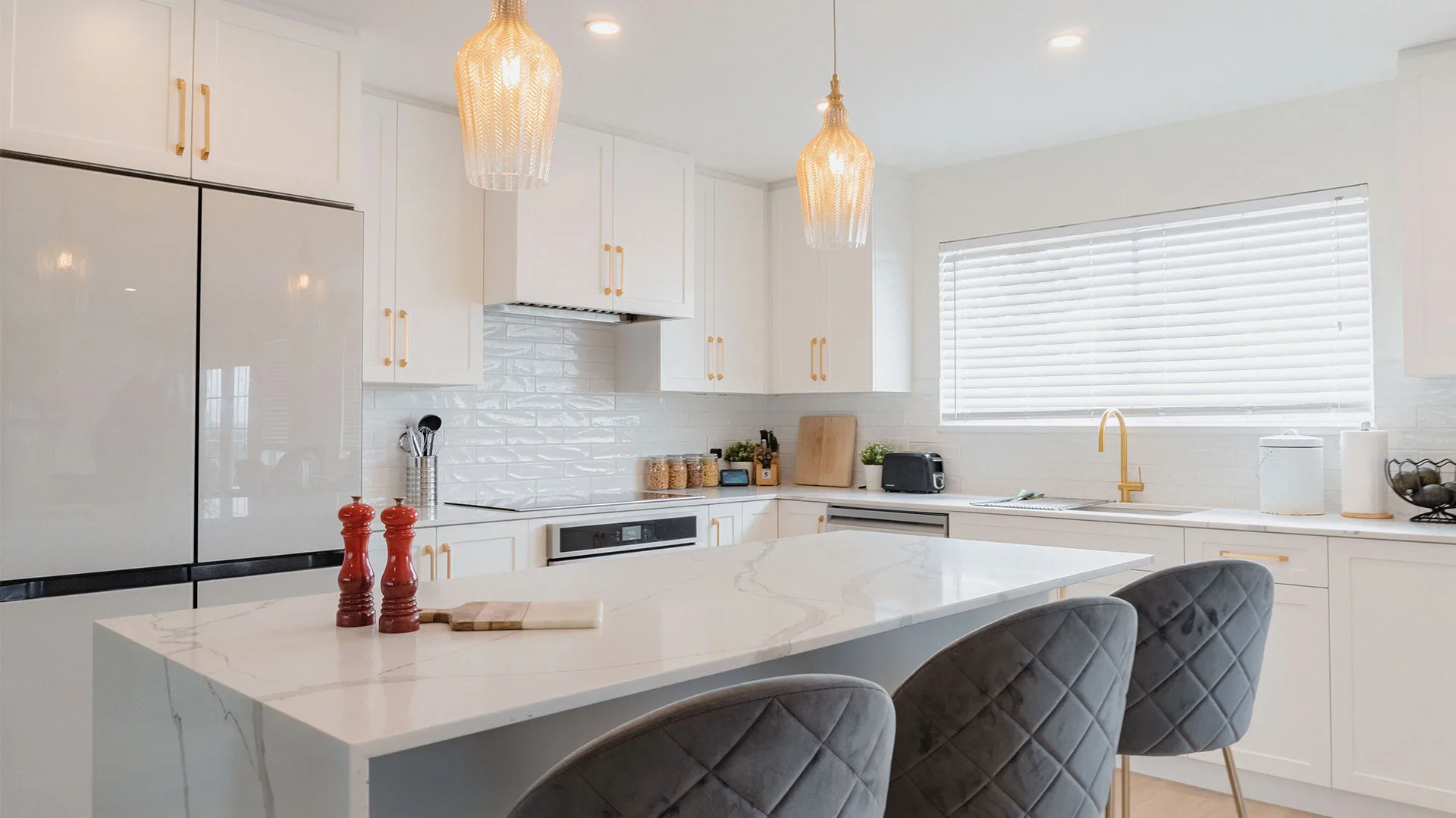
Kitchen Renovation Cost in Vancouver: Real Pricing for Every Budget (2026)
If you’ve started researching a kitchen renovation in Vancouver, you’ve probably noticed the numbers are all over the map. One contractor quotes $35,000. Another says $90,000 for the same job. A friend in Toronto spent $40,000 on what sounds like a more elaborate project. What’s going on?
The honest answer: kitchen renovation costs in Vancouver are among the highest in Canada — and there are specific, concrete reasons for that. This guide breaks down exactly what drives those costs in 2026, what you should expect to pay at every budget level, and how to tell whether a quote you’ve received is fair.
At Vancouver General Contractors, we’ve completed hundreds of kitchen renovations across Metro Vancouver — from quick cosmetic refreshes in East Van condos to full structural gut-and-rebuilds on Westside heritage homes. The pricing, timelines, and ROI data in this article are drawn directly from our own project history and current supplier relationships, not recycled industry averages from other markets.
Vancouver kitchen renovations run 20–30% above comparable projects in Toronto or Calgary — not because of contractor margins, but because of labour costs, materials, and regulatory requirements that are structural to this market.
Vancouver General Contractors, 2026 Project Data
What’s Driving Kitchen Renovation Costs in Vancouver in 2026?
A mid-range kitchen renovation costing $55,000 in Calgary or Edmonton typically runs $65,000–$75,000 in Metro Vancouver — sometimes more, before a single permit is filed. That gap isn’t contractor profit padding. It reflects three structural forces built into this market that won’t change anytime soon.
The Labour Shortage Is Real and Ongoing
British Columbia has faced a skilled trades shortage since well before the pandemic, and the post-COVID period has made it significantly worse. Red Seal carpenters — the credential you want for precision cabinet installation and finish carpentry — currently command $80–$120/hr in Metro Vancouver. Licensed electricians run $120–$160/hr. Licensed plumbers sit at $110–$150/hr.
These aren’t inflated billing rates — they reflect what tradespeople can actually earn in a tight market where residential, commercial, and infrastructure projects are all competing for the same pool of licensed workers. A kitchen renovation that involves electrical or plumbing work (and most do) draws heavily on these trades, and their hours add up fast.
Material Costs Have Stabilized at a Higher Plateau
The pandemic-era supply chain chaos has mostly resolved, but material prices haven’t returned to 2019 levels. Custom cabinet pricing currently runs $800–$2,500 per linear foot (supply only) from local Vancouver cabinet shops. Quartz countertops installed run $85–$200/sq ft depending on the slab and edge profile you choose. These figures are roughly 25–35% above what they were in 2020.
Vancouver-Specific Regulatory Factors
Unlike most Canadian cities, Vancouver has seismic requirements baked into its building code. Any structural work — removing a wall, adding a beam, reconfiguring load paths — requires engineering sign-off that accounts for seismic loading. That adds engineering fees ($2,000–$6,000 for most kitchen-scale structural changes) that don’t exist in most other markets.
City of Vancouver permit fees are also calculated at 1–1.5% of declared renovation value. On a $75,000 kitchen renovation with electrical and plumbing work, expect to budget $750–$1,125 in permit fees alone, plus separate trade permits for electrical and gas work.
Vancouver’s famously narrow lots and dense housing stock also create site logistics costs that don’t apply in suburban markets. Delivering a 12-foot kitchen island panel to a 1940s bungalow with a 5-foot side yard access requires careful coordination — and sometimes custom sequencing — that adds time and cost.
Kitchen Renovation Cost by Scope: The Three Tiers
We organize every kitchen renovation into one of three tiers based on scope and budget. This framework helps homeowners quickly calibrate expectations and understand what moves the needle between tiers.
| Feature | Tier 1: Refresh ($25K–$45K) | Tier 2: Mid-Range ($50K–$80K) | Tier 3: Premium ($85K–$120K+) |
|---|---|---|---|
| Cabinets | Door/drawer replacement or stock refacing | Semi-custom, new layout | Full custom, local cabinet shop |
| Countertops | Laminate or entry quartz | Mid-grade quartz, full slab | Quartzite, marble, or premium quartz |
| Appliances | Entry-level Samsung/LG package | Bosch or Frigidaire suite | Sub-Zero, Wolf, or Miele suite |
| Layout changes | No layout change | Minor — sink relocation, added circuit | Full reconfiguration, wall removal |
| Flooring | Refinish existing or vinyl plank | Tile or hardwood to match | Heated tile, site-finished hardwood |
| Lighting | New fixtures, basic overhead | Under-cabinet LED, pot lights | Full lighting design, pot filler |
| Backsplash | Subway tile, basic pattern | Custom tile, herringbone or stack | Slab backsplash, custom mosaic |
| Island | None or freestanding | Prefab or simple built-in | Custom built-in with waterfall edge |
| Structural work | None | None or minor | Yes — walls, beams, butler’s pantry |
| Permit required | Sometimes (electrical/gas) | Usually (electrical, plumbing) | Always (structural + trades) |
| Typical timeline | 6–10 weeks total | 3–5 months total | 5–7 months total |
Tier 1: Kitchen Refresh ($25,000–$45,000)
A Tier 1 refresh is the right approach when your kitchen layout works, the cabinet boxes are structurally sound, and you want a meaningful visual transformation without a full rebuild. This tier is extremely common in Vancouver condos and townhomes built in the 1990s and 2000s where the bones are good but the finishes are dated.
Typical scope includes: cabinet door and drawer front replacement (keeping existing boxes), new countertops, new backsplash, updated fixtures and hardware, fresh paint, and a new appliance package. Electrical is usually limited to adding a circuit for a new range or dishwasher — no panel work, no wall moves.
Tier 2: Mid-Range Renovation ($50,000–$80,000)
This is the most popular tier for Metro Vancouver homeowners renovating before listing or investing in a long-term home. Scope includes a full cabinet replacement with semi-custom cabinetry, quartz countertops, a complete appliance suite, under-cabinet lighting, new flooring, and usually some electrical or plumbing work (added circuits, sink relocation, pot filler rough-in).
At this tier, you’re getting a kitchen that will look current and perform well for 15–20 years. The semi-custom cabinet range gives you meaningful choices in door profile, finish, and interior fittings without the 12–16 week lead time of fully custom work.
Tier 3: Premium Renovation ($85,000–$120,000+)
A Tier 3 kitchen is typically a full gut to the studs — removing everything including plumbing, electrical, and sometimes structural walls to create an entirely new floor plan. This tier is common on Vancouver’s Westside, North Shore, and in higher-end Burnaby and Coquitlam neighbourhoods where homeowners are investing for the long term in homes valued at $2M+.
Expect custom cabinetry from a local Vancouver shop, a premium appliance suite (Sub-Zero refrigeration, Wolf range, Miele dishwasher), structural wall removal with engineered steel beam, a custom island with waterfall countertop, and a butler’s pantry or integrated wine station. Every finish is specified, coordinated, and installed to a hospitality-grade standard.
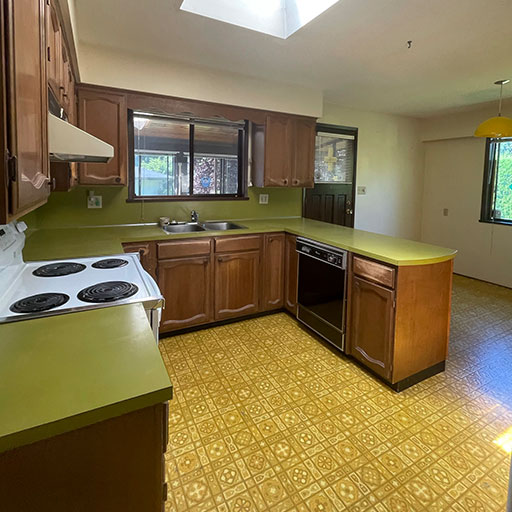
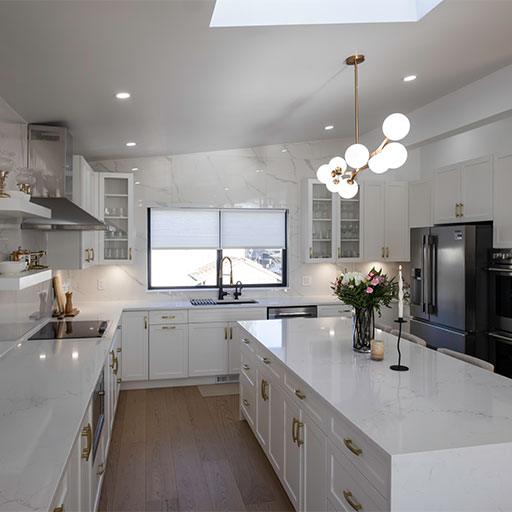
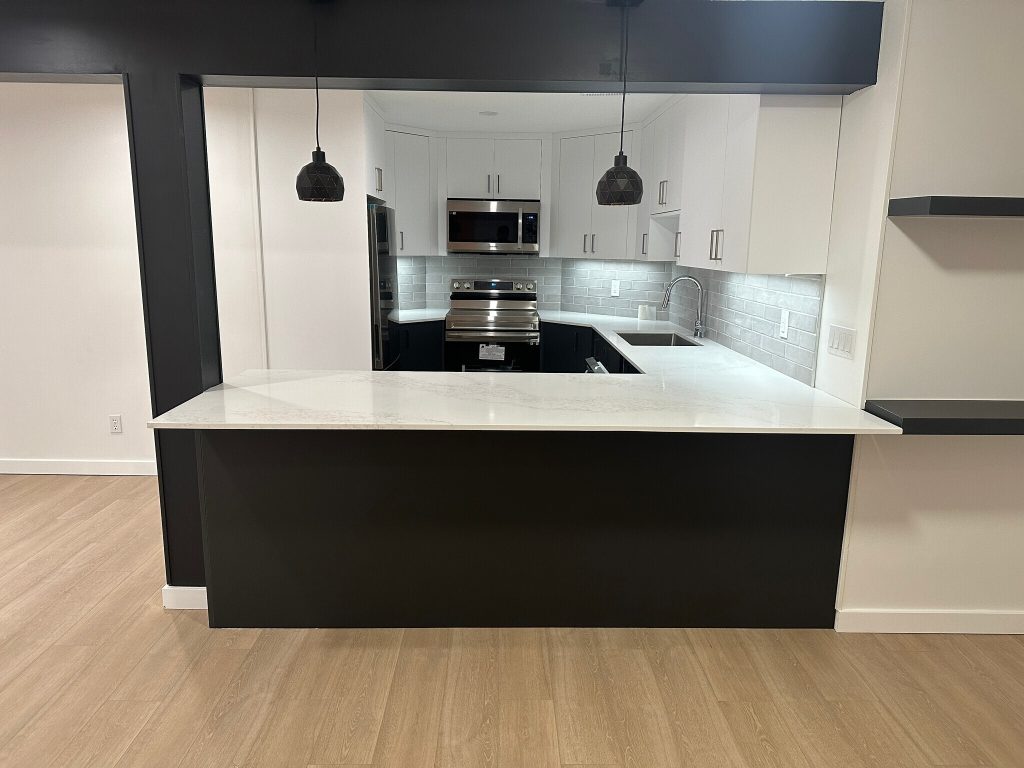 North Vancouver — Capilano project by VGC” class=”wp-image-10704″ />
Real Vancouver Kitchen Renovations: Before & After
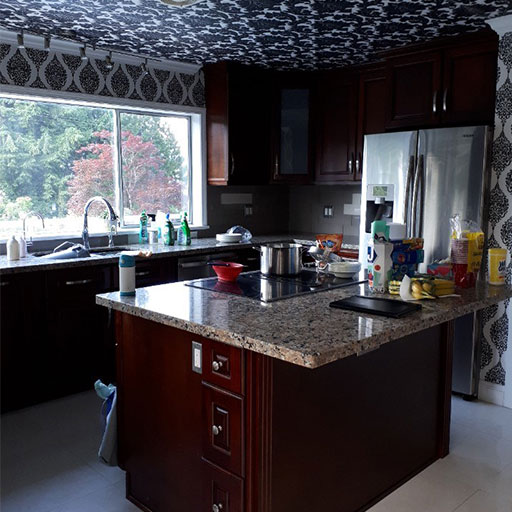
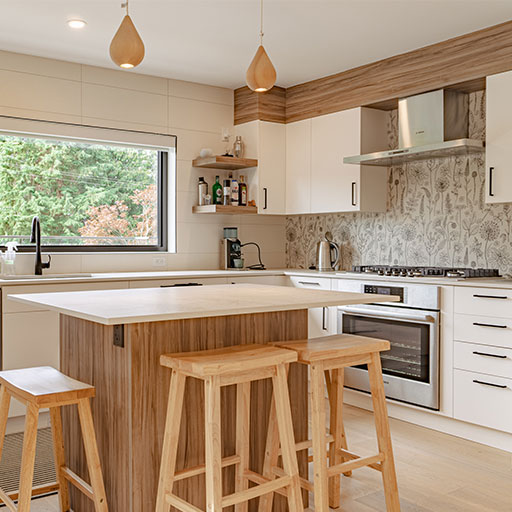
Two real VGC kitchen projects — one Tier 1 refresh and one Tier 2 gut renovation, both in Metro Vancouver — showing what each tier actually delivers.
Kitchen Cabinet Costs in Vancouver
Cabinets are typically the single largest line item in a kitchen renovation — often 35–45% of total project cost. Understanding the three cabinet categories helps you make a decision that aligns budget with longevity goals. For a deep dive on brands, box quality, and door styles, see our complete kitchen cabinet cost guide for Vancouver.
Stock Cabinets: $3,000–$8,000 (Supply Only)
Stock cabinets from IKEA, Home Depot (Hampton Bay), or Rona are pre-manufactured in fixed sizes and available immediately. IKEA’s SEKTION system is genuinely solid for the price — the interior fittings and drawer hardware are surprisingly good. The limitations are fixed sizing (you’ll have filler strips in non-standard kitchens), limited finish options, and assembly labour that adds $1,500–$3,000 on top of supply cost.
Stock cabinets are a reasonable choice for rental suites, strata-restricted renovations with tight budgets, or homeowners who plan to sell within 3–5 years and are primarily after a cosmetic update.
Semi-Custom Cabinets: $8,000–$20,000 (Supply Only)
Semi-custom cabinets offer a middle ground that we consider the sweet spot for most Vancouver homeowners. Local suppliers and cabinet makers (as well as brands like KraftMaid, Aristokraft, and Dura Supreme available through local dealers) offer a wide range of door styles, finish colours, and interior configurations — but still use standardized box sizes that keep lead times to 4–6 weeks rather than 12–16.
At the $12,000–$18,000 supply range, you can get solid wood door frames, soft-close hinges and drawer slides throughout, pull-out shelving, and a finish that looks genuinely custom to most buyers. This is the cabinet category that delivers the best cost-per-impression ratio in Vancouver’s real estate market.
Custom Cabinets: $18,000–$45,000 (Supply Only)
Full custom cabinets are built to your exact dimensions by a local Vancouver cabinet shop. Every millimetre is specified — no fillers, no compromises, no standard sizing. The result is a kitchen that fits the space perfectly and can incorporate features that semi-custom simply can’t: integrated appliance panels, custom fluted columns, floor-to-ceiling cabinetry precisely fitted to sloped ceilings, and custom interior fittings designed around how you actually cook.
Lead times run 10–16 weeks from deposit to delivery. Budget 8–12 weeks for design and approval before production begins. For a premium kitchen, this timeline is just the reality.
Cabinet Installation Labour: $2,000–$6,000
Cabinet installation is separate from supply cost and varies based on kitchen complexity, wall conditions, and the number of upper cabinets. A straightforward galley kitchen can be installed in 2–3 days; a complex L or U-shaped kitchen with full uppers, a pantry tower, and island can take 5–7 days. At current labour rates, budget $2,000–$4,000 for standard installations and $4,000–$6,000 for larger or more complex kitchens.
VGC recommendation: Semi-custom cabinets in the $12,000–$18,000 supply range hit the sweet spot for most Vancouver homeowners. They look custom, perform well for 20+ years, have manageable lead times, and resonate strongly with buyers in the $900K–$2.5M home price range that dominates Metro Vancouver’s market.
Kitchen Countertop Costs in Vancouver
Countertops are the second-most-visible element in any kitchen renovation, and one of the areas where spending wisely — rather than spending most — delivers the best outcomes. For a complete material comparison, see our kitchen countertop cost guide.
Laminate: $800–$2,500 Installed
Modern laminate (think Wilsonart or Formica HD) has come a long way from the cheap plastic look of the 1990s. Some current patterns convincingly mimic quartz and marble at a fraction of the cost. For rental properties or tight-budget refreshes where appearance rather than durability is the goal, laminate is a legitimate choice. However, in Vancouver’s resale market, buyers consistently expect stone or engineered stone. Laminate will be noticed — and discounted — by informed buyers in most price segments.
Quartz: $4,500–$12,000 Installed
Quartz (engineered stone) is the dominant choice in Metro Vancouver kitchen renovations, and for good reason. Brands like Caesarstone, Silestone, Cambria, and local distributor-stocked options deliver a non-porous, maintenance-free surface in hundreds of patterns and colours. Installed cost runs $85–$200/sq ft depending on slab grade and edge profile. A typical 40 sq ft kitchen countertop with a standard edge lands at $4,500–$7,000; with a mitered waterfall island, budget $9,000–$12,000.
Quartz is the best ROI pick in Vancouver. Buyers in every submarket from East Van to West Van expect it. Homes with quartz countertops consistently attract stronger offers and shorter days on market compared to equivalent homes with laminate or even entry-level granite.
Quartzite and Marble: $6,000–$18,000 Installed
Natural stone — quartzite, marble, soapstone — commands premium pricing and delivers a distinctive look that engineered stone can’t quite replicate. Quartzite (often confused with quartz, but a completely different natural material) is extremely hard and durable; marble is softer and requires sealing and care. For Tier 3 kitchens targeting the top end of the market, natural stone slabs are the expected choice. Budget $120–$300/sq ft installed for premium natural stone.
Butcher Block: $1,800–$5,000 Installed
Butcher block works beautifully as a secondary countertop surface — often used on a kitchen island while the perimeter runs quartz. It adds warmth, is repairable (light sanding removes scratches), and is a cost-effective way to introduce material contrast in a kitchen design. It requires regular oiling and isn’t suitable as the primary surface around a main sink. As a design accent, it punches well above its price point.
Kitchen Appliance Costs in Vancouver
Appliances are frequently one of the most misunderstood parts of a kitchen renovation budget. Many contractor quotes do not include appliances — they quote the construction scope only. Always clarify this explicitly before signing a contract.
Entry-Level Package (Samsung/LG): $4,500–$8,000
A standard three-piece package (refrigerator, range or cooktop/wall oven, dishwasher) from Samsung, LG, or Whirlpool hits $4,500–$8,000 depending on finish and features. Stainless is standard; black stainless and fingerprint-resistant finishes add $300–$600. These appliances perform reliably and look good, but service and parts availability can be inconsistent in Canada, and warranties are typically one year.
Mid-Range Package (Bosch/Frigidaire): $8,000–$15,000
Bosch is the benchmark in this tier — their dishwashers in particular are notably quieter and more efficient than entry-level alternatives. A Bosch dishwasher, Frigidaire or GE range, and a mid-grade French door refrigerator lands at $8,000–$12,000. Add a Bosch range and you’re at $11,000–$15,000. This is the appliance tier that most Tier 2 kitchen renovations are designed around.
Premium Package (Wolf/Sub-Zero/Miele): $18,000–$45,000+
Sub-Zero refrigeration, Wolf ranges and ovens, and Miele dishwashers represent the top tier of residential appliances. A Sub-Zero 36″ column refrigerator alone runs $8,000–$12,000. A 48″ Wolf dual-fuel range is $12,000–$16,000. Miele dishwashers run $1,800–$3,500. Combined, a full premium suite easily reaches $25,000–$45,000 before delivery and installation.
Viking appliances are another common premium choice — particularly the ranges — at a slightly lower price point than Wolf while still delivering commercial-grade performance. These appliances are genuinely expected in premium kitchens in Shaughnessy, Point Grey, Dunbar, and North Shore luxury segments.
Delivery and Installation: $500–$1,500
Appliance delivery and hookup (electrical connection, gas line connection, water line for refrigerator) costs $500–$1,500 depending on the number of units and complexity. Note that gas line work must be done by a licensed gas fitter — your general contractor coordinates this, but it’s a real cost. Factor it in regardless of whether your contractor’s quote includes it.
What Kitchen Permits Does Vancouver Require?
One of the most common questions we receive is: “Do I need a permit for my kitchen renovation?” The honest answer depends on exactly what work is being done — and getting this wrong has real consequences at resale. For the complete permit guide, see our Vancouver renovation permit guide.
Work That Does NOT Require a Permit
- Cabinet replacement (no structural changes)
- Countertop replacement
- Backsplash tile installation
- Paint and cosmetic finishes
- Fixture replacement (same-location swap — faucet, sink, dishwasher)
- Flooring replacement (no subfloor structural work)
Work That DOES Require a Permit
- Relocating or extending a gas line (requires gas permit + licensed gas fitter)
- Adding new electrical circuits or upgrading the panel
- Relocating plumbing drain or supply lines
- Removing or altering any wall (especially load-bearing)
- Adding a range hood with new exterior venting penetration
- Any structural beam or post work
- Adding a kitchen to an existing space (suite conversions)
Vancouver Permit Fees and Timelines
The City of Vancouver calculates building permit fees at approximately 1–1.5% of declared renovation value. For a $70,000 kitchen renovation, expect $700–$1,050 in building permit fees. Separate electrical and gas permits typically add another $200–$600 combined.
Permit timelines vary significantly by scope:
- Fast-track review (3 business days): Available for simple projects — electrical circuit additions, gas line relocation, minor plumbing changes with no structural work.
- Standard review (6–10 weeks): Required for any structural work, wall removal, or significant layout changes. Engineering drawings required.
From our project experience at VGC, approximately 40% of kitchen renovations require at least one permit. If your kitchen is more than 20 years old, involves any gas appliances, or you’re considering any layout changes at all, budget for permit fees and timeline in your planning.
Kitchen Renovation Timeline in Vancouver
One of the most consistent surprises for homeowners is how long a kitchen renovation actually takes from decision to completion. The construction phase is typically the shortest part of the process.
| Phase | Tier 1 Refresh | Tier 2 Mid-Range | Tier 3 Premium |
|---|---|---|---|
| Planning + design | 1–2 weeks | 3–4 weeks | 4–6 weeks |
| Permit application | 0–3 business days | 3 days – 6 weeks | 6–10 weeks |
| Cabinet lead time | Same day – 2 weeks | 4–6 weeks | 10–16 weeks |
| Appliance delivery lead time | 1–3 weeks | 2–6 weeks | 4–12 weeks |
| Construction on-site | 2–3 weeks | 3–5 weeks | 5–8 weeks |
| Total realistic timeline | 6–10 weeks | 3–5 months | 5–7 months |
The most common sources of delay in Metro Vancouver kitchen renovations are:
- Permit revisions: A single revision request from a City of Vancouver plan checker can add 3–6 weeks to a standard review. Submitting complete, professionally drawn plans the first time prevents this.
- Cabinet manufacturing delays: Semi-custom and custom cabinet shops in BC are running at capacity. A quoted 6-week lead time can become 9–10 weeks if the shop takes on more work than anticipated. Get a delivery guarantee in writing.
- Appliance backorders: Premium appliances — particularly Sub-Zero and Wolf — can have 6–16 week lead times depending on the model and current inventory. Order appliances the day your contractor contract is signed.
- Hidden scope discovery: Opening walls and floors reveals conditions (see next section) that require additional work and sometimes additional permits before construction can continue.
Hidden Kitchen Renovation Costs to Budget For
Every experienced contractor in Vancouver will tell you the same thing: what you find when you open the walls can change a project significantly. These are the most common hidden costs we encounter in Metro Vancouver kitchen renovations, along with realistic pricing for each.
Asbestos in Vinyl Floor Tiles: $2,500–$8,000
Homes built before 1990 frequently have vinyl composition tile (VCT) with asbestos-containing adhesive under the surface flooring. This is extremely common in Vancouver’s vast inventory of 1950s–1980s housing stock. If an asbestos survey (required before demolition in BC for pre-1990 buildings) finds asbestos-containing materials, abatement by a licensed WorkSafeBC contractor is mandatory. Typical kitchen abatement runs $2,500–$8,000 depending on extent of materials.
Knob-and-Tube Wiring: $8,000–$20,000
Knob-and-tube (K&T) wiring is present in many Vancouver homes built before 1950. Once exposed during a kitchen renovation, BC Electrical Code requires that K&T in the renovation zone be remediated — you cannot simply work around it. Remediation of the kitchen electrical section (not the whole house) typically runs $8,000–$20,000 including new wiring, updated panel capacity, and inspection. This is non-negotiable once it’s found.
Structural Wall Removal: $8,000–$25,000
Opening up a kitchen by removing a wall that turns out to be load-bearing is one of the most significant cost escalations possible in a kitchen renovation. A structural engineer must design the solution, typically involving a steel or LVL beam and updated shear wall provisions (seismic requirement). Full cost including engineering fees, beam supply and installation, temporary shoring, header work, and patching runs $8,000–$25,000 depending on span length and the structural complexity of the solution.
Plumbing Rough-In for Island: $2,500–$5,000
Adding a sink to a kitchen island requires running a drain line and supply lines through the floor — which means opening the subfloor and potentially working in the space below (crawlspace, basement suite, or occupied unit in a strata). This is entirely doable but adds $2,500–$5,000 in plumbing rough-in costs that aren’t always included in initial quotes.
Range Hood Exterior Venting: $800–$2,500
Many Vancouver kitchen renovations add a proper exterior-vented range hood for the first time, replacing a recirculating unit. This requires penetrating an exterior wall or roof, installing a duct, and finishing both the interior and exterior penetrations. In a strata, exterior penetrations require strata approval, which can add 4–8 weeks. Cost: $800–$2,500 depending on routing complexity.
Temporary Kitchen Setup: $500–$1,500
For Tier 2 and Tier 3 renovations where the kitchen is fully demolished, many families set up a temporary cooking station — a microwave, a two-burner induction cooktop, a bar fridge, and a utility table. Budget $500–$1,500 to rent or purchase these items for the 4–8 weeks of active construction. It’s a quality-of-life investment that makes the renovation period significantly more manageable.
The 10–15% Contingency Rule
Every kitchen renovation budget in Vancouver should include a 10–15% contingency on top of the quoted scope. This is not a contractor cushion — it’s your buffer for the hidden conditions described above. A $70,000 quoted kitchen should have $7,000–$10,500 in contingency set aside. In older homes (pre-1980), use 15%. In newer construction or recent-gut condos, 10% is usually sufficient.
Kitchen Renovation ROI in Vancouver
Kitchen renovations are consistently Vancouver’s highest-ROI home improvement project — and the local real estate market’s price sensitivity to kitchen quality makes this one of the most data-supported claims in residential renovation. See our complete renovation ROI guide for a cross-category comparison.
What the Numbers Look Like Across Tiers
| Renovation Tier | Investment Range | Typical Value Add (Metro Vancouver) | Estimated ROI |
|---|---|---|---|
| Tier 1: Refresh | $25K–$45K | $30K–$55K added to list price | 90–120% |
| Tier 2: Mid-Range | $50K–$80K | $60K–$90K in most submarkets | 100–130% |
| Tier 3: Premium | $85K–$120K | $80K–$140K (Westside/North Shore/Burnaby) | 90–120% |
Local real estate agents consistently report that updated kitchens result in 2–3 fewer days on market and 3–5% higher offers compared to equivalent homes with dated kitchens. In Vancouver’s market, where a 3% price difference can represent $50,000–$100,000 on a typical detached home, the math is compelling.
VGC Case Study: Killarney Mid-Range Kitchen
One of our most illustrative recent projects: a 1970s bungalow in Vancouver’s Killarney neighbourhood with a completely original kitchen. The owners were preparing to list and asked us to assess what renovation scope would maximize return at the price point they were targeting.
We recommended a Tier 2 mid-range renovation: semi-custom white shaker cabinets, Caesarstone quartz countertops, a Bosch appliance suite, subway tile backsplash, LVP flooring, and pot lighting throughout. The project came in at $62,000 including a minor electrical upgrade for the new appliance circuits.
The home sold at a price $88,000 above what comparable un-renovated homes in the same block sold for in the same quarter. Net ROI after renovation cost: approximately 142%. The kitchen wasn’t just a cosmetic upgrade — it signalled to buyers that the home had been properly maintained and invested in, which reduced their perceived risk and increased their willingness to offer strongly.
Small Kitchen Renovation Ideas for Vancouver Condos
Vancouver condos present a unique set of opportunities and constraints. With average unit sizes running 650–850 sq ft, the kitchen is rarely large — and every square foot of counter space and storage matters enormously. See our dedicated small kitchen renovation guide for layout strategies specific to Vancouver condos and townhouses.
High-Impact, Low-Footprint Upgrades
- Cabinet-height increase to ceiling ($1,500–$3,500): Running upper cabinets all the way to the ceiling adds substantial storage, eliminates the visually awkward dust-collecting gap above upper cabinets, and makes the kitchen feel dramatically taller. In an 8-foot or 9-foot ceiling condo, this single change can transform the feel of the entire kitchen.
- Counter extension or peninsula ($2,500–$6,000): Many Vancouver condo kitchens can gain 6–8 linear feet of counter space with a modest peninsula extension — adding seating for 2–3 people and doubling available prep surface without changing the footprint. This is one of the best-value modifications in a condo kitchen.
- Under-cabinet LED lighting ($800–$2,000): The single change that most dramatically improves the perceived quality of a kitchen for the least money. Hardwired LED strips under upper cabinets eliminate shadows on work surfaces, make the kitchen feel brighter and more spacious, and are immediately noticed by buyers at every showing.
- High-gloss cabinet finishes: In smaller condo kitchens, high-gloss white or light-coloured cabinets reflect light and make the space read larger. This is a design choice that specifically benefits compact kitchens.
Full Condo Kitchen Renovation: $28,000–$55,000
A full renovation of a typical 80–120 sq ft condo kitchen — replacing everything from cabinets to countertops, flooring, lighting, and appliances — runs $28,000–$55,000. The lower end applies to a compact galley kitchen with stock or entry-level semi-custom cabinets and an entry-level appliance suite. The upper end applies to a larger L-shaped condo kitchen with semi-custom cabinetry, quartz countertops, a Bosch suite, and a full pot lighting installation.
Strata Considerations for Condo Renovations
Condo kitchen renovations in Vancouver require strata approval before work begins — this is a legal requirement under the BC Strata Property Act, not just a courtesy. Submit detailed renovation drawings including plumbing layout, electrical plan, and any structural work to your strata council for approval. Most strata approvals take 2–4 weeks for a straightforward kitchen renovation.
Additional strata requirements to anticipate: (1) Any plumbing work requires a certificate from a licensed plumber confirming work was done to code. (2) Noise bylaws typically restrict construction to Monday–Friday, 8am–5pm. (3) Some stratas require a renovation deposit ($500–$2,500) held against common area damage. Build all of these into your planning and budget.
How to Get an Accurate Kitchen Renovation Quote in Vancouver
The quality of a renovation quote is directly proportional to the quality of the information you provide to the contractor. Vague scopes produce vague (and unreliable) quotes. Here’s how to get quotes that are actually comparable and trustworthy.
What to Prepare Before Requesting Quotes
- Accurate kitchen dimensions (length, width, ceiling height) and a rough sketch or photo showing current layout
- Clear description of what you want to change vs. keep (specify if layout changes are on the table)
- Your cabinet preference tier (stock / semi-custom / custom) and any specific brands or styles you’re drawn to
- Appliance specifications — are you supplying your own appliances or does the contractor include them?
- Photos of the current kitchen — especially showing existing electrical panel location, window positions, and any awkward features
- Your target timeline — do you have a hard date (listing deadline, family milestone)?
Why Three Quotes Is the Minimum
We recommend getting at least three quotes from experienced kitchen contractors in Vancouver. A price spread of $20,000–$40,000 between quotes on the same scope is completely normal — and usually reflects differences in cabinet specifications, assumed labour rates, overhead structures, and what’s included vs. excluded. Three quotes give you enough data to identify outliers in either direction (suspiciously low quotes that exclude critical items; suspiciously high quotes that are padding scope).
Red Flags in Kitchen Renovation Quotes
- No permit included: Any quote for work that requires permits (electrical, gas, plumbing, structural) should explicitly include permit management. If a contractor says “you handle permits” or “we don’t need permits for this,” that’s a serious warning sign.
- Time-and-materials only (no fixed price): T&M contracts transfer all cost risk to you. For a full kitchen renovation, insist on a fixed-price scope with explicitly documented exclusions. Legitimate unknowns (hidden conditions) are handled through a clearly defined change order process, not an open-ended T&M arrangement.
- Large upfront payment demanded: A 20–30% deposit to start is standard and reasonable. Demands for 50%+ upfront, or full payment before work begins, are red flags. Payment should follow project milestones, not contractor cash flow needs.
- No written contract or vague scope: If a contractor resists putting a detailed written scope together, walk away. The scope document is your legal protection if anything goes sideways.
What VGC Includes in Every Kitchen Quote
At Vancouver General Contractors, every kitchen renovation quote includes a fixed-price scope with clearly itemized line items for cabinets, countertops, labour, permits, and finishes. Our payment schedule follows construction milestones: 20% at contract signing, 40% at rough-in completion, 30% at cabinet installation, 10% at final completion and walkthrough. We manage all permit applications and coordinate all trade work directly — you have one point of contact throughout the project.
VGC offers free in-home consultations — typically 45–60 minutes covering your scope, timeline, and budget in detail. Call 604-430-3004 or book online. For a broad overview of what to expect across all renovation types, visit our Vancouver Renovation Guide.
More Kitchen Renovations Guides

Open Concept Kitchen Renovation in Vancouver: Complete Planning Guide

Open Shelving vs. Upper Cabinets in a Vancouver Kitchen: Which is Right for You?
Small Kitchen Renovation in a Vancouver Condo: Strata Rules and Smart Design Ideas

Range Hood vs. Over-the-Range Microwave in Vancouver: Performance and Cost Comparison
Adding a Kitchen Island to Your Vancouver Home: Design, Permits, and Cost
Ready to start your renovation?
Frequently Asked Questions: Kitchen Renovation Cost in Vancouver
Answers to the questions Vancouver homeowners ask most often about kitchen renovation budgets, timelines, permits, and return on investment.
How much does a kitchen renovation cost in Vancouver on average?
The average kitchen renovation in Metro Vancouver costs between $45,000 and $75,000 for a typical detached home or townhouse kitchen. Condo kitchens run slightly lower at $28,000–$55,000. High-end or full custom kitchen renovations on Vancouver’s Westside, North Shore, or premium Burnaby areas regularly reach $85,000–$150,000+. These figures are materially higher than national Canadian averages due to local labour costs, permit requirements, and material pricing.
What is the cheapest way to renovate a kitchen in Vancouver?
The most cost-effective approach is a cosmetic refresh that keeps the existing cabinet boxes and layout intact. Replacing cabinet doors and drawer fronts, installing new countertops (laminate or entry-level quartz), a new backsplash, updated fixtures, and fresh paint can transform a kitchen for $18,000–$30,000. IKEA cabinet systems are a legitimate option for very tight budgets. Avoid cutting costs on labour — hiring an unlicensed contractor to save money typically creates permit and quality problems that cost more to fix than they saved.
Do I need a permit for a kitchen renovation in Vancouver?
It depends on the scope. Pure cosmetic work — new cabinets, countertops, backsplash, paint — does not require a permit. However, if your renovation involves any electrical work (new circuits, panel upgrade), gas line work (range hookup, gas cooktop addition), plumbing relocation, or any structural changes (wall removal, beam installation), one or more permits are required. Approximately 40% of kitchen renovations we complete in Vancouver require at least one permit. Your contractor should identify this in the initial quote and include permit management in their scope.
How long does a kitchen renovation take in Vancouver?
From the decision to start to completion, realistic timelines are: 6–10 weeks for a Tier 1 refresh, 3–5 months for a Tier 2 mid-range renovation, and 5–7 months for a Tier 3 premium project. The on-site construction phase is often only 3–6 weeks — the majority of the timeline is consumed by design, permit application, and cabinet/appliance lead times. Planning ahead is the single most effective way to control your total renovation timeline.
Is it worth renovating a kitchen before selling in Vancouver?
In most Metro Vancouver submarkets, yes — particularly for homes in the $900K–$2.5M price range. A well-executed Tier 2 kitchen renovation consistently returns 100–130% of its cost in increased sale price in Vancouver. Real estate agents report updated kitchens sell homes 2–3 days faster and attract 3–5% higher offers. The key is matching renovation scope to the neighbourhood price point — over-renovating (spending $120K on a kitchen in a neighbourhood where homes sell for $900K) reduces ROI significantly.
How much do custom cabinets cost in Vancouver?
Custom cabinets built by a local Vancouver cabinet shop run $18,000–$45,000 in supply cost (before installation) for a typical kitchen. Per linear foot pricing runs $800–$2,500/LF depending on materials, finish, and complexity. Lead times are 10–16 weeks from deposit to delivery. For most Vancouver homeowners, semi-custom cabinets at $12,000–$18,000 supply cost deliver comparable visual results with shorter lead times and lower cost.
What countertops add the most value in Vancouver?
Quartz countertops (engineered stone) deliver the best ROI in Vancouver’s market. Brands like Caesarstone, Silestone, and Cambria are widely recognized by buyers, require minimal maintenance, and are expected in virtually every price segment above entry-level. At $85–$200/sq ft installed, quartz is a reliable investment. Natural quartzite or marble delivers a premium aesthetic for top-tier kitchens but is more expensive and requires more maintenance — justified in Tier 3 projects but not necessary for Tier 1 or 2.
Should I use a general contractor or a kitchen specialist for my renovation?
For any kitchen renovation that involves electrical, plumbing, gas work, or structural changes — which is the majority of meaningful kitchen renovations — a licensed general contractor is the better choice. A GC coordinates all trades, manages permits, carries appropriate insurance, and provides a single point of accountability. Kitchen “specialists” who focus only on design and cabinet installation may not have the licensing or trade coordination capability for comprehensive renovations. For a pure cosmetic cabinet-and-countertop project, a kitchen specialist can be appropriate.
What’s a realistic budget for a condo kitchen renovation in Vancouver?
A full renovation of a typical Vancouver condo kitchen (80–120 sq ft) costs $28,000–$55,000. This includes new cabinets, countertops, backsplash, appliances, flooring, and lighting. A focused refresh (new countertops, backsplash, paint, hardware, under-cabinet lighting) without cabinet replacement can be done for $8,000–$18,000. Budget for strata approval costs, potential renovation deposit, and additional time in your timeline for the strata approval process.
Can I stay in my home during a kitchen renovation?
Yes, for most kitchen renovations. The first few days of demolition are the most disruptive (dust, noise, loss of kitchen function), but once demolition is complete and rough-in work begins, the home is generally livable. We strongly recommend setting up a temporary kitchen station (bar fridge, microwave, induction cooktop) for the duration. For Tier 3 premium renovations with extensive structural work, some families choose to relocate for 2–4 weeks during the most intensive phase. Your contractor should discuss this with you during planning.
What are the payment terms for kitchen renovations in Vancouver?
Standard payment terms for reputable Vancouver kitchen renovation contractors follow project milestones: a 20–25% deposit to secure scheduling and begin material procurement, a second payment of 35–40% at rough-in/structural completion, a third payment of 25–30% at cabinet installation, and a 10% holdback released at final completion and client sign-off. Never pay more than 30% upfront, and never make the final payment until you’ve done a thorough walkthrough and confirmed all deficiencies are resolved.
How much does labour cost for a kitchen renovation in Vancouver?
Labour typically represents 30–45% of total kitchen renovation cost in Vancouver. At current trade rates — carpenters $80–$120/hr, electricians $120–$160/hr, plumbers $110–$150/hr — a Tier 2 kitchen renovation with full trade work will accumulate $20,000–$35,000 in labour costs alone. A Tier 1 cosmetic refresh with minimal trade work runs $6,000–$12,000 in labour. These are legitimate market rates, not padding — Vancouver’s labour market is genuinely tight and trades command premium rates.
What permits does a kitchen renovation require in Vancouver?
The permits required depend entirely on scope: a building permit is required for any structural work or significant layout changes; an electrical permit is required for new circuits, panel upgrades, or significant electrical changes; a gas permit is required for any gas line relocation, extension, or new gas appliance hookup; a plumbing permit is required for drain or supply line relocation. In the City of Vancouver, permits are applied for through the Development, Buildings, and Licensing (DBL) department. Your contractor should manage all permit applications — verify this is included in their scope.
How do I choose kitchen cabinets that will last?
Key durability indicators: (1) Plywood box construction rather than particleboard — plywood holds screws far better and doesn’t swell when exposed to moisture. (2) Soft-close hardware on all hinges and drawer slides — this dramatically reduces wear on both hardware and cabinet box joints. (3) Dovetail or dado-jointed drawers — these joints hold together under heavy daily use. (4) Proper installation — even excellent cabinets fail if installed on unlevel walls or without proper blocking. Ask your contractor to specify box material in the quote. Plywood boxes cost more but last 20–30 years; particleboard boxes typically show wear within 10–15 years in a Vancouver home’s moisture environment.
What’s the ROI on a kitchen renovation in Vancouver?
Kitchen renovations consistently deliver the highest ROI of any renovation category in Metro Vancouver — typically 90–130% depending on tier, neighbourhood, and execution quality. A Tier 2 mid-range kitchen renovation in most Metro Vancouver submarkets returns more than it costs in increased sale price. Even accounting for transaction costs and holding period, the data strongly supports kitchen renovation as a value-creating investment for Vancouver homeowners who plan to sell within 3–7 years. The key condition: the renovation must be executed to current market standards (quartz countertops, semi-custom or better cabinets, updated appliances) — outdated or poorly executed renovations can actually hurt value.
Ready to Start Your Kitchen Renovation?
Get a free, no-pressure quote from Metro Vancouver’s trusted renovation specialists. Hundreds of kitchens completed across Vancouver, Burnaby, North Shore & beyond.
Get Your Free Quote →Ready to start your project? Vancouver General Contractors (VGC) provides free, fixed-price quotes for homeowners across Metro Vancouver. Learn more about our kitchen renovation Vancouver services or request a free quote today.
VGC serves Vancouver and surrounding areas. View all renovation services in Vancouver →

Comments are closed