




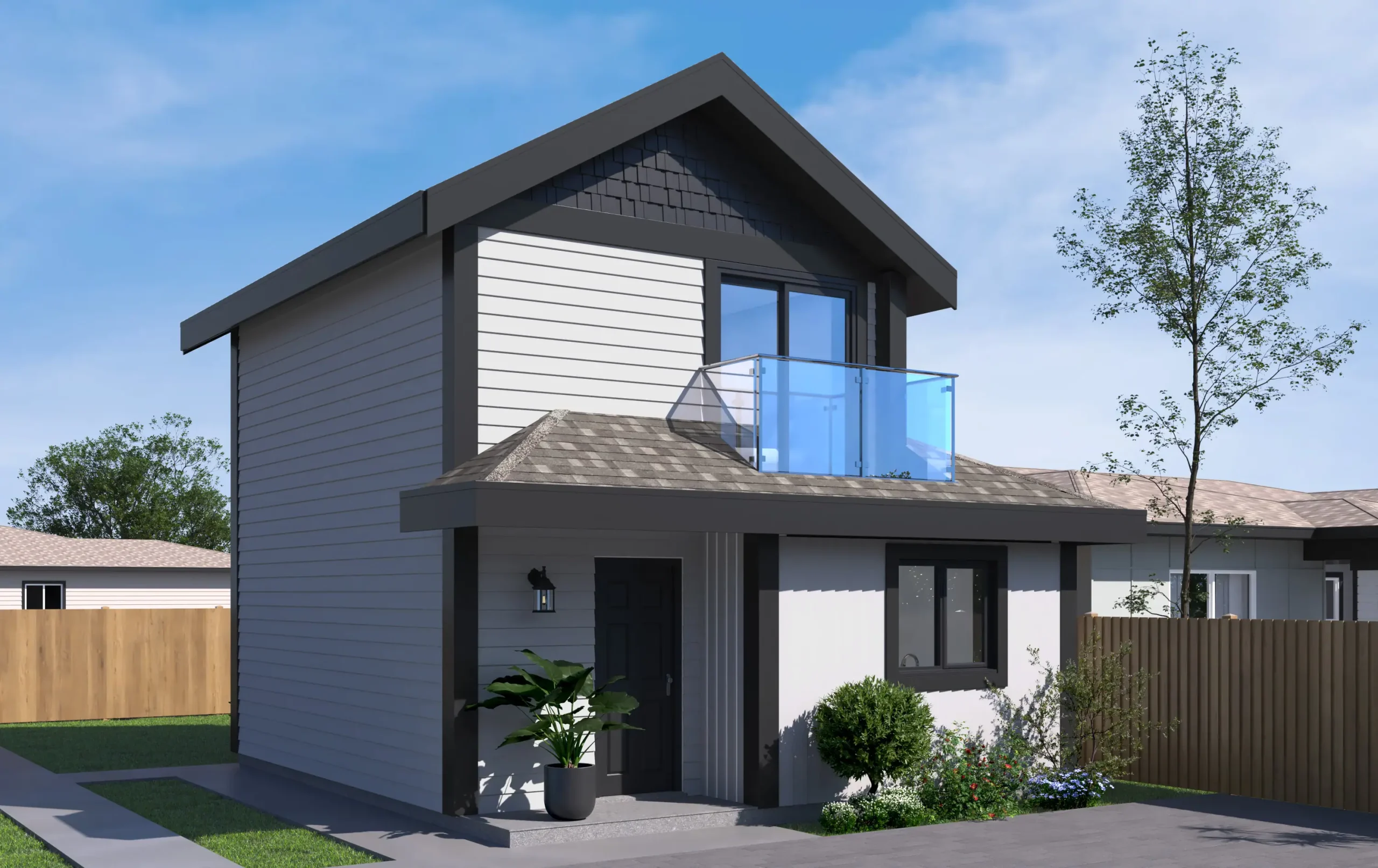
Laneway House Financing Vancouver: HELOC, Construction Mortgage & CMHC (2026)
You own a Vancouver home worth $2.2 million. You have an existing mortgage of $800,000. You want to build a laneway house that will cost $420,000 to construct and generate $2,600 per month in rental income. The math looks good — so why does financing feel impossible?
The answer is that most homeowners approach laneway house financing the wrong way. They walk into their bank expecting a home renovation loan and get turned away because lenders can’t appraise something that hasn’t been built yet. They assume construction financing is only for developers. They don’t realize that their Vancouver home equity — likely the largest financial asset they’ll ever own — is the exact collateral lenders want for exactly this type of project.
This guide breaks down every viable laneway house financing path available to Vancouver homeowners in 2026: the HELOC approach, construction mortgages, refinancing with an as-improved appraisal, and CMHC MLI Select for multi-unit properties. We’ll give you the real numbers — loan-to-value ratios, interest rates, draw schedules, rental income qualification rules, and a full cost-benefit model — so you can walk into any lender conversation with confidence.
Standard home renovation loans — the kind banks offer for kitchen remodels or bathroom updates
Vancouver General Contractors
The Laneway House Financing Challenge — And Why It’s More Solvable Than You Think
Building a laneway house in Vancouver typically costs between $350,000 and $550,000 all-in, depending on size, finishes, and site conditions. That’s a substantial sum stacked on top of an existing mortgage — which is why many homeowners assume traditional financing won’t work for them.
Standard home renovation loans — the kind banks offer for kitchen remodels or bathroom updates — typically cap out at $50,000 to $150,000 and require the work to be already completed or nearly finished before funds are advanced. A laneway house doesn’t fit this model at all. You need money at the start of construction, not the end. And the amount is far larger than any renovation loan product is designed to handle.
The second obstacle is appraisal. When you apply for a standard loan, the lender sends an appraiser to confirm the value of your home. That’s straightforward for an existing structure. But for a laneway house that doesn’t exist yet, there’s nothing to appraise in the traditional sense — and most lenders aren’t set up to do speculative valuations on planned construction.
Here’s what changes everything: the as-improved appraisal. This is a specialized valuation where a licensed appraiser estimates the value of your property after the laneway is built and occupied. In Vancouver, where single-family homes routinely sell for $2M+ and laneway houses generate $2,200–$3,200 per month in rent, the as-improved value of your combined property almost always justifies the financing. We’ll cover this in detail in Section 7.
The three viable laneway house financing paths in Vancouver are:
- HELOC (Home Equity Line of Credit) — the most flexible option if you have sufficient equity
- Refinance with as-improved appraisal — roll construction costs into a new or extended mortgage
- Construction mortgage — staged draws specifically designed for the building phase
Each path suits different financial situations. Understanding which one matches your equity position, income, and construction timeline is the first step to a successful laneway project.
Laneway House Construction Costs in Vancouver 2026
Before choosing a financing strategy, you need accurate cost numbers. Many homeowners underestimate laneway costs because they compare them to basement suites or large home renovations — but a laneway house is a separate structure built from the ground up, with its own foundation, all-new mechanical systems, and dedicated utility connections.
Here are realistic construction cost ranges for Vancouver in 2026, based on projects we’ve completed across the city:
| Laneway Size | Footprint | Construction Cost | All-In Cost (with soft costs) |
|---|---|---|---|
| Studio / Bachelor | 400–500 sq ft | $280,000–$380,000 | $335,000–$460,000 |
| 1-Bedroom | 500–650 sq ft | $320,000–$440,000 | $380,000–$530,000 |
| 2-Bedroom | 650–850 sq ft | $380,000–$520,000 | $450,000–$620,000 |
| 3-Bedroom | 850–1,100 sq ft | $450,000–$620,000 | $530,000–$730,000 |
Construction cost includes: foundation and excavation, structural framing, roofing, windows and doors, insulation and vapour barrier, electrical panel and wiring, plumbing rough-in and fixtures, HVAC (heat pump or mini-split), interior finishes (flooring, drywall, paint, kitchen, bathrooms), landscaping restoration, and utility connection fees.
Soft costs — the non-construction expenses that precede and accompany the build — are frequently overlooked and can add $50,000–$100,000 to your total project budget:
| Soft Cost Item | Typical Range |
|---|---|
| City of Vancouver permit fees | $15,000–$35,000 |
| Architectural design | $20,000–$45,000 |
| Structural engineering | $8,000–$18,000 |
| Geotechnical assessment (if required) | $3,000–$8,000 |
| Survey and legal | $3,000–$7,000 |
| As-improved appraisal | $500–$1,200 |
| Development cost levies | $5,000–$15,000 |
| Project management / contingency (10–15%) | $28,000–$78,000 |
For financing purposes, always plan your budget around the all-in cost, including soft costs and a 10–15% contingency. Lenders who offer construction mortgages will want to see a complete project budget — and if you run out of money mid-build because you didn’t account for soft costs, your construction draw schedule collapses.
When you’re ready to get precise numbers for your lot and planned laneway design, our team provides detailed construction estimates as part of the early project planning process. Contact us here to start with a site assessment.
Option 1: HELOC — The Most Flexible Laneway Financing Path
For Vancouver homeowners with substantial equity, a Home Equity Line of Credit is often the fastest, most flexible, and most cost-effective way to finance a laneway house. A HELOC works like a secured credit line — you borrow against the equity in your home, paying interest only on what you draw, and repay at your own pace within the credit limit.
How HELOC loan-to-value ratios work for laneway financing:
Canadian lenders allow a standalone HELOC up to 65% of your home’s appraised value, or a combined mortgage-plus-HELOC up to 80% LTV. Here’s what that means in practice for a typical Vancouver homeowner:
| Example | Amount |
|---|---|
| Home appraised value | $2,200,000 |
| Existing mortgage balance | $800,000 |
| 80% LTV ceiling | $1,760,000 |
| Maximum HELOC room (80% − mortgage) | $960,000 |
| Laneway construction budget | $420,000 |
| HELOC utilization after laneway | 44% of available room |
In this example, the homeowner has nearly $1 million in available HELOC room — more than enough to finance the entire laneway project without touching their existing mortgage structure. This is the typical situation for Vancouver homeowners who purchased before 2020 and have seen significant equity appreciation.
HELOC interest rates in 2026: HELOCs are priced at prime rate plus a spread, typically prime + 0.50% to prime + 1.00%. With the Bank of Canada prime rate at approximately 5.20% in early 2026, a HELOC rate of 5.70%–6.20% is typical. This is variable — it moves with prime — but for a construction project, the rate flexibility is usually worth the variability.
Why HELOCs are ideal for laneway projects specifically:
- Revolving credit — you only pay interest on what you’ve drawn, not the full credit limit. If your laneway build takes 12 months and you draw funds in stages, you minimize interest costs during construction.
- No draw schedule restrictions — unlike a construction mortgage, you control when and how much you advance. Pay your contractor in whatever tranches they require.
- No appraisal required for each draw — once the HELOC is established, you advance funds without inspector sign-offs (unlike construction mortgages).
- Reusable credit — once the laneway is built and generating rental income, you can pay down the HELOC and redeploy the credit room for future projects.
- Interest-only minimum payments — during the build phase, your cash flow obligation is minimal. On $420,000 drawn at 6.00%, interest is approximately $2,100/month.
The primary qualification requirement for a HELOC is equity — specifically, having enough home value net of your existing mortgage to reach the required LTV headroom. Most major banks and credit unions will require a new appraisal (typically $400–$600) to establish the current property value before setting the HELOC limit.
For homeowners who qualify, the HELOC approach allows you to start drawing funds within weeks of approval — no construction mortgage administration, no staged inspections, no delays. It’s the reason most experienced laneway builders in Vancouver default to this option when equity permits.
Option 2: Refinance and Roll In the Construction Cost
If your HELOC room is limited — or if you want to lock in a fixed rate on the full project cost — refinancing your existing mortgage to include laneway construction costs is a powerful alternative. This approach uses an as-improved appraisal to establish the post-construction value of your property, then finances a new, larger mortgage against that future value.
Two refinance approaches:
Blend-and-extend is for homeowners mid-mortgage-term who want to avoid a mortgage break penalty. The lender blends your current rate with the new rate and extends the term. The new loan amount includes your existing mortgage plus the laneway construction budget. This avoids penalties but means you’ll carry a blended rate for the remainder of the term.
Full break and refinance makes sense when you’re at or near the end of your mortgage term, or when interest rate savings justify the penalty. You discharge the existing mortgage, pay the IRD penalty (which for a $800,000 mortgage can be $15,000–$40,000 depending on your rate gap and remaining term), and take out a new mortgage at current rates for the full project amount.
How the as-improved appraisal works for a refinance:
Instead of appraising your current property, the lender orders an as-improved appraisal — an estimate of what the property will be worth after the laneway is built. Appraisers use two methods: comparable sales (recently sold properties with laneways in similar Vancouver neighbourhoods) and income capitalization (the net rental income of the laneway, divided by a market cap rate of 4%–5%).
Using our Vancouver example:
| Refinance with As-Improved Appraisal | Amount |
|---|---|
| Current home value (land + existing house) | $2,200,000 |
| Estimated laneway value (as-improved) | $450,000 |
| Total as-improved property value | $2,650,000 |
| Maximum mortgage at 60% LTV (conventional) | $1,590,000 |
| Existing mortgage balance | $800,000 |
| Available for laneway construction | $790,000 |
| Actual laneway budget needed | $420,000 |
In this scenario, the as-improved appraisal unlocks substantial financing room — far more than the construction budget requires. The new mortgage of approximately $1,220,000 ($800K existing + $420K laneway) represents a comfortable 46% LTV against the as-improved value of $2,650,000.
Most lenders handling as-improved refinances for laneway construction will advance funds in stages tied to construction milestones — similar to a construction mortgage — rather than releasing the full amount upfront. This protects their collateral during the build phase. Once the laneway is complete and has received its occupancy permit, the remaining holdback is released.
The refinance approach suits homeowners who:
- Prefer fixed-rate certainty over variable HELOC rates
- Want to consolidate all debt into a single mortgage structure
- Have a mortgage coming up for renewal within 6–12 months
- Don’t have sufficient HELOC room but have strong as-improved equity
Option 3: Construction Mortgage — Built for the Build Phase
A construction mortgage is a specialized lending product designed specifically for new building projects. Unlike a standard mortgage that advances a lump sum at closing, a construction mortgage releases funds in staged draws tied to verified construction milestones — ensuring the lender’s money is always secured by completed, inspected work.
Typical draw schedule for a Vancouver laneway house:
| Construction Stage | % of Loan Released | What’s Complete |
|---|---|---|
| Initial advance | 10–15% | Permits approved, site preparation, demolition |
| Foundation draw | 20–25% | Foundation poured and cured, inspected |
| Framing draw | 40–50% | Structural framing, roof sheathing, windows in |
| Rough-in draw | 60–70% | Electrical, plumbing, HVAC rough-in inspected |
| Drywall / lock-up draw | 75–85% | Insulation, drywall, exterior complete |
| Completion draw | 95–100% | Occupancy permit issued, finishes complete |
At each draw stage, the lender sends an independent inspector (or requires a municipal inspection report) to confirm that work is complete before advancing the next tranche. This inspection process typically takes 3–7 business days, so plan your contractor payment schedule to accommodate these intervals.
Interest during construction: Construction mortgages are interest-only during the build phase. You pay interest only on the funds actually drawn — not the full loan amount. If your construction mortgage is $450,000 and you’ve drawn $180,000 for foundation and framing, you pay interest on $180,000. At 6.5%, that’s approximately $975/month — a manageable carrying cost during construction.
Converting to a term mortgage: Once the laneway receives its occupancy permit, the construction mortgage converts to a standard amortizing mortgage. At this point, you negotiate your term, rate, and amortization period. Many homeowners refinance their entire portfolio (existing home mortgage + laneway construction loan) at conversion for the cleanest financial structure.
As-improved appraisal requirement: Construction mortgages require an as-improved appraisal at the outset — the lender needs to confirm that the completed project will have sufficient value to secure the loan. This appraisal is ordered before the first draw, and it’s what determines your maximum loan amount.
CMHC-insured construction mortgages are available for laneway projects. If you qualify for CMHC mortgage insurance, you can access up to 80% LTV on the as-improved value — higher than the conventional 65%–75% ceiling. This is particularly valuable for homeowners with less equity who are counting on the as-improved appraisal to unlock financing. CMHC insurance premiums (2.8%–4.0% of the loan amount) are added to the mortgage — a cost worth calculating against the benefit of higher LTV access.
The construction mortgage is the right choice for homeowners who:
- Don’t have sufficient equity for a HELOC (less than 35–40% equity above their existing mortgage)
- Are building on a lot where they currently have no mortgage (such as a paid-off property)
- Want the discipline of staged releases tied to verified completion
- Need the as-improved appraisal to justify the total loan amount
CMHC MLI Select — Multi-Unit Insurance for Laneway Properties
CMHC’s MLI Select (Multi-Unit Mortgage Loan Insurance Select) is a specialized insurance product designed for multi-unit residential properties — and it’s one of the most underused financing tools available to Vancouver homeowners adding laneway houses.
When does MLI Select apply to a laneway project?
MLI Select applies when your property reaches three or more residential units. In Vancouver, many lots have a main house with an existing secondary suite, plus a newly constructed laneway house. That combination — main house + secondary suite + laneway — creates a three-unit property that qualifies for MLI Select treatment.
Key MLI Select benefits:
- Higher LTV — up to 80% on the as-improved appraised value (versus 65% for a conventional HELOC or 75% for a standard insured mortgage)
- Lower insurance premiums for properties charging affordable rents (below CMHC’s rent thresholds, which vary by unit size and Vancouver location)
- Extended amortization — up to 40 years for qualifying multi-unit properties, reducing monthly payment pressure
- Access to institutional lenders — MLI Select makes the loan insurable, opening doors to more competitive interest rates from a broader range of lenders
MLI Select eligibility for laneway projects:
To qualify, the property must have at least 3 residential units, the mortgage must be for the purpose of purchasing, constructing, or improving a multi-unit residential property, and the borrower must meet CMHC’s standard income and credit requirements. For new construction laneways, the construction mortgage (or the post-completion refinance) can be structured as MLI Select from the start.
Affordable rent incentives: MLI Select’s premium structure rewards landlords who charge below-market rents. If your laneway house rents for 10–30% below CMHC’s market rent benchmark for that unit size and location, your insurance premium decreases accordingly. For a $450,000 mortgage, the difference between standard and affordable-rent premiums can be $4,500–$13,500 — real savings worth calculating against your rent optimization strategy.
Application process: MLI Select applications are submitted by your lender (not directly by you) through CMHC’s approved lender network. Not all lenders offer MLI Select — you’ll need a mortgage broker or a lender with an active CMHC multi-unit lending relationship. Plan for 4–6 weeks for CMHC underwriting approval, which runs parallel to your construction planning timeline.
MLI Select is particularly powerful combined with a construction mortgage: structure the construction loan as MLI Select from the start, access 80% as-improved LTV during the build, then convert to a standard amortizing MLI Select mortgage at completion. This gives you maximum capital access through the full project lifecycle.
The As-Improved Appraisal — The Key That Unlocks Laneway Financing
The as-improved appraisal is the single most important document in a laneway house financing application. Understanding how it works — and why Vancouver laneways typically appraise well — will give you confidence in the financing process.
What is an as-improved appraisal?
An as-improved appraisal (also called a prospective or hypothetical appraisal) is a licensed appraiser’s estimate of your property’s market value as it will exist after the planned construction is complete. The appraiser reviews your architectural plans, specifications, and construction budget, then applies market analysis to estimate what the completed property would sell for — or generate in income — on the open market.
Two valuation approaches appraisers use for laneways:
1. Comparable sales approach: The appraiser finds recent sales of Vancouver properties with existing laneway houses in comparable neighbourhoods (Kitsilano, Main Street, Commercial Drive, East Van, etc.) and adjusts for size, age, finishes, and lot characteristics. Vancouver’s active laneway market means there are usually sufficient comparables to support this approach.
2. Income capitalization approach: For rental-oriented laneways, the appraiser estimates market rent ($2,200–$3,200/month for a 1–2 bedroom Vancouver laneway), applies a vacancy and operating cost deduction to arrive at net operating income, then divides by a market capitalization rate (typically 4%–5% in Vancouver’s current market) to arrive at a value.
Example: A 1-bedroom laneway generating $2,600/month ($31,200/year) in gross rent, with 5% vacancy and $4,800 annual operating costs, produces net operating income of approximately $24,840. At a 4.5% cap rate, that’s a capitalized value of approximately $552,000. Against a construction cost of $420,000, the income approach supports a value well above construction cost — which is what lenders want to see.
Why Vancouver laneways typically appraise at or above construction cost:
Vancouver’s housing shortage and the city’s formal laneway house program (active since 2009) have created a mature, liquid market for properties with laneways. Buyers pay a premium for laneway-equipped properties because they understand the income potential and the difficulty of adding a laneway after the fact. As a result, lenders and appraisers in Vancouver are comfortable with as-improved appraisals for laneways in a way that lenders in smaller Canadian markets may not be.
Appraisal cost and timeline: An as-improved appraisal for a Vancouver laneway project costs $500–$1,200 depending on the complexity of the property and the appraiser. Allow 1–2 weeks for the report to be completed. Your lender will specify which appraisal firms they accept — always confirm the appraiser is on your lender’s approved list before ordering.
Using Rental Income to Qualify for Laneway Financing
One of the most significant advantages of laneway house financing — compared to any other type of renovation loan — is the ability to use projected rental income in your mortgage qualification. This can dramatically increase the loan amount you’re eligible for, often by more than the construction cost itself.
How lenders count rental income:
Canadian lenders typically apply an income add-back of 50%–80% of projected market rent when calculating your Total Debt Service (TDS) ratio for a rental property mortgage. This means that if your laneway is expected to rent for $2,600/month, the lender adds $1,300–$2,080 per month to your qualifying income — before you’ve collected a single dollar in rent.
Here’s a practical qualification example:
| Qualification Factor | Without Rental Income | With 80% Rental Add-Back |
|---|---|---|
| Household employment income | $180,000/year | $180,000/year |
| Laneway rental income add-back (80% of $2,600/month) | — | $24,960/year |
| Total qualifying income | $180,000 | $204,960 |
| Maximum TDS at 44% | $79,200/year | $90,182/year |
| Existing mortgage PITIT | $54,000/year | $54,000/year |
| Room for laneway mortgage (P+I) | $25,200/year | $36,182/year |
| Supportable laneway loan at 6.5% / 25yr | ~$330,000 | ~$475,000 |
The rental income add-back increases the supportable laneway loan by approximately $145,000 in this example — a substantial difference that can be the deciding factor between financing approval and rejection.
CMHC market rent benchmarks for Vancouver: When CMHC underwrites an MLI Select application, they use their own market rent data to determine the income add-back. CMHC’s 2026 market rent benchmarks for Vancouver laneways typically range:
- Studio / bachelor laneway: $1,800–$2,400/month
- 1-bedroom laneway: $2,200–$2,800/month
- 2-bedroom laneway: $2,800–$3,500/month
Important distinction: Most lenders require projected rental income to be market rent supported by the as-improved appraisal — not just a number you’ve selected. The appraiser’s rent opinion in the as-improved appraisal is the document lenders rely on for income qualification.
For homeowners concerned about mortgage qualification — especially those who are self-employed or have variable income — the rental income add-back from a laneway can be the difference between financing being possible and not. This is a powerful tool that many homeowners don’t know about.
Staged Financing Strategy — The Phase Approach
The most sophisticated laneway financing strategy isn’t choosing between HELOC, refinance, and construction mortgage — it’s phasing these tools to minimize cost, reduce risk, and optimize your financial position at each stage of the project.
Phase 1: Permit and Design (Months 1–8)
Use your HELOC — or a personal line of credit — to fund the pre-construction phase: architectural design, engineering, permit applications, and site surveys. This phase typically costs $45,000–$100,000 and can take 6–12 months for City of Vancouver permit approval.
Funding the permit phase with a HELOC rather than a construction mortgage avoids the overhead of a formal construction loan during a period when no building is happening. Your interest cost during Phase 1 on $75,000 drawn at 6.0% is approximately $375/month — minimal carrying cost for an 8-month permit phase.
Phase 2: Construction (Months 9–18)
Once your permit is in hand, transition to your primary construction financing vehicle — HELOC draws, a construction mortgage, or both. Your permit approval also triggers a new milestone: the city has formally confirmed your laneway can be built, which strengthens any lender’s confidence in the as-improved appraisal.
If using a construction mortgage, your lender will advance draws based on inspection sign-offs. Coordinate your contractor’s payment schedule with the draw timeline to avoid gaps where your contractor is waiting for funds. A typical Vancouver laneway build takes 9–14 months from groundbreaking to occupancy permit.
Phase 3: Completion and Refinance (Month 18–24)
Once the occupancy permit is issued, you have three options:
- Convert the construction mortgage to a standard amortizing mortgage at your lender’s current term rates
- Refinance everything — combine your existing home mortgage and laneway construction loan into a single new mortgage based on the completed property’s appraised value
- Leave the HELOC in place and begin repaying principal from rental income, which at $2,600/month can retire $420,000 over approximately 15 years even at moderate extra payments
Full financial timeline summary:
| Phase | Timeline | Activity | Monthly Cost |
|---|---|---|---|
| Design & Permit | Months 1–8 | Design, engineering, permit submission | $375 (HELOC interest on $75K) |
| Construction | Months 9–18 | Build, staged draws, inspections | $1,950–$2,600 (interest on $350K–$420K) |
| Completion | Month 18 | Occupancy permit, tenant placement | — |
| Rental income begins | Month 19+ | $2,600/month income offsets financing cost | Net: breakeven to positive |
The phase approach is particularly valuable for managing cash flow. By keeping interest costs low during the permit phase and only drawing full construction loan amounts once building begins, you minimize the total interest paid over the 18–24 month project lifecycle. If your permit takes 10 months instead of 8, you’re not paying interest on $420,000 for those extra two months — you’re only paying on the $75,000 drawn for design work.
For a detailed walkthrough of how phased financing would work for your specific property, visit our renovation guide or speak with our team directly.
Cost-Benefit Analysis — Does Laneway House Financing Make Financial Sense?
Let’s build a complete financial model for a typical Vancouver laneway project to answer the question every homeowner asks: is this worth it?
Project parameters:
| Item | Amount |
|---|---|
| Total laneway construction cost (all-in) | $420,000 |
| Financing: HELOC at prime + 0.75% (6.00%) | $420,000 |
| Monthly interest cost (Year 1) | $2,100 |
| Annual interest cost (Year 1) | $25,200 |
| Monthly rental income (1-bedroom laneway) | $2,600 |
| Annual gross rental income | $31,200 |
Year 1 cash flow analysis:
| Income / Expense | Annual Amount |
|---|---|
| Gross rental income | $31,200 |
| Vacancy allowance (5%) | −$1,560 |
| Property tax allocation | −$1,200 |
| Insurance | −$1,000 |
| Maintenance reserve (1% of construction cost) | −$4,200 |
| Property management (if applicable, 8%) | −$2,000 |
| Net operating income | $21,240 |
| HELOC interest (6.00% on $420,000) | −$25,200 |
| Year 1 net cash flow | −$3,960 |
Year 1 shows a modest negative cash flow of approximately $3,960 — about $330/month — essentially breakeven. This is a reasonable outcome for a brand-new rental property in one of the world’s most supply-constrained housing markets.
5-year projection (assuming 3% annual rent growth and stable rates):
| Year | Monthly Rent | Net Operating Income | HELOC Interest | Net Cash Flow |
|---|---|---|---|---|
| Year 1 | $2,600 | $21,240 | $25,200 | −$3,960 |
| Year 2 | $2,678 | $21,977 | $25,200 | −$3,223 |
| Year 3 | $2,758 | $22,737 | $25,200 | −$2,463 |
| Year 4 | $2,841 | $23,520 | $25,200 | −$1,680 |
| Year 5 | $2,927 | $24,328 | $25,200 | −$872 |
If the Bank of Canada prime rate drops by 1.0% — which many economists project for 2026–2027 — HELOC interest falls to approximately $21,000/year, producing positive cash flow by Year 2–3 at the above rent trajectory.
Property value uplift — the bigger financial story:
Cash flow tells only part of the laneway house financial story. Vancouver properties with laneway houses command a significant premium over equivalent properties without them. Based on 2024–2026 sales data in Vancouver’s east-side and west-side single-family markets, properties with permitted laneway houses sell for $350,000–$550,000 more than comparable properties without laneways.
Against a $420,000 all-in construction cost, a $400,000 property value uplift represents a nearly dollar-for-dollar return on capital at the time of construction — before collecting a single month of rent. When combined with 5–10 years of rental income, the total financial return on a Vancouver laneway project is compelling by any real estate investment standard.
For homeowners planning to hold long-term, the laneway house is not primarily an income play — it’s a wealth-building strategy embedded in Vancouver’s housing market fundamentals. The rental income helps service the financing while the underlying equity grows.
Tax Considerations for Laneway House Financing
Financing a laneway house has meaningful tax implications that can significantly improve the after-tax economics of your project. While you should always work with a qualified CPA for your specific situation, here are the key tax considerations Vancouver homeowners should understand.
Interest deductibility on HELOC used for rental property:
Interest paid on borrowed funds used to earn rental income is deductible against that rental income on your T776 (Statement of Real Estate Rentals). If you draw $420,000 from a HELOC to build a laneway that generates rental income, the interest on that $420,000 is a rental expense — deductible in full against your rental revenue.
At 6.00% HELOC interest on $420,000, your annual interest deduction is $25,200. In the 43.7% combined federal/BC marginal tax bracket (for income over $220,000), this deduction is worth approximately $11,012 in annual tax savings. This materially improves the cash flow picture from our model above — effective net cost of HELOC interest is closer to $14,188/year after tax.
Critical rule — the direct use test: The CRA requires a clear, traceable connection between the borrowed funds and the income-producing use. Draw your HELOC funds specifically into an account used for laneway construction. Commingling HELOC funds with personal expenses can jeopardize the deductibility of the interest.
Capital Cost Allowance (CCA) on the laneway building:
The laneway structure itself (not the land) is depreciable for CCA purposes. Residential rental buildings are Class 1 (4% declining balance) or Class 10.1 depending on acquisition date and cost. On a $320,000 building value (after allocating ~$100,000 to soft costs and land improvements), Class 1 CCA generates approximately $12,800 in the first full year — a paper deduction that reduces rental income to a loss for tax purposes while the underlying investment appreciates.
However, CCA cannot create or increase a rental loss — you can only claim CCA to reduce rental income to zero, not below zero. And CCA claimed reduces your adjusted cost base, increasing your eventual capital gain. This is a strategy best modeled with your accountant before the project starts.
GST/HST on new construction laneways:
A newly constructed laneway house is subject to GST/HST on the construction costs paid to your contractor. In BC, GST applies at 5% — on a $420,000 build, that’s $21,000 in GST. However, if you’re building for long-term residential rental (not for sale), you may qualify for the GST New Residential Rental Property Rebate, which returns 36% of the GST paid on the first $350,000 of fair market value — a potential rebate of up to $6,300. This rebate requires the property to be rented to a qualifying tenant at or below a threshold rent. Your contractor should be GST-registered and charging GST on invoices; the rebate application is filed separately by the homeowner.
Principal residence implications:
Adding a laneway house for rental does not automatically trigger a deemed disposition of your principal residence. Your existing home continues to qualify for the principal residence exemption (PRE) in full, provided the laneway is genuinely a separate rental unit and you don’t subdivide the lot. However, if you claim rental expenses against the laneway, you must track the cost allocation carefully — the laneway is a separate property for tax purposes from the main house.
Always consult a CPA with Vancouver real estate rental experience before finalizing your laneway financing structure. The interaction between HELOC interest deductibility, CCA timing, GST rebates, and PRE implications is complex enough that professional guidance typically pays for itself many times over.
More Laneway Homes & Multiplexes Guides

Laneway House vs. Secondary Suite in Vancouver: Which is the Better Investment?

Prefab vs. Custom-Built Laneway House in Vancouver: Complete Comparison for 2026

Duplex vs. Secondary Suite in Vancouver: Which Maximizes Your Investment Return?

Strata vs. Rental for Your Vancouver Duplex: Which Makes More Financial Sense?
Garden Suite vs. Laneway House in Vancouver: Key Differences and Which to Choose
Ready to start your renovation?
Frequently Asked Questions About Laneway House Financing in Vancouver
How much home equity do I need to finance a laneway house with a HELOC?
For a HELOC to finance a $420,000 laneway project, you need at least $420,000 of HELOC room available after your existing mortgage. Under the 80% combined LTV rule, a home worth $2,200,000 with an $800,000 mortgage has $960,000 of potential HELOC room — more than sufficient. A home worth $1,500,000 with a $900,000 mortgage has $300,000 of potential HELOC room — likely insufficient for a full laneway build without additional financing. Generally, you need at least 35–40% net equity (property value minus all debt) to comfortably HELOC-finance a mid-range laneway.
How does the as-improved appraisal work and how accurate is it?
An as-improved appraisal is an opinion of future value based on completed construction plans. Vancouver appraisers have extensive comparable sales data for laneway properties, making these appraisals relatively reliable. In our experience, as-improved appraisals for well-designed Vancouver laneways typically come in at or above the construction budget — meaning the appraisal supports the full loan amount. Appraisals rarely come in significantly below budget if the plans are market-appropriate and the construction cost is competitive. Budget $500–$1,200 and 1–2 weeks for the appraisal process.
Do I qualify for CMHC MLI Select if I have an existing secondary suite plus a new laneway?
Yes — a property with a main house, an existing secondary suite (basement suite), and a new laneway house qualifies as a three-unit residential property, making it eligible for MLI Select. The key requirements are that all units must be self-contained residential units with their own kitchens and bathrooms, and the mortgage must be structured as a multi-unit residential mortgage. Work with a mortgage broker who specializes in multi-unit lending to structure this correctly from the start.
What does the construction mortgage draw schedule look like in practice?
In practice, each draw requires your contractor to request funds, the lender orders an inspection (3–7 business days), and funds are released once the inspector confirms the milestone is complete. Draw requests typically happen 4–6 times over the construction period. Experienced contractors manage their cash flow to accommodate these intervals — advances from the homeowner or operating credit during the wait period are common. When interviewing contractors, ask specifically about their experience with construction mortgage draw schedules.
Can projected rental income from the laneway help me qualify for the mortgage?
Yes, and this is one of the most powerful features of laneway financing. Lenders applying the income add-back method will count 50%–80% of projected market rent toward your qualifying income. On a $2,600/month laneway, that adds $1,300–$2,080/month to your debt service capacity — enough to support an additional $170,000–$275,000 in mortgage amount depending on rates and amortization. CMHC uses this method for MLI Select applications. Even conventional lenders are increasingly comfortable with rental income add-backs for permitted laneway houses with strong as-improved appraisals.
How long does the full laneway house process take from financing application to rental income?
Realistically plan 24–30 months from financing application to receiving your first rent cheque. The City of Vancouver permit process alone averages 8–14 months for a new laneway house. Construction takes 9–14 months. Total elapsed time from decision to occupancy is typically 18–28 months. Financing applications can run parallel to the design and permit phase — you don’t need to wait for a permit to establish a HELOC or begin the construction mortgage application process. Getting financing in place early eliminates one potential delay when your permit is finally approved.
Should I refinance my entire mortgage when the laneway is complete, or keep it separate?
This depends on your current mortgage terms, rate, and remaining term. If your current mortgage has a competitive rate with several years remaining, there’s no advantage — and potentially significant penalty cost — in breaking it to consolidate. In that case, carry the HELOC or converted construction loan separately until your mortgage term expires, then consolidate at renewal. If your mortgage is coming up for renewal within 12 months of laneway completion, timing a full consolidation with the renewal avoids penalties and produces the cleanest long-term structure.
What’s the difference in interest rates between a HELOC and a construction mortgage?
In 2026, HELOCs typically price at prime + 0.50% to prime + 1.00%, giving an effective rate of approximately 5.70%–6.20%. Construction mortgages price slightly higher — typically prime + 1.00% to prime + 2.00% — reflecting the higher administration cost and risk of the staged draw structure. The rate difference is 0.50%–1.00%, which on $420,000 is approximately $2,100–$4,200 per year in additional interest cost. For homeowners who qualify for both, the HELOC’s lower rate and greater flexibility usually wins. However, if you need the higher LTV that a CMHC-insured construction mortgage provides, the rate premium may be worth paying.
What happens if construction goes over budget?
Cost overruns are the primary risk in laneway construction financing. A 10–15% contingency should be built into both your project budget and your financing structure. If you have a HELOC with $960,000 of available room and you’ve used $420,000 for the laneway, a 15% overrun ($63,000) draws on readily available HELOC room without requiring any lender approval. With a construction mortgage, cost overruns above the approved budget require a formal loan modification — which takes time and is not guaranteed. This is one reason experienced laneway builders often prefer HELOC financing: it absorbs overruns silently, without disrupting the construction schedule.
Do I need a mortgage broker or can I go directly to my bank for laneway financing?
You can approach your existing bank directly, but a mortgage broker with multi-unit and construction financing experience will typically produce better outcomes — both in rate and in loan structuring. Not all banks have active construction mortgage or MLI Select programs. A broker with Vancouver laneway experience will know which lenders are currently most competitive, which ones are comfortable with as-improved appraisals for small multi-unit properties, and how to structure your application to maximize qualifying income. The broker fee is paid by the lender, not by you — there’s no cost to using a broker for most residential and small multi-unit applications.
Can I use a HELOC from a different lender than my existing mortgage?
Yes, but it’s more complex. A HELOC from a different lender requires that lender to register a second charge on title behind your existing first mortgage. Most lenders are reluctant to offer a HELOC in second position — they prefer first-position security. Your existing mortgage lender is typically the easiest and most economical source for a HELOC, since they already hold first position and adding a HELOC collateral charge is straightforward. If your existing lender doesn’t offer HELOCs or offers uncompetitive rates, you could consider moving your entire mortgage to a lender who offers a combined first mortgage + HELOC (like a readvanceable mortgage) at renewal.
Is there a minimum credit score required for laneway house financing?
Most chartered bank lenders require a minimum credit score of 680 for HELOC approval, and 680–700 for construction mortgages. CMHC MLI Select typically requires 680+ as well. Credit unions may be more flexible, with some accepting scores as low as 620 for well-secured applications. If your credit score is below 680, address any derogatory items (missed payments, high utilization) before applying for laneway financing — the interest rate difference between a score of 650 and 720 can be 0.50%–1.00%, which on $420,000 is $2,100–$4,200/year in additional interest.
What documents do lenders typically require for laneway construction financing?
Lenders for construction mortgages or as-improved refinances typically require: approved architectural drawings and specifications, a fixed-price or detailed contractor quote (from a licensed general contractor), your contractor’s business license and WCB clearance, the as-improved appraisal, your existing mortgage statement, 2 years of T1 General tax returns (or NOAs), recent pay stubs, proof of down payment / equity (property tax assessment, recent appraisal), and the City building permit (or permit application confirmation). Having these documents organized before your first lender meeting demonstrates project readiness and accelerates the approval process.
What’s the best way to find the right contractor for a laneway project that also involves complex financing?
The intersection of laneway construction expertise and financing-aware project management is critical. Your contractor should be comfortable providing the detailed fixed-price quotes and draw-schedule documentation that construction mortgage lenders require. They should have experience with City of Vancouver laneway permits and the inspection process. Ask prospective contractors for references specifically from homeowners who used construction mortgage financing — the ability to manage a draw-schedule build without cash flow disruptions is a real skill. Learn more about our laneway construction process here, or contact our team to discuss your project.
Can I live in the laneway house and rent out my main house instead?
Yes — many Vancouver homeowners build a laneway to downsize into, renting out the main house for substantially higher income ($4,500–$7,000+/month for a 3–4 bedroom main house) while paying a lower mortgage on a smaller, newer structure. From a financing perspective, the same principles apply: the as-improved appraisal values the full property with both structures, rental income from the main house qualifies in the mortgage application, and HELOC or construction mortgage financing works identically regardless of which unit you occupy. The tax treatment changes slightly — if you move into the laneway, the main house becomes the rental property and the laneway your principal residence.
How does laneway financing differ if I own a strata property vs. a single-family home?
Laneway houses can only be built on single-family residential lots in Vancouver — strata properties (condos, townhouses) are not eligible for laneway development. If you own a strata property, a laneway is not an option. If you own a single-family RS-1, RS-2, RS-3, RS-5, or RT-zoned lot in Vancouver, you are likely eligible for a laneway house subject to lot size, setback, and height requirements. The City of Vancouver’s laneway house program applies specifically to these single-family and two-family residential zones.
Get a Free Renovation Quote
Metro Vancouver’s trusted general contractors. Free consultations across Vancouver, Burnaby, Richmond, North Shore & beyond.
Get Your Free Quote →Ready to explore laneway house financing for your Vancouver property? The first step is understanding your equity position and what financing path best matches your situation. Our team has helped hundreds of Vancouver homeowners navigate the full laneway process — from site assessment and permit applications through construction and occupancy. Contact us for a no-obligation project consultation.
Ready to start your project? Vancouver General Contractors (VGC) provides free, fixed-price quotes for homeowners across Metro Vancouver. Learn more about our laneway home Vancouver services or request a free quote today.
VGC serves Vancouver and surrounding areas. View all renovation services in Vancouver →

Comments are closed