




Laneway House vs. Basement Suite in Vancouver: A Side-by-Side Financial Comparison (2026)
Vancouver homeowners are sitting on some of the most valuable residential land in North America, and an increasing number of them are asking the same question: should I build a laneway house or add a basement suite? Both options generate rental income. Both increase property value. But the costs, timelines, payback periods, and complexity are dramatically different. This guide gives you a complete, honest, side-by-side financial comparison so you can make the right decision for your specific lot, budget, and goals.
The Core Question: Why Vancouver Homeowners Are Asking This Now
Vancouver’s housing affordability crisis has fundamentally changed how homeowners think about their properties. A single-family lot that was purely a place to live a decade ago is now viewed through a dual lens: as a home and as an income-generating asset. Both laneway houses and basement suites have existed in Vancouver for years, but several recent developments have made this conversation more urgent and more financially compelling than ever before.
The R1-1 zoning changes introduced in 2023 expanded eligibility for secondary suites and multiplex development across most formerly single-family-zoned lots in Vancouver. Lots that previously couldn’t accommodate additional units now qualify — and the city’s stated goal is to encourage densification. This means more homeowners than ever have the legal option to add rental income to their property.
And then there's the rental market itself. Metro Vancouver's vacancy rate remains among the lowest in North America
Vancouver General Contractors
At the same time, the federal government’s Canada Secondary Suite Loan program — offering up to $80,000 at a 2% fixed interest rate — has completely changed the financial math on basement suites. When you can borrow the majority of your build cost at 2%, the payback period compresses from years to months in many cases. No equivalent financing incentive exists for laneway house construction.
And then there’s the rental market itself. Metro Vancouver’s vacancy rate remains among the lowest in North America, and monthly rents for both basement suites and laneway houses have continued to rise. Homeowners who complete these projects are, in most cases, fully rented within weeks of listing.
Our team at Vancouver General Contractors has built dozens of laneway houses and hundreds of basement suites across Metro Vancouver. We’ve watched clients struggle with this decision, and we’ve seen both choices work brilliantly — and both choices disappoint — depending on the circumstances. This article is the resource we wish existed when those clients first came to us.
Understanding Each Option: What You’re Actually Building
The Laneway House
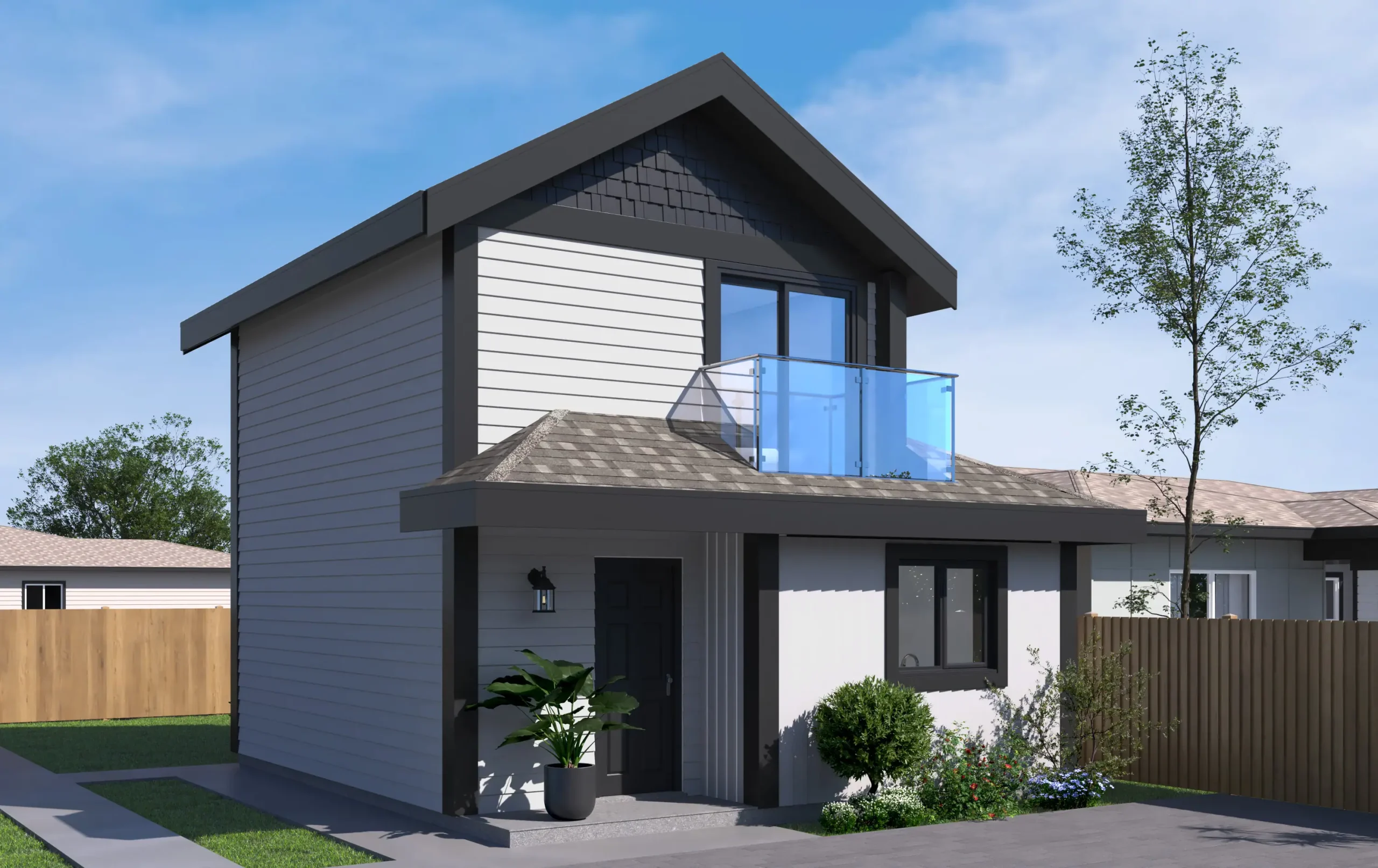
A laneway house is a completely separate, detached dwelling unit built on the rear of your lot, with its entrance fronting the lane rather than the street. It is architecturally and functionally independent from your main house in virtually every sense. It has its own front door, its own kitchen, its own bathroom, its own laundry — and critically, its own utility connections. That means a separate water meter, a separate sewer connection, a separate BC Hydro service, and its own civic address on the lane.
In Vancouver, laneway houses typically range from 400 to 900 square feet, with the maximum size governed by the lot dimensions and zoning rules. Depending on lot size and the specific R1-1 or RS zoning, a laneway house can be one or two storeys. Two-storey laneway houses are common on smaller lots where footprint is constrained but height allowances are available.
From a tenant’s perspective, a laneway house is the most desirable form of secondary rental housing: it feels like a standalone home, not an apartment. There are no shared walls, no shared laundry, no walking past the landlord’s kitchen. The tenant has their own outdoor space (typically the rear yard), their own address, and a level of privacy that basement suites simply cannot match. This is why laneway houses consistently command a 15–25% rent premium over comparable basement suites in the same neighbourhood.
One important note: laneway houses are eligible for short-term rental licensing through the City of Vancouver, provided they are the homeowner’s principal residence. However, this is a nuanced area — if the laneway is rented long-term and the homeowner lives in the main house, STR rules may limit usage. Always verify current City of Vancouver STR licensing requirements before banking on short-term rental income.
The Basement Suite
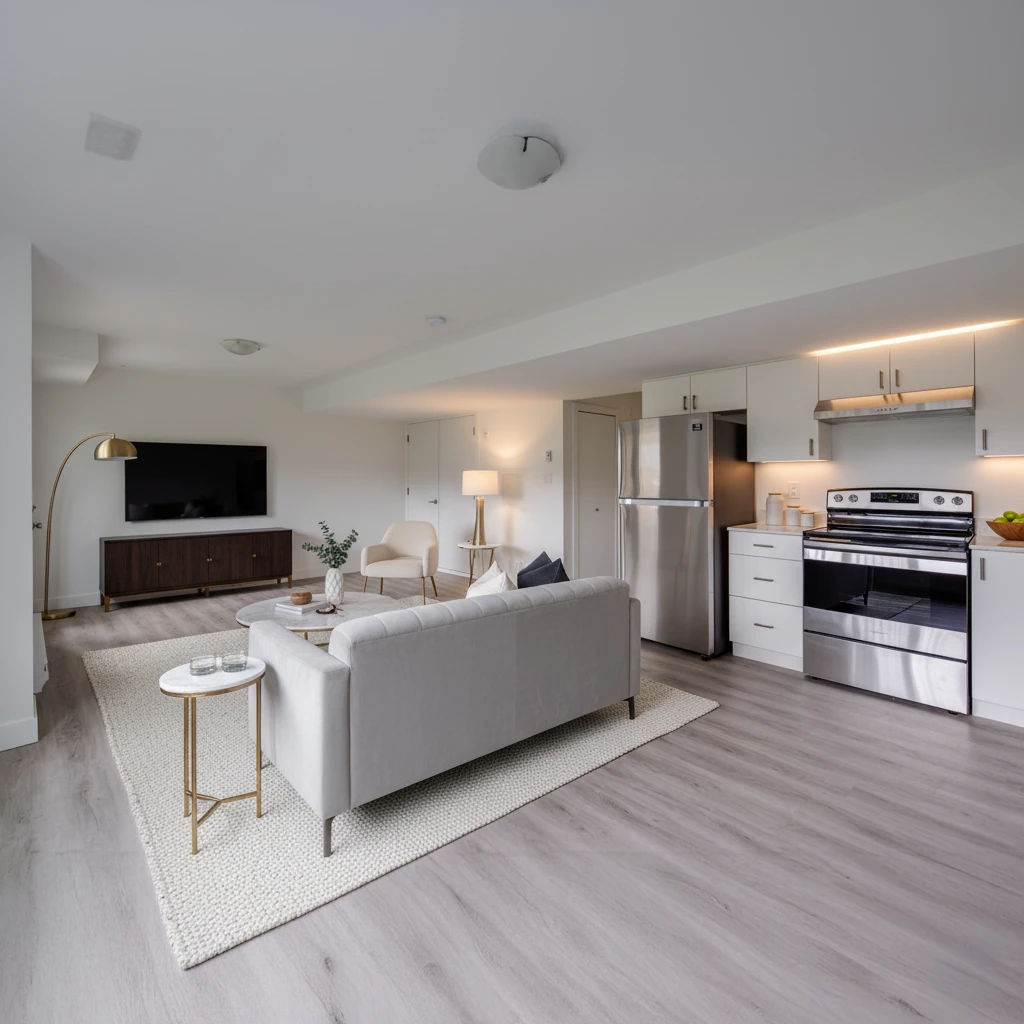
A basement suite is a self-contained dwelling unit built within the existing footprint of your home — typically the basement level, though garden suites and ground-floor suites also exist. To qualify as a legal suite in the City of Vancouver, it must have a separate exterior entrance, a self-contained kitchen, a bathroom, and must meet BC Building Code requirements for ceiling height, egress windows, fire separation, and ventilation.
Basement suites typically range from 400 to 900 square feet depending on the home’s footprint, and can be configured as studios, one-bedroom, or two-bedroom units. Unlike a laneway house, a basement suite shares the building envelope with the main house — same roof, same foundation, same exterior walls — which dramatically reduces construction cost and complexity.
Utility connections for a basement suite are typically shared with the main house, though separate sub-metering for electricity is possible and increasingly common. There is no separate civic address. From a short-term rental standpoint, City of Vancouver STR rules restrict short-term rentals to a homeowner’s principal residence — meaning if you rent your basement suite long-term and live upstairs, you cannot also operate an Airbnb in the suite. The main house could qualify, but the suite itself cannot be rented short-term while a long-term tenant occupies it.
The key advantage of a basement suite is financial accessibility. Most homeowners can execute a high-quality legal basement suite for $70,000–$170,000 all-in, compared to $375,000–$610,000 for a laneway house. This cost difference is the single most important variable in any head-to-head comparison.
For more detail on the basement renovation process, see our complete Vancouver basement renovation guide. If you’re considering the laneway route, our laneway homes page covers the design and approval process in depth.
All-In Cost Comparison: What You Actually Pay
The single biggest mistake homeowners make when researching this decision is comparing headline construction quotes without accounting for soft costs, permit fees, and utility connections. Here is the complete picture.
| Cost Item | Laneway House | Basement Suite |
|---|---|---|
| Design / architectural drawings | $15,000–$35,000 | $3,000–$8,000 |
| Engineering (structural) | $5,000–$12,000 | $1,500–$4,000 |
| City of Vancouver permits + DCLs | $35,000–$65,000 | $3,500–$12,000 |
| Site preparation / excavation | $8,000–$25,000 | $2,000–$8,000 |
| Sewer / water service connection | $25,000–$35,000 | $0–$5,000 (often shared) |
| BC Hydro service upgrade | $5,000–$18,000 | $0–$3,500 |
| Construction (structure + finish) | $280,000–$420,000 | $60,000–$130,000 |
| Total all-in | $375,000–$610,000 | $70,000–$170,000 |
A few critical notes on these numbers:
- Laneway house median all-in (Metro Vancouver, 2025): approximately $480,000. This is what our team sees most often on a typical 33-foot lot in East Vancouver or Burnaby. Larger lots with two-storey laneway houses on the West Side regularly reach $550,000–$610,000.
- Basement suite median all-in (new from raw basement, 2025): approximately $110,000 for a one-bedroom legal suite with full code compliance, separate entrance, proper egress windows, and quality finishes.
- Legalizing an existing non-compliant suite: $35,000–$85,000 depending on what work is required to meet current BC Building Code. Older suites often need ceiling height remediation, fire separation upgrades, and new egress windows.
- Canada Secondary Suite Loan: Available for basement suite construction and legalization — up to $80,000 at a 2% fixed rate. This program does NOT apply to laneway houses, which are classified as separate structures, not secondary suites within an existing dwelling.
The Development Cost Levies (DCLs) charged by the City of Vancouver are a significant and often overlooked component of the laneway house cost. DCLs exist to fund city infrastructure and currently add $25,000–$40,000 to a typical laneway permit — costs that simply don’t apply to adding a suite within an existing structure. This is one of the primary reasons the cost gap between the two options is so large.
Rental Income by Neighbourhood: What Each Option Earns
The following rental rates reflect 2025 market conditions based on our team’s network of clients actively renting their completed projects, supplemented by current CMHC rental market data and local listing analysis. These are achievable rates for well-finished, fully legal, move-in-ready units — not aspirational numbers.
| Neighbourhood | Laneway House (1BR/Studio) | Basement Suite (1BR) | Basement Suite (2BR) |
|---|---|---|---|
| East Vancouver | $2,200–$2,800/mo | $1,800–$2,300/mo | $2,200–$2,800/mo |
| Kitsilano / West Side | $2,500–$3,200/mo | $2,000–$2,600/mo | $2,500–$3,200/mo |
| North Vancouver | $2,200–$2,900/mo | $1,900–$2,400/mo | $2,300–$2,900/mo |
| West Vancouver | $2,800–$3,800/mo | $2,200–$3,000/mo | $2,800–$3,500/mo |
| Burnaby | $2,000–$2,600/mo | $1,700–$2,200/mo | $2,100–$2,700/mo |
| Richmond | $1,900–$2,500/mo | $1,600–$2,100/mo | $2,000–$2,600/mo |
| Surrey | $1,700–$2,200/mo | $1,500–$1,900/mo | $1,800–$2,300/mo |
| Coquitlam | $1,800–$2,300/mo | $1,600–$2,000/mo | $1,900–$2,400/mo |
Laneway houses command a consistent 15–25% rent premium over comparable basement suites across all neighbourhoods. This premium is entirely justified by the tenant experience: full detachment, privacy, no shared walls, a separate outdoor area, and a private address. In practical terms, a laneway house in East Vancouver will typically rent for $2,400–$2,600 per month, while a one-bedroom basement suite on the same block rents for $1,900–$2,100.
The gap narrows for larger basement suites. A well-designed two-bedroom basement suite in Kitsilano or North Vancouver can achieve rents that approach the lower end of the laneway house range — though the laneway still wins on desirability and lease-up speed.
One important variable: vacancy between tenants. Laneway houses in Metro Vancouver typically sit vacant for 1–2 weeks between tenants, sometimes less. Basement suites are similar. For planning purposes, we model 11 months of rental income per year to account for vacancy and turnover.
Payback Period Analysis: How Long Until You Break Even
This is the section that matters most. Let’s work through a real-world scenario using East Vancouver as the example — the most common market our team works in.
Scenario A: Laneway House in East Vancouver
- All-in build cost: $480,000 (median for a 33-foot lot, one-bedroom laneway)
- Monthly rental income: $2,500
- Annual rental income (11 months): $27,500
- Annual operating expenses (property tax allocation, insurance, maintenance reserve): ~$4,500
- Net annual rental income: $23,000
- Simple payback period: 20.9 years
- Canada Secondary Suite Loan: Not applicable — laneway is a separate structure
If you finance the $480,000 build cost through a HELOC or construction mortgage at 6.5%, the annual interest cost on the drawn amount adds approximately $31,200 to your costs in year one — exceeding rental income. The break-even only works if you’re paying cash or have significant home equity to draw from at low rates. This is not a criticism of laneway houses — it’s a financial reality that every homeowner needs to understand before committing.
Scenario B: Basement Suite in East Vancouver (New from Raw Basement)
- All-in build cost: $110,000
- Canada Secondary Suite Loan: $80,000 at 2% fixed, 10-year term = ~$736/month ($8,832/year)
- Net out-of-pocket at build: $30,000
- Monthly rental income: $2,100
- Annual rental income (11 months): $23,100
- Annual loan repayment: $8,832
- Annual operating expenses: ~$2,000
- Annual net cash flow after loan payments: $23,100 – $8,832 – $2,000 = $12,268
- Simple payback on $30,000 out-of-pocket: 2.4 years
- Total cost payback (including full loan): approximately 6.5 years
The contrast is stark. With the Canada Secondary Suite Loan, a homeowner building a basement suite in East Vancouver is cash-flow positive from month one — the rental income exceeds both the loan payment and operating costs. The $30,000 out-of-pocket investment is recovered in approximately two and a half years. By the time the loan is paid off at year 10, the homeowner has generated approximately $122,680 in cumulative net cash flow against a $30,000 personal investment.
The laneway house generates higher absolute rental income ($2,500/mo vs. $2,100/mo), but the cost gap is so large that the basement suite wins decisively on every financial metric: payback period, cash-on-cash return, and total value created relative to investment.
The Bottom Line on Payback
If your primary goal is financial return, the basement suite wins — and it isn’t close. The combination of lower cost, faster construction, simpler permitting, and access to the 2% CMHC loan creates a financial profile that the laneway house simply cannot match. The laneway house earns more income per month, but at 4–5x the cost, the math doesn’t work in its favour on a pure ROI basis.
The laneway house makes financial sense when you factor in non-financial benefits — multi-generational living, long-term land value, or the ability to add a second suite later — but if your spreadsheet is driving the decision, the basement suite is the clear winner.
Property Value Impact: What Each Option Adds to Your Home
Beyond rental income, both options affect the resale value and appraised value of your property. This is particularly important if you’re financing through a HELOC or refinancing after construction.
Laneway house: Metro Vancouver appraisers typically value laneway houses using an income approach, capitalizing the expected annual rental income at prevailing cap rates. In practice, a laneway house in East Vancouver currently adds approximately $350,000–$500,000 to the appraised value of the property. On a $480,000 build cost, this means the laneway house is roughly cost-neutral in terms of appraised value — you spend $480,000 and your property is worth approximately $400,000–$480,000 more. You’re not losing money on paper, but you’re not creating significant value above cost either.
On the open market, however, laneway houses often generate buyer premiums beyond pure income capitalization. Investors, multi-generational families, and buyers seeking a mortgage helper all compete for these properties, frequently pushing sale prices above what income capitalization alone would suggest. In a Vancouver market with persistently low inventory, a property with a detached laneway house can command a significant premium over the pure financial analysis.
Legal basement suite: A well-built legal basement suite adds approximately $180,000–$350,000 to appraised and market value in Metro Vancouver, depending on suite size, quality, and location. Against a $110,000 build cost, this represents a value multiple of 1.6x to 3.2x — meaning you create $1.60 to $3.20 in property value for every dollar you invest. This is an exceptionally strong value multiple by any real estate standard.
The basement suite’s value advantage over cost is more pronounced in markets where detached laneway construction isn’t possible — for example, lots without lane access or in municipalities that don’t permit laneway houses. In those markets, a legal basement suite is the only way to add a rental unit, and buyers pay accordingly.
An important caveat: property value impacts vary significantly by neighbourhood, lot size, and current market conditions. These figures reflect Metro Vancouver broadly in 2025. Before making decisions based on value uplift projections, we strongly recommend consulting a local appraiser and a realtor who specializes in income properties in your specific area.
Permit Complexity Comparison
One of the most underestimated variables in this decision is the permit process. Both options require City permits, but the scope, timeline, and complexity are substantially different.
| Factor | Laneway House | Basement Suite |
|---|---|---|
| Permit type | Building + Plumbing + Electrical + Development | Building + Plumbing + Electrical |
| Permit timeline | 20–32 weeks typical | 8–16 weeks typical |
| Drawings required | Full architectural + structural + energy compliance | Architectural + structural (if opening floors) |
| Development permit | Sometimes required | Not required |
| Lot eligibility check needed | Yes — lane access, lot size, setbacks, FSR | No — most RS and R1-1 lots eligible |
| Zoning restrictions | Must front a lane; minimum lot dimensions apply | Most single-family lots eligible |
| City of Vancouver permit fees + DCLs | $35,000–$65,000 | $3,500–$12,000 |
The laneway house permit process is genuinely complex. You need a full set of architectural drawings (typically 15–25 sheets), structural engineering, an energy compliance report under Step 4 of the BC Energy Step Code, and — depending on your lot — a development permit review that can add 8–12 weeks to the timeline. Our team has seen laneway house permits take as long as 40 weeks on complex lots with heritage overlays or unusual setback situations.
The basement suite permit process is more straightforward. If your home is already sitting on a conforming lot with standard zoning, and you’re not removing bearing walls or modifying the structure, you may only need a building permit and plumbing permit. Architectural drawings are simpler — often 5–8 sheets. Our team typically completes basement suite permits in 8–12 weeks in Vancouver, and often faster in surrounding municipalities like Burnaby or North Vancouver.
There is one important permit consideration that homeowners often overlook: the difference between a legal suite permit and an unpermitted suite. A significant percentage of Vancouver’s basement suites are unpermitted — built without drawings or inspections. If you’re legalizing an existing unpermitted suite, the permit process involves bringing all existing work up to current code, which may require opening walls, upgrading the electrical panel, and installing fire separation. Budget accordingly. An unpermitted suite that generates rental income is also a liability — insurance implications, tenancy agreement enforceability, and sale complications all arise when a suite lacks legal status.
Which Option Is Right for Your Situation?
Based on our team’s experience completing both laneway houses and basement suites across Metro Vancouver, here is the clearest decision framework we can offer.
Choose a Laneway House If:
- Your lot fronts a lane. This is non-negotiable — a laneway house requires lane access. If your lot doesn’t have a lane, this option is off the table entirely.
- You want maximum privacy for your tenant. Full detachment means no shared walls, no shared entrances, no noise bleed-through. The laneway house offers a qualitatively different tenant experience that basement suites cannot replicate.
- You’re comfortable with a 15–25 year payback horizon — or you’re financing the build from equity and the monthly carrying cost is manageable relative to the rental income.
- You want to maximize absolute rental income. The laneway house earns $300–$600 more per month than a comparable basement suite. Over 20 years, that income differential is significant.
- You’re planning for multi-generational use. Adult children, aging parents, or in-laws benefit enormously from the privacy and independence of a laneway house. The financial return is a bonus; the family use case is the primary driver.
- Your lot qualifies under R1-1 zoning and you want to explore the full range of options, including eventually adding a basement suite to the main house as well.
Choose a Basement Suite If:
- You want the fastest possible payback. With the Canada Secondary Suite Loan, most basement suite projects in Metro Vancouver pay back the homeowner’s out-of-pocket investment within 2–4 years. Nothing in residential real estate development comes close to this return profile.
- Your lot doesn’t front a lane or doesn’t qualify for laneway construction under current zoning. Many older RS-1 lots in Vancouver were never designed with lane access — the basement suite is your only path to adding a rental unit.
- Your budget is under $150,000. This is the realistic budget floor for a laneway house including soft costs and permits. Below that, you cannot build a compliant, finished laneway house in Metro Vancouver. Above $150,000 is where basement suites operate, and that range comfortably funds a very high-quality legal suite.
- You want a simpler process. The permit timeline for a basement suite is roughly half that of a laneway house. From initial consultation to tenants moved in, a basement suite project typically takes 6–10 months. A laneway house is typically 14–24 months from start to occupancy.
- You qualify for the Canada Secondary Suite Loan. If you are eligible for the $80,000 at 2% CMHC program, the financial case for the basement suite becomes overwhelming. No competing financial incentive exists for laneway house construction.
- You want maximum property value uplift relative to your investment. A $110,000 basement suite that adds $220,000–$300,000 in property value is a value-creation story that stands on its own, independent of rental income.
Consider Both If:
- Your lot qualifies for both options — it fronts a lane, is RS or R1-1 zoned, and has the minimum dimensions for a laneway house.
- You have the budget — a combined laneway + basement suite project typically costs $550,000–$780,000 all-in, but generates $4,300–$5,500/month in combined rental income ($51,600–$66,000/year).
- You’re thinking about the R1-1 multiplex route. Under R1-1, qualifying lots can accommodate up to 6 dwelling units. A main house + basement suite + laneway house is already 3 units. Adding a laneway suite (a secondary unit within the laneway house) takes you to 4. Our renovation planning guide covers the multiplex pathway in detail.
Tax Considerations
Tax treatment of rental income is often misunderstood, and both options have implications that are worth addressing directly — though we strongly recommend consulting a CPA or tax advisor for your specific situation.
Rental income is taxable: Both laneway house and basement suite rental income is reported as rental income on your personal tax return (T776). There is no way around this, and it would be foolish to omit it — rental income and mortgage interest deductions are both reported to CRA through various channels.
Operating expense deductions: The silver lining is that rental income comes with extensive deductions. You can deduct the portion of your property taxes allocated to the rental unit, a portion of your home insurance, utilities (if you pay them for the tenant), mortgage interest allocated to the rental space, maintenance and repair costs, and advertising costs for finding tenants. These deductions meaningfully reduce the net taxable rental income — in many cases by 20–35%.
Capital Cost Allowance (CCA): You can technically claim CCA on the depreciable portion of the suite or laneway house construction, which reduces current-year taxable income. However, CCA is fully recaptured as income when you sell the property, creating a tax liability at sale. For most homeowners who intend to sell eventually, claiming CCA creates a deferred tax problem rather than a benefit. Most tax advisors recommend against claiming CCA on personal rental properties.
Principal residence exemption — the most complex issue: This is where laneway houses and basement suites diverge significantly. Your main house continues to qualify for the principal residence exemption (PRE) regardless of which option you choose, provided you live there. A basement suite within your home does not create a separate property for PRE purposes — the full lot remains your principal residence.
A laneway house, however, sits on the same legal lot as your main home but is a distinct structure. CRA’s position on PRE eligibility for the laneway house portion of the property is nuanced and fact-specific. In general, where the lot is sold as a single property, the PRE may apply to the entire lot including the laneway — but this is not guaranteed, and CRA has increasingly scrutinized mixed-use properties. Given the potential six-figure tax implication on a $500,000+ structure, this is not an area where you want to rely on general advice. Engage a CPA who specializes in real estate taxation before you build.
GST/HST considerations: New laneway house construction may be subject to GST. If you build a laneway house and rent it long-term as residential accommodation, you may be eligible for a GST New Residential Rental Property Rebate. If you sell the property within a certain period of converting it to rental use, GST complications can arise. This is another area requiring a qualified tax professional’s input.
Basement suite renovations: There is no GST on renovation work to an existing residential dwelling. The $110,000 basement suite build cost is GST-exempt from a renovation standpoint, making it more financially clean from a tax perspective than a new laneway house.
Our Recommendation
We’ve worked with enough Vancouver homeowners to say this clearly: for the majority of homeowners asking this question, the basement suite is the right starting point.
The financial case is overwhelming. A $110,000 investment that generates $23,000/year in rental income, adds $200,000–$280,000 to your property value, and qualifies for $80,000 in 2% government financing is one of the best risk-adjusted investments available to a Vancouver homeowner. The permit process is manageable, the timeline is reasonable, and the ongoing complexity is low.
The laneway house makes sense — and we’ve built beautiful ones — but it requires a specific set of circumstances: a qualifying lot with lane access, a budget of $400,000+, a long investment horizon, and a clear non-financial rationale (usually multi-generational living) that justifies the cost premium over the basement suite. If you’re making this decision purely on financial grounds and your lot qualifies for both options, start with the basement suite. Bank the rental income for 3–5 years, build equity, and then revisit the laneway house from a much stronger financial position.
If your lot doesn’t front a lane, the decision is made for you: the basement suite is your path to rental income, and it’s an excellent one.
Ready to get started? Our team provides free consultations and site assessments across Metro Vancouver. Use our renovation guide to understand the full process, or explore our laneway homes portfolio if you’re leaning in that direction.
More Laneway Homes & Multiplexes Guides

Laneway House vs. Secondary Suite in Vancouver: Which is the Better Investment?

Prefab vs. Custom-Built Laneway House in Vancouver: Complete Comparison for 2026

Duplex vs. Secondary Suite in Vancouver: Which Maximizes Your Investment Return?

Strata vs. Rental for Your Vancouver Duplex: Which Makes More Financial Sense?
Garden Suite vs. Laneway House in Vancouver: Key Differences and Which to Choose
Ready to start your renovation?
Frequently Asked Questions
Can I build both a laneway house AND a basement suite on my Vancouver property?
Yes — if your lot is eligible. Under R1-1 zoning and the City of Vancouver’s current rules, a qualifying single-family lot can have a main dwelling, a secondary suite (basement), and a laneway house simultaneously. The lot must front a lane and meet minimum size requirements for the laneway house. This three-unit configuration is increasingly common on larger lots and is the starting point for the full R1-1 multiplex pathway.
Does my lot qualify for a laneway house?
The primary requirement is that your lot fronts a back lane. Beyond that, the lot must meet minimum dimensions under the applicable zoning (typically a minimum of 25–28 feet of lot width for a small laneway, and specific rear yard setback requirements). The City of Vancouver has an online zoning map and our team can conduct a free lot eligibility assessment. Many homeowners are surprised to find their lot qualifies — especially after the R1-1 zoning changes broadened eligibility in 2023.
Can I use the Canada Secondary Suite Loan for a laneway house?
No. The Canada Secondary Suite Loan is specifically for secondary suites within existing dwellings — basement suites, garden suites, and similar units within the footprint of an existing home. A laneway house is a new, detached structure and does not qualify. If you are building a laneway house, you will need to finance it through conventional construction financing, a HELOC, or home equity refinancing.
What’s the minimum lot size for a laneway house in Vancouver?
Under the City of Vancouver’s R1-1 zoning, lots must generally be at least 25 feet wide and have lane access to accommodate a laneway house. The allowable footprint and maximum floor area ratio depend on the lot dimensions. A 33-foot lot — the standard in much of East Vancouver — comfortably accommodates a 400–600 sq ft laneway house. Smaller lots are possible but constrain the footprint significantly. We recommend a formal zoning review before committing to the project.
Do I need strata approval to add a basement suite?
This question only arises if you own a strata lot — a townhouse or a portion of a stratified property. If you own a standard detached single-family home (RS or R1-1 zoned), there is no strata and no strata approval is needed. For strata owners, adding a secondary suite typically requires strata council approval and may be prohibited by the strata bylaws entirely. Review your strata documents carefully.
Can I Airbnb my laneway house in Vancouver?
Only if the laneway house is your principal residence — which means you must live in it, not the main house. If you live in the main house and rent the laneway long-term, the laneway house does not qualify as your principal residence and cannot be separately licensed for STR. The City of Vancouver’s short-term rental rules restrict STR licenses to a property owner’s principal dwelling. Always verify current rules with the City directly, as STR regulations are subject to frequent revision.
How does a laneway house affect my property taxes?
A laneway house increases the assessed value of your property, which increases your annual property tax. The increase depends on the assessed value of the laneway house — typically in the range of $300,000–$500,000 in Metro Vancouver. At Vancouver’s current residential mill rate (approximately 0.26% of assessed value), a $400,000 laneway house adds approximately $1,040 per year in property tax. This is a manageable operating cost relative to $2,500/month in rental income, but it should be included in your pro forma.
What happens to my principal residence exemption if I build a laneway house?
This is a genuinely complex tax question and the answer depends on how and when you sell, how long you’ve rented the laneway, and CRA’s current administrative position. In general, if you sell the entire property as one legal lot, the PRE may apply to the full lot — but CRA has taken varying positions on properties with multiple structures generating rental income. The risk is that a portion of any capital gain attributable to the laneway house is taxable. Engage a CPA with real estate tax expertise before building, not after.
Can I get a construction mortgage to build a laneway house?
Yes, though the options are more limited than for a new primary home. Some lenders offer construction draws secured against your existing home equity, advancing funds in stages as construction milestones are reached. A HELOC is the most flexible approach if you have sufficient equity — draw what you need, when you need it. Conventional construction mortgages for laneway projects exist but typically require significant equity in the existing property (usually 35%+ loan-to-value after the project is complete). Our team works with several lenders who specialize in this type of financing and can provide introductions.
Is rental income from a basement suite taxable?
Yes. All rental income in Canada is taxable as personal income and must be reported on a T776 (Statement of Real Estate Rentals). However, you can deduct allowable expenses including a proportional share of property taxes, insurance, maintenance, and mortgage interest. In practice, many homeowners find that deductible expenses offset a significant portion of the gross rental income. Keep all receipts and consult a tax accountant for proper filing.
Which option gives me more privacy as a homeowner?
The laneway house wins decisively on privacy — for both the homeowner and the tenant. A fully detached structure with its own entrance, yard access from the lane, and no shared walls means the homeowner and tenant can live completely independently. With a basement suite, you share a building and potentially hear each other through the floor. Thoughtful acoustic insulation during construction significantly reduces sound transmission in a basement suite, but it cannot fully replicate the separation of a detached laneway house.
Can a basement suite tenant access my backyard?
This depends entirely on how the suite entrance is designed and what your tenancy agreement specifies. Many basement suites have side-yard or rear-yard entrances that require crossing shared outdoor space. We recommend designing a clear physical separation — a fence, a defined path, separate outdoor areas — and specifying exclusive use of outdoor areas clearly in the tenancy agreement. The BC Residential Tenancy Act allows landlords and tenants to define shared space use in the agreement.
What maintenance costs should I budget for a laneway house vs. a basement suite?
A laneway house has more maintenance exposure because it’s a complete building with its own roof, exterior envelope, mechanical systems, and utility infrastructure. Budget approximately $2,500–$4,500 per year for a well-built laneway house — this covers routine maintenance, appliance replacements, and an annual reserve for major items (roof, hot water tank, etc.). A basement suite, sharing the building envelope with the main house, typically runs $1,000–$2,500 per year in incremental maintenance costs. The basement suite’s maintenance savings are another factor in its stronger net return profile.
Can I convert a laneway house to a short-term rental?
Only under the circumstances described above — the laneway must be your principal residence. If you built a laneway house as a long-term rental and wish to convert to STR, you would need to move into the laneway yourself (making it your principal residence) and apply for a City of Vancouver STR license. Converting a currently long-term-tenanted laneway to STR requires complying with BC’s residential tenancy laws around ending a tenancy, which have specific notice and compensation requirements.
How does R1-1 zoning change my options in Vancouver?
The R1-1 zoning district, introduced in 2023, replaced most former RS zoning across Vancouver and significantly expanded what’s permitted on single-family lots. Under R1-1, qualifying lots can support up to 6 dwelling units — a main house, secondary suite, laneway house, and additional units depending on lot size and configuration. R1-1 also removed many of the historical restrictions on secondary suites (minimum lot sizes, restrictions on suite size relative to main house), making it faster and cheaper to add rental units. If you purchased a home under the old RS-1 or RS-2 zoning designations, your property has almost certainly been rezoned to R1-1 — check the City of Vancouver’s zoning map for current designation. Our renovation planning guide has a detailed section on R1-1 and what it means for your specific lot.
Get a Free Renovation Quote
Metro Vancouver’s trusted general contractors. Free consultations across Vancouver, Burnaby, Richmond, North Shore & beyond.
Get Your Free Quote →VGC serves Vancouver and surrounding areas. View all renovation services in Vancouver →

Comments are closed