




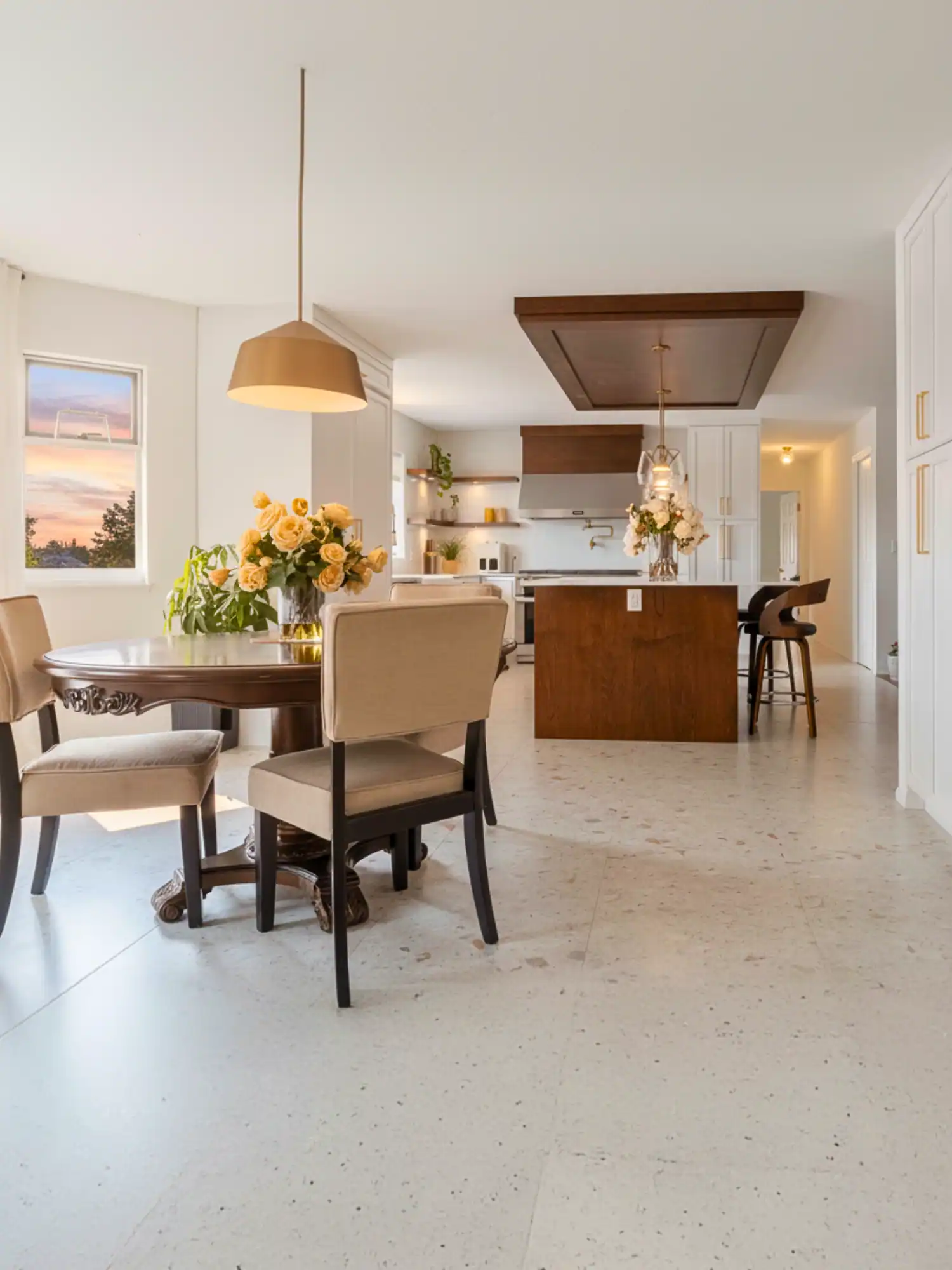
Open Concept Renovation in Vancouver: Costs, Structural Reality, and What Contractors Find in Your Walls (2026)
The walls that divide Vancouver kitchens from living rooms were not designed with 2026 in mind. They were framed in an era when cooking was a private activity, when separate dining rooms signalled formality, and when natural light was something that happened to one room at a time. Today, those same walls block light, fragment space, and reduce resale value on homes that could otherwise command a premium.
Open concept renovation is consistently one of the highest-return projects a Vancouver homeowner can undertake — but it is also one of the most technically complex. The moment you consider removing a wall in a 1960s bungalow or a Vancouver Special, you are entering the territory of structural engineering, building permits, hidden mechanical systems, and costs that vary enormously depending on what is behind the drywall. This guide covers all of it: what the work actually costs in 2026, how to identify a load-bearing wall, what permits are required, what contractors regularly find inside Vancouver walls, and what the renovation return looks like in today’s market.
What Is an Open Concept Renovation and Why Is It So Popular in Vancouver?
An open concept renovation removes the walls that separate the kitchen, dining room, and living room — replacing a collection of individual rooms with a single unified great room. The result is a space where someone cooking can see the television, where guests at the island are part of the conversation in the living room, and where natural light from rear windows can reach the front of the house.
The only definitive answer about whether a wall is load-bearing comes from a licensed structural engineer
Vancouver General Contractors
The demand for this transformation in Vancouver is driven primarily by the city’s housing stock. The vast majority of detached and semi-detached homes in Vancouver, Burnaby, North Vancouver, and the broader Metro area were built between 1940 and 1985. Every one of those homes was built with a compartmentalized floor plan: a closed kitchen in the back corner, a formal dining room in the middle, and a living room at the front. The floor plan made sense for its era. It makes no sense for how people actually live today.
The home types most commonly requesting open concept renovation in Vancouver follow a predictable pattern. Vancouver Specials — those ubiquitous two-storey homes built between 1965 and 1985 across East Vancouver, Burnaby, and surrounding municipalities — have a pronounced central bearing wall that bisects the entire main floor. Bungalows in Kitsilano, Mount Pleasant, and East Van typically have a kitchen-to-living-room dividing wall that blocks light and creates a cramped, dated feel. Ranchers from the 1970s often have a formal dining room that nobody uses and a kitchen that feels isolated. Two-storey homes from the 1960s and 1970s frequently have a dark kitchen at the rear with no sightlines to the rest of the house.
Vancouver’s real estate market adds a financial dimension to the decision. Real estate agents consistently report a five to twelve percent value increase on listings where the main floor has been opened. On a $1.5 million East Vancouver home, that is a $75,000 to $180,000 increase in list price. The renovation that produced the open concept typically costs $35,000 to $75,000. The arithmetic is favourable in most cases.
That said, open concept is not universally the right choice. Post-pandemic, a meaningful segment of Vancouver homeowners who work from home have rediscovered the value of acoustic separation. Cooking smells travel freely through an open plan. Noise from the kitchen — dishwashers, range fans, morning coffee routines — reaches the living and sleeping areas without a wall to absorb it. The design decision should match the household’s actual lifestyle, not simply follow the trend.
Is Your Wall Load-Bearing? How to Tell in Vancouver Homes
The single most important determination in any open concept project is whether the wall you want to remove is load-bearing. A load-bearing wall carries the weight of the structure above it — floor joists, upper storey, roof — and transfers that load down to the foundation. Removing it without installing an engineered beam to replace the load path causes structural failure. This is not a theoretical risk; it is a documented cause of home collapse.
The only definitive answer about whether a wall is load-bearing comes from a licensed structural engineer. In Metro Vancouver, a residential structural engineer consultation costs $800 to $1,800 for an assessment and preliminary determination. If stamped drawings are required for a permit — and they almost always are for load-bearing work — expect $1,200 to $2,500 total. This is not an optional expense. It is the foundation of a safe and permitted project.
There are DIY indicators that can guide your thinking before the engineer visit, but none of them are definitive. A wall running perpendicular to the floor joists — visible from the basement below — is more likely to be load-bearing, because joists typically bear on top of it. A wall positioned directly above the main beam in the basement is a strong indicator of a load path. A wall that appears in the same location on every floor of the house is likely structural. A wall running parallel to the joists, with no wall below it in the basement and no wall above it on the next floor, is more likely non-load-bearing.
Vancouver Specials have a known structural signature that VGC encounters on every project: a central bearing wall that runs the full width of the main floor, typically positioned roughly in the centre of the house. This wall carries the upper floor, the central roof beam, and the ceiling joists. It is always load-bearing. There is no version of a Vancouver Special where the central wall is non-structural.
Bungalows in Vancouver and Burnaby typically have a central bearing wall supporting the ceiling joists, running perpendicular to the ridge. The kitchen-living dividing wall in these homes is often this same central bearing wall, which is why a simple-looking kitchen opening becomes a structural engineering project.
In 1960s and 1970s two-storey homes, the kitchen-living room dividing wall is more often parallel to the floor joists and does not carry upper-floor load. These are the more straightforward cases — but they still require verification, because electrical panels, branch circuits, plumbing stacks, and HVAC ducts can run through walls that are structurally non-bearing.
VGC’s standing rule: we confirm wall classification with a structural engineer before finalizing any open concept quote. A contractor who tells you a wall is not load-bearing based on a visual inspection alone — without engineer involvement — is not providing you with a safe or insurable assessment.
Open Concept Renovation Cost in Vancouver
Cost for open concept renovation in Vancouver in 2026 ranges from $3,500 for a simple non-load-bearing wall removal to $140,000 for a combined open concept and full kitchen renovation. The range is wide because the variables are significant: wall length, whether it is load-bearing, span of the beam required, what mechanical systems are hidden inside, permit complexity, and the finish level of the surrounding work.
| Scope | Description | Cost Range |
|---|---|---|
| Non-load-bearing wall removal | Single wall, patch and paint | $3,500–$8,000 |
| Load-bearing wall removal (simple) | Beam + posts in single-storey | $15,000–$30,000 |
| Load-bearing wall removal (complex) | Two-storey with transfer load | $25,000–$55,000 |
| Full main floor open concept | Multiple walls, structural, finishes | $35,000–$75,000 |
| Open concept + kitchen renovation | Complete transformation | $80,000–$140,000 |
For a typical load-bearing wall removal on a Vancouver bungalow or two-storey home, the cost breakdown looks like this:
| Item | Cost |
|---|---|
| Structural engineer (assessment + drawings) | $1,200–$2,500 |
| Temporary shoring | $800–$2,000 |
| Steel or LVL beam supply | $1,500–$6,000 |
| Beam installation + posts | $2,000–$5,000 |
| New footings (if required) | $2,500–$6,000 |
| Electrical relocation | $800–$3,000 |
| Plumbing relocation (if applicable) | $1,500–$5,000 |
| HVAC duct relocation | $800–$3,000 |
| Drywall patch, skim coat, and paint | $2,500–$6,000 |
| Flooring patch | $1,500–$4,000 |
These figures are based on Vancouver labour rates and current material costs. They do not include kitchen cabinetry, countertops, appliances, or any finishing work beyond closing up the walls and floor where the removed wall previously stood. A complete kitchen renovation added to this scope adds $45,000 to $90,000 depending on specification.
The cost range for any given project is wide because of what is unknown before demolition begins. A wall that contains a 200-amp subpanel feed, a cast-iron plumbing stack, and two HVAC supply ducts costs dramatically more to remove than the same wall with nothing inside it. Experienced contractors price for the likely scenario and include a contingency allowance for discoveries. Be cautious of fixed-price quotes that do not account for mechanical relocation — they are either based on an unusually thorough pre-demolition investigation, or they do not cover what they appear to cover.
The Beam: The Most Important Decision in Open Concept
When a load-bearing wall is removed, something must carry the load it was carrying. That something is a beam — a horizontal structural member spanning the opening and transferring the load to posts or columns at each end, which carry it down to the foundation. The beam is the most consequential element of any open concept project, and its sizing is determined by a structural engineer’s calculations, not by a contractor’s preference or experience.
The two primary beam materials used in Metro Vancouver residential open concept work are LVL (Laminated Veneer Lumber) and steel W-flange beams. Each has specific applications and cost profiles.
LVL Beam
LVL — Laminated Veneer Lumber — is an engineered wood product made from thin wood veneers bonded under pressure with structural adhesives. It is dimensionally stable, predictably strong, and significantly more capable than dimensional lumber of the same depth. LVL beams are the standard solution for residential open concept spans of 12 to 18 feet. Supply cost for a typical residential LVL beam runs $1,200 to $4,000 depending on depth, length, and the number of plies required. LVL beams are installed by carpenters and do not require steel fabrication or welding trades.
Steel W-Flange Beam
For longer spans, heavier tributary loads, or situations where minimizing beam depth is a priority, structural engineers specify steel W-flange (wide flange) beams. Steel can carry greater loads at shallower depths than wood, which matters when the goal is to conceal the beam within the ceiling plane. Supply cost for a steel W-flange beam in typical residential sizes runs $2,500 to $6,000. Steel beams require a crane or equipment hire for installation, and coordination with a certified welder or steel contractor for any field modifications. Total installed cost, including supply and labour, is typically $4,000 to $10,000 for the beam element alone.
Flush vs. Dropped Beam
The beam’s relationship to the ceiling plane is a critical design decision. A flush beam is concealed within the ceiling structure — the bottom of the beam sits at the same level as the underside of the surrounding ceiling joists, making it invisible once drywalled. This is the most visually desirable result and the one most clients want. Achieving it requires that the ceiling structure has sufficient depth to house the beam, which is not always the case in older Vancouver homes with shallow ceiling framing. When flush installation is not possible, a dropped beam is the alternative: the beam hangs below the ceiling plane and is visible in the finished space. Dropped beams can be drywalled into a bulkhead or wrapped in wood for an intentional design statement, but they are a compromise compared to a true flush installation.
Posts and Columns
The beam must transfer its load to the foundation at each end via posts or columns. Posts can be concealed within existing wall stubs — short sections of wall left at the perimeter — or they can be exposed as a design element. Steel columns wrapped in wood cladding are a popular finish treatment in Vancouver renovation projects. The critical point is that post loads must be traced all the way to the foundation: if the posts bear on a floor structure that was not designed for that concentrated load, new footings or foundation reinforcement may be required. This is a common source of unexpected cost in open concept projects and is something VGC’s structural engineers assess as part of every load-bearing wall removal.
Vancouver Specials present a particular beam challenge. The central bearing wall on a Vancouver Special typically runs the full width of the main floor — 28 to 32 feet in most cases. Spanning that opening in a single beam is not structurally practical. The standard approach is to introduce one or two intermediate posts, reducing the beam span to manageable segments of 12 to 18 feet each. A flush steel beam with two intermediate posts, properly coordinated with finish design, allows the space to read as open while remaining structurally sound.
Permit Requirements for Open Concept Work in Vancouver
Open concept renovation in the City of Vancouver requires building permits. This is not a matter of interpretation — it is the position of Vancouver Building Services, and it applies to both load-bearing and non-load-bearing wall removal.
The City of Vancouver’s building bylaw requires a permit for any structural change to a building, and wall removal is classified as a structural change regardless of whether the wall carries load. In addition to the building permit, open concept projects typically require an electrical permit for any circuit relocation, and a plumbing permit if any plumbing is being moved. Each permit is a separate application and separate fee.
Permit fees for a typical open concept scope in Vancouver run $800 to $3,500. The fee is calculated based on the value of construction, so more extensive projects with higher stated construction values attract higher permit fees.
Processing time at Vancouver Building Services is the most significant timeline variable in open concept projects. Standard processing currently runs six to twelve weeks from application to permit issuance. Fast-track processing may be available for simpler scopes — wall removal only, no mechanical relocation — but fast-track eligibility is determined by the city, not the applicant. Burnaby, North Vancouver, and other Metro municipalities have their own permit offices with their own processing timelines, which vary.
Required documents for a permit application typically include engineer-stamped beam design drawings showing the beam size, post locations, and load path, along with a floor plan clearly indicating which wall is being removed and the scope of associated work. For projects involving plumbing or electrical relocation, additional drawings showing the new routing are required.
The most common permit mistake VGC encounters is homeowners who removed a wall without permits — sometimes years before the current owner purchased the home — and are now discovering the unpermitted work when attempting to sell or refinance. Unpermitted structural work creates disclosure obligations for the seller, can cause mortgage financing to stall, and in some cases requires the work to be exposed and inspected before it can be accepted. The cost of retroactively permitting structural work typically exceeds the original permit cost by two to five times, because engineer drawings must be produced after the fact and the city may require invasive inspection of concealed work.
Wiring, Plumbing, and HVAC: What’s Hidden in Vancouver Walls
The wall you want to remove is, in Vancouver homes built before 1990, rarely just a wall. It is a conduit for the mechanical systems that make the house function. What is inside that wall is the primary driver of cost variance in open concept projects, and it is not knowable without opening the wall or doing invasive investigation.
Electrical
Almost every main-floor dividing wall in a Vancouver home built between 1950 and 1985 has electrical in it. At minimum, this means switched outlets and possibly lighting circuits. In many cases it means a circuit feeding the subpanel, a kitchen circuit for above-counter appliances, or a dedicated circuit for the refrigerator or dishwasher. Relocating a circuit costs $800 to $3,000 per circuit depending on the routing distance and complexity.
The more significant electrical discovery is knob-and-tube wiring. Homes built before approximately 1960 in Vancouver frequently still have original knob-and-tube wiring, or a combination of knob-and-tube and subsequent additions. Knob-and-tube wiring is not compatible with modern junction practices, and once it is discovered during a renovation, building inspectors and insurance companies require it to be addressed. Rewiring a Vancouver home from knob-and-tube to modern wiring costs $15,000 to $35,000 for a typical detached house. This is a legitimate and necessary expense, but it can double or triple the budget of an open concept project that started as a wall removal.
Plumbing
The kitchen wet wall — the wall behind the sink — contains the drain stack, water supply lines, and vent pipe. If the wall you want to remove is the kitchen’s wet wall, or if it contains any portion of the drain stack, the plumbing must be rerouted. There is no shortcut: the plumbing has to go somewhere, and somewhere means rerouting through the floor cavity, the basement, or an island structure. Plumbing relocation for open concept work runs $2,000 to $8,000 depending on the complexity of the rerouting and whether the island needs new stub-ups for a sink or dishwasher.
Cast iron drain pipes in homes built before 1975 add complexity. Cast iron is heavy, difficult to modify, and sometimes corroded to a point where it makes sense to replace the entire stack rather than modify a section. If a plumber opens a wall and finds cast iron in poor condition, expect the scope to expand.
HVAC
Forced-air heating systems in Vancouver homes from the 1960s, 1970s, and 1980s typically route supply ducts through floor cavities and sometimes through interior walls. A main-floor dividing wall may contain a supply duct feeding the living room, a return air grille serving the same area, or a duct chase connecting basement mechanical to upper floor distribution. Relocating HVAC ductwork costs $1,500 to $5,000 per duct run depending on the routing complexity.
In cases where duct relocation is impractical — for example, where the ceiling structure does not allow new duct routing — a ductless mini-split system can supplement or replace the lost distribution, providing both heating and cooling to the newly opened area.
Asbestos
Pre-1980 Vancouver homes may contain asbestos-containing materials in wall construction — particularly vermiculite insulation, sprayed fireproofing on structural steel, and certain acoustic ceiling or wall textures. Before any demolition of walls in a home built before 1980, an asbestos assessment by a qualified assessor is strongly recommended. If asbestos-containing materials are identified, abatement by a licensed asbestos contractor is required before demolition proceeds. Asbestos abatement costs $1,500 to $8,000 depending on the area and material type.
The Vancouver Special Open Concept: VGC’s Most Common Project
The Vancouver Special is the house type that defines Metro Vancouver’s residential renovation landscape. Built by the thousands between 1965 and 1985, these two-storey homes sit on standard 33-foot lots across East Vancouver, Burnaby, New Westminster, and North Vancouver. Their floor plans are instantly recognizable: a main floor with a living room at the front, a dining room in the middle, and a kitchen at the back — all separated by the central bearing wall.
That central wall carries the upper floor, the central roof beam, and the ceiling joists of the main floor. It runs the full width of the house — typically 28 to 32 feet on a standard lot. It almost always contains at minimum two electrical circuits, and frequently a plumbing stack or an HVAC duct run. VGC has completed open concept renovations on dozens of Vancouver Specials, and the central wall is never empty.
Removing the Vancouver Special central wall fully — creating a single open great room across the entire main floor — requires a steel W-flange beam with two intermediate posts, engineer-stamped drawings, a building permit, and significant mechanical relocation. Total cost for this transformation runs $18,000 to $45,000 for the structural and mechanical work alone. With flooring patched end-to-end, drywall and paint throughout, and new kitchen layout to suit the open plan, total project cost is typically $35,000 to $65,000.
A more modest intervention — creating a wide pass-through opening or removing a portion of the central wall while retaining structural sections — costs $8,000 to $18,000. This approach preserves some zoning between kitchen and living areas while dramatically improving light and connection between spaces.
VGC’s most common Vancouver Special transformation is full wall removal with a flush steel beam, a new kitchen island to define the cooking zone, and hardwood floors patched to run continuously from front to rear of the main floor. The before-and-after is dramatic: the main floor goes from a series of dark, undersized rooms to a cohesive 600 to 800 square foot great room that feels contemporary and functional. On a $1.5 to $2.0 million East Van Vancouver Special, this transformation routinely adds $60,000 to $100,000 to the property’s market value — a return well in excess of the renovation cost.
Design Considerations for Open Concept in Vancouver
Removing walls is the structural act; designing the resulting space is the creative one. Open concept renovation does not automatically produce a beautiful or functional space — it produces a large undivided floor plate that requires intentional design to work well.
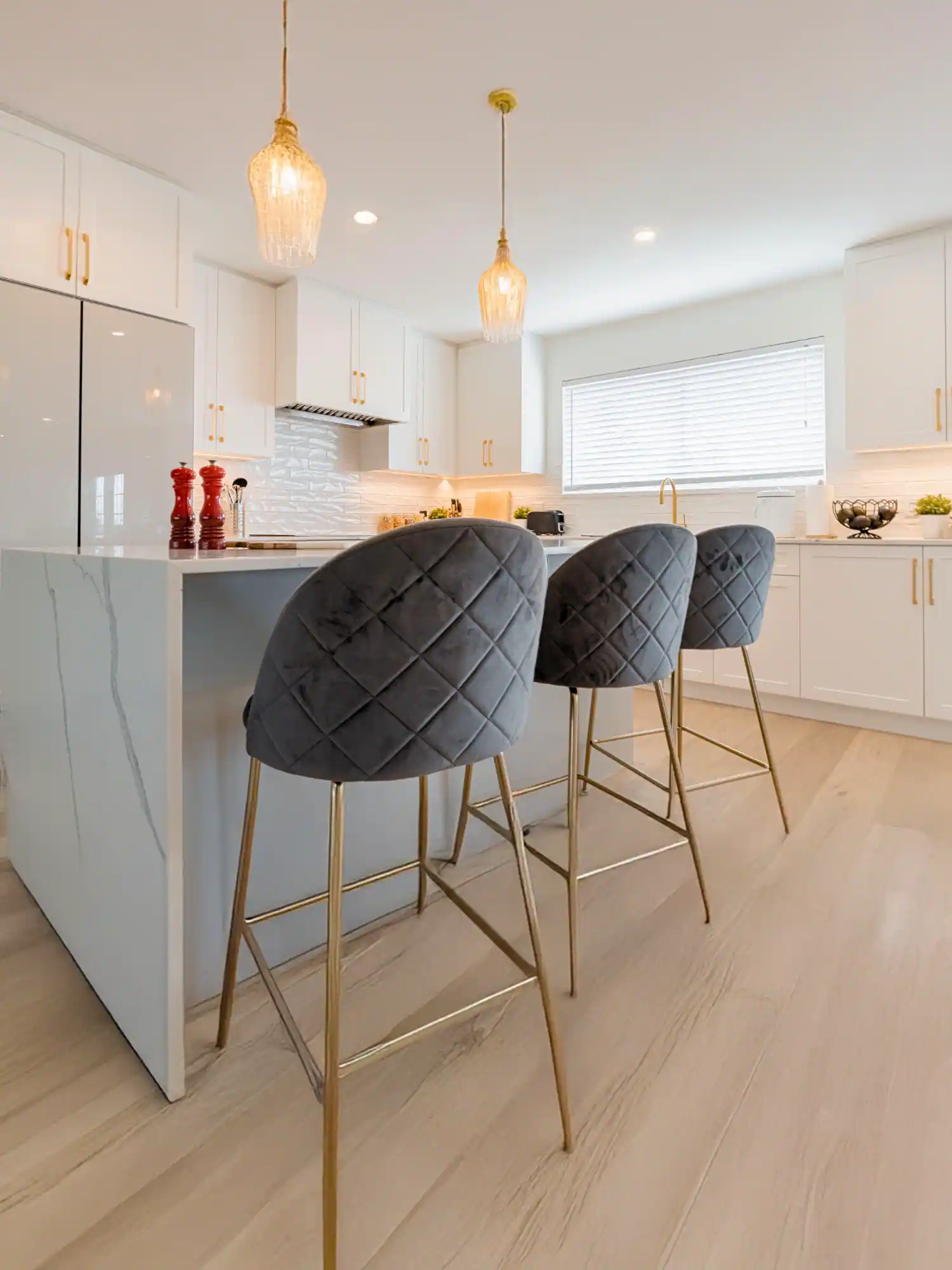
The most effective open concept main floors define zones through means other than walls. A kitchen island — ideally with seating — creates a clear boundary between cooking and living areas without blocking sight lines or light. Area rugs anchor the seating area and signal to the eye where the living room begins. Pendant lighting over the island and recessed lighting zones in the living and dining areas create distinct atmospheres within the same open volume. Ceiling details — exposed beams, a dropped bulkhead demarcating the dining zone, a coffered ceiling over the living area — create definition without obstruction.
Acoustic management is a genuine challenge in open concept spaces and should be addressed in the design phase rather than after the fact. A powerful range hood — 600 CFM or higher for serious cooking — is essential; kitchen noise in an open plan is significantly more intrusive than in a closed kitchen. Ceiling insulation between the main floor and the upper storey reduces the transmission of cooking and living noise to bedrooms above. Solid-core interior doors to bedrooms provide meaningful acoustic separation. Area rugs and upholstered furniture absorb sound within the open volume itself.
Storage loss is a practical consequence of wall removal that is frequently overlooked in the excitement of the concept phase. Every removed wall eliminates potential storage — closets, built-in shelving, pantry space. The design response should include compensatory storage: a kitchen island with deep base cabinets, a custom built-in at the transition from living to dining, or a full-height pantry cabinet to replace volume lost when the kitchen wall came down.
Sightlines from the entry to the kitchen are a specific consideration for Vancouver homes. In an open plan, the kitchen is visible from the front door. This is a selling feature when the kitchen is organized and clean; it is a liability when the kitchen is cluttered. Open shelving in the kitchen is a popular design choice, but it requires a consistently edited and organized display. Closed upper cabinets on the wall visible from the entry are a more forgiving alternative.
Natural light is one of the most compelling arguments for open concept renovation in Vancouver. The city’s long, grey winters make the ability to see natural light from the rear of the house — a garden, a deck, a south-facing window — while standing anywhere on the main floor a genuine quality-of-life improvement. Open concept renovation, more than almost any other single renovation, transforms how a Vancouver home feels to live in during the months when it matters most.
How Long Does Open Concept Renovation Take?
Timeline for open concept renovation in Vancouver depends primarily on whether a permit is required and how long permit processing takes. The actual construction work is relatively fast. The permit queue is not.
| Phase | Duration |
|---|---|
| Engineer assessment + drawings | 1–2 weeks |
| Permit application to issuance | 6–12 weeks |
| Temporary shoring setup | 1–2 days |
| Wall demolition + beam installation | 3–7 days |
| Mechanical relocation | 3–10 days |
| Drywall and finishing | 5–10 days |
| Floor patch and paint | 3–7 days |
For a non-load-bearing wall removal with no mechanical complications — the simplest open concept scope — total construction time is one to two weeks. For a load-bearing wall removal with engineer drawings, permit, beam installation, and mechanical relocation, the construction phase is typically three to four weeks, but the project timeline from decision to completion is two to four months, dominated by permit processing time.
When open concept is combined with a full kitchen renovation — the most common combination — total project timeline from permit application to final walkthrough is three to six months. The permit for the structural work and the kitchen cabinetry lead time are the two dominant schedule drivers. Kitchen cabinetry from a mid-range manufacturer in Metro Vancouver currently has a lead time of eight to fourteen weeks.
The practical implication is that open concept renovation should be planned well in advance of any desired completion date. A homeowner who wants an open concept main floor for a summer entertaining season needs to have a contractor engaged and permit applied for before February. A fall project should be planned in spring. The city permit queue does not move on the homeowner’s schedule.
VGC’s approach to timeline management includes submitting permit applications as early as possible in the project cycle — before finishes are finalized, before kitchen cabinets are specified — because the permit application requires structural drawings, not finish selections. Getting the permit clock running while the design and specification work continues in parallel saves six to ten weeks on a typical project timeline.
Open Concept ROI in Metro Vancouver
The return on investment for open concept renovation in Metro Vancouver is among the strongest of any home renovation category, driven by the combination of an older housing stock that uniformly has compartmentalized floor plans, and a resale market where buyers consistently pay premiums for move-in-ready homes with modern layouts.
Real estate agents working in East Vancouver, Burnaby, North Vancouver, and Coquitlam consistently report that open concept main floors add five to twelve percent to listing prices compared to otherwise equivalent homes with closed floor plans. On a $1.5 million East Vancouver home, an eight percent increase represents $120,000. On a $2.5 million Kitsilano home, a six percent increase represents $150,000. The renovation that produces this result typically costs $35,000 to $55,000 for a structural open concept project, yielding a return of 120 to 300 percent on renovation investment.
The ROI case is strongest in the pre-2000 housing stock in East Vancouver, Burnaby, New Westminster, and North Vancouver, where compartmentalized floor plans are still the norm and the price ceiling on the home type leaves room for value to be added. It is weaker in cases where the buyer has already paid a premium for the home specifically because of its vintage character — in neighbourhoods where original details command a premium, modernizing the floor plan may not yield a corresponding price increase.
The ROI calculation should also account for the value of living in the improved space. For homeowners who plan to remain in the home for five or more years before selling, the quality-of-life improvement — more light, more connection, a more functional main floor — has real value independent of the eventual resale premium. For homeowners renovating immediately before a sale, the financial return is the primary consideration and the numbers remain strongly favourable in most Metro Vancouver price bands.
VGC has completed open concept transformations on Vancouver homes at all price points from $900,000 to $3.5 million, and the pattern holds consistently: the renovation pays for itself and then some in every case except homes purchased specifically as vintage-character properties where the original floor plan is part of the appeal.
How to Get a Quote for Open Concept Work in Vancouver
The most effective way to get an accurate quote for open concept renovation is to give your contractor the information they need to make a reliable assessment before the first site visit. Three things help more than anything else: a floor plan of the main floor (even a rough hand-drawn sketch), photographs of both sides of the wall you want to remove, and a basement photo showing the framing direction beneath the wall in question. If you have existing drawings from a previous permit or the original building permit for the house, include those.
A qualified contractor conducting a site assessment for open concept work should do several things: examine the wall from both sides, go to the basement to assess the framing direction and any existing structure beneath the wall, identify any visible mechanical systems (electrical panels, plumbing, HVAC grilles), and give you an honest initial assessment of whether the wall is likely load-bearing — while making clear that the definitive answer requires a structural engineer. They should discuss the engineer process with you, either as a separate engagement you manage or as a service they coordinate. If they quote load-bearing wall removal without mentioning a structural engineer, that is a problem.
Red flags to watch for when reviewing open concept quotes in Vancouver: a contractor who says the wall does not need a permit; a quote that does not include engineer involvement for any wall they have not definitively confirmed as non-structural; a quote with no line items for mechanical relocation (unless they have genuinely verified no mechanical is present); and a quote that does not include temporary shoring in the scope for load-bearing work.
VGC’s open concept process follows four stages: site visit and honest assessment of what the wall is and what it contains; referral to our structural engineer network for wall classification and beam design; fixed-price quote that includes permit fees, engineer drawings, beam supply and installation, mechanical relocation, drywall and paint, and floor patching; and a milestone-based payment schedule tied to defined project phases. We do not charge for the initial site visit. We do not provide quotes for structural work without engineer input.
If you are planning an open concept renovation in Vancouver and want a realistic assessment of what it will cost and how long it will take, start with our renovation planning guide or contact VGC directly for a site visit. We cover Vancouver, Burnaby, North Vancouver, West Vancouver, Coquitlam, and the broader Metro area. Our home renovation services encompass the full scope of open concept work from structural engineering coordination through finished floors.
More Cost Guides Guides

Asphalt vs. Metal Roofing in Vancouver: Cost, Lifespan, and Performance Compared

Heat Pump vs. Gas Furnace in Vancouver: The Complete 2026 Cost and Performance Comparison

Triple-Pane vs. Double-Pane Windows in Vancouver: Is the Upgrade Worth It?

Real Wood vs. Engineered Hardwood Flooring in Vancouver: Which Lasts Longer?
Solid Surface vs. Laminate Countertops for Vancouver Kitchens: Budget Comparison
Ready to start your renovation?
Frequently Asked Questions: Open Concept Renovation in Vancouver
How much does it cost to remove a wall in Vancouver?
A non-load-bearing wall removal with patch and paint costs $3,500 to $8,000. A load-bearing wall removal including beam, posts, engineer drawings, and permit costs $15,000 to $55,000 depending on the span and complexity. A full main-floor open concept with multiple walls and all associated finishes runs $35,000 to $75,000 in 2026.
Do I need a permit to remove a wall in Vancouver?
Yes. The City of Vancouver requires a building permit for any structural change to a building, including non-load-bearing wall removal. Load-bearing wall removal also requires engineer-stamped drawings as part of the permit package. Electrical and plumbing permits are required if those systems are being relocated.
How do I know if a wall is load-bearing in my Vancouver home?
The only definitive answer comes from a licensed structural engineer. DIY indicators include: the wall runs perpendicular to floor joists (check from the basement), there is a wall or beam directly below it in the basement, and the wall appears in the same position on multiple floors. Vancouver Specials always have a load-bearing central wall. All wall classification for open concept work should be confirmed by a structural engineer before any demolition.
What is the cost of open concept renovation in Vancouver?
Open concept renovation in Vancouver costs $3,500 to $140,000 depending on scope. A single non-load-bearing wall removal starts at $3,500. A full main-floor transformation with load-bearing wall, beam, permits, mechanical relocation, and finished flooring runs $35,000 to $75,000. Combined with a kitchen renovation, total project cost is typically $80,000 to $140,000.
How long does open concept renovation take?
Non-load-bearing wall removal takes one to two weeks of construction. Load-bearing wall removal with permit takes two to four months total, with six to twelve weeks of that time consumed by permit processing at Vancouver Building Services. Combined with a kitchen renovation, total timeline is three to six months from permit application to completion.
What is an LVL beam?
LVL stands for Laminated Veneer Lumber. It is an engineered wood product made from thin wood veneers bonded under pressure, producing a dimensionally stable and highly predictable structural member. LVL beams are the standard solution for residential load-bearing wall removal spans of 12 to 18 feet in Vancouver. Supply cost for a typical residential LVL beam is $1,200 to $4,000.
Can I remove the wall between kitchen and living room?
In most Vancouver homes, yes — but the specifics depend on whether the wall is load-bearing, what mechanical systems it contains, and what permits are required. The wall between kitchen and living room in bungalows and Vancouver Specials is often load-bearing and requires a structural engineer and building permit. In some 1960s–1980s two-storey homes, this wall is non-load-bearing. Engineer assessment is required before any work begins.
What is hidden inside Vancouver walls?
Common discoveries inside main-floor walls in Vancouver homes built before 1990 include: electrical circuits (outlets, lighting, subpanel feeds), plumbing drain stacks and supply lines, HVAC supply and return ducts, knob-and-tube wiring in pre-1960 homes, and asbestos-containing materials in pre-1980 homes. The contents of a wall are unknown until it is opened, which is why experienced contractors include contingency allowances in their open concept quotes.
Does open concept renovation add value in Vancouver?
Yes. Vancouver real estate agents consistently report a five to twelve percent value increase for homes with open concept main floors compared to equivalent homes with compartmentalized floor plans. On a $1.5 million East Van home, this represents $75,000 to $180,000 in additional value. The renovation cost of $35,000 to $55,000 yields an ROI of 120 to 300 percent in most Metro Vancouver price bands.
What is the Vancouver Special central wall?
The Vancouver Special central wall is a load-bearing wall that runs the full width of the main floor in Vancouver Special homes (built 1965–1985). It carries the upper floor, central roof beam, and main-floor ceiling joists. It is always structural, almost always contains electrical and often plumbing or HVAC, and requires a steel beam and multiple posts to remove. Full removal costs $18,000 to $45,000 for the structural scope alone.
Can I do an open concept renovation myself?
Non-load-bearing wall removal can be done by an experienced DIYer, though a permit is still required and the work will be inspected. Load-bearing wall removal should not be approached as a DIY project. The consequences of an incorrectly supported structural wall — including partial or complete structural failure — are severe. The temporary shoring required to safely remove a bearing wall while installing a beam is a specialized skill. VGC recommends professional engagement for any open concept work involving a load-bearing wall.
How much does a structural engineer cost in Vancouver?
A residential structural engineer consultation for wall classification and assessment costs $800 to $1,800 in Metro Vancouver. If the engineer’s stamped drawings are required for a permit — which they are for all load-bearing wall removal — total engineer cost including drawings runs $1,200 to $2,500. This is a mandatory investment, not an optional add-on.
What happens if I remove a wall without a permit?
Unpermitted structural work becomes a disclosure obligation when you sell the property, can cause mortgage financing complications, and may require retroactive permitting before a sale can close. Retroactive permitting of structural work is more expensive than getting the permit upfront — typically two to five times more costly because engineer drawings must be produced after the fact and the city may require invasive inspection. In the worst cases, the city can require the work to be demolished and redone to standard.
What beam do I need to remove a load-bearing wall?
Beam sizing is determined by a structural engineer’s calculation based on span length, tributary load area, and the load path to the foundation. For typical Vancouver residential spans of 12 to 18 feet, an LVL beam is the standard solution. For longer spans or situations where minimizing beam depth is a priority, a steel W-flange beam is specified. No contractor or homeowner should select a beam size without an engineer’s calculation — undersized beams fail.
Should I do open concept or keep walls for privacy?
Open concept increases light, flow, and resale value — but it has real tradeoffs: cooking smells and noise travel freely, and there is less acoustic separation for people working from home. The right answer depends on your household’s lifestyle. For a family that entertains frequently and values light and connection, open concept is a strong investment. For someone who works from home and values quiet, or who prefers acoustic separation between cooking and living, retaining some wall structure may be preferable. A partial opening — wide pass-through or pocket opening — often captures most of the visual and light benefits with fewer of the acoustic tradeoffs.
Get a Free Renovation Quote
Metro Vancouver’s trusted general contractors. Free consultations across Vancouver, Burnaby, Richmond, North Shore & beyond.
Get Your Free Quote →Ready to start your project? Vancouver General Contractors (VGC) provides free, fixed-price quotes for homeowners across Metro Vancouver. Learn more about our Vancouver renovation costs services or request a free quote today.

Comments are closed