




Powder Room Renovation Vancouver: Costs, Design Ideas & ROI (2026)
Your powder room is roughly 25 square feet of floor space. It contains one sink, one toilet, and probably a mirror you have been meaning to replace for three years. It is also, square foot for square foot, the highest-return renovation investment in your entire home. Vancouver buyers touring a property notice the powder room in the first 30 seconds and form an impression that colours every room they walk through afterward. A dated half-bath with builder-grade fixtures drags the entire showing. A polished, design-forward powder room signals that the owners care — and that the rest of the home has been maintained to the same standard.
This guide covers everything you need to know about powder room renovation in Vancouver: what it costs at each tier, which design moves deliver the most impact, what the City of Vancouver requires for permits, how long the project takes, and how to spend your budget where it actually matters. Whether you are refreshing a dated half-bath for resale or creating a statement space you will enjoy every day, the principles are the same — make every square inch count.
Why Powder Rooms Punch Above Their Weight
Real estate appraisers and buyer’s agents in Metro Vancouver consistently rank the powder room as one of the highest-ROI renovation projects a homeowner can undertake. The math is straightforward: a full bathroom renovation in Vancouver runs $22,000–$45,000 and adds perhaps $15,000–$25,000 in appraised value. A powder room renovation at $8,000–$14,000 frequently returns $10,000–$18,000 at resale — a better ratio at a fraction of the cost and disruption.
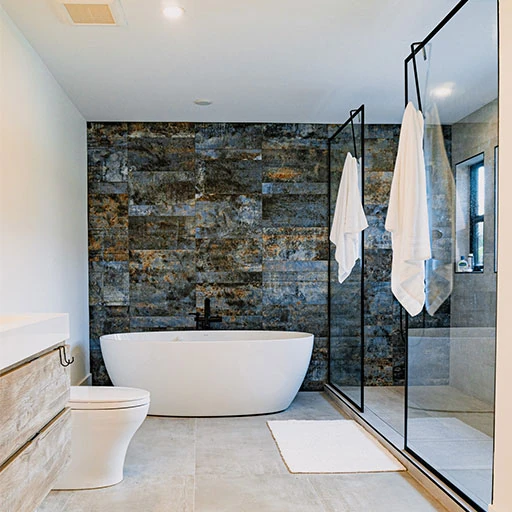
Powder rooms typically run 20–35 square feet in Vancouver homes — enough for a toilet, a small vanity or pedestal sink, and a mirror
Vancouver General Contractors
The reason is psychological as much as financial. In a home showing, the powder room is a private, enclosed space that buyers often use. They spend 60–90 seconds alone in it. Every detail registers: the quality of the faucet, the finish on the hardware, whether the grout lines are sharp, whether the mirror is frameless or surrounded by dated wood moulding. A great powder room creates a moment of surprise and delight in a showing that buyers carry through the rest of the walkthrough. A poor one does the opposite.
Powder rooms typically run 20–35 square feet in Vancouver homes — enough for a toilet, a small vanity or pedestal sink, and a mirror. That compact footprint is actually an advantage when it comes to renovation. You can afford better materials because you need so little of them. A $30-per-square-foot statement floor tile that would cost $15,000 in a kitchen costs $900 in a powder room. A hand-painted wallpaper that would be prohibitively expensive in a living room is entirely achievable at powder room scale. The space rewards boldness in a way that larger rooms simply cannot.
Powder Room Renovation Costs in Vancouver (2026)
Vancouver renovation costs are among the highest in Canada, driven by labour rates, permit fees, and material costs. Here is what you can realistically expect to spend at each tier of powder room renovation, based on current market pricing from licensed contractors working in the City of Vancouver and surrounding municipalities.
| Tier | Cost Range | What You Get |
|---|---|---|
| Basic Refresh | $4,000–$8,000 | New vanity, faucet, mirror, paint, updated lighting fixture. Existing tile and layout kept. No structural or plumbing changes. |
| Mid-Range Renovation | $8,000–$14,000 | Full demo and rebuild. New tile floor and walls, new vanity, toilet, faucet, mirror, lighting. Plumbing fixture swap (same rough-in locations). |
| High-End Designer | $14,000–$22,000 | Statement floor tile (large format, patterned, or heated), custom or semi-custom vanity, vessel sink, designer faucet, backlit mirror, professional wallpaper installation, premium lighting. |
| Luxury Statement | $22,000–$35,000 | Full custom design, handmade tile, bespoke vanity millwork, wall-hung toilet with in-wall tank, designer fixtures throughout, feature wall treatment, integrated lighting design. |
What drives costs at each tier: Labour is the largest single cost in any Vancouver renovation, typically 40–50% of total project cost. A mid-range powder room renovation will run approximately $3,000–$5,000 in labour for tile setting, plumbing, electrical, and carpentry. Materials for the same scope run $4,000–$8,000 depending on fixture and tile selections. Permit fees in the City of Vancouver add $300–$700 for a standard renovation permit. Demolition and disposal typically add $500–$1,000.
The jump from mid-range to high-end is almost entirely materials-driven. Labour cost for a heated floor installation adds $400–$600 versus standard tile. Labour for a wall-hung toilet installation adds $800–$1,500 due to in-wall carrier frame work. Custom millwork for a bespoke floating vanity adds $2,000–$5,000 over a semi-custom option. The tile itself is where most clients underestimate: a 25-square-foot floor with a patterned mosaic at $45/sq ft is still only $1,125 in materials — but installation of intricate mosaic can run $18–$25 per square foot in labour, versus $8–$12 for standard tile. Budget for installation cost, not just material cost.
Design Impact in a Small Space: Making Bold Choices Work
The design rule that most homeowners get wrong about small spaces is the assumption that smaller rooms demand restraint. The opposite is true in powder rooms. Because the space is so compact and the time spent in it so brief, bold design choices read as intentional and sophisticated rather than overwhelming. A powder room can handle drama that a bedroom, living room, or even a full bathroom cannot.
Wallpaper: This is the single highest-impact, highest-ROI design decision you can make in a powder room. A bold, large-scale wallpaper pattern — botanical, geometric, maximalist, or hand-painted — transforms the space immediately. The cost of papering a 25-square-foot powder room is modest: most rooms require 2–3 rolls at $80–$250 per roll for quality wallpaper, plus $400–$700 for professional installation. Total: $600–$1,500. The visual impact rivals a much more expensive renovation. In Vancouver, powder rooms with designer wallpaper consistently appear in listing photography as a hero shot — a signal of taste that buyers respond to strongly.
For powder rooms specifically (as opposed to full bathrooms), wallpaper durability concerns are minimal. The space has no shower or tub, so humidity levels are much lower. Standard wallpaper performs well. Vinyl-coated wallpaper performs exceptionally well and is the practical choice for a space that may see occasional splashing near the sink.
Statement vanities: The vanity is the centrepiece of the powder room. In a space this small, a bold vanity colour — deep navy, forest green, matte black, terracotta — reads as intentional design rather than a risk. Pair a coloured vanity with simple, high-contrast hardware (brushed brass on navy is a combination that consistently lands well with Vancouver buyers) and a simple frameless mirror. The combination costs no more than a beige vanity with chrome hardware but signals entirely different design sensibility.
Two-tone walls: A classic powder room technique involves painting the lower third of the wall a darker or contrasting colour (often with a chair rail or shadow box wainscoting), with a lighter tone above. This creates visual layering in a space that might otherwise feel flat. Combined with a statement mirror or wallpaper in the upper zone, two-tone walls add architectural interest without structural cost.
Black fixtures: Matte black faucets, towel rings, toilet paper holders, and drain covers have become a dominant trend in Vancouver powder rooms since 2022 and show no sign of receding. The appeal is that black reads as both modern and timeless — it ages better than brushed nickel (which dates to the 2000s) and doesn’t show water spots the way polished chrome does. Black fixture sets are available at every price point, from $150 for a basic faucet to $800 for a designer option.
Powder Room Fixtures: Toilets, Sinks, Vanities, and Faucets
Fixture selection in a powder room is both a design and a practical decision. The space constraints of a typical Vancouver powder room (20–35 square feet, often 5 feet wide or less) narrow your options, which is actually helpful — it forces a focused selection process rather than an overwhelming one.
Toilets: The standard choice for a powder room is a compact round-bowl toilet, which projects 26–28 inches from the wall versus 29–31 inches for a standard elongated model. In a tight powder room, those 3 inches matter. Rough-in distance (from finished wall to drain centre) is typically 12 inches in Vancouver homes built after 1980; older homes occasionally have 10-inch or 14-inch rough-ins, which limits toilet selection and can add cost if an adapter is needed.
Wall-hung toilets are the premium option for powder rooms with the budget to support them. The toilet bowl mounts to an in-wall carrier frame, with the tank concealed inside the wall. The floor-to-bowl clearance makes the space easier to clean and visually lighter. Cost: $2,500–$5,500 installed, including the carrier frame and wall modification. This is a meaningful budget premium but delivers a result that reads as unambiguously high-end. In luxury powder room renovations in Vancouver, wall-hung toilets are essentially standard.
Sinks and vanities: The choice between a pedestal sink and a floating vanity is the most consequential fixture decision in a powder room renovation. Pedestal sinks (typically $300–$800 for the unit) feel classic, take up less visual space, and work well in smaller or more traditional powder rooms. Their drawback is zero storage — acceptable in a powder room where storage needs are minimal, but a consideration if the space is used by guests regularly.
Floating vanities (typically $600–$2,500 for semi-custom units, $3,000–$6,000 for custom millwork) provide a small amount of under-sink storage and create the clean, modern aesthetic that currently dominates Vancouver renovation design. The wall-mounted installation requires blocking in the wall during renovation — plan for this if the walls are open during demo. Floating vanities in the 18–24 inch width range are the standard for powder rooms; anything wider starts to crowd the space. Vessel sinks (above-counter bowls) are a popular pairing with floating vanities, adding visual drama and design interest. Budget $300–$900 for a quality vessel sink.
Faucets: The faucet is a detail that buyers and visitors notice and touch. It is not the place to save money. A quality single-hole faucet in a finish that coordinates with your other hardware runs $200–$500 for a mid-range option (Moen, Delta, Kohler) and $500–$800 for designer options (Grohe, Hansgrohe, Brizo). Avoid faucets under $150 — the finish will dull and the mechanism will degrade quickly under regular use. Buy the best faucet your budget allows; it is one of the most touched surfaces in the room and signals quality (or its absence) immediately.
Tile and Flooring for Powder Rooms: Statement Floors That Deliver
The powder room floor is one of the most photographed surfaces in any home listing — it appears in virtually every overhead or wide-angle shot of the space. It is also an area where bold, pattern-driven choices perform exceptionally well because the square footage is small enough to make even expensive tile affordable.
Statement floor tile: Large hexagon tile (12-inch or larger), Moroccan fish-scale tile, encaustic cement tile with graphic patterns, and classic black-and-white mosaic are all strong choices for Vancouver powder rooms. The design principle is that a floor pattern anchors the space and gives it a visual identity that paint and fixtures alone cannot achieve. At 25 square feet, even premium handmade tile at $50–$80 per square foot costs $1,250–$2,000 for materials — a meaningful but manageable investment.
Continuous floor-to-wall tile: A more advanced design move involves carrying the same tile from the floor up the lower portion of the wall, or even continuing it full-height on a feature wall. This “wrapped” effect is popular in contemporary Vancouver powder room renovations and creates a cohesive, spa-like quality. The installation is more complex (tile cuts at the wall junction require precision) and adds to labour cost, but the result is distinctive.
Heated floors: In-floor electric heating under tile is one of the most consistently appreciated upgrades in a powder room renovation. The installation cost is $800–$1,400 for a powder room (electric mat + thermostat + electrician permit), and the operating cost for a 25-square-foot mat is minimal — roughly $10–$20 per month during winter if run constantly. In practice, most homeowners run powder room heated floors on a timer or sensor. The comfort factor is immediate and notable, and it is a feature that buyers and guests register immediately in a showing. It is worth including in any mid-range or above renovation if the walls are open and the tile is being replaced anyway.
Vinyl plank flooring: For budget powder room refreshes, luxury vinyl plank (LVP) is a legitimate and practical option. Modern LVP looks convincing, installs quickly, is 100% waterproof, and costs $3–$8 per square foot for materials — a total of $75–$200 for a powder room floor. The installation over existing subfloor (no tile removal) can be completed in a few hours. The aesthetic ceiling of LVP is lower than tile — no LVP floor will replicate the look of a marble hexagon or a hand-painted encaustic cement tile — but for a basic refresh where the budget is constrained, it is a defensible choice.
Lighting Design for Powder Rooms: Layers That Transform the Space
Lighting is consistently the most underbudgeted element of powder room renovations, and it is also one of the most impactful. A powder room with poor lighting — a single overhead pot light, for example — feels institutional regardless of how good the tile and fixtures are. Layered lighting transforms the space and makes every other design element look better.
The layered lighting approach: An effective powder room lighting plan combines at least two sources: a general overhead fixture (flush mount, semi-flush, or a small statement chandelier or pendant) and vanity lighting that illuminates the face from the front rather than casting shadows from above. The overhead provides ambient light; the vanity lighting provides the task light needed for a usable mirror. In a powder room with a backlit mirror, the mirror itself becomes a third light source that adds depth and warmth to the space.
Backlit mirrors: LED backlit mirrors have become the standard of quality in Vancouver powder rooms in the $14,000+ renovation tier. They provide front-facing light (the most flattering for faces), eliminate the need for a separate vanity light bar, and add a contemporary visual quality that reads immediately as a design upgrade. Budget $400–$800 for a quality backlit mirror (VIGO, Kohler, or similar) to $1,200+ for a custom or designer option. The electrical connection for a hardwired backlit mirror requires an electrician and permit if a new circuit is needed.
Dimmer switches: Every powder room should have a dimmer switch on at least the overhead circuit. Dimmer switches cost $30–$80 and take 30 minutes to install, but they allow the space to function as an intimate, atmosphere-appropriate room rather than a utility space. In BC, dimmer installation on an existing switch does not require a permit if it is a direct replacement (same location, same circuit). Installing a new dimmer circuit does require an electrical permit.
Electrical permit requirements in BC: Any new electrical circuit in a powder room — for a heated floor thermostat, a new vanity light circuit, or a hardwired mirror — requires an electrical permit from the BC Safety Authority (Technical Safety BC). This is separate from any City of Vancouver building permit. Cost: $100–$200 for the permit. Your electrician should pull this permit before work begins. Homeowners can legally do their own electrical work in BC but must still obtain the permit and have the work inspected.
Ventilation in Powder Rooms: BC Code Requirements and Best Options
Many homeowners assume that powder rooms — because they have no shower or tub — are exempt from ventilation requirements. They are not. The BC Building Code requires mechanical ventilation in all bathrooms, including half-baths and powder rooms, regardless of whether they have a window. A window does not satisfy the Code requirement; a powered exhaust fan is required.
The Code minimum for a powder room is 25 CFM (cubic feet per minute) of exhaust capacity, continuously or intermittently. In practice, most contractors install 50–80 CFM fans in powder rooms to provide adequate odour control and humidity management. The fan must exhaust to the exterior — not into the attic or a wall cavity — through ductwork of the appropriate diameter (typically 4 inches).
HRV integration: In homes with a Heat Recovery Ventilator (HRV) — increasingly common in new Vancouver construction and in well-performing older homes — the powder room exhaust can be tied into the HRV rather than running a separate dedicated fan. This approach is more energy-efficient because the HRV recovers heat from the exhaust air rather than simply dumping it outdoors. If your home has an HRV and the mechanical room is accessible during your renovation, discuss HRV integration with your contractor. It adds complexity but is the best long-term solution.
Quiet fan options: The most common complaint about bathroom exhaust fans is noise. Standard builder-grade fans run at 1.0–4.0 sones (a sone is a unit of perceived loudness). Quality fans from Panasonic (WhisperCeiling, WhisperWarm series) run at 0.3–0.8 sones — essentially inaudible during normal room use. The cost difference is modest: a Panasonic WhisperCeiling 80 CFM fan runs $80–$120 versus $20–$40 for a builder-grade unit. This is an upgrade where the cost difference is small and the quality difference is significant. Budget $300–$600 installed for a quality fan with appropriate ducting in a standard renovation scope.
Adding a Powder Room to Your Vancouver Home
If your home does not currently have a powder room — or has one on the wrong floor — adding one is one of the most transformative improvements you can make to the home’s livability and resale value. Vancouver detached homes from the 1950s through the 1980s frequently have a full bathroom upstairs and nothing on the main floor, a configuration that modern buyers find inconvenient and that appraisers recognize as a value gap relative to comparable homes with main-floor powder rooms.
Cost to add a new powder room: A new powder room addition in Vancouver costs $15,000–$30,000, depending primarily on the complexity of the plumbing rough-in. The largest cost variable is whether existing rough-in plumbing is accessible nearby. A powder room added adjacent to an existing plumbing stack (such as under a staircase near a kitchen or existing bathroom) requires only short plumbing runs and costs at the lower end of this range. A powder room requiring long new plumbing runs through finished walls and floors — or requiring a sewage ejector pump because it sits below the main drain line — costs significantly more.
Finding existing rough-in: In many Vancouver homes built with future expansion in mind, there is a capped rough-in (drain and vent stack) in the basement or under a staircase that was intended for a future powder room or bathroom. Your contractor or plumber can help identify these rough-ins. If one exists, the cost of adding a powder room drops significantly — sometimes to $12,000–$18,000 — because the most expensive plumbing work is already partially done.
Structural considerations: Adding a powder room sometimes requires relocating a wall or building a partition wall where none exists. This is typically modest structural work — non-load-bearing partition walls are simple for any competent carpenter — but if the addition requires moving or cutting a load-bearing wall (to create a corridor or enlarge a space), structural engineering consultation and beam installation add $3,000–$8,000 to the project cost.
Permit requirements for new additions: Any new bathroom addition in the City of Vancouver requires a building permit. The permit application requires drawings showing the existing and proposed layout, plumbing, electrical, and ventilation plans. Permit fees are typically $500–$1,200 for a powder room addition scope. Processing time in the City of Vancouver currently runs 6–10 weeks for residential permits, though this varies. Your contractor can advise whether a designer or architect is needed to prepare permit drawings for your specific project scope.
High-ROI Powder Room Upgrades: What Buyers and Appraisers Actually Notice
Not every powder room upgrade delivers equal return. Understanding which investments appraisers and buyers register — and which ones are invisible to everyone except the owner — is the difference between a renovation that pays for itself and one that delivers enjoyment but limited resale value. Both are legitimate goals; clarity about which you are pursuing matters.
High-ROI upgrades that buyers and appraisers notice:
- Floating vanity with quality finish: Immediately reads as contemporary and high-end. One of the clearest signals of a quality renovation to any buyer who has toured multiple properties.
- Frameless mirror: Frameless or thin-profile mirrors read as modern; wood-framed or ornate mirrors read as dated regardless of their actual age. Swap a dated mirror for a simple frameless option ($80–$300) and the room improves visibly.
- Quality faucet in a current finish: Matte black, brushed gold, or brushed nickel in a simple profile. The faucet is touched in every showing and every guest visit. A worn or corroded faucet undermines everything else.
- Statement floor tile: Appears in listing photography and is noticed immediately by buyers. One of the highest-visibility investments in the space.
- Consistent hardware finish throughout: Towel ring, toilet paper holder, faucet, and drain cover all matching. The cost is modest; the coherence it creates is significant.
What NOT to over-invest in for resale:
- Bespoke millwork in a rental property or lower price point home: Custom vanity millwork at $4,000–$6,000 in a home where buyers will expect $8,000 worth of kitchen upgrades delivers poor return. Match the investment level to the home’s price tier.
- Wallpaper in highly personal or polarizing patterns: Botanical and geometric wallpapers are broadly appealing. Highly specific patterns (cartoon motifs, very niche aesthetic choices) may alienate buyers. If renovating for resale, choose broadly appealing patterns.
- Luxury toilets with electronic features: Heated seats, bidets, and integrated washing functions are increasingly popular but still polarizing. Budget $800–$1,500 for a quality toilet without electronics for a resale renovation.
Resale vs. enjoyment budget split: A useful framework is to allocate 70% of your budget to elements that are broadly appealing and appraisable (tile, plumbing fixtures, vanity, lighting) and 30% to elements that reflect your personal taste (wallpaper, accent colour, decorative mirror). If you are renovating primarily for enjoyment and plan to stay in the home 10+ years, that ratio can shift to 50/50 or even 40/60. If you are renovating primarily for resale in the next 1–3 years, stay closer to 80/20.
Permit Requirements for Powder Room Renovation in Vancouver
Permit requirements in the City of Vancouver depend on the scope of your renovation. Understanding when permits are and are not required — and following the rules — protects you at resale, protects you if something goes wrong, and ensures your renovation meets current building and safety standards.
When a building permit IS required:
- Adding a new powder room where none exists (always requires permit)
- Moving walls or changing the room layout
- Moving drain or supply plumbing to a new location (not just replacing fixtures at existing locations)
- Any structural work
- Changes to ventilation ducting or routing
When a building permit is NOT typically required (City of Vancouver):
- In-kind replacement of toilet, vanity, and sink at existing rough-in locations
- Replacing tile, flooring, and finishes (no structural or plumbing changes)
- Painting and wallpaper
- Replacing light fixtures on existing circuits
- Replacing a vanity with a new vanity at the same location
Electrical permits — always required for new circuits: Installing a heated floor thermostat, adding a new circuit for a hardwired mirror or vanity light, or installing a new exhaust fan where none existed all require an electrical permit from Technical Safety BC (TSBC). This is separate from a City of Vancouver building permit and is the responsibility of the licensed electrician doing the work. Homeowners doing their own electrical work must also obtain this permit and book an inspection. Cost: $100–$200 for the permit.
The City of Vancouver permit process: Building permit applications for residential renovations are submitted through the City’s Online Permitting Portal. Simple renovation permits (no structural work, no additions) are often issued as a rapid permit (RPP) within 5–10 business days. More complex permits (additions, structural work) go through standard review and currently take 6–10 weeks. Your licensed contractor can advise on the appropriate permit category for your project and can submit the application on your behalf. Note: Permit fees are based on the value of construction; a $15,000 powder room renovation might have permit fees of $400–$700.
A note on unpermitted work: Vancouver’s real estate market has become increasingly sophisticated about permit history. Buyers’ agents routinely pull permit records. Unpermitted renovation work disclosed at sale often triggers price renegotiation or conditional requirements. Unpermitted work that is discovered post-sale can result in orders to remediate. The cost and inconvenience of doing the work properly with permits is almost always less than the downstream consequences of not doing so. Get your permits.
Planning and Sequencing Your Powder Room Renovation
A well-planned powder room renovation takes 2–3 weeks from demo to finished — one of the shorter renovation timelines in residential construction. But the planning phase, if rushed, will extend the project significantly through material delays, sequencing errors, and costly corrections. The following sequence reflects how experienced Vancouver contractors approach powder room projects.
Phase 1: Design and specification (4–6 weeks before construction): Finalize all material selections before any demolition begins. This means: tile (floor and wall), vanity, sink, faucet, toilet, mirror, lighting, wallpaper (if applicable), and all hardware. Long lead-time items — custom vanities, specialty tile, and designer fixtures — often have 4–8 week lead times from Vancouver suppliers. Order these first. Nothing extends a renovation like discovering on demo day that the tile you selected is 6 weeks out.
Phase 2: Demolition (Day 1–2): Full demo of existing finishes — tile removal, vanity removal, toilet removal, mirror removal. If the scope includes opening walls (for heated floor electrical, new plumbing locations, or in-wall toilet carrier), this happens during demo phase. Demolition generates significant debris; budget for a half-bin or full bin disposal, or confirm your contractor includes disposal.
Phase 3: Rough-in work (Day 2–4): Plumbing adjustments (if any), electrical rough-in (heated floor mat, new circuits), ventilation ducting. This is the phase that requires inspections if permitted work is being done. Book inspections in advance — City of Vancouver inspection bookings typically have 3–5 business day lead times.
Phase 4: Substrate and waterproofing (Day 4–5): Cement board or appropriate backer installation on walls and floor. Waterproofing membrane on the floor and any wet areas. Allow cure time per product specs — typically 24 hours.
Phase 5: Tile setting (Day 5–8): Floor tile first, then wall tile. Allow full mortar cure before grouting — typically 24 hours. Grout cures in 24–72 hours. Heated floor mats are embedded in the mortar bed during floor tile installation. Allow heated floor to cure fully (typically 28 days at low heat) before running at full temperature.
Phase 6: Fixtures and finishes (Day 8–12): Vanity installation, sink and faucet, toilet, mirror, lighting fixtures, wallpaper. Paint before wallpaper; wallpaper before fixtures where possible. Final electrical connections (heated floor thermostat, mirror connection).
Phase 7: Punch list and final inspection (Day 12–15): Touch-up paint, caulking at all joints (tub/vanity/toilet base), hardware installation, accessory installation (towel ring, toilet paper holder). Final electrical inspection if required. Photos.
Living with one less bathroom during renovation: For households with only one full bathroom and no powder room, a powder room renovation means temporary loss of the toilet for 2–3 days during the tile cure phase (toilet cannot be set until tile is cured). Discuss this timing with your contractor and plan accordingly. Portable toilet rental ($200–$400/week) or a scheduled project start coordinated with a vacation or travel period are both practical solutions.
For comprehensive guidance on planning your full renovation scope, including how powder room work fits into a larger project, review our Renovation Guide. For information on broader home renovation projects that might include a powder room addition, see our home renovation services page.
More Bathroom Renovations Guides
Frameless vs. Semi-Frameless Shower Door in Vancouver: Which is Worth the Cost?
Freestanding vs. Alcove Bathtub in Vancouver: Design, Space, and Cost Comparison
Porcelain vs. Natural Stone Tile for Vancouver Bathrooms: The Complete Comparison
Electric vs. Hydronic Heated Bathroom Floor in Vancouver: Which is Better?
Walk-In Shower Renovation in Vancouver: Design Options, Waterproofing, and Costs
Ready to start your renovation?
Frequently Asked Questions: Powder Room Renovation Vancouver
What is the difference between a half bath and a powder room?
The terms are used interchangeably in Vancouver and throughout Canada. Both refer to a bathroom with a toilet and a sink but no shower or bathtub. The “half bath” terminology reflects the fact that it contains two of the four standard bathroom fixtures (toilet + sink = half of toilet + sink + tub + shower). “Powder room” is the more formal and design-oriented term, often used when the space has been finished to a higher standard. For all practical purposes — code, permits, real estate listings — they are the same thing.
How much does it cost to add a powder room to a Vancouver home?
Adding a new powder room where none exists costs $15,000–$30,000 in Vancouver. The primary cost variable is plumbing complexity — specifically, how far new drain and supply lines must run to reach the new room, and whether a sewage ejector pump is needed (for rooms below the main drain elevation). A powder room added adjacent to an existing plumbing stack (under a staircase, beside a kitchen, next to an existing bathroom) costs at the lower end. Rooms requiring long runs or pump systems cost at the high end. This estimate includes permit fees, demolition, framing, plumbing, electrical, ventilation, and all finishes.
What are the best ROI powder room upgrades for resale?
The upgrades with the best resale ROI in Vancouver powder rooms are: (1) statement floor tile, which appears prominently in listing photos and is noticed by every buyer; (2) floating vanity with quality hardware, which reads as contemporary and well-renovated to buyers who have toured multiple properties; (3) frameless or backlit mirror, which modernizes the space immediately; (4) consistent fixture finishes throughout (faucet, towel ring, toilet paper holder all matching); and (5) quality ventilation fan, which is noticed negatively when absent but appreciated positively when present. Bold wallpaper also delivers strong ROI at modest cost if the pattern is broadly appealing.
Do I need a permit for a powder room renovation in Vancouver?
It depends on the scope. Replacing tile, vanity, toilet, and faucet at existing locations without moving plumbing or walls generally does not require a building permit in the City of Vancouver. Adding a powder room where none exists, moving walls, or relocating plumbing rough-in always requires a building permit. Any new electrical circuit — for a heated floor thermostat, a hardwired mirror, or a new exhaust fan — requires an electrical permit from Technical Safety BC regardless of whether a building permit is needed. When in doubt, ask your licensed contractor — pulling the wrong permits (or not pulling them) creates real problems at resale.
Is a wall-hung toilet worth the cost in a powder room?
Yes — in a powder room with the budget to support it. Wall-hung toilets cost $2,500–$5,500 installed (unit + carrier frame + in-wall tank + wall modification + labour) versus $800–$1,500 for a quality floor-mounted unit. The premium delivers three real benefits: visual lightness (the floating bowl makes the space feel larger and cleaner), easier floor cleaning (no base to mop around), and a design statement that reads as unambiguously high-end to any buyer or guest. In a luxury powder room renovation in Vancouver ($20,000+), a wall-hung toilet is effectively standard. In a mid-range renovation ($8,000–$14,000), it is a meaningful splurge that may or may not be justified depending on your other priorities.
Will wallpaper hold up in a powder room?
Yes — powder rooms are actually ideal for wallpaper. Unlike full bathrooms with showers or tubs, powder rooms have minimal humidity and no direct water splash on the walls (except near the sink). Standard wallpaper performs well. Vinyl-coated wallpaper is even more durable and is the practical recommendation for the area immediately adjacent to the sink. Properly installed wallpaper in a powder room should last 10–15 years without issues. The key is professional installation — a poorly hung seam or improperly primed wall will cause peeling regardless of wallpaper quality.
Are heated floors worth installing in a powder room?
Yes — heated floors are one of the best value-per-dollar upgrades in a powder room renovation. The installed cost is $800–$1,400 for a 25-square-foot powder room (electric mat, thermostat, permit, and electrician). Operating cost is negligible. The user experience is immediately and consistently positive — there is no renovation upgrade that generates more positive comments from guests and family. If the floor tile is being replaced anyway and the budget allows, there is no strong reason not to include it. It also adds a real (if modest) value signal at resale that appraisers can point to.
Do I need wall blocking for a floating vanity?
Yes. Floating vanities require solid blocking (typically 2×8 or 2×10 lumber, or a plywood panel) inside the wall at the mounting height. This blocking must be installed during the renovation before drywall goes back up — it cannot be done after the walls are closed without reopening them. Most bathroom walls are 16-inch stud framing; a floating vanity that spans multiple stud bays needs blocking between the studs. Your framing carpenter or contractor should install this during the rough-in phase. The cost is trivial ($50–$100 in materials and 1 hour of labour) but it is a detail that must be done at the right stage. If you are getting quotes, confirm the contractor includes blocking in their scope.
How long does a powder room renovation take?
A straightforward powder room renovation (existing space, no new additions) takes 2–3 weeks from demo to finished. The tile setting phase requires 2–3 days for the tile work plus 24–48 hours of cure time before grouting, plus another 24 hours before fixtures can be installed. Wallpaper installation adds 1 day. Custom vanity delivery is often the longest lead-time item — plan for 4–8 weeks if ordering custom or semi-custom millwork. Standard vanities (IKEA, Home Depot, or local kitchen and bath showrooms) are typically available immediately or within 1–2 weeks. The pre-construction planning phase (material selection, ordering, permit application) should run 4–6 weeks before construction begins to avoid mid-project delays.
What are the most common powder room renovation mistakes?
The most common mistakes we see in powder room renovations are: (1) skipping the permit for electrical work (heated floor, hardwired mirror), which creates problems at resale; (2) selecting tile without accounting for installation cost — a $15/sq ft tile can have $20/sq ft installation costs for complex patterns; (3) ordering materials without confirming lead times, causing project delays mid-construction; (4) choosing a floating vanity without specifying wall blocking in the renovation scope; (5) failing to run wallpaper behind the mirror before hanging it (the mirror must come off for any future wallpaper changes if paper doesn’t run behind it); (6) neglecting ventilation and installing a fan that is too loud or too underpowered for the space; and (7) mismatching hardware finishes — combining brushed nickel, chrome, and satin nickel creates visual noise that undermines even excellent other choices.
What size vanity works best in a small powder room?
For powder rooms in the 20–35 square foot range (the typical Vancouver powder room), an 18–24 inch wide vanity is the standard recommendation. This provides adequate sink space without overwhelming the room or creating clearance issues (BC Building Code requires 21 inches of clear space in front of a toilet; a vanity that is too wide can compromise this). Pedestal sinks take up essentially no width but also provide no storage. If your powder room is on the smaller end (under 25 square feet), a pedestal sink or a small 18-inch floating vanity maximizes the perception of space. If you have 30+ square feet to work with, a 24-inch or even 30-inch vanity is workable and provides more storage utility.
Can I convert a closet into a powder room?
Yes — and this is one of the most common powder room addition approaches in older Vancouver homes that lack a main-floor bathroom. A standard 5×3 foot closet (15 square feet) is tight but functional for a toilet and small pedestal sink. A 5×5 closet (25 square feet) is comfortable. The main challenges are: (1) getting drain and vent plumbing to the new location — this often requires opening the floor or running plumbing through adjacent walls; (2) ventilation — an exterior wall location makes fan ducting straightforward; an interior closet may require a longer duct run; and (3) door swing — the existing closet door configuration may need to change to provide adequate clearance. Cost for a closet conversion to powder room: $15,000–$25,000 in Vancouver, depending on plumbing complexity.
What vessel sink styles work best in Vancouver powder rooms?
Vessel sinks (above-counter basins) are one of the stronger design moves in a contemporary Vancouver powder room. The styles that currently perform best aesthetically and at resale are: (1) white ceramic round or oval basins with a simple, clean profile — these are versatile and pair with any vanity style; (2) matte white or off-white stone-look ceramic for a spa aesthetic; (3) concrete-look or terrazzo vessels for an industrial or eclectic aesthetic. Glass vessel sinks (once popular in the 2000s) have dated and are not recommended. The pairing matters: a vessel sink raises the working height by 5–7 inches, so the vanity should be 28–32 inches tall (lower than a standard vanity) to keep the overall sink height comfortable.
How do I choose a contractor for a powder room renovation in Vancouver?
Look for a licensed general contractor who carries WorkSafeBC coverage and can demonstrate experience with bathroom renovations specifically. Ask for 3 references from completed bathroom projects in the past 12 months and follow up on them. Get 3 written quotes with detailed scope of work — not just a lump sum, but a line-by-line breakdown of labour and materials. Be cautious of quotes that are significantly lower than the others; this usually indicates missing scope or unlicensed subcontractors who are not permitted. Ask specifically who will do the plumbing and electrical work, and confirm they are licensed trades. A good contractor will pull all required permits before work begins and will have their subcontractors do the same. See our contact page to discuss your powder room renovation project with our team.
Should I renovate my powder room before listing my home for sale?
In most cases, yes — particularly if the current powder room is dated or shows signs of deferred maintenance. The powder room renovation has the best cost-to-return ratio of any renovation type in Vancouver real estate. A mid-range renovation at $8,000–$14,000 frequently recovers more than its cost in the sale price, and it also affects buyer psychology in ways that are hard to quantify but well-documented by agents. However, timing matters: allow 6–8 weeks before listing to complete the renovation, let the project settle, and photograph the finished room properly. A rushed renovation finished 2 days before listing photos will show. Also consider: if the home has significant deferred maintenance in other areas (roof, windows, HVAC), address those first — buyers and inspectors will notice structural and mechanical issues before they notice a dated powder room.
What is the minimum square footage for a powder room in Vancouver?
The BC Building Code does not specify a minimum square footage for a powder room, but it does specify minimum clearances. The toilet must have a minimum 15 inches of clear space from the centreline to any side wall or obstruction (so a minimum of 30 inches of width at the toilet). There must be a minimum of 21 inches of clear space in front of the toilet. The sink must have adequate clearance for use. In practice, the minimum workable powder room footprint is approximately 11 square feet (roughly 3.5 x 3 feet) — tight but code-compliant. Most livable powder rooms are 15–35 square feet. Your contractor or a designer familiar with Vancouver building requirements can confirm clearances for your specific proposed layout before you commit to a configuration.
Ready to get started on your powder room renovation? Our team at Vancouver General Contractors has completed hundreds of bathroom renovations across the city and brings the design knowledge, trade coordination, and permit experience to deliver a finished result that holds up. Contact us for a consultation and quote, or start with our Renovation Guide to understand what your project will involve from start to finish.
Get a Free Renovation Quote
Metro Vancouver’s trusted general contractors. Free consultations across Vancouver, Burnaby, Richmond, North Shore & beyond.
Get Your Free Quote →Ready to start your project? Vancouver General Contractors (VGC) provides free, fixed-price quotes for homeowners across Metro Vancouver. Learn more about our bathroom renovation Vancouver services or request a free quote today.
VGC serves Vancouver and surrounding areas. View all renovation services in Vancouver →

Comments are closed