





Renovation Costs by Vancouver Neighbourhood: What to Budget in East Van, Westside, Burnaby, North Van & More (2026)
Ask ten Vancouver homeowners what their renovation cost and you’ll get ten wildly different answers — even for the same project scope. A kitchen renovation in Kitsilano is not the same financial conversation as one in Fraserview. A legal basement suite in Burnaby has different permit implications than one in Strathcona. And a full gut renovation on the Westside operates in an entirely different financial universe than one in Surrey.
This guide breaks down what renovations actually cost across Metro Vancouver’s major neighbourhoods and municipalities in 2026 — drawing on real project data from VGC’s work across the region. Whether you’re in East Van looking to add a legal suite, a Westside homeowner planning a high-end kitchen, or a North Van family eyeing a deck addition, the numbers here will give you a grounded starting point for your budget conversation.
We also cover permit complexity, heritage restrictions, strata rules, and neighbourhood-specific ROI considerations — because renovation cost is never just about materials and labour.
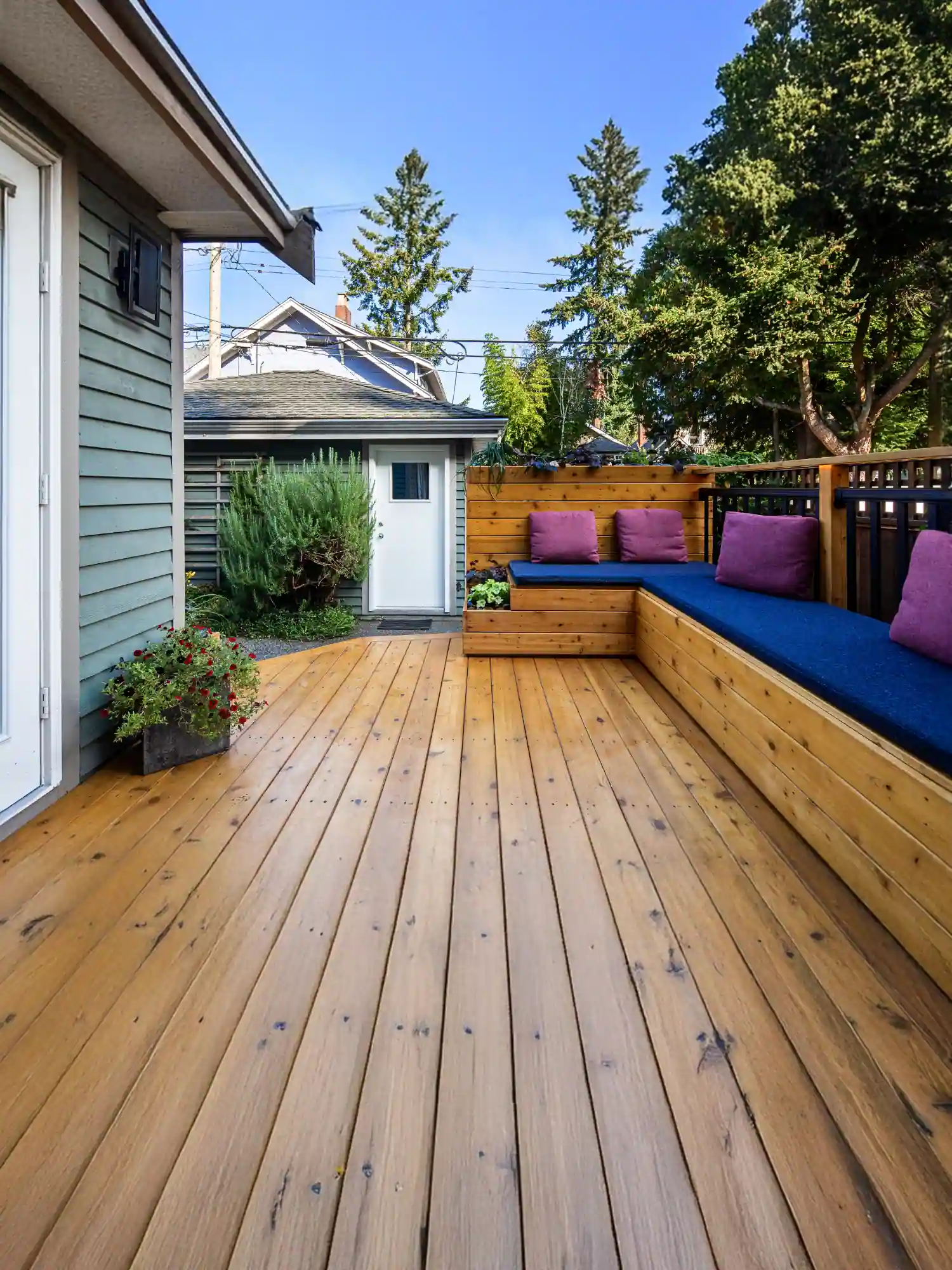
Burnaby's wide arterial streets and suburban lot layouts, by contrast, allow for straightforward material staging, large bin placement, and efficient crew mobilization
Vancouver General Contractors
Why Renovation Costs Vary by Vancouver Neighbourhood
Before diving into neighbourhood-by-neighbourhood numbers, it’s worth understanding the structural reasons why renovation costs vary so significantly across Metro Vancouver. These aren’t arbitrary differences — they reflect real logistical, regulatory, and market realities that every contractor and homeowner navigates on every project.
Access and Site Logistics
Site access is one of the most underappreciated cost drivers in Vancouver renovation. Strathcona’s narrow heritage lanes mean a 20-yard bin truck cannot turn around — waste disposal requires smaller loads, more trips, and higher cost. Deep Cove properties on steep hillsides may require a crane to deliver framing lumber. A Yaletown condo on the 15th floor means every sheet of drywall goes up in the elevator, one load at a time, with a building-mandated elevator booking fee on top.
Burnaby’s wide arterial streets and suburban lot layouts, by contrast, allow for straightforward material staging, large bin placement, and efficient crew mobilization. That difference alone can shift a project cost by 8–15% compared to an equivalent scope in a dense Vancouver neighbourhood.
Home Era and What’s Behind the Walls
The decade a home was built tells a contractor a great deal about what surprises await. Pre-war homes in Mount Pleasant or East Van (pre-1940) commonly contain knob-and-tube wiring, horsehair plaster walls, and balloon-frame construction — all of which require specialized handling and add cost. Homes built in the 1960s and 1970s in Fraserview, Burnaby, and Richmond frequently contain aluminum branch wiring (a fire hazard that must be addressed before permit final), asbestos-containing vinyl tile, and vermiculite insulation in attics.
1980s–1990s homes in Surrey and Coquitlam are generally cleaner structurally, though they may have polybutylene plumbing (a known failure risk) and original fibreglass insulation that falls short of current energy code requirements. Understanding your home’s era is the single best predictor of renovation surprises — and budgeting accordingly is essential.
Finish Expectations by Market
Renovation cost is also heavily influenced by what buyers in a given neighbourhood expect. On the Westside — Kitsilano, Point Grey, Kerrisdale — the baseline for a “renovated” kitchen means Sub-Zero refrigeration, quartz or quartzite countertops, custom cabinetry, and designer tile. A kitchen that might satisfy a buyer in Fraserview for $65,000 would be considered underwhelming in Dunbar, where the same space commands a $110,000–$140,000 investment to meet market expectations.
This is not snobbery — it is market reality. Buyers calibrate their expectations to the neighbourhood, and a renovation that under-delivers relative to comparable sales will not achieve the expected ROI.
ROI Math Differs Dramatically
A $150,000 renovation on a $1.6 million East Van home is a 9.4% investment against asset value. The same $150,000 renovation on a $4.5 million Westside property is a 3.3% investment. The ROI math — whether a renovation adds more value than it costs — therefore varies enormously by neighbourhood. In East Van, where properties are gentrifying and buyers are value-seeking, a well-executed renovation can add 15–25% to sale price. On the Westside, the baseline expectation is already high, and over-renovation risk (spending more than the market will return) is a real concern above the $500,000–$700,000 renovation threshold.
Permit Complexity and Heritage Review
City of Vancouver permits are among the most complex in the region. Structural additions require a registered engineer, and many renovations now trigger energy code upgrades under BC Step Code requirements. Heritage areas — Strathcona, Shaughnessy, Gastown — add an additional layer of architectural review and documentation that can add $15,000–$40,000 and 4–12 weeks to a project timeline.
Municipalities like Burnaby, Surrey, and Coquitlam generally have faster permit turnaround (4–8 weeks vs. 8–16 weeks in CoV) and less complex heritage review — a meaningful advantage for homeowners working on tighter timelines.
Strata vs. Freehold
Condo renovations in Vancouver operate under a completely different governance structure than freehold homes. Before a single trade enters a strata unit, the owner must submit an Alteration Agreement to strata council — a document that includes trade licence copies, insurance certificates, scope of work, and a damage deposit (typically $1,000–$5,000). Approval can take 2–8 weeks. Work is restricted to weekdays, typically 8am–5pm. Noise complaints can halt a project mid-scope. These constraints add both cost and timeline to strata renovations and are a factor that every Downtown, False Creek, or Coal Harbour condo owner must plan around.
East Vancouver Renovation Costs (Fraserview, Killarney, Renfrew-Collingwood, Hastings-Sunrise)
East Vancouver is the most active renovation market in the region right now. The combination of 1950s–1985 home stock, strong gentrification pressure, and a property value range ($1.4M–$2.0M) that makes renovation a smart financial move has created sustained demand for renovation services across Fraserview, Killarney, Renfrew-Collingwood, and Hastings-Sunrise.
Home Stock and What to Expect
The dominant housing type in East Van is the Vancouver Special (1965–1985), the bungalow (1945–1965), and the split-level (1960–1980). Vancouver Specials in particular are a renovation rite of passage in this part of the city — boxy, functional, often dated, but sitting on full-size lots with excellent suite potential. Pre-war bungalows in Hastings-Sunrise and Renfrew can be charming but require careful assessment of electrical, plumbing, and foundation systems before renovation budgets are set.
Typical East Van Renovation Budgets
The following ranges reflect VGC project data for East Van properties in 2025–2026. All figures include labour, materials, permit fees, and project management. They assume a functioning structure without major hidden deficiencies — budget an additional 10–20% contingency for older homes.
- Vancouver Special update (full main floor + suite reconfiguration): $120,000–$220,000
- Kitchen mid-range renovation: $50,000–$75,000 (semi-custom cabinets, quartz counters, new appliances, full electrical and plumbing updates)
- Legal basement secondary suite (new): $70,000–$95,000 (includes separate entrance, kitchen, bathroom, egress windows, fire separation, permit)
- Bathroom refresh (existing footprint): $18,000–$32,000
- Full main floor renovation (kitchen + living + dining open concept): $95,000–$160,000
For a detailed breakdown of Vancouver Special renovation costs specifically, see our complete renovation planning guide.
Common Surprises in East Van Homes
East Van renovations regularly surface three categories of hidden cost that must be budgeted for: knob-and-tube wiring in pre-1960 homes (requiring full rewire, typically $12,000–$20,000), aluminum branch circuit wiring in 1970s homes (remediation with AlumiConn connectors or pigtailing, $4,000–$8,000 depending on panel size), and asbestos-containing vinyl floor tile in basements and kitchen floors of 1955–1975 homes (abatement, $2,500–$6,000). None of these are deal-breakers — they are simply East Van realities that a good contractor will identify during pre-construction assessment and factor into your contingency budget.
ROI Context for East Van
East Van properties are in a sustained gentrification cycle. Fraserview and Killarney, once considered “value” East Van, now regularly see renovated homes sell at 15–25% premiums over comparable unrenoved properties. The most compelling ROI project in East Van remains the legal basement suite — rental demand in this corridor is exceptionally strong, and a $70,000–$95,000 suite investment generating $2,200–$2,800/month in rental income typically achieves payback in under 4 years before any appreciation benefit is counted.
| Project | Budget Range | Est. Value Added | ROI |
|---|---|---|---|
| Legal basement suite | $70K–$95K | $140K–$180K | 200–280% |
| Kitchen mid-range | $50K–$75K | $55K–$90K | 90–130% |
| Bathroom refresh | $18K–$32K | $20K–$35K | 90–110% |
| Vancouver Special full update | $120K–$220K | $180K–$300K | 120–160% |
Westside Vancouver Renovation Costs (Kitsilano, Point Grey, Kerrisdale, Dunbar, Oakridge)
Westside Vancouver is a different renovation conversation entirely. Properties ranging from $3.0M to $6.0M and beyond mean that the financial calculus, finish expectations, and regulatory complexity all operate at a higher register. Renovations here are less about adding value for resale and more about creating a home that matches the neighbourhood’s character and the owner’s vision.
Home Stock: Pre-War Heritage to Post-War Custom
The Westside contains some of Vancouver’s most architecturally significant residential stock — 1920s–1940s craftsman and character homes in Dunbar and Point Grey, post-war custom homes in Kerrisdale and Oakridge, and newer infill construction throughout. Many pre-war Westside properties carry character house overlays or heritage designations, particularly in Point Grey and the western edges of Kitsilano, adding a layer of regulatory complexity to any exterior scope.
Premium Finish Expectations
On the Westside, “renovation” typically means premium. Sub-Zero and Wolf appliances are standard in a fully renovated Kitsilano kitchen. Quartzite (not quartz) countertops, custom inset cabinetry, Waterworks or Kohler plumbing fixtures, heated tile floors in every bathroom, and integrated smart home systems are the baseline expectation for homes in this price bracket. These finishes are not optional for buyers at this price point — they are required to achieve market value.
Typical Westside Renovation Budgets
- Kitchen premium renovation: $90,000–$150,000+ (custom cabinetry, premium appliances, structural layout changes)
- Master ensuite luxury renovation: $70,000–$120,000 (heated floor, custom tile, steam shower, freestanding tub)
- Full gut renovation (2,500–3,500 sq ft home): $350,000–$700,000
- Architect and designer fees: $30,000–$80,000 (often mandatory for permit on larger scope)
- Heritage facade restoration (where required): $40,000–$90,000 additional
Heritage Restrictions in Point Grey and Dunbar
Many Westside properties built before 1940 carry a character house overlay under the City of Vancouver’s zoning bylaws. This overlay does not prevent renovation — interior scope is unrestricted — but it does require that character-defining exterior features (porch, original windows, wood siding profile, roofline) be retained or restored when any exterior work triggers a permit. In practice, this means custom window replication (not off-the-shelf vinyl), heritage-profile wood siding matching, and architect documentation — all adding $15,000–$40,000 to a project that might otherwise be straightforward.
Shaughnessy Heritage Conservation Area represents the most restrictive overlay in Vancouver — exterior changes require Heritage Commission review, which adds both time (4–12 weeks) and cost. If you own a Shaughnessy property, budget for a heritage architect from day one.
Over-Renovation Risk on the Westside
One counterintuitive reality of the Westside market: ROI is not the primary renovation motivator here, and over-renovation risk is real. A $700,000 renovation on a $4.5M home adds roughly 15% to the asset value in a normal market — but Westside buyers are primarily purchasing location, school catchment, and lot size. A renovation that exceeds $800,000 on a property valued below $5M is unlikely to return full dollar-for-dollar value at sale. Westside renovation budgets are best understood as lifestyle investments with partial financial return — a different framework than East Van or Burnaby, where renovation ROI math is more compelling.
Downtown Vancouver and False Creek Renovation Costs (Condos)
Downtown Vancouver and the False Creek corridor — Yaletown, Coal Harbour, Concord Pacific, Olympic Village — represent an almost entirely strata-governed renovation market. The rules here are different, the constraints are real, and the costs reflect the complexity of working within high-rise and mid-rise strata environments.
Strata Considerations Before Any Renovation
Every Downtown condo renovation begins not with a contractor call, but with a strata council application. Before work commences, owners must submit an Alteration Agreement that typically includes: a detailed scope of work, copies of all trades’ licences and liability insurance certificates, a damage deposit (commonly $1,000–$5,000, refundable), and confirmation of noise bylaw compliance. Council review takes 2–8 weeks depending on the strata corporation’s meeting schedule.
Work hours are typically restricted to weekdays, 8am–5pm. No weekend work is the standard bylaw provision in most Downtown stratas. Elevator booking fees ($150–$400/day for padded elevator reservation) apply on move-in/move-out of materials and are mandatory in most buildings. Trades cannot park on-site on weekdays — they pay for nearby parkade parking, which adds $25–$50/day per trade vehicle to project cost. In aggregate, these constraints add $3,000–$8,000 to the mobilization cost of a condo renovation compared to an equivalent freehold project.
Typical Downtown Condo Renovation Budgets
- Kitchen renovation (600–950 sq ft condo): $45,000–$85,000. Note: gas modifications in pre-2000 buildings are often prohibited by strata — electric induction only.
- Bathroom renovation: $22,000–$45,000. Moving drains is frequently prohibited or requires written strata engineer approval — wet walls typically stay in place, limiting layout flexibility.
- Full condo renovation (650 sq ft): $80,000–$160,000
- Premium high-rise renovation (Coal Harbour, Yaletown): $200,000–$500,000 for luxury units with premium finishes
The Condo Renovation ROI Challenge
Condo renovation ROI is the most constrained in the Metro Vancouver market. High renovation costs (driven by strata constraints, elevator logistics, and premium finishes expected in this price tier), combined with a condo market that has faced valuation pressure since 2022, means that full condo gut renovations typically return 60–80 cents on the dollar at sale. The primary driver for condo renovation in this market is personal enjoyment and quality of living — not financial return. Buyers who purchased pre-sale in 2018–2021 at peak prices and are now renovating to sell should seek a VGC consultation before committing to a full scope, as the math may not support a premium renovation at current market values.
North Vancouver Renovation Costs (Lower Lonsdale, Lynn Valley, Deep Cove)
North Vancouver — both the District and the City — offers a renovation market with its own distinct character. Strong family demographics, an outdoor-lifestyle culture, and a housing stock ranging from 1950s bungalows to 1990s stucco boxes create consistent demand for kitchen, bathroom, basement suite, and outdoor living renovations.
What Makes North Van Unique
The most distinctive cost driver in North Van is topography. Steep lots — common in Lynn Valley, Deep Cove, and the upper reaches of North Lonsdale — require site work that simply doesn’t exist in flat Metro Vancouver municipalities. Retaining walls, engineered fill, site drainage, and in some cases crane-assisted material delivery add $10,000–$40,000 to projects on challenging terrain. Outdoor living renovations (decks, patios, outdoor kitchens) are proportionally more popular here than in any other Metro Vancouver area — North Van buyers pay a premium for usable outdoor space, and the renovation ROI on a well-executed deck and landscaping package is among the strongest in the region.
Seismic considerations are also more pronounced in North Van — the District requires seismic upgrades as a condition of certain permit types, and older cedar homes (pre-1960) in Deep Cove and Lynn Valley may require additional structural assessment before renovation scope is finalized.
Typical North Vancouver Renovation Budgets
- Kitchen mid-range renovation: $55,000–$80,000
- Bathroom renovation: $22,000–$40,000
- Legal basement suite: $65,000–$90,000 (District of North Van permits suites in most RS-1 zones)
- Deck and outdoor living addition: $25,000–$80,000 depending on size, materials (composite vs. wood), and site complexity
- Full home renovation (1,800–2,400 sq ft): $200,000–$380,000
The mountain aesthetic — stone accents, timber elements, warm wood tones — is a strong design preference in North Van and influences material choices throughout. Budget for natural stone tile, wood-look engineered hardwood, and timber accent features that align with this market’s expectations.
Burnaby Renovation Costs (Metrotown, Burnaby Mountain, North Burnaby)
Burnaby represents one of the best-value renovation markets in Metro Vancouver. Property values in the $1.4M–$2.5M range (freehold single-family), strong rental demand driven by SkyTrain proximity, and a 1960s–1980s housing stock that’s due for updating create compelling renovation economics — particularly for secondary suite additions.
Burnaby’s Logistical Advantages
Burnaby’s suburban lot layout is a meaningful practical advantage for renovation projects. Wider lots allow for material staging areas, large bin placement, and multi-trade access without the logistical gymnastics required in dense Vancouver neighbourhoods. A project in Metrotown or North Burnaby that might require two days of setup time in Strathcona can mobilize in half a day in Burnaby — and that efficiency shows up in project cost.
Secondary Suites and Bill 44 Context
Burnaby’s secondary suite program closely parallels the City of Vancouver’s, with permit required and similar fire separation and egress window standards. The notable context in 2026 is Bill 44 — the BC provincial legislation that rezoned most RS-1 lots in Metro Vancouver municipalities for multi-unit development (up to 4-plex). Many Burnaby RS-1 lots that previously allowed only a single-family home with one suite are now eligible for 4-plex development. Homeowners who add a secondary suite today may be creating a valuable, income-generating precursor to a future multi-unit development application — making the suite investment even more strategically valuable than its direct ROI suggests.
Typical Burnaby Renovation Budgets
- Kitchen renovation: $50,000–$80,000
- Bathroom renovation: $20,000–$38,000
- Legal basement suite (new): $65,000–$95,000
- Second storey addition: $250,000–$380,000 (structural, full interior + exterior envelope)
- Full home renovation: $180,000–$350,000
Burnaby permit timelines run 4–8 weeks for straightforward residential permits — faster than City of Vancouver’s typical 8–16 week window. For homeowners eager to start, Burnaby’s permitting efficiency is a real advantage.
Richmond Renovation Costs
Richmond’s renovation market reflects its unique demographic and architectural character. A strong Asian-Canadian homeowner culture has shaped a preference for large, open kitchens, premium appliances, and high-quality finishes throughout. Property values ranging from $1.6M to $3.5M for single-family homes support renovation budgets that often exceed what comparable Vancouver East properties would justify.
The Flood Plain Factor
Richmond’s most distinctive renovation challenge is its location within the Fraser River flood plain. Many Richmond properties are subject to “flood construction level” requirements — a regulation specifying that the first habitable floor must be at least 2 metres above the applicable flood datum in affected areas. This has critical implications for basement suite development: in many Richmond RS zones, a legal basement suite is simply not achievable because the basement floor is below the flood construction level. Homeowners planning basement development in Richmond must confirm flood construction level compliance with the City before committing to any basement renovation budget.
Typical Richmond Renovation Budgets
- Kitchen renovation (typically larger than Vancouver counterparts): $55,000–$90,000. Richmond kitchens average 200–300 sq ft — larger than the typical Vancouver kitchen — which drives higher materials and labour cost.
- Bathroom renovation: $22,000–$45,000
- Full custom home renovation: $250,000–$600,000
- Basement development (where flood plain permits): $60,000–$90,000
Heritage is not a significant factor in Richmond’s renovation landscape — the city’s residential stock is predominantly post-1970s, and heritage overlays are rare in residential neighbourhoods. Premium finishes are the rule rather than the exception in Richmond’s renovation culture, and budgets reflect this expectation.
Surrey and Langley Renovation Costs
Surrey and Langley represent the most accessible entry point in Metro Vancouver’s renovation market. Larger lots, simpler permit processes, and a 1985–2010 housing stock that’s structurally sound but cosmetically dated create a renovation market that delivers strong ROI on relatively modest investment.
Where Surrey Costs Differ from Vancouver
A common misconception is that renovation costs in Surrey and Langley are dramatically lower than in Vancouver. In reality, the labour market for trades is Metro Vancouver-wide — a plumber in Surrey charges the same hourly rate as a plumber in Kitsilano. Materials are priced regionally. The genuine cost advantages in Surrey are: faster permit approval (4–8 weeks, compared to 8–16 in CoV), less complex heritage and character house review, no density-related rezoning complexity, and simpler site logistics. These factors translate to reduced overhead, shorter timelines, and — in aggregate — a project cost that may run 8–15% lower than an equivalent scope in inner Vancouver, primarily driven by permit and overhead efficiency rather than lower trade rates.
Typical Surrey and Langley Renovation Budgets
- Kitchen renovation: $40,000–$75,000
- Bathroom renovation: $18,000–$35,000
- Legal basement suite: $60,000–$85,000 (owner-occupancy requirement applies in many Surrey RS zones)
- Full home renovation: $130,000–$280,000
- Second storey addition: $200,000–$320,000
ROI in Surrey and Langley
Surrey and Langley have been among Metro Vancouver’s strongest appreciation markets over the past decade, and renovation ROI in these areas reflects that trajectory. A well-executed legal suite in a Surrey RS home — costing $60,000–$85,000 — can generate $1,800–$2,400/month in rental income and add $120,000–$180,000 to assessed value in a rising market. Renovation premiums of 12–20% over unrenovated comparable sales are consistently achievable for kitchen and bathroom renovations in this price bracket.
Coquitlam and Tri-Cities Renovation Costs
Coquitlam and the Tri-Cities (Port Moody, Port Coquitlam) offer a renovation market that closely parallels East Vancouver in pricing and housing stock characteristics, with the added context of new construction in Burke Mountain that creates a two-tiered market within the same municipality.
Old Coquitlam vs. Burke Mountain
Pre-1990 Coquitlam homes — primarily in the Austin Heights, Harbour Chines, and central Coquitlam areas — closely resemble East Van housing stock in age, construction type, and the kinds of hidden surprises contractors encounter. Aluminum wiring, asbestos tile, and dated plumbing systems are common finds in this housing cohort. Burke Mountain new builds (2010–present), by contrast, are typically 15–20 years from needing any significant renovation — buyers in this area are purchasing quality construction that simply doesn’t require the scope that older stock demands.
Typical Coquitlam and Tri-Cities Renovation Budgets
- Kitchen mid-range renovation: $45,000–$75,000
- Bathroom renovation: $20,000–$38,000
- Legal basement suite: $60,000–$85,000
- Addition (main floor extension or second storey): $150,000–$320,000
- Full home renovation (pre-1990 stock): $160,000–$300,000
Tri-Cities permit timelines are comparable to Burnaby — generally faster than City of Vancouver. Port Moody in particular has seen strong renovation demand driven by SkyTrain Evergreen Extension ridership growth, and kitchen and bathroom renovations in established Port Moody neighbourhoods consistently achieve 85–115% ROI.
Getting the Most ROI by Neighbourhood: VGC’s Metro Vancouver ROI Matrix
Understanding which renovation project delivers the best return in your specific neighbourhood is the starting point for any financially sound renovation decision. The matrix below summarizes VGC’s 2025–2026 project data and market analysis for Metro Vancouver’s major areas.
| Neighbourhood | Best ROI Project | Expected Return | VGC Notes |
|---|---|---|---|
| East Vancouver | Legal basement suite | 200–280% | Strong rental demand, sustained gentrification — the single best renovation investment in Metro Vancouver |
| Westside Vancouver | Kitchen + ensuite refresh | 80–110% | Avoid over-renovation; buyers are buying location, not renovation quality |
| North Vancouver | Kitchen + outdoor deck | 90–130% | Outdoor lifestyle premium is real and measurable in North Van sale prices |
| Burnaby | Secondary suite | 190–250% | SkyTrain rental demand is exceptional; Bill 44 adds strategic land value upside |
| Richmond | Kitchen expansion | 85–120% | Large kitchens are the baseline expectation; undersized kitchens actively reduce sale price |
| Surrey / Langley | Basement suite | 180–240% | Most affordable entry point for suite investment; strong rental demand in family market |
| Coquitlam / Tri-Cities | Kitchen + bathroom | 85–115% | Family buyer market; functional updates deliver reliable returns |
| Downtown condo | Full unit renovation | 60–80% | High cost, strata constraints, and market pressure limit upside; renovate for lifestyle, not ROI |
These ROI figures represent value added at sale relative to renovation cost — they do not include rental income benefit (which dramatically improves suite ROI) or the personal value of living in a renovated home. For a personalized ROI analysis for your specific property, contact VGC for a consultation.
Heritage and Character House Renovations in Vancouver
Heritage and character house designations affect a significant portion of Vancouver’s pre-1940 residential stock — and they represent one of the most common sources of budget surprise for homeowners who didn’t know the rules before they started planning. Understanding what applies to your property before engaging a contractor can save significant time and cost.
Character House Overlay: What It Means in Practice
The City of Vancouver’s character house overlay applies to many pre-1940 homes throughout the city — Dunbar, Hastings-Sunrise, Mount Pleasant, Kitsilano, and Point Grey all contain significant numbers of character-overlaid properties. The overlay is zoning-level, not a formal heritage designation, but it carries real restrictions: character-defining exterior features (original porch, wood siding profile, window proportions, roofline) must be retained or sympathetically restored when any exterior permit scope triggers review.
What the overlay does NOT restrict: interior scope. A character-overlaid home can be fully gutted, rewired, replumbed, and reconfigured internally without heritage review. The distinction matters — many homeowners assume a character overlay means they can’t meaningfully renovate. In fact, it only restricts exterior character features, and a well-planned renovation works around those constraints effectively.
Shaughnessy Heritage Conservation Area
Shaughnessy represents the most regulated heritage environment in Vancouver. Unlike the city-wide character overlay (which is a zoning provision applied at permit review), the Shaughnessy Heritage Conservation Area is a formal designation under the Vancouver Heritage Register framework. Exterior changes of any significance require application to the Heritage Commission, a documented heritage assessment, and often the involvement of a heritage architect. The process typically adds 8–16 weeks to project timelines and $20,000–$50,000 in professional fees and bespoke construction requirements.
Gastown and Strathcona Heritage Review Areas
Gastown’s Heritage Review Area and Strathcona’s character conservation provisions create similar (though somewhat less restrictive) requirements for properties within their boundaries. Strathcona in particular contains a high concentration of pre-1910 homes — the oldest residential stock in Vancouver — and renovation projects here regularly surface structural surprises (post-and-pier foundations, non-engineered framing, original single-wall construction) that require careful assessment and budget contingency.
Formal Heritage Designation vs. Character Overlay
A formal heritage designation — appearing on the Vancouver Heritage Register — is more significant than a character overlay. Designated properties may be eligible for heritage compensation (density transfer or financial incentive from the City), but they also face more restrictive exterior change requirements and, in some cases, restrictions on demolition or major structural alteration. If you are considering purchasing a heritage-designated property with renovation intent, a pre-purchase consultation with a heritage architect and a general contractor is strongly recommended before making any financial commitments.
Budget Impact of Heritage Requirements
Across all heritage categories, the typical budget impact of heritage requirements on an otherwise straightforward renovation is $15,000–$40,000. This includes: heritage architect review and documentation fees ($8,000–$20,000), custom window replication to match original proportions and profiles ($3,000–$12,000 depending on count), heritage-profile wood siding matching and installation ($5,000–$15,000 for partial re-siding), and City heritage review delays (which extend carrying costs and project overhead). Budget for this explicitly if your property is pre-1940 in any of the areas named above — do not treat it as a contingency item.
More Neighbourhood Guides Guides

Renovation in Deep Cove, North Vancouver: Unique Character & Coastal Property Tips

Renovation in Oakridge & Cambie Village, Vancouver: Densifying Corridor Guide 2026

Renovation in Yaletown: Loft Conversions, Condo Renos & Strata Rules in Vancouver
Renovation in Gastown, Vancouver: Heritage Buildings, Commercial Conversions & Rules

Renovation in South Granville, Vancouver: Luxury Homes & High-End Finishing Standards
Ready to start your renovation?
Frequently Asked Questions
Which Vancouver neighbourhood has the cheapest renovation costs?
Surrey and Langley consistently offer the lowest all-in renovation costs in Metro Vancouver — not because trade rates are lower (they’re the same region-wide), but because permit processes are faster, site logistics are simpler, and heritage review requirements are minimal. A kitchen renovation in Surrey runs $40,000–$75,000 compared to $50,000–$75,000 in East Van and $90,000–$150,000 on the Westside. Within the City of Vancouver itself, East Van neighbourhoods like Fraserview and Renfrew-Collingwood offer the most accessible renovation price points.
Is it worth renovating a home in East Van?
Yes — East Van is one of the strongest renovation ROI markets in Metro Vancouver in 2026. The combination of sustained neighbourhood gentrification, strong rental demand for legal suites, and property values that still leave room for renovation premiums creates compelling economics. A legal basement suite investment of $70,000–$95,000 generating $2,200–$2,800/month in rental income achieves payback in under 4 years purely on cash flow — before any appreciation benefit is counted. Kitchen and bathroom renovations in East Van consistently achieve 90–130% ROI at resale.
Do renovation costs vary by neighbourhood in Vancouver?
Significantly. A kitchen renovation on the Westside costs $90,000–$150,000; the same functional scope in Fraserview costs $50,000–$75,000; and in Surrey it costs $40,000–$75,000. The drivers of this variation include: finish expectations (Westside buyers require premium appliances and custom cabinetry), site access complexity (dense urban neighbourhoods vs. suburban lots), permit complexity (City of Vancouver vs. suburban municipalities), and heritage requirements (Westside and old East Van have more character overlays). Labour rates are consistent region-wide — the cost differences are structural, not workforce-based.
What permits are required for renovations in North Vancouver?
North Vancouver (both the District and City) requires building permits for structural work, additions, secondary suite creation, and significant electrical or plumbing work. The District of North Van typically processes residential renovation permits in 4–8 weeks. Seismic upgrade requirements may apply when certain permit types are triggered. Heritage overlays in parts of the City of North Van (Lower Lonsdale’s older residential areas) add design review requirements for exterior changes. Start permit applications early — North Van’s planning departments are busy, and pre-application meetings for larger scope projects can save weeks of back-and-forth during formal review.
Can I add a secondary suite in Burnaby?
Yes. Burnaby permits secondary suites in most RS-1 (single-family) zones, subject to permit, fire separation requirements, and minimum ceiling height standards. The process is similar to City of Vancouver’s suite permit process. In the context of Bill 44 (2024), many Burnaby RS-1 lots are now eligible for up to 4-plex development — adding a suite today is a strategically sound precursor to future multi-unit development, and Burnaby’s planning department has been actively processing suite permit applications as a result of increased homeowner awareness of this opportunity.
What makes renovating in Westside Vancouver more expensive?
Three primary factors drive Westside renovation costs above other Metro Vancouver areas: finish expectations (Sub-Zero/Wolf appliances, quartzite counters, custom inset cabinetry, and designer fixtures are the market baseline, not upgrades), professional fees (architect and interior designer engagement is standard practice for larger Westside projects and typically mandatory for permit on full renovations), and heritage/character review requirements for pre-1940 properties. Site access in established Westside neighbourhoods can also be challenging — mature trees, limited street parking for trades, and narrow driveways in older Kerrisdale and Dunbar properties add logistical cost compared to a Burnaby or Surrey project of equivalent scope.
Are renovation costs in Surrey lower than Vancouver?
Modestly, yes — but not dramatically. Trade hourly rates are the same across Metro Vancouver. Material pricing is regional. The real cost advantages in Surrey are faster permit approval (saving weeks of overhead cost), simpler site logistics (wider lots, easier access), and minimal heritage review requirements. In aggregate, these factors translate to a project that may run 8–15% lower than an equivalent scope in inner Vancouver. For the same kitchen scope, expect to save $5,000–$15,000 in Surrey vs. East Van, and $30,000–$50,000 vs. a Westside kitchen — though that Westside premium is largely driven by finish level, not geography.
What heritage requirements apply to Vancouver renovations?
Heritage requirements in Vancouver operate at two levels: character house overlay (a zoning provision affecting many pre-1940 homes city-wide, requiring retention of exterior character features when exterior permit scope is triggered) and formal heritage designation (a more restrictive designation for properties on the Vancouver Heritage Register, including Shaughnessy Heritage Conservation Area properties). Interior renovation scope is unrestricted under either category. Heritage requirements add $15,000–$40,000 to projects where exterior work is part of the scope. Check your property’s zoning and heritage status on the City of Vancouver’s website before finalizing any renovation plan that includes exterior changes.
How does strata approval work for condo renovations?
Strata approval for condo renovations requires submitting an Alteration Agreement to strata council before any work commences. The agreement typically requires: a detailed scope of work, copies of all trade licences and liability insurance certificates, a refundable damage deposit ($1,000–$5,000), and confirmation of work hour compliance (typically 8am–5pm weekdays only). Council review takes 2–8 weeks. Certain scope items — gas line modifications, drain relocations, load-bearing wall changes — may require engineer sign-off as a condition of strata approval. Starting this process early is critical, as strata approval delays are the single most common cause of condo renovation timeline overruns.
What’s the best renovation ROI in each Metro Vancouver area?
Based on VGC’s 2025–2026 project data: East Van and Burnaby deliver the best overall ROI through legal basement suites (200–280%). North Van’s best return comes from kitchen and outdoor deck combinations (90–130%). Richmond’s kitchen expansion reliably returns 85–120%. Surrey and Langley basement suites deliver 180–240%. Westside kitchen and ensuite refreshes return 80–110% — lower percentage but larger absolute dollar amounts. Downtown condo renovations offer the lowest ROI (60–80%) and are best justified on lifestyle grounds rather than financial return. See the VGC home renovation services page for detailed project-type guidance.
Do contractors charge more to work in Vancouver vs. the suburbs?
Trade hourly rates are consistent across Metro Vancouver — a licensed electrician in Coquitlam charges the same as one in Kitsilano. Where Vancouver proper costs more is in project overhead: longer permit timelines (more weeks of project management overhead), more complex site logistics (adding mobilization cost), heritage review requirements (adding professional fees), and in the case of Downtown condos, strata-mandated constraints that reduce daily productivity. These overhead factors can add 10–20% to project cost compared to equivalent suburban scope — but the individual trade rates driving the bulk of your renovation budget are the same everywhere in Metro Vancouver.
What surprises should I expect renovating a 1960s Vancouver home?
A 1960s Vancouver home in East Van, Burnaby, or North Vancouver should be budgeted with a 15–20% contingency for hidden conditions. The most common surprises VGC encounters in this housing cohort: aluminum branch circuit wiring (present in approximately 60–70% of 1968–1978 homes — requires professional remediation before permit final), asbestos-containing vinyl floor tile in basements and kitchens (abatement required before demolition, $2,500–$6,000), original galvanized steel plumbing that has corroded to near-blockage (full replumb, $8,000–$18,000 depending on home size), and single-pane aluminum windows in exterior walls that don’t meet current energy code (triggering required upgrades when certain permit types are applied for). None of these issues make a 1960s home unrenovatable — they simply need to be budgeted for honestly.
Can I renovate my condo in Vancouver?
Yes — condo renovation is common and achievable, but the process is more complex than freehold renovation. You must obtain strata approval via an Alteration Agreement before work begins. Work is typically restricted to weekdays, 8am–5pm. Certain scope items are restricted or prohibited by strata bylaws (gas modifications in pre-2000 buildings, drain relocations without engineer approval, changes to common property elements). A City of Vancouver building permit is also required for structural, electrical, or plumbing work within the unit. VGC handles the full strata approval process on behalf of condo renovation clients — start the conversation early, as strata approval alone can take 2–8 weeks. Visit our renovation planning guide for a step-by-step overview of the condo renovation process.
What is a character house overlay in Vancouver?
A character house overlay is a City of Vancouver zoning provision that applies to many pre-1940 homes throughout the city. Unlike a formal heritage designation, the overlay is applied at the zoning level and triggers review when an exterior permit scope is submitted. Its practical effect: character-defining exterior features — original porch, wood siding profile, window proportions, dormer details, roofline — must be retained or sympathetically restored as a condition of permit approval. The overlay does not restrict interior renovation scope. Homes subject to a character house overlay may also be eligible for character house incentive programs under the CoV Zoning and Development Bylaw, which allow for additional floor space in exchange for retention of character features. Check your property’s overlay status at the City of Vancouver’s online zoning map before finalizing any exterior renovation scope.
How do renovation costs in Richmond compare to Vancouver?
Richmond renovation costs are broadly comparable to East Vancouver for most project types, with one key exception: kitchen renovations in Richmond tend to run higher ($55,000–$90,000 vs. $50,000–$75,000 in East Van) because Richmond kitchens are structurally larger — 200–300 sq ft vs. 150–200 sq ft in typical East Van homes — and the homeowner culture in Richmond places a strong premium on kitchen quality and scale. The flood plain constraint (basement suite limitations in flood-affected areas) means Richmond homeowners cannot always access the highest-ROI project type (legal basement suite) that’s available to East Van and Burnaby homeowners. Full home renovation budgets in Richmond ($250,000–$600,000) overlap with and can exceed Westside Vancouver in custom projects, reflecting the premium finish expectations of the market.
Get a Free Renovation Quote
Metro Vancouver’s trusted general contractors. Free consultations across Vancouver, Burnaby, Richmond, North Shore & beyond.
Get Your Free Quote →Ready to get a precise renovation budget for your neighbourhood? VGC provides detailed renovation estimates for homeowners across Metro Vancouver — from East Van heritage bungalows to Westside custom homes to North Van split-levels. Our project consultations include a scope review, permit complexity assessment, and neighbourhood-specific budget range before you commit to anything. Contact VGC today to schedule your consultation.
Ready to start your project? Vancouver General Contractors (VGC) provides free, fixed-price quotes for homeowners across Metro Vancouver. Learn more about our Renovation Costs renovation contractor services or request a free quote today.
VGC serves Vancouver and surrounding areas. View all renovation services in Vancouver →

Comments are closed