




Split-Level Home Renovation Vancouver: Costs, Layouts & What to Expect (2026)
Split-level homes are one of Vancouver’s most misunderstood housing types. Built primarily between the 1960s and 1980s, these staggered-storey houses were once the pinnacle of suburban design — offering privacy between living and sleeping areas while making brilliant use of Metro Vancouver’s sloping terrain. Today, they sit at a crossroads: priced at a slight discount compared to raised bungalows and two-storeys, yet loaded with renovation potential for buyers who understand their unique architecture.
This guide covers everything homeowners and buyers need to know about split-level renovation in Vancouver — from the structural realities of the layout to realistic costs, the highest-impact upgrades, and how to work with the split rather than against it. Whether you own a bi-level in Lynn Valley or a tri-level in Capitol Hill, the strategies here will help you maximize your investment.
What Is a Split-Level Home? Understanding the Architecture
A split-level home is not simply a two-storey house. Where a two-storey has two full floors connected by a single staircase, a split-level has three or four levels staggered by approximately half a storey — roughly 4 feet or 1.2 metres between each level. You enter the home at a mid-level landing, then go up five to seven stairs to reach the bedrooms, or down five to seven stairs to reach the family room, garage, or basement.
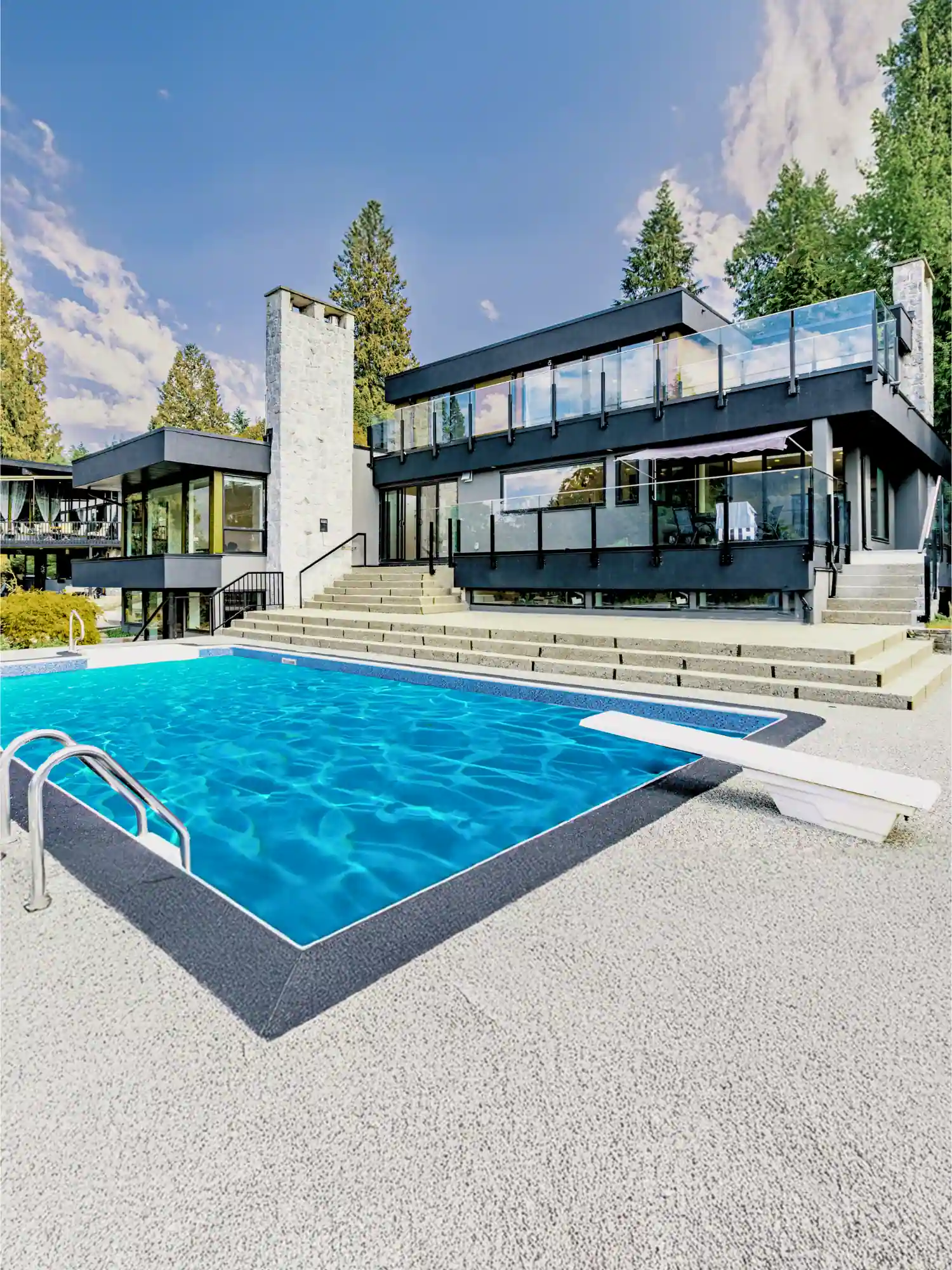
Split-levels were built in Vancouver predominantly from the early 1960s through the early 1980s
Vancouver General Contractors
This staggered design was intentional. Architects in the post-war boom era recognized that sloping lots — abundant throughout Metro Vancouver’s hillside neighbourhoods — could be exploited to separate the home’s zones naturally. Sleeping areas gained acoustic and visual privacy from living areas without requiring a full second storey. Garages could tuck under the main level without excavating a full basement. The result was a highly efficient use of both lot and construction budget.
There are four main types of split-level homes you’ll encounter in the Lower Mainland:
- Bi-level: Entry at grade with the home divided into two half-storeys — living areas on one level, bedrooms on the other. The simplest split-level form.
- Tri-level: Three distinct levels — typically upper (bedrooms), main (kitchen/living/dining), and lower (family room or garage). The most common type found in Vancouver suburbs.
- Back-split: A bi-level where the split occurs at the rear of the house. From the street it can look like a single-storey bungalow, but the rear reveals a lower level.
- Side-split: The levels are visible from the exterior on each side of the house — one side of the roof is higher, creating the characteristic stepped silhouette that immediately identifies a split-level from the street.
Split-levels were built in Vancouver predominantly from the early 1960s through the early 1980s. By the mid-1980s, the open-concept floor plan had become fashionable, and the enclosed, zoned layout of split-levels fell out of favour with new construction. This means the split-levels you encounter today are almost universally 40 to 60 years old — carrying original kitchens, bathrooms, finishes, and mechanical systems that are well past their renovation horizon.
Where Split-Level Homes Are Found in Metro Vancouver
Not all Metro Vancouver neighbourhoods have significant split-level stock. These homes cluster in areas where topography made them sensible — hillside communities where flat lots were the exception rather than the rule.
North Vancouver has the highest concentration of split-level homes in the region. Lynn Valley, Deep Cove, and Parkgate were developed heavily during the 1960s and 1970s, and the mountain terrain made split-levels the natural choice for builders working with sloped lots. Drive through Lynn Valley Road on a Sunday and you’ll see dozens of side-splits and tri-levels, many still wearing their original cedar siding and aluminum windows.
Burnaby‘s Capitol Hill and Burnaby Mountain neighbourhoods similarly feature substantial split-level inventory. The steep grades of Capitol Hill made conventional slab-on-grade construction impractical, and developers turned to split-level designs throughout the 1960s and 1970s.
Coquitlam and Port Moody — particularly older areas like Maillardville and the hillside sections above Clarke Road — carry significant split-level stock from the same era. Langley and Surrey‘s older suburbs also have pockets of split-levels, particularly in neighbourhoods developed in the 1970s.
In terms of current market value, split-level homes in Metro Vancouver typically trade in the $1.1M to $2.2M range depending on neighbourhood, lot size, and condition. North Vancouver split-levels tend to command the higher end of this range given land values; Coquitlam and Langley examples sit closer to the lower end.
Crucially, split-levels consistently sell at a slight discount relative to raised bungalows and two-storeys of equivalent size and vintage in the same neighbourhood. Buyers perceive the stairs-everywhere layout as less functional, the lack of open-concept flow as a dealbreaker, and the dated interiors as expensive to fix. This is precisely the opportunity for buyers willing to renovate: purchase a structurally sound split-level at a discount, invest in targeted upgrades, and emerge with a modernized home that outperforms its unrenovated neighbours at resale.
Split-Level Renovation Costs in Vancouver: 2026 Reference Table
Before diving into strategy, it helps to understand what split-level renovation actually costs in Metro Vancouver. The figures below reflect current contractor rates, permit costs, and material prices across the Lower Mainland. All figures include labour, materials, permits where applicable, and GST.
| Renovation Scope | Cost Range (2026) | Notes |
|---|---|---|
| Kitchen renovation | $38,000 – $95,000 | Mid-range to high-end cabinets, countertops, appliances, tile |
| Bathroom renovation (main) | $18,000 – $52,000 | Full gut and rebuild; higher end includes heated floors, custom tile |
| Main level open-concept conversion | $35,000 – $75,000 | Wall removal, structural beam, kitchen integration; excludes new kitchen |
| Full main floor renovation | $85,000 – $175,000 | Open concept + complete kitchen + flooring + lighting + paint |
| Lower level family room modernization | $35,000 – $65,000 | New drywall, flooring, pot lights, gas fireplace, egress window |
| Lower level legal suite conversion | $55,000 – $95,000 | Includes separate entry, kitchen, bathroom, electrical, permit |
| Stair renovation (per flight) | $8,000 – $18,000 | Hardwood/LVP treads, cable or glass railing; split-levels often have 2–3 flights |
| Upper level bedrooms + bathroom | $45,000 – $95,000 | 3 bedrooms + 1–2 bathrooms; flooring, closets, fixtures |
| Exterior renovation (complete) | $28,000 – $65,000 | Siding, windows, garage door, front entry — full exterior refresh |
| Full whole-home renovation | $185,000 – $380,000 | All levels, interior and exterior; permits, engineering included |
These ranges reflect real project costs from Metro Vancouver contractors in 2026. The spread within each range is driven primarily by finish level (builder-grade vs. premium), the specific condition of the existing structure, and site-specific complexities common in split-levels — particularly around load-bearing walls and mechanical systems that have never been updated.
For a detailed breakdown of renovation costs across all home types in the region, our Vancouver renovation guide provides the most comprehensive reference available for local homeowners.
The Split-Level Layout Challenge: Working With the Architecture
Here is the single most important thing to understand about renovating a split-level home: a split-level is architecturally the opposite of open-concept, and no renovation can fully change that fundamental reality.
In a two-storey home, the main floor is one continuous level. Remove a wall and you’ve opened up two adjacent rooms. In a split-level, the “levels” are defined by stairs, not walls. The separation between the main level and the bedroom level is not a wall you can remove — it is a structural floor system with a half-storey of height change. Lowering the upper floor or raising the main floor ceiling to eliminate this transition would require complete structural reconstruction of the home. It is theoretically possible, but the cost ($300,000+) would far exceed the value created.
The right renovation strategy for split-levels is to work with the split, not against it. This means:
- Accepting that bedrooms will always be a half-storey above or below the main level — and leaning into the privacy and acoustic separation this provides
- Focusing open-concept improvements on the main level itself, where kitchen, dining, and living are often on the same floor and separated only by walls (not stairs)
- Using the lower level’s natural separation to create a distinct use zone — a legal suite, a family room, a home office — rather than trying to visually connect it to the main level
- Investing in the stair flights as the defining visual element of the home’s interior, since they are unavoidable focal points
Homeowners who approach split-level renovation with realistic expectations — and a strategy matched to the architecture — consistently achieve excellent results. Those who enter the process hoping to “make it feel like an open-concept two-storey” consistently experience budget overruns and disappointment.
Opening the Kitchen: The Highest-Impact Split-Level Renovation
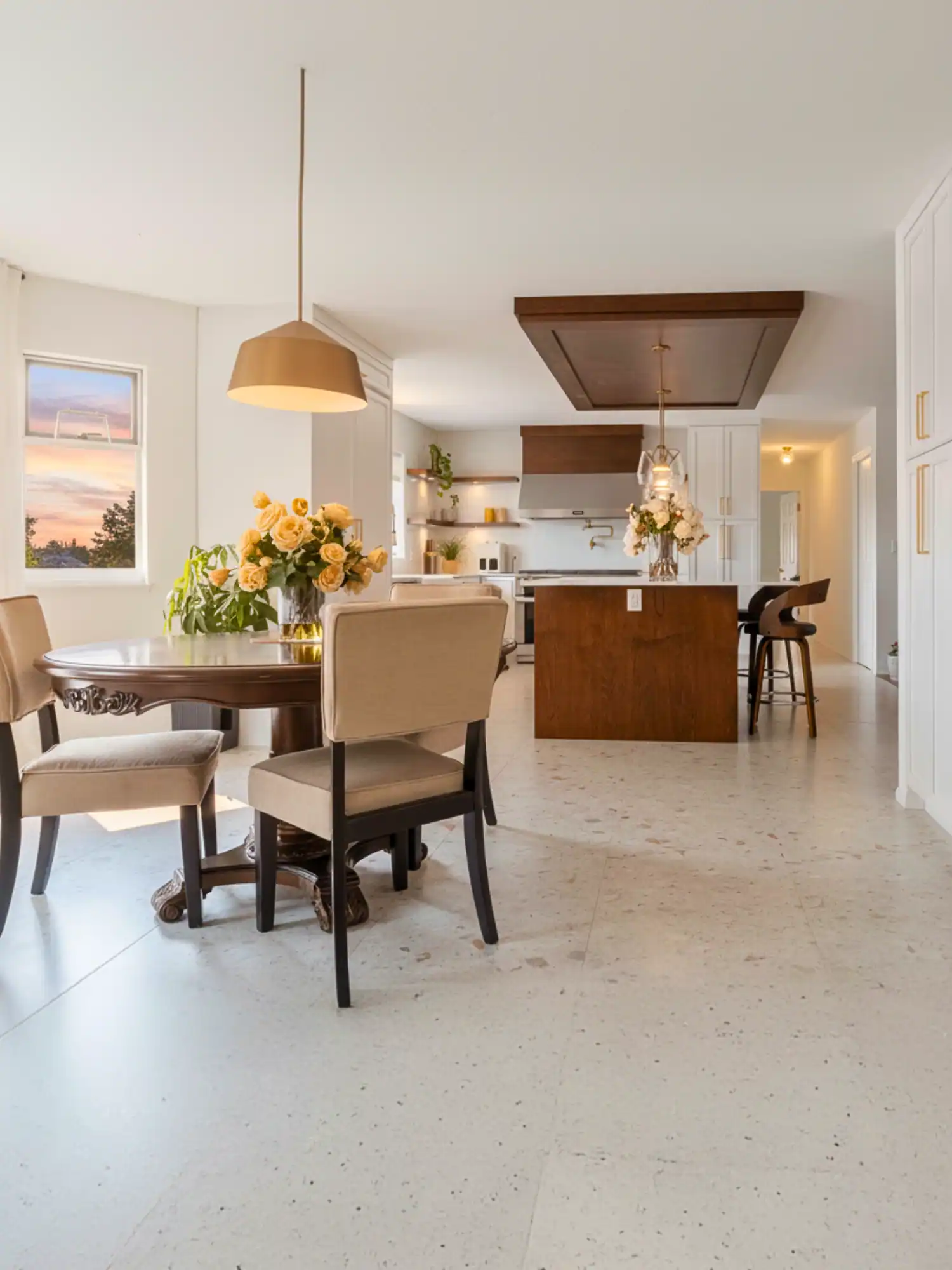
In the vast majority of split-level homes built in the 1960s through 1980s, the kitchen is an enclosed room at the back of the main level, separated from the dining area by a wall (and often a doorway), and from the living room by a hallway or second wall. This compartmentalized layout was the design norm of the era. Today it reads as the primary deficiency that drives buyer hesitation and depresses resale values.
The good news: on the main level of a split-level home, the kitchen-to-dining-to-living connection can be substantially opened up. Unlike the level transitions themselves (which involve structural floor changes), the walls between kitchen, dining, and living areas on the same level are frequently non-structural — or, when bearing, can be removed with an engineered beam and appropriate point-load support.
A typical split-level kitchen opening scope includes:
- Bearing wall assessment by a structural engineer ($800–$1,500) — non-negotiable before any wall removal in a split-level given the complex load paths
- Wall removal and beam installation — if the wall is load-bearing, an LVL (laminated veneer lumber) or steel beam carries the load, with new posts at each end transferring loads to the foundation; this is the most variable cost item ($8,000–$22,000 depending on beam span and load complexity)
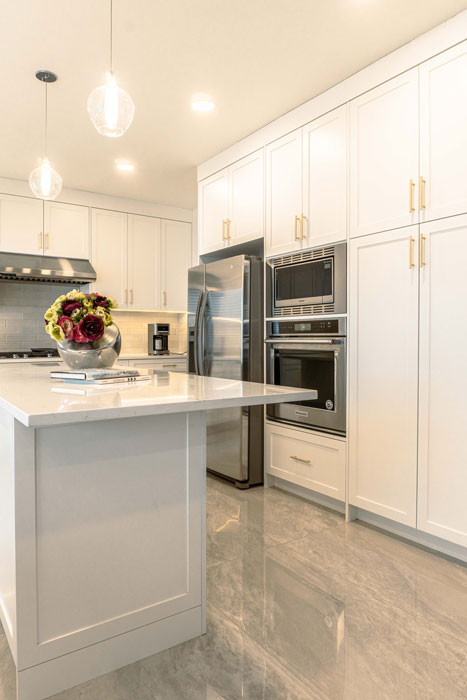
- Kitchen reconfiguration — new layout that takes advantage of the opened space, typically introducing an island or peninsula that defines the kitchen zone while maintaining visual connection to dining and living
- Flooring continuity — running consistent hardwood or LVP throughout the opened main level is critical; patchwork flooring defeats the visual purpose of opening the space
- Lighting redesign — pot lights replacing fluorescent boxes and 1970s fixtures, pendant lighting over the new island
The combined cost for open-concept conversion plus a complete kitchen renovation on the main level of a split-level typically runs $85,000 to $175,000 — at the higher end when premium appliances and custom cabinetry are specified, at the lower end with semi-custom cabinets and mid-range appliances. This is the renovation investment with the highest return in split-level homes, as it directly addresses the layout deficiency that most suppresses resale value.
If budget requires prioritization, the open-concept kitchen conversion alone (without a full kitchen rebuild) — where you remove the wall and refinish the surfaces but keep existing cabinets — can be accomplished for $35,000 to $55,000, substantially improving the feel of the home while deferring the full kitchen investment.
The Lower Level: Modernize, Suite, or Convert
The lower level of a typical Metro Vancouver split-level — that half-storey below the main floor — is almost universally the most dated and underutilized space in the home. Walk into a 1970s tri-level in Lynn Valley and you’ll typically find: dark wood panelling from floor to ceiling, a drop-ceiling or exposed joists, small aluminum-frame windows that let in minimal light, wall-to-wall carpet over concrete, and an aging oil or gas furnace tucked in a utility corner.
This space has significant potential. The renovation decision comes down to three primary options:
Option 1: Modernize as a Family Room ($35,000–$65,000)
Remove the wood panelling, add proper insulation and vapour barrier, install new drywall, and refinish the space as a contemporary family room. Pot lights replace the drop ceiling. LVP flooring replaces carpet. A gas fireplace (direct-vent) creates a focal point and provides supplemental heat. Egress window enlargement improves natural light and code compliance. This is the lowest-cost option and produces a dramatically improved space that connects to the rest of the home.
Option 2: Convert to Legal Suite ($55,000–$95,000)
Split-levels are well-suited to secondary suite conversion because the lower level is naturally separated from the main living areas by the stair transition. A separate entrance is typically achievable through the existing garage or a side door. The ceiling height in most split-level lower levels — typically 7’6″ to 8’0″ — meets the City of Vancouver’s minimum 7’4″ requirement (North Vancouver and Burnaby have similar minimums). Key scope items: separate entry, kitchen (sink, stove, refrigerator, cabinets), full bathroom (3-piece minimum), electrical sub-panel, separate HVAC supply, smoke/CO detection per code, and egress windows in all sleeping rooms. Permits are required and will trigger a building inspection. Budget an additional $8,000–$12,000 for permit fees and the engineer letter typically required by municipalities. The return on this investment in Metro Vancouver’s rental market is substantial — a lower-level suite in North Vancouver can achieve $2,000–$2,500/month in rental income.
Option 3: Home Office, Gym, or Media Room ($25,000–$45,000)
If suite income isn’t the goal, the lower level makes an excellent dedicated use space that benefits from the natural separation from the main living areas. A home gym with rubber flooring, mirrored walls, and proper ventilation. A media room with acoustic insulation, a projection screen, and theatre seating. A home office with built-in shelving and dedicated lighting. These conversions are lower in cost than a suite because they don’t require a kitchen, bathroom, or separate entry — but they similarly transform the most dated space in the home into its most functional.
Window enlargement deserves specific attention regardless of which option you choose. The small windows typical of split-level lower levels were sized to code minimums of the era — they let in little light and, critically, do not meet current egress requirements for sleeping rooms. Enlarging windows to proper egress dimensions ($1,500–$3,500 per window including the concrete cutting and lintel work) both improves livability and is mandatory if the space will include sleeping areas.
Stair Renovation: The Defining Visual Element
No architectural element defines a split-level home more than its stairs. A typical tri-level has two full stair flights — main to upper (bedrooms), and main to lower (family room). Some configurations have three flights. In a home where the staircase is always visible from the entry landing, the condition of those stairs communicates the age and quality of the renovation immediately and powerfully.
Original split-level stairs from the 1960s–1980s typically feature: wall-to-wall carpet over particleboard treads, a closed-riser design that blocks light, painted hollow wooden newel posts, and turned spindle railings in oak or pine that are now universally associated with “grandma’s house” aesthetics. Even in a home where the kitchen and bathrooms have been updated, leaving these original stair elements intact anchors the home visually in the past.
Modern stair renovation approaches for split-levels:
- Hardwood or LVP treads: Replace carpeted treads with matching hardwood (white oak is the current dominant choice in Metro Vancouver renovations) or high-quality LVP. Matching the main floor flooring material creates visual continuity across levels.
- Open riser vs. closed riser: Removing risers (the vertical face between treads) creates an airy, contemporary look that allows light to pass through the staircase. Code requires specific tread-to-riser ratios and maximum opening dimensions to prevent fall hazards — a detail that requires attention in permit drawings.
- Cable railing: Horizontal stainless steel cables between steel posts are the most popular contemporary railing choice in Vancouver renovations. They maintain sightlines across the open staircase, are extremely durable, and have a clean minimal aesthetic. Cost premium over traditional wood railings is offset by the dramatic visual upgrade.
- Glass panel railing: Frameless glass panels or glass infill panels between posts are an alternative to cable. Slightly higher cost, zero visual obstruction, requires more careful cleaning maintenance.
- Painted closed riser with wood treads: A more budget-conscious option — keep the closed risers but paint them crisp white, install hardwood treads, and update the railing system. Still a substantial visual improvement at lower cost.
Cost per flight in Metro Vancouver: $8,000–$18,000, depending on railing system complexity, tread material, and whether the stringer (the structural side board) requires replacement. With two or three flights, stair renovation is a meaningful line item in the renovation budget — but the visual impact-to-cost ratio is among the highest of any renovation investment in a split-level home.
One stair-specific consideration in split-levels: the staircase is structural, not just finish. The stringers, newel posts (particularly those at landings), and in some configurations the stair carriages themselves are integral to the floor system. Any stair renovation must assess whether structural elements need reinforcement or replacement, not just cosmetic resurfacing.
Main Floor Renovation: The Heart of the Split-Level
The main level — where you enter the home from the front door and where kitchen, dining, and living areas reside — is the primary focus of most split-level renovations. It is the level guests see first, the space where daily living happens, and the area with the greatest potential for transformation.
A complete main floor renovation in a split-level typically encompasses:
- Interior wall removal and structural work — opening the kitchen to the dining/living area, as discussed above
- Complete kitchen renovation — new custom or semi-custom cabinetry, quartz or stone countertops, tile backsplash, integrated appliances, under-cabinet lighting, and island or peninsula
- Hardwood or LVP flooring throughout — consistency across the entire main level is essential; using different materials in kitchen vs. living vs. dining fragments the space visually and undermines the open-concept conversion
- Pot lighting and feature lighting — replacing surface-mount fixtures and fluorescent kitchen lighting with recessed LED pot lights, pendant lighting over the island, and accent lighting in the living area
- Paint — full repaint including ceilings (often still popcorn texture in split-levels from this era, which may require removal for lead/asbestos assessment and remediation before repainting)
- Window and door updates — replacing aluminum-frame sliders with vinyl or fibralloy double-pane units improves thermal performance and updates the aesthetic; new interior doors with modern hardware throughout
The complete main floor transformation in a split-level — from dated 1970s compartmentalized layout to contemporary open-concept living — costs $85,000 to $175,000. At the higher end of this range you’re specifying premium appliances ($20,000+), custom cabinetry with integrated refrigerator and appliance panels, stone countertops, and wide-plank white oak hardwood throughout. At the lower end you’re working with semi-custom cabinets, mid-range appliances, and engineered hardwood or quality LVP.
Homeowners sometimes ask whether they should renovate the main floor or the lower level first. For resale within a 3–5 year horizon, the main floor renovation generates more value per dollar invested. For homeowners planning to stay 10+ years and seeking rental income to offset mortgage costs, the suite conversion in the lower level may provide better financial return through cash flow — particularly in the current Metro Vancouver rental market.
Our team at Vancouver General Contractors has completed dozens of split-level main floor renovations across North Vancouver, Burnaby, and Coquitlam. For a personalized cost estimate and scope recommendation, contact us for a free consultation.
Bedroom Level Renovation: The Upper Half-Storey
The upper level of a split-level — reached by going up five to seven stairs from the main floor landing — typically contains three bedrooms and one full bathroom. In larger tri-levels or side-splits, a primary bedroom with a 2-piece or 3-piece en suite may be present from original construction. More commonly, however, the original bathroom is shared by all three bedrooms with no en suite provision — a layout that conflicts sharply with contemporary buyer expectations.
Upper level renovation scope typically includes:
- Bathroom renovation or expansion ($22,000–$52,000): The shared bathroom in a 1970s split-level typically features a 5-foot alcove tub, builder-grade vanity, and tile that has aged poorly. Full renovation includes new shower/tub surround (often converting the tub to a walk-in shower with the tub relocated or eliminated), custom tile, new vanity, and updated fixtures. Expanding the bathroom footprint requires taking space from an adjacent bedroom or closet — possible but adds complexity and may require a permit.
- En suite addition: Adding an en suite to the primary bedroom in a split-level is feasible but rarely straightforward. The typical approach is to convert half of the smallest bedroom into en suite space, or to take space from an existing oversized closet. The structural implications — cutting through the existing floor system for drain lines in an upper half-storey — require careful planning and a permit. Budget $35,000–$65,000 for a new en suite addition in a split-level. The ROI at resale in the North Shore and Burnaby markets is strong, as primary suites with en suites are now a baseline expectation for buyers at the $1.5M+ price point.
- Flooring: Carpet in all three bedrooms is the standard original condition. Replacing with engineered hardwood ($12–$18/sq ft installed) or high-quality carpet ($6–$10/sq ft installed) is a meaningful upgrade. Many renovators choose hardwood in the primary bedroom and quality carpet in secondary bedrooms for comfort and cost management.
- Closet organization: Original built-in closets in 1960s–1980s split-levels are typically a single rod with a shelf above. Installing a closet organization system (wire or custom wood) costs $800–$2,500 per closet and significantly improves function.
One renovation that is rarely feasible in split-levels is bedroom addition. The upper level of a split-level is defined by the roofline — typically a low-pitched gable or hip roof that closely follows the floor below. Lifting the roofline to add height for a full dormer or room addition would require substantial structural and exterior work ($150,000+) that is generally not cost-effective relative to the value created. Homeowners seeking more bedrooms are better served by converting the lower level to a suite (reducing the family’s own bedroom count but adding rental income) or by purchasing a larger home.
Curb Appeal and Exterior: Updating the Split-Level Silhouette
A split-level home has a distinctive exterior profile that no amount of interior renovation can change: the “stepped” roofline is immediately identifiable from the street. This silhouette dated the homes in the design cycle of the 1990s and 2000s, when symmetrical two-storey boxes dominated new construction. Today, the architectural honesty of the split-level silhouette is actually enjoying a rehabilitation — the stepped profile reads as interesting rather than dated when the exterior materials are contemporary.
The elements that truly date split-level exteriors — and that renovation can address directly — are:
- Siding: Original T-111 plywood siding, painted cedar, or textured stucco has typically aged poorly over 40–60 years. Replacement with fibre cement (James Hardie board and batten or lap siding) is the dominant choice in Metro Vancouver exterior renovations. Fibre cement is dimensionally stable in Vancouver’s wet climate, paintable in any colour, and has a 30-year warranty. Cost for full siding replacement on a split-level: $18,000–$35,000 depending on size and complexity.
- Windows: Original aluminum-frame single or early-double-pane windows are the single largest source of heat loss in split-levels of this era and among the most visually dated elements. Replacement with vinyl or fibralloy (fibreglass composite) double-pane or triple-pane units provides immediate energy savings, eliminates condensation on frames, and dramatically updates the exterior appearance. A full window replacement on a typical split-level (12–18 windows) costs $18,000–$35,000.
- Garage door: The single or double garage door faces the street in most split-level configurations and occupies a substantial portion of the visible facade. Replacing a 1970s raised-panel metal door with a contemporary full-view aluminum door with glass inserts ($3,500–$6,500 installed) is one of the highest-ROI individual items in exterior renovation.
- Front entry: The entry to a split-level is at mid-level — often approached by a short exterior stair. Adding a canopy, pergola, or covered entry structure over this landing updates the arrival experience substantially and can be designed to complement the stepped roofline rather than fight it. A custom entry canopy or pergola runs $8,000–$18,000 installed.
- Landscaping and hardscaping: Split-levels on sloped lots typically have retaining walls, tiered gardens, and complex drainage to manage. Replacing original retaining walls (often untreated wood that has failed over 40 years) with concrete block or natural stone, adding proper drainage, and landscaping the front with low-maintenance plantings completes the exterior refresh.
A complete exterior renovation of a split-level — siding, windows, garage door, entry, and basic landscaping — costs $28,000 to $65,000 in Metro Vancouver’s current market. This is also the scope most likely to be phased: windows and siding first (greatest functional benefit), garage door and entry as a second phase, landscaping as a third.
One exterior consideration specific to split-levels on sloped lots: the lower level often has exposed concrete foundation walls visible from the street or side yard. These foundation walls can be finished with cultured stone veneer ($60–$120/sq ft installed) or painted elastomeric coating ($15–$25/sq ft) to integrate them into the overall aesthetic rather than leaving them as an obvious exposed concrete base.
Structural Considerations Unique to Split-Level Homes
Split-level homes present structural conditions that require more careful pre-renovation assessment than a conventional single-storey or two-storey home. Any contractor who dismisses the need for a structural engineering review before opening walls in a split-level should be viewed with caution.
Key structural realities of split-level construction:
Load transfer at mid-level landings: The entry landing of a split-level — the mid-level point from which you go either up to bedrooms or down to the lower level — is a complex structural node. Loads from the upper floor transfer through the walls framing this landing to the main level floor system below. The walls immediately adjacent to the landing (including those between the kitchen and dining area, in many configurations) frequently carry these loads, making them bearing walls even when their position might not suggest it. A structural engineer’s assessment of load paths in a split-level — not just a visual inspection — is the only reliable method.
Garage below main level implications: In split-levels where the garage occupies the lower level below part of the main floor, the main floor joists span over the garage ceiling. Any point loads added to the main floor (a heavy kitchen island with a stone top, a new bath in an unexpected location, a hot tub on an upper deck) may transfer directly to garage ceiling framing designed for residential live loads only. Structural review before any significant main floor changes is essential.
The staircase as a structural element: In split-levels, the stair carriages and surrounding framing are integral to the floor systems at each level. This is more pronounced than in conventional two-storey homes because the stair flights in a split-level are typically shorter (5–7 steps) and more tightly integrated into the floor structure at each landing. Renovation involving any stair modification — widening a staircase, relocating a stair, changing the tread configuration — requires structural review.
Original construction quality variation: Split-levels from the 1960s were built under building codes significantly less stringent than current standards. Shear wall provisions, holddown requirements, and foundation reinforcing that are standard today were either minimal or absent in original construction. A comprehensive structural assessment before renovation helps identify whether upgrades to lateral load resistance are warranted — particularly relevant in Metro Vancouver’s seismic zone.
Budget $1,500–$3,000 for a structural engineering consultation and review of plans before committing to wall removal or significant structural changes in a split-level. This is not optional cost — it is the information that determines whether your renovation budget is being spent correctly. For guidance on structuring your renovation project from the planning stage, our home renovation page outlines our full project management process.
More Vancouver Housing Types Guides
Vancouver Special vs. Character Home Renovation: Key Differences in Approach and Cost

Condo vs. House Renovation in Vancouver: What's Different About Strata?
Townhouse vs. Detached Home Renovation in Vancouver: What Strata Changes About Your Project

Century Old Home Renovation Knob Tube Asbestos Foundation

Point Grey Mansion Renovation Luxury Heritage Combined
Ready to start your renovation?
Frequently Asked Questions: Split-Level Renovation Vancouver
Is a split-level hard to renovate?
Split-levels are not inherently harder to renovate than other home types, but they do have specific challenges that require more careful planning than a conventional two-storey. The primary complexities are: load path assessment before any wall removal (split-levels have non-obvious load-bearing walls), the multi-flight stair system that requires coordinated renovation across levels, and the mechanical systems (heating, plumbing) that often need rerouting as the renovation unfolds. Working with a contractor who has specific split-level experience in Metro Vancouver will significantly de-risk the project.
Can I make a split-level open concept?
Partially — and strategically. On the main level of a split-level (where kitchen, dining, and living are located), open-concept conversion through wall removal is achievable and is the highest-impact renovation available in this home type. What you cannot achieve is a visual or spatial connection between levels (main to upper, main to lower) without structural reconstruction that would cost more than the home itself. The correct expectation is: open and connected on the main level, with the other levels remaining distinct and separated — which is, in fact, the intentional privacy feature of split-level design.
What is the difference between a bi-level and a tri-level?
A bi-level split-level has two half-storeys — you enter at grade and go either up or down a half-storey. There are two levels in total. A tri-level has three levels — typically an upper bedroom level, a main living level at the entry, and a lower family room or garage level. Tri-levels are more common in Metro Vancouver’s hillside neighbourhoods because the terrain often accommodated three distinct terraces. Most renovation considerations apply to both types, though tri-levels have one additional stair flight to address.
How do split-level renovation costs compare to two-storey renovation costs?
On a per-square-foot basis, split-level renovations typically cost 10–20% more than equivalent two-storey renovations, primarily because of the structural complexity around load paths, the multi-flight stair renovation cost, and the less efficient material distribution across multiple levels. A whole-home renovation that would cost $150,000 on a comparably sized two-storey may cost $165,000–$180,000 on a split-level. However, because split-levels often purchase at a discount vs. comparable two-storeys, the net renovation economics can still favour the split-level for buyers who are comfortable with the layout.
Can I add a legal suite to a split-level home?
Yes — split-levels are among the better candidates for secondary suite conversion precisely because the lower level is naturally separated from the main living areas. Key requirements: ceiling height minimum 7’4″ (most split-level lower levels meet this), egress windows in all sleeping rooms, separate entry (typically achievable through the garage or a side door), a kitchen (sink, stove, refrigerator), a 3-piece bathroom, and compliance with your municipality’s secondary suite bylaw. North Vancouver District, City of North Vancouver, Burnaby, and Coquitlam all permit secondary suites in single-family homes subject to specific requirements. Budget $55,000–$95,000 for a permitted suite conversion in a split-level, including permit fees of $8,000–$12,000.
What is the best flooring for a split-level renovation?
Consistency across the main level is the most important flooring principle in a split-level renovation. White oak engineered hardwood (9.5mm–15mm wear layer) is the dominant choice in current Metro Vancouver renovations for the main level. It can be installed on grade and handles the humidity variation of a Vancouver winter without the movement risk of solid hardwood. For the lower level (typically on or below grade), luxury vinyl plank (LVP) with a 20mil wear layer is the best choice — fully waterproof, comfortable underfoot, and available in wide-plank formats that match the aesthetic of upper-level hardwood. For stairs, matching the main level hardwood species and stain creates the most cohesive visual result.
How do you modernize a split-level exterior?
The most impactful exterior modernization sequence for a split-level: (1) window replacement — nothing ages a split-level exterior faster than aluminum-frame windows; new vinyl or fibralloy units with black or bronze frames immediately update the look; (2) siding replacement — James Hardie board and batten or lap siding in a contemporary colour palette replaces dated T-111 or cedar siding; (3) garage door — a full-view aluminum door with glass inserts modernizes the largest element of the street-facing facade; (4) entry canopy or pergola — a covered entry at the mid-level landing improves arrival experience; (5) painted or stone-veneered foundation walls — integrates the exposed concrete base into the overall aesthetic.
How long does a split-level renovation take?
A complete whole-home split-level renovation (all levels, interior and exterior) typically takes 5–9 months from permit issuance to substantial completion in Metro Vancouver’s current construction market. A main floor renovation only (open-concept conversion + kitchen) takes 3–4 months. A lower level suite conversion takes 2–3 months. These timelines assume permits are in place before construction begins — permitting in North Vancouver and Burnaby currently takes 8–14 weeks for residential renovation permits, so factor this into your planning horizon. Starting the permit process early is the single most effective timeline management strategy available to homeowners.
Does renovating a split-level improve resale value?
Yes — with the right scope. The renovations that most directly address the layout and aesthetic deficiencies that discount split-level values generate strong resale returns. A main floor open-concept conversion plus kitchen renovation ($85,000–$175,000 investment) typically returns 70–90% of cost at resale in Metro Vancouver’s current market. A full whole-home renovation in a well-located split-level (North Vancouver, Burnaby Capitol Hill) can fully recoup renovation costs within 3–5 years given land value appreciation in those markets. The worst ROI comes from over-capitalizing on finishes (premium imported tile, bespoke millwork) in a neighbourhood where comparable unrenovated split-levels trade below $1.3M — match finish level to neighbourhood ceiling price.
Can you remove stairs from a split-level to make it single-level?
No — not in any practical sense. The stairs in a split-level are not decorative; they are the only means of accessing each level. Eliminating the level transition itself would require raising or lowering floor systems, which involves reconstructing the structural framing at each level. This is beyond the scope of renovation and into the territory of a rebuild. The only feasible stair-related modification is relocating a stair flight within a level (changing where it emerges, for example), not eliminating the height transition between levels.
Can I convert my split-level garage to living space?
Yes, with planning. Garage-to-living-space conversions are common in split-levels where the garage occupies part of the lower level. Requirements: insulation to current energy code (walls, ceiling, slab), vapour barrier, drywall, egress window or door, heating, and a building permit. The concrete slab requires a floating floor system (sleepers + subfloor, or thick LVP on dimple mat) to bring it to a comfortable living surface. If the garage conversion creates additional habitable space for suite purposes, plumbing and electrical must be brought to current code. Note that removing a garage may trigger requirements for alternative vehicle parking under local zoning — check with your municipality before proceeding. Budget $25,000–$45,000 for a garage conversion to livable space in a split-level.
What permits are required for a split-level suite conversion?
A secondary suite conversion in Metro Vancouver requires a building permit from your local municipality (City of North Vancouver, District of North Vancouver, City of Burnaby, City of Coquitlam, etc.). The permit application requires: drawings showing the proposed layout, compliance with BC Building Code secondary suite requirements (ceiling height, egress, kitchen, bathroom), an energy compliance assessment, and in some cases a structural engineer’s letter if structural modifications are involved. Once permitted, the suite must pass inspections at framing, rough electrical, rough plumbing, and final stages. The permit process typically takes 8–14 weeks in current North Shore and Burnaby queues. Some municipalities also require a business licence for rental suites. Your contractor should pull all permits — if a contractor suggests doing suite work “without permits to save money,” walk away.
Why are split-level homes cheaper to buy than other Vancouver home types?
Split-levels trade at a discount for several interconnected reasons: the multi-stair layout is perceived as less functional than open-concept two-storeys; the homes are universally older (1960s–1980s) with more deferred maintenance; the compartmentalized floor plan doesn’t photograph well for MLS listings (a meaningful market influence in the Instagram era); and buyers broadly associate split-levels with extensive renovation costs. This discount ranges from approximately 5–15% relative to a comparable raised bungalow or two-storey in the same neighbourhood. For buyers who are renovation-ready and understand split-level architecture, this discount represents a genuine opportunity to acquire more square footage on a better lot in an established neighbourhood than the same budget would achieve with a contemporary home type.
Split-level vs. rancher renovation: which is better value?
These are very different renovation propositions. A rancher (single-storey bungalow) on the same lot as a split-level will typically have less total square footage but simpler renovation: one floor, no stair complexity, easier mechanical access, and greater suitability for aging-in-place buyers. A split-level offers more square footage for the lot size and more renovation upside (particularly through suite conversion of the lower level), but at higher renovation cost and complexity. For families with children, the split-level’s bedroom separation often works well. For buyers anticipating aging in place, the stair dependency of a split-level is a meaningful long-term concern. The financial case for each depends on your specific neighbourhood, lot, and timeline — there is no universal answer.
What are the heating challenges in split-level homes?
Split-levels present distinct heating challenges compared to single-level homes. Because each level is physically separated and the stairwells act as heat chimneys (warm air rises through each stair opening), the upper bedroom level tends to be warmer than the main level, and the lower level tends to be coldest — especially when it is partly below grade. Original forced-air systems in split-levels from the 1960s–1980s were frequently undersized and used undersized duct runs to the upper level. Renovation is an opportunity to assess and upgrade the heating system: modern high-efficiency gas furnaces with properly sized ductwork, mini-split heat pump systems (which allow zone-level control and provide both heating and cooling), and in-floor radiant heat for the lower level slab are all options worth evaluating. A heat loss calculation by a mechanical engineer or HVAC contractor specific to the split-level configuration is a worthwhile investment ($500–$1,000) before any major renovation that changes the thermal envelope.
Planning Your Split-Level Renovation in Metro Vancouver
A well-executed split-level renovation is one of the most rewarding renovation projects in Metro Vancouver’s housing stock. These homes offer generous square footage, established neighbourhoods with mature trees and community infrastructure, and — critically — acquisition prices that provide room for renovation investment without over-capitalizing relative to the neighbourhood ceiling.
The renovation strategy that consistently produces the best outcomes for split-level homeowners:
- Start with a structural engineering assessment ($1,500–$3,000) before any design commitment. Understanding which walls are bearing and how loads transfer through the split-level structure prevents costly redesigns mid-project.
- Prioritize the main floor if your budget requires sequencing. The open-concept kitchen conversion is the renovation most directly linked to perceived value — both for resale and for daily livability.
- Plan the stair renovation as part of the main floor scope. Renovating the kitchen while leaving 1970s carpet and spindle railings on the adjacent staircase produces an incoherent result. These elements are always visible together.
- Get the lower level strategy right early. The decision to pursue a legal suite vs. a family room modernization affects plumbing rough-in placement, electrical panel sizing, and egress window placement — all of which are far more expensive to change after the fact than during the initial renovation.
- Budget 15% contingency over your contractor estimate for a split-level renovation. These homes consistently reveal unexpected conditions — original knob-and-tube wiring, asbestos in floor adhesive, undersized beams, or foundation drainage issues — that add cost. The contingency is not pessimism; it is the appropriate reserve for a home type with 40–60 years of accumulated conditions.
Vancouver General Contractors has been executing residential renovations across Metro Vancouver for over 15 years, with extensive experience in split-level homes throughout North Vancouver, Burnaby, and the Tri-Cities. We bring structural engineering partnerships, in-house design consultation, and transparent fixed-price contracts to every project.
To start planning your split-level renovation, contact us for a free on-site consultation. We’ll walk through the home with you, identify the structural realities, and provide a clear scope and budget framework within two weeks of the initial meeting. For a comprehensive overview of what renovation planning involves — from permits to contractor selection to project management — visit our complete Vancouver renovation guide.
Split-level homes built the suburbs of Metro Vancouver. Renovated thoughtfully, they’re among the best value propositions remaining in one of Canada’s most expensive housing markets.
Get a Free Renovation Quote
Metro Vancouver’s trusted general contractors. Free consultations across Vancouver, Burnaby, Richmond, North Shore & beyond.
Get Your Free Quote →VGC serves Vancouver and surrounding areas. View all renovation services in Vancouver →

Comments are closed