




Townhouse Renovation Vancouver: Strata Rules, Costs & What You Can Actually Do (2026)
Renovating a townhouse in Vancouver is fundamentally different from renovating a detached home — and most homeowners find that out the hard way. You own the interior of your unit, but the moment your project touches anything structural, exterior, or shared, you’re operating inside a strata framework governed by the BC Strata Property Act. That means written applications, strata council votes, potential engineer sign-offs, and timelines that can stretch three months before a hammer swings.
This guide covers everything Metro Vancouver townhouse owners need to know: current renovation costs, exactly what requires strata approval and what doesn’t, how to navigate the approval process efficiently, and what to expect from specific project types — kitchens, bathrooms, rooftop patios, and basements. Whether you’re in a Burnaby three-storey townhouse, a Coquitlam stacked rowhouse, or a heritage townhome on Vancouver’s west side, the framework applies.
Vancouver’s Townhouse Renovation Market: Why It’s Different
Attached townhouses and rowhouses represent roughly 15% of Metro Vancouver’s total housing stock — approximately 130,000 units spread across every municipality. Values range from $800,000 for a compact Port Coquitlam rowhouse to $2.2 million or more for a three-storey Kitsilano townhome, with the average Metro Vancouver attached townhouse sitting around $1.1 million as of early 2026.
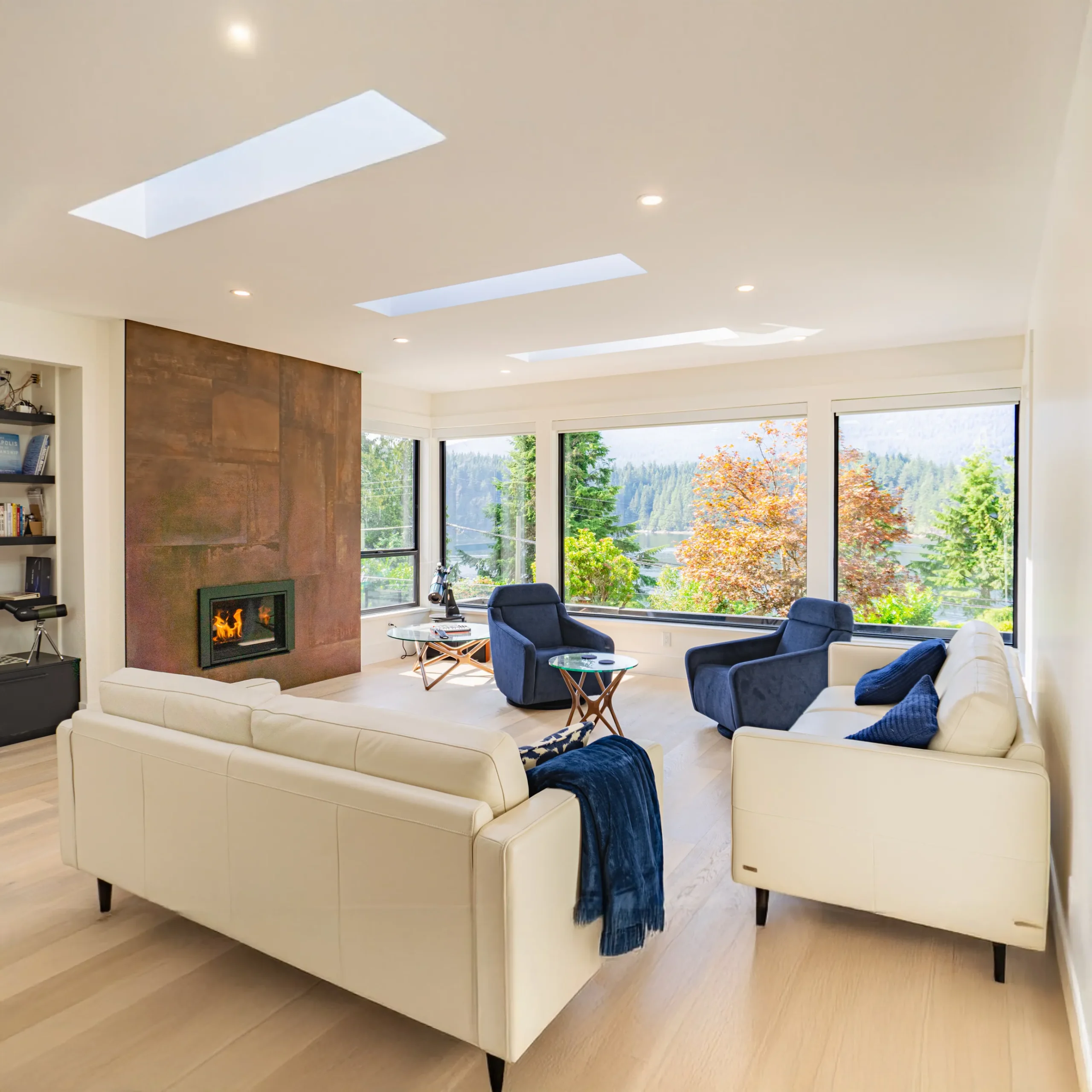
Vancouver townhouse renovations carry cost premiums over equivalent detached home work. Access is typically through a single front door with narrow stairs and landings
Vancouver General Contractors
That value concentration makes townhouse renovation one of the most financially significant decisions a Vancouver homeowner can make. A well-executed kitchen renovation in a Yaletown townhouse can add $80,000–$120,000 in resale value. A botched exterior modification that violates strata bylaws can trigger a forced restoration order — at your expense.
The unique challenge of townhouse renovation comes from the strata ownership model. When you purchase a townhouse in BC, you receive a strata lot — typically the interior of the unit bounded by the interior surface of floors, ceilings, and walls. Everything beyond those surfaces — the structure, the exterior envelope, shared drainage stacks, roofs, common hallways, and outdoor common property — belongs either to the strata corporation as a whole or is designated limited common property for your exclusive use but under strata control.
This creates a renovation framework unlike anything in detached home ownership. A kitchen renovation is generally within your rights. Installing a new window in the same rough opening might not be. Removing an interior wall is probably fine. Touching a party wall that separates your unit from your neighbour’s could require a three-quarters supermajority vote of all strata owners.
Understanding exactly where these lines fall — and how to work efficiently within them — is what separates a smooth townhouse renovation from a costly, stressful dispute.
Townhouse Renovation Costs in Vancouver: 2026 Price Guide
Vancouver townhouse renovations carry cost premiums over equivalent detached home work. Access is typically through a single front door with narrow stairs and landings. Waste removal requires coordinating with strata rules on bin placement and construction traffic. Noise restrictions imposed by strata bylaws limit working hours — many Metro Vancouver strata corporations restrict construction to 8am–5pm Monday through Friday, adding days to project timelines. These factors add 10–20% to labour costs compared to a similar detached renovation.
| Project Type | Typical Range (Metro Van, 2026) | Key Variables |
|---|---|---|
| Bathroom renovation (full) | $18,000 – $32,000 | Tile selection, fixture grade, plumbing relocation |
| Kitchen renovation (full) | $38,000 – $65,000 | Cabinet line, appliance spec, layout changes |
| Flooring — all levels | $15,000 – $28,000 | Material, sq footage, subfloor condition |
| Full interior gut renovation | $120,000 – $240,000 | Scope, finishes, strata approval complexity |
| Rooftop patio addition | $35,000 – $70,000 | Structural load, waterproofing spec, drainage |
| Basement finishing | $45,000 – $85,000 | Egress windows, suite vs. family room finish |
| Window replacement (in-kind) | $800 – $1,400 per window | Strata approval required in most buildings |
| Exterior door replacement | $2,500 – $5,000 per door | Strata approval required; must match building standard |
| Balcony/patio renovation | $8,000 – $25,000 | Limited common property; strata approval required |
| HVAC system replacement | $12,000 – $22,000 | Depends on whether shared or unit-specific system |
The cost premium for townhouse renovations relative to detached homes breaks down across three primary factors:
- Access constraints: Materials and waste move through a single entrance. No side-yard staging area. Delivery and removal costs are higher, and physical labour is slower when moving between three levels of a narrow townhouse versus an open detached home site.
- Noise and time restrictions: Strata-imposed work hour limits reduce productive hours per day. A kitchen demolition that takes one day in a detached home may take two in a strata building with 8am–5pm restrictions and lunch-hour quiet periods some strata bylaws impose.
- Waste disposal: Many strata corporations restrict bin placement, require advance notice, and limit the duration bins can occupy visitor parking. Some prohibit bins entirely, requiring shuttle-and-load disposal — significantly more expensive per cubic yard.
BC Strata Property Act Framework: What You Own vs. What the Strata Owns
The BC Strata Property Act (SPA) divides a strata corporation’s physical reality into three categories, and where your renovation falls within that structure determines what approval you need — or whether you need any at all.
Strata lot is what you own outright: the interior airspace of your unit, bounded by the unfinished interior surfaces of walls, floors, and ceilings. Subject to bylaws, you can generally do what you like within this space without strata approval. This includes painting, replacing flooring, upgrading kitchen cabinets, and changing interior fixtures.
Common property is owned collectively by all strata owners and managed by the strata corporation. This includes the exterior envelope of the building (roof, exterior walls, exterior doors and windows), structural elements, common hallways, elevators, and shared mechanical systems. You cannot alter common property without strata corporation approval — and in some cases, a three-quarters vote of all owners is required.
Limited common property (LCP) is common property designated for the exclusive use of one or more strata lots. Your private balcony, rooftop patio space, or assigned parking stall is typically LCP. You have exclusive use of it, but you don’t own it outright. Changes to LCP generally require strata approval, and the strata corporation retains maintenance responsibility unless bylaws assign it to owners.
Beyond the property classification, every strata corporation has bylaws (which are enforceable rules registered with the Land Title Office and can only be changed by a three-quarters vote) and rules (day-to-day operating policies approved by simple majority). Both affect what you can renovate and how.
Before starting any renovation, request your strata’s current bylaws, rules, and any renovation-specific policies from the strata manager. Many Metro Vancouver strata corporations have specific renovation bylaws that expand on the SPA framework, specifying required notice periods, required documentation (engineering letters, building permits), insurance requirements, and damage deposit amounts.
What Requires Strata Approval in a Townhouse Renovation
Any renovation that touches common property, limited common property, or that could affect the structural integrity, exterior appearance, or shared systems of a strata building requires strata approval. Here is a detailed breakdown of what typically falls into that category for Metro Vancouver townhouses:
Exterior Changes
The exterior envelope of a townhouse — walls, roof, windows, and doors visible from outside — is common property in nearly all BC strata corporations. Any alteration to it requires strata approval. This includes:
- Window replacement (even in-kind same-size replacements, because windows are typically common property)
- Exterior door replacement (front door, patio door, garage door)
- Installing a new exterior door or window where none previously existed
- Any changes to exterior cladding, siding, or trim
- Adding or modifying fencing on the property boundary
- Installing a satellite dish or exterior-mounted equipment
- Rooftop patio construction or modification
Structural Changes
Structural elements — load-bearing walls, beams, foundations, party walls separating your unit from neighbouring units — are common property or affect the structural integrity of the building. Changes include:
- Removing or modifying any load-bearing wall
- Any work on a party wall (the wall separating your unit from your neighbour’s)
- Installing structural beams or posts
- Adding, moving, or enlarging openings in structural walls
- Any work that affects the building’s foundation
Plumbing and Mechanical Changes
Shared drainage stacks, supply mains, and common mechanical systems are common property. Work that connects to or modifies shared systems requires approval:
- Relocating a bathroom (which requires new connections to the shared drain stack)
- Adding a new bathroom where none previously existed
- Modifying connections to shared drainage stacks or supply mains
- HVAC changes that affect shared ductwork or mechanical rooms
- Adding in-suite laundry where it didn’t previously exist (drain stack connection)
Limited Common Property Changes
Your balcony, patio, and any other LCP assigned to your unit requires strata approval for any modification beyond routine personal use:
- Installing a pergola, shade structure, or privacy screen on a balcony
- Adding planters or structures that penetrate or load the balcony membrane
- Installing outdoor lighting hardwired to your unit’s electrical panel
- Any modification to LCP drainage or waterproofing systems
What Does NOT Require Strata Approval
A significant portion of typical townhouse renovation work falls entirely within your strata lot and does not require approval. Understanding this clearly can save you weeks of unnecessary waiting. The following are generally within your rights as a strata lot owner without any approval process:
- Interior painting — walls, ceilings, trim, interior doors
- Flooring replacement — removing carpet and installing hardwood, LVP, or tile (subject to noise/IIC bylaw requirements in some strata corporations)
- Kitchen cabinet replacement — removing existing cabinets and installing new ones, including changing layout as long as plumbing and electrical connections stay in existing locations
- Countertop replacement — any material, any configuration within existing footprint
- Appliance replacement — stove, refrigerator, dishwasher, range hood (assuming existing electrical/gas connections)
- Bathroom tile replacement in-kind — re-tiling walls and floors in the same locations, as long as no plumbing is relocated
- Fixture replacement in-kind — new toilet, new sink, new shower fixtures in existing rough-in locations
- Interior millwork and built-ins — bookshelves, closet organizers, window seats, wainscoting
- Electrical panel upgrades within the strata lot — upgrading your breaker panel (if it’s within your strata lot, not in a shared electrical room)
- Lighting changes — replacing fixtures, adding pot lights in existing ceiling space (subject to structural considerations)
- Interior non-structural wall removal — removing partition walls that are not load-bearing and do not touch party walls
Even for work that doesn’t require strata approval, you still need City of Vancouver (or applicable municipality) building permits for structural work, electrical upgrades, and plumbing changes. Permit requirements exist independent of strata approval requirements — you need both where both apply.
Also be aware that some strata corporations have bylaws that go beyond the SPA minimums. Some require written notice (not approval, just notice) for any renovation work. Some require proof of permits. Check your specific strata’s bylaws before assuming a project is approval-free.
Getting Strata Approval: How the Process Works
If your renovation requires strata approval, the process in BC follows a relatively consistent path, though timelines and specific requirements vary by strata corporation. Here is how to navigate it efficiently and improve your chances of approval on the first application.
Step 1: Review Your Strata’s Bylaws and Renovation Policy
Before drafting anything, obtain your strata corporation’s current bylaws, rules, and any renovation-specific policy. Many Metro Vancouver strata corporations have a formal renovation policy separate from their bylaws that specifies required documentation, damage deposit amounts, insurance requirements, and contractor licensing requirements. Your strata manager can provide these documents.
Step 2: Prepare a Formal Written Application
Your application to the strata council should include:
- Detailed project description: Scope of work, materials to be used, systems to be affected
- Drawings or plans: For structural work or anything affecting shared elements, professional drawings (and often engineer’s letters) are required. For simpler projects, clear before-and-after plans suffice.
- Contractor information: Name, licence number, and proof of WCB coverage and liability insurance (most strata require $2M–$5M general liability)
- Timeline: Proposed start and end dates, daily working hours
- Neighbour notification plan: How and when you’ll notify adjacent unit owners
- Damage deposit: Many strata corporations require a refundable deposit ($500–$5,000 depending on project scope) held against damage to common property during construction
- Permit confirmation: Confirmation that required building permits will be obtained before work starts
Step 3: Understand the Approval Threshold
Most renovation approvals in a townhouse strata can be granted by the strata council alone (a simple majority of council members). However, under Section 71 of the BC Strata Property Act, alterations to common property that are significant require a three-quarters vote of all owners at a general meeting or by written consent. This is relevant for major exterior changes, structural alterations affecting common property, and anything that permanently alters common property in ways that may affect all owners.
For most standard renovation requests — window replacement approved by council policy, rooftop patio additions, exterior door replacements — council approval is sufficient if the strata’s bylaws authorize the council to grant such approvals. Confirm this with your strata manager before assuming the council can approve your specific request without a general meeting.
Step 4: Navigate the Timeline
Strata councils in Metro Vancouver typically meet monthly. If your application arrives a week before the meeting, you may receive a decision within 30 days. If it arrives the day after a meeting, you’re waiting six weeks for the next one. For complex projects requiring engineer sign-off or three-quarters votes, budget two to four months from application to approval.
Common reasons for rejection or delay:
- Incomplete application (missing insurance certificates, contractor info, or engineer letters)
- Proposed working hours that violate strata bylaws
- Exterior changes that don’t conform to the building’s existing aesthetic standard
- No plan for protecting common property during construction (elevators, hallways, common area flooring)
- Missing building permits or permits not yet applied for
- Proposals that affect neighbouring units without documented neighbour consent
A complete, professional application that pre-empts all of these concerns dramatically improves your approval odds and speed. Working with a general contractor experienced in Metro Vancouver strata renovations is the most reliable way to submit a bulletproof application — we handle this for clients regularly. See our renovation planning guide for a full project checklist.
Townhouse Kitchen Renovation: Scope, Costs, and Approval Requirements
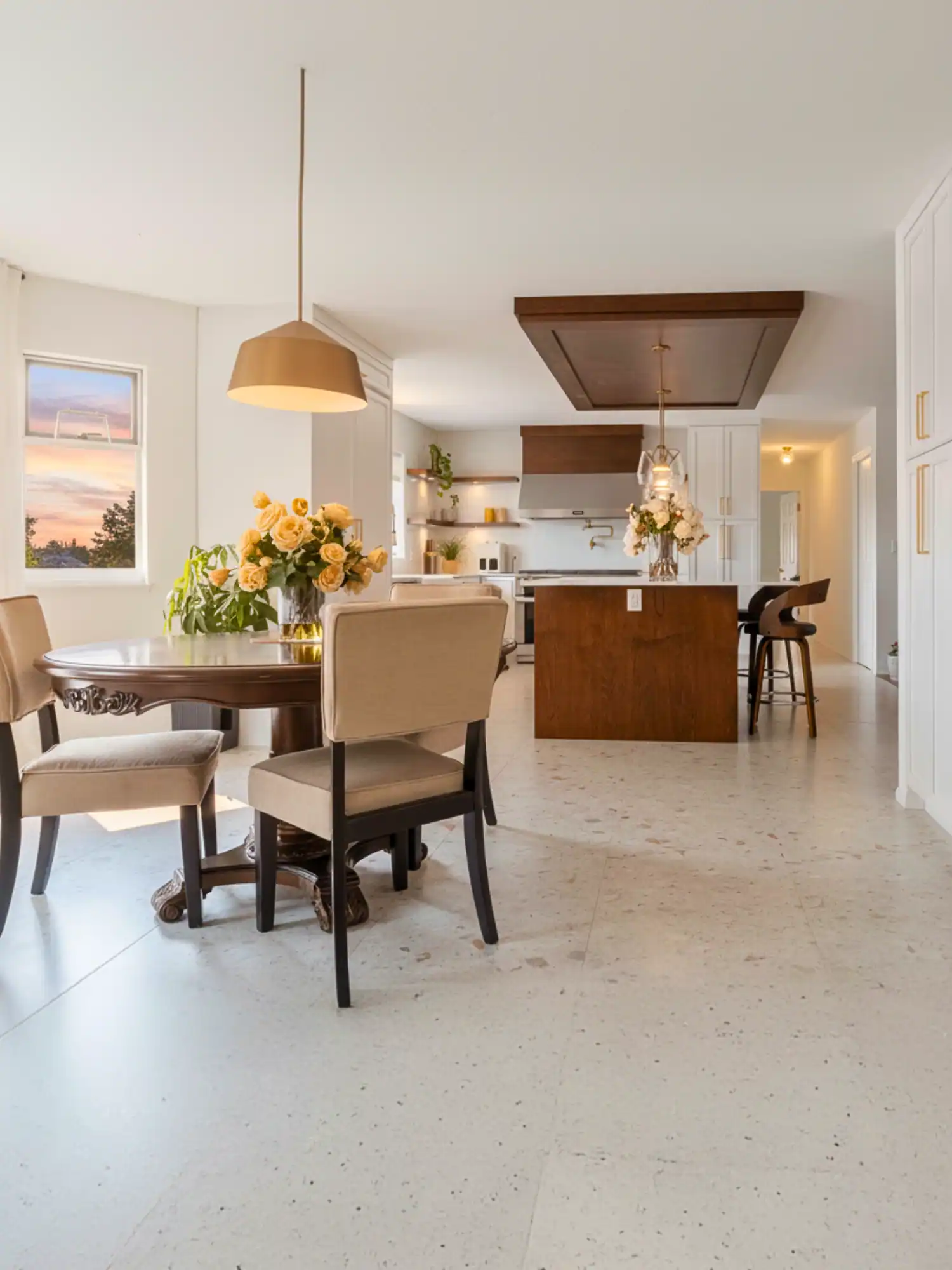
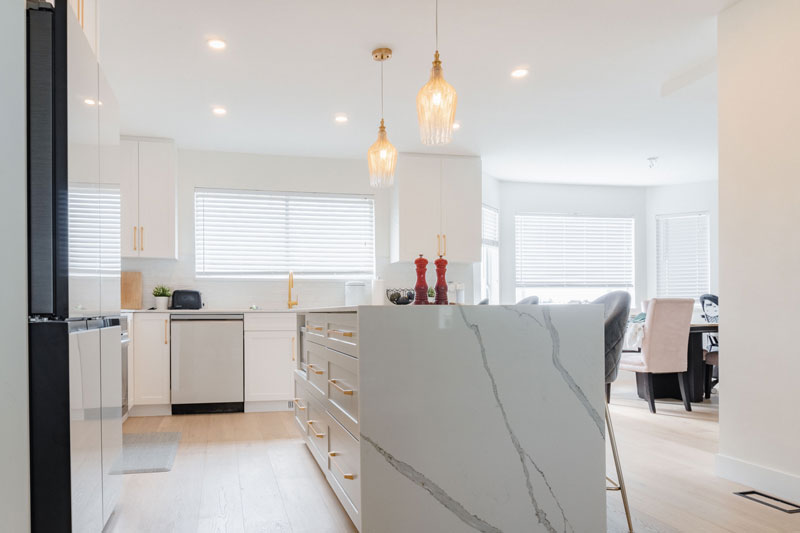
A kitchen renovation is typically the highest-ROI project in a Metro Vancouver townhouse. The typical Vancouver townhouse kitchen ranges from 80 to 150 square feet — smaller than in a detached home, which actually simplifies certain aspects of the project (less tile, shorter runs of countertop) while concentrating the cost into cabinet, fixture, and appliance quality.
The good news for strata owners: a standard kitchen renovation — replacing cabinets, countertops, tile backsplash, appliances, sink, faucet, and lighting in existing locations — does not require strata approval in most BC strata corporations. As long as your renovation stays within the existing footprint and uses existing plumbing and electrical rough-ins, you’re operating entirely within your strata lot.
Where strata approval becomes necessary:
- Opening a wall between the kitchen and an adjacent space (strata approval needed if that wall is load-bearing or a party wall; building permit required regardless)
- Relocating the sink or dishwasher drain (may affect shared drain stack — confirm with plumber and strata)
- Adding a kitchen island with an electrical outlet (electrical work requires permit; strata approval typically not required)
- Installing a new range hood ducted to the exterior (requires penetrating the exterior wall — common property — so strata approval is required)
Cost breakdown for a Metro Vancouver townhouse kitchen renovation (2026):
| Component | Mid-Range | High-End |
|---|---|---|
| Cabinets (semi-custom) | $12,000 – $18,000 | $22,000 – $35,000 |
| Countertops (quartz) | $4,000 – $7,000 | $8,000 – $15,000 |
| Tile backsplash (installed) | $1,500 – $3,000 | $3,500 – $6,000 |
| Appliances (package) | $5,000 – $10,000 | $15,000 – $30,000 |
| Sink and faucet | $800 – $1,500 | $2,000 – $5,000 |
| Lighting | $800 – $1,500 | $2,000 – $4,000 |
| Labour (demo, install, finishing) | $8,000 – $14,000 | $14,000 – $20,000 |
| Total | $38,000 – $55,000 | $55,000 – $65,000+ |
In a higher-value townhouse — Kitsilano, False Creek, Yaletown — investing at the upper end of this range typically yields strong resale returns. In a Burnaby or Surrey townhouse valued at $900K–$1.1M, a mid-range renovation with quartz countertops, clean European-style cabinetry, and integrated appliances is the sweet spot for ROI.
Townhouse Bathroom Renovation: In-Kind Replacement vs. Full Reconfiguration
Bathroom renovation in a townhouse strata operates on a simple principle: replace in-kind without relocating plumbing, and you generally don’t need strata approval. Relocate plumbing — particularly if it requires new connections to a shared drain stack — and you need approval, proper permits, and possibly an engineer letter confirming the work won’t affect shared systems.
The typical Metro Vancouver townhouse has one or two bathrooms, often a smaller main bath (40–60 sq ft) and a primary ensuite (50–80 sq ft). Full renovation costs depend heavily on whether plumbing stays in place:
| Scope | Approximate Cost | Strata Approval? |
|---|---|---|
| Cosmetic update (tile, fixtures, vanity in-place) | $8,000 – $12,000 | No |
| Full renovation — plumbing in existing location | $18,000 – $26,000 | No (permit required) |
| Full renovation — plumbing relocated within unit | $22,000 – $32,000 | Possible — depends on stack |
| Adding new bathroom where none exists | $35,000 – $55,000 | Yes — new stack connection |
One aspect of townhouse bathroom renovation that deserves particular attention: waterproofing. In a shared-wall structure, a shower tile failure that allows water to penetrate into a party wall doesn’t just damage your unit — it can migrate into your neighbour’s wall cavity, causing structural damage and mould. The strata corporation can hold you personally liable for repair costs extending beyond your strata lot boundary.
Proper townhouse bathroom waterproofing means:
- Full sheet membrane or liquid membrane (RedGard or equivalent) on all shower walls, not just pan liner
- Schluter or equivalent transition strips at all floor/wall junctions
- No cement board on party walls without membrane behind — use a bonded waterproofing system
- Pre-slope and proper weep hole protection under linear drains
Any licensed contractor doing townhouse bathroom work in Metro Vancouver should be waterproofing to these standards as a matter of course. If a contractor proposes cement board alone as a backer on party walls, that’s a red flag — particularly in a strata building where a leak creates liability far beyond your own unit.
Adding a Rooftop Patio or Expanding Outdoor Space
Rooftop patios on top-floor townhouses are one of the most desirable — and most strata-complex — renovation projects in Metro Vancouver. Done right, a finished rooftop patio can add $100,000–$200,000 in value to a top-floor townhouse and create usable outdoor living space that’s otherwise non-existent in a stacked unit. Done wrong, a rooftop renovation can trigger strata enforcement action, destroy your unit’s weatherproofing, and expose you to massive liability for consequential water damage below.
Rooftop patios always require strata approval. The roof is common property in virtually every BC strata corporation. Converting any portion of it to a private-use patio requires a strata corporation approval and, in most cases, designation of that portion as limited common property for your exclusive use — a change that typically requires a three-quarters vote of all owners.
What strata councils look for in a rooftop patio application:
- Structural load assessment: A structural engineer must confirm the roof structure can support the intended live load (people, furniture, planters, possibly a hot tub). Older Metro Vancouver townhouses from the 1980s and 1990s frequently have roof structures that were never designed for patio loads. The engineer’s report is non-negotiable.
- Waterproofing plan: The roofing membrane and all penetrations (railing posts, drain connections) must be designed by a roofing professional. Any waterproofing failure on a shared roof affects units below — the strata will require documentation that the system meets or exceeds current code standards.
- Drainage: New drainage that connects to the building’s stormwater system (common property) requires design review and often approval from the municipality as well.
- Insurance implications: Your strata’s insurance provider will need to be notified. In some cases, the strata corporation’s master policy premium increases when LCP is modified in ways that increase risk. Costs may be charged back to you.
- Neighbour impact: If your rooftop patio is adjacent to another owner’s space or window, privacy screening and sight-line impacts are frequently raised at strata council.
Cost breakdown for a Metro Vancouver rooftop patio addition (2026):
| Component | Cost Range |
|---|---|
| Structural engineering assessment + report | $2,500 – $5,000 |
| Roofing membrane + waterproofing system | $8,000 – $18,000 |
| Decking (composite or porcelain pavers) | $6,000 – $15,000 |
| Glass railing system | $8,000 – $18,000 |
| Drainage modifications | $2,000 – $6,000 |
| Lighting, electrical (weatherproof) | $2,000 – $5,000 |
| Permits and approvals | $1,500 – $3,000 |
| Total | $35,000 – $70,000 |
Strata councils that approve rooftop patios most readily are those where the structural assessment is clean, the waterproofing plan is conservative (over-designed rather than minimum-code), and the applicant has clearly thought through drainage, maintenance access, and neighbour impacts. Applications that fail typically arrive without an engineer report and propose light-framed decking structures that the council correctly identifies as unverified structural loads on a shared roof.
Sound and Vibration Management in Townhouse Renovations
Sound transmission is one of the defining quality issues in attached housing, and it becomes both a renovation design consideration and a strata compliance issue when you’re planning a townhouse renovation in Metro Vancouver. The BC Building Code sets minimum STC (Sound Transmission Class) and IIC (Impact Insulation Class) requirements for floors and walls separating strata lots — and many strata corporations go further with their bylaws.
If your renovation involves new flooring on any level above ground floor, your strata’s bylaws almost certainly specify minimum IIC ratings for flooring assemblies. A standard IIC requirement in Metro Vancouver strata corporations is IIC 55 for above-grade floors. Hardwood or LVP directly over concrete subfloor typically achieves IIC 20–30 without underlayment — far below what most strata bylaws require. A proper acoustic underlayment (StrataMatIIC, Soundmat, QuietWalk Plus or equivalent) brings assemblies into compliance.
Party walls — the walls between your unit and neighbouring units — deserve particular attention during renovation. These walls typically achieve STC 50–55 as built in newer Metro Vancouver townhouses, and less in older buildings. Any renovation that requires penetrating or modifying a party wall (running new electrical, adding a recessed shelf, opening for a beam) risks degrading sound isolation. Work should be done with acoustic sealant at all penetrations, and the finished wall assembly should restore the original STC rating.
Construction noise compliance during renovation:
Most Metro Vancouver municipalities restrict construction noise to 7am–8pm on weekdays and 9am–6pm on weekends, with some areas having stricter limits. Beyond municipal bylaws, your strata corporation may impose additional restrictions. Common strata noise bylaws include:
- Construction restricted to 8am–5pm Monday through Friday only (no weekend work)
- No jackhammering or concrete cutting before 9am
- Maximum one hour of high-impact noise (demolition, nail guns) before a 30-minute quiet period
- Written notice to all adjacent-unit owners at least 48–72 hours before work begins
Ignoring these restrictions is the fastest path to a strata enforcement action, a stop-work order, and a fine. Before work begins, your contractor should provide a noise management plan to the strata — this is standard practice for experienced Metro Vancouver strata renovation contractors and costs nothing beyond the few minutes it takes to document the approach.
Basement Renovation in a Townhouse
A significant portion of Metro Vancouver townhouses — particularly detached rowhouses in Burnaby, New Westminster, Port Moody, and Coquitlam — have unfinished basements that represent 400–700 square feet of untapped living space. Finishing a townhouse basement into a family room, home office, or secondary suite is one of the highest-ROI renovation projects available to townhouse owners in those markets.
From a strata approval perspective, basement finishing is generally treated similarly to any other interior renovation: if the work stays within your strata lot (interior non-structural finishing of an existing unfinished space), strata approval is typically not required. However, several aspects of basement renovations do require permits and occasionally strata approval:
- Building permit: Required for any finished basement suite, bedroom, or habitable room. Permit includes inspection of framing, insulation, electrical, and egress.
- Egress windows: Any bedroom in a finished basement requires an egress window meeting BC Building Code minimum opening size (0.35 m² minimum opening, minimum 380mm height and width). Installing an egress window requires cutting through the foundation wall or below-grade wall — this may require strata approval depending on whether the foundation wall is common property in your strata’s scheme.
- Plumbing additions: Adding a bathroom in the basement requires new drain connections. If the basement drains to a shared stack, strata approval is required for the new connection.
- Moisture management: Below-grade walls in a shared structure require careful waterproofing. Interior drainage mat systems (Delta-MS or equivalent) against foundation walls are standard; avoid finishing directly against concrete without a drainage plane.
| Basement Finish Scope | Cost Range (2026) |
|---|---|
| Basic family room / recreation room | $45,000 – $60,000 |
| Finished suite with bathroom (no kitchen) | $60,000 – $75,000 |
| Fully finished legal secondary suite | $75,000 – $85,000+ |
| Egress window installation (per window) | $3,500 – $7,000 |
| Waterproofing + drainage system | $4,000 – $12,000 |
One consideration specific to Metro Vancouver’s secondary suite rules: as of 2024, most Metro Vancouver municipalities permit secondary suites in townhouses subject to the same rules as detached homes. Check your municipality’s zoning bylaw for specific parking and unit size requirements. And remember: even if the municipality permits a secondary suite, your strata bylaws may prohibit short-term rentals or impose rental restrictions that affect how you use a secondary suite.
Need help planning a basement renovation? Our team has completed dozens of basement finishing projects in Metro Vancouver townhouses. Get our renovation planning checklist or contact us for a consultation.
Choosing the Right Contractor for a Vancouver Townhouse Renovation
Not every renovation contractor in Metro Vancouver has experience navigating strata renovations. The difference between a contractor who has never worked in a strata building and one who completes strata projects regularly is substantial — in terms of application quality, compliance management, neighbour relations, and project delivery.
When evaluating contractors for a townhouse renovation, ask specifically about their strata renovation experience. Key questions:
- Have you prepared strata approval applications for similar projects? Can you assist with our application?
- Do you carry $5M general liability insurance (some strata corporations require this for larger projects)?
- How do you handle construction waste removal in a strata building?
- What is your process for protecting common property (elevator cabs, hallways, common area flooring) during the project?
- Do you have experience with the specific municipality’s permit process for townhouse renovations?
- Can you provide references from strata renovation projects specifically?
An experienced strata renovation contractor will have ready answers to all of these questions. They will know that most Metro Vancouver strata corporations require common area protection plans, that elevators need temporary protective liners during material moves, and that waste bins need advance strata authorization. This operational experience prevents the project delays and strata disputes that plague renovations managed by contractors unfamiliar with the strata environment.
Vancouver General Contractors has completed townhouse renovations across Metro Vancouver — from Kitsilano to Coquitlam, from full interior gut renovations to targeted kitchen and bathroom projects. We manage the strata application process, all municipal permits, and the full coordination between trades that a multi-storey townhouse renovation requires. Learn more about our home renovation services or request a quote today.
More Vancouver Housing Types Guides
Vancouver Special vs. Character Home Renovation: Key Differences in Approach and Cost

Condo vs. House Renovation in Vancouver: What's Different About Strata?
Townhouse vs. Detached Home Renovation in Vancouver: What Strata Changes About Your Project
East Vancouver Character Home Renovation Guide

Net Zero Ready Home Step Code 5 Vancouver
Ready to start your renovation?
Frequently Asked Questions: Townhouse Renovation in Vancouver
1. Do I need strata approval to renovate my townhouse kitchen?
For a standard kitchen renovation — replacing cabinets, countertops, appliances, backsplash, and fixtures in their existing locations — you typically do not need strata approval. This work stays within your strata lot. However, if you’re relocating the sink drain, adding a new exterior vent hood (which penetrates the building envelope), or removing a load-bearing wall to open the kitchen, you will need strata approval, building permits, or both.
2. How long does strata approval take in BC?
Most strata councils in Metro Vancouver meet monthly. A simple approval request with complete documentation can be decided at the next council meeting — potentially 2–4 weeks if your application arrives well before the meeting date. Complex projects requiring engineering letters, neighbour notification, or a three-quarters owner vote can take 2–4 months. Budget 6–8 weeks minimum for anything requiring strata approval when planning your project timeline.
3. What if the strata council refuses my renovation request?
Under the BC Strata Property Act, strata corporations cannot unreasonably withhold approval for alterations to limited common property or within strata lots. If a council refuses a reasonable renovation request without adequate justification, you have the right to request a hearing before the strata council, submit a petition to have the matter voted on at a general meeting, or apply to BC’s Civil Resolution Tribunal (CRT) for a dispute resolution ruling. In practice, most rejections are addressable by improving the application — adding the missing engineer letter, revising the timeline, or modifying the scope to address the council’s specific concerns.
4. Can I do work on the party wall between my unit and my neighbour’s?
Party walls are typically common property or structural elements. Any work that modifies a party wall — opening it, adding penetrations, installing in-wall systems — requires strata approval and in most cases building permits. You must also have a plan to restore the party wall to its original or better acoustic and fire-separation performance. Structural changes to party walls require an engineer’s letter. Cosmetic work on your side of a party wall (painting, drywall repair, adding surface-mounted fixtures) does not typically require approval.
5. Do I need strata approval to replace my windows?
Yes, in almost all Metro Vancouver strata corporations. Windows are part of the building envelope — common property — regardless of which unit they serve. Even a straight in-kind replacement (same size, same rough opening) typically requires strata approval because the window product must meet the strata’s standards for the building’s appearance and performance. Some strata corporations have pre-approved window specifications that simplify the process; ask your strata manager. The good news: window replacement approvals are generally routine and processed quickly once documentation is in order.
6. Can I add a rooftop patio to my top-floor townhouse?
Yes, but it requires strata approval — and in most cases a three-quarters vote of all strata owners, since you’re asking for exclusive use of a portion of the common property roof. You’ll need a structural engineering report, a professional waterproofing plan, and a municipality building permit. Costs run $35,000–$70,000. Strata councils approve these projects when the application demonstrates that the structural, waterproofing, and drainage concerns have been professionally addressed. Start the strata process 4–6 months before your target construction date.
7. Can I build a secondary suite in my townhouse basement?
In most Metro Vancouver municipalities, yes — zoning changes since 2024 have broadly enabled secondary suites in attached housing. The basement renovation itself (finishing, egress windows, bathroom addition) requires building permits and may require strata approval if foundation or shared drain stack modifications are involved. However, check your strata’s bylaws for rental restrictions. Some strata corporations prohibit short-term rentals (Airbnb) and some have rules about the number of occupants per unit. A legal secondary suite in a rental-restricted strata may limit your income options.
8. How much does a full townhouse renovation add to resale value in Vancouver?
In Metro Vancouver’s $1M–$1.5M townhouse market, a full interior renovation (kitchen, bathrooms, flooring, paint) costing $120,000–$160,000 typically adds $180,000–$250,000 in resale value in a stable market. Kitchen renovations have the highest individual ROI (70–90% cost recovery on top-tier finishes in higher-value markets). Bathroom renovations typically return 60–80%. Flooring and paint return the highest percentage (80–120%) because they transform the entire visual impression of the home at relatively low cost. Exterior improvements that required strata approval — rooftop patios, new windows, upgraded front entries — are significant selling points in the attached housing market.
9. What are the most common strata disputes related to renovations?
The most frequent strata renovation disputes in BC involve: (1) Unauthorized alterations — work done without approval that is discovered during or after construction; (2) Noise bylaw violations during construction; (3) Damage to common property (elevator cabs, hallways, parking areas) during material moves; (4) Water damage originating from a renovated unit affecting neighbouring units or common property; (5) Disputes over whether finished work matches the approved application. The first and fourth categories carry the most financial risk — restoration orders and damage liability can easily exceed the cost of the original renovation.
10. Do I need special insurance during a townhouse renovation?
Your general contractor must carry a minimum general liability insurance (typically $2M–$5M as required by your strata). You should also notify your own home insurance provider that a renovation is underway — some policies require endorsements for renovation projects above a certain value, and coverage can be affected if the unit is unoccupied for extended periods during construction. The strata corporation’s master policy will not cover damage to your strata lot caused during your own renovation, and it may have a deductible that you’re responsible for if your renovation causes damage to common property or other units.
11. Can I remove an interior wall without strata approval?
Removing a non-load-bearing partition wall entirely within your strata lot (not a party wall, not touching any shared structure) typically does not require strata approval. However, you do need to confirm the wall is non-load-bearing (this requires a qualified professional assessment — not a guess), and you need a building permit for any structural alteration in BC. If there is any doubt about whether a wall is load-bearing or whether it touches common property, consult a structural engineer before proceeding. The cost of an engineer consultation ($500–$1,500) is trivial compared to the liability of damaging a structural element.
12. What flooring can I install without strata approval?
You can generally install any flooring material without strata approval, provided you comply with your strata’s acoustic bylaw. Most Metro Vancouver strata corporations require a minimum IIC 55 rating for above-grade floor assemblies. Hardwood, LVP, or tile without proper acoustic underlayment typically falls well below this threshold. Have your flooring contractor specify and install a compliant underlayment system, and keep documentation showing the product’s IIC rating — your strata council may ask for it. Carpet over a standard pad typically exceeds IIC 55 without additional underlayment and is always compliant.
13. How do I find out if my townhouse strata has renovation bylaws?
Request a copy of your strata’s bylaws from your strata manager (they are required to provide them). The bylaws will be registered with the Land Title Office — you can also search them online at ltsa.ca using your strata plan number. Look specifically for sections on alterations, renovations, and owner responsibilities. In addition to the registered bylaws, ask for any renovation-specific rules or policies that the strata council has adopted — these may not appear in the registered bylaw document but are still enforceable as strata rules.
14. What happens if I renovate without required strata approval?
Unauthorized alterations are among the most serious strata violations in BC. The strata corporation can issue a bylaw contravention fine (typically $200 per week under standard bylaws, or higher if your strata has amended its bylaw), issue a restoration order requiring you to return the property to its original state at your expense, and in extreme cases pursue legal action through BC’s Civil Resolution Tribunal or Supreme Court. If the unauthorized work causes damage to other units or common property, your liability can extend far beyond the renovation cost. Unauthorized alterations also create title issues that must be disclosed on sale — and in some cases, require remediation before a sale can proceed.
15. How do I renovate a townhouse in Vancouver without causing neighbour conflicts?
Neighbour communication is as important as strata approval in a townhouse renovation. Before work starts, knock on doors and speak directly with the neighbours sharing your party walls — tell them what you’re doing, how long it will take, your working hours, and give them a direct contact number for your project manager. During the project, respect all noise restrictions, keep common areas clean daily, and proactively address any concerns that arise. Neighbours who feel informed and respected rarely escalate to formal complaints; neighbours who feel surprised and inconvenienced frequently do. A well-communicated renovation project is a smoother renovation project.
Get a Free Renovation Quote
Metro Vancouver’s trusted general contractors. Free consultations across Vancouver, Burnaby, Richmond, North Shore & beyond.
Get Your Free Quote →VGC serves Vancouver and surrounding areas. View all renovation services in Vancouver →

Comments are closed