





Renovating a Vancouver Bungalow: What to Expect, What It Costs, and What to Watch Out For (2026)
Vancouver’s bungalow stock is one of the most compelling renovation opportunities in Canadian real estate. A well-executed Vancouver bungalow renovation can add $300,000 to $600,000 in market value, create a legal rental suite, and transform a cramped pre-war cottage into a modern family home — all while preserving the street presence and neighbourhood character that makes East Van, Kitsilano, and Mount Pleasant so desirable. But bungalow renovations also carry risks that full-demolition builds do not: knob-and-tube wiring hiding inside plaster walls, asbestos floor tiles under that original linoleum, and heritage overlays that restrict what you can do to the exterior without City approval. This guide covers everything you need to plan, budget, and execute a successful Vancouver bungalow renovation in 2026 — from a cosmetic refresh to a full second-storey addition.
Vancouver’s Bungalow Stock: What You’re Working With
Before you plan a single thing, it helps to understand exactly what kind of bungalow you own. Vancouver’s bungalow inventory divides into two distinct eras, each with its own set of structural characteristics, hidden hazards, and renovation constraints.
Craftsman and Heritage Bungalows (1910–1940)
The pre-war Craftsman bungalow is the iconic Vancouver form: low-pitched gable roof, wide front porch with tapered columns, exposed rafter tails, and wood clapboard or shingle siding. Inside, these homes almost universally feature Douglas fir hardwood floors, plaster-on-lath walls, solid wood door and window casing, and — if they haven’t been touched — original single-pane wood-sash windows. Structurally, they rely on balloon or platform framing using old-growth lumber, which is dimensionally larger and denser than contemporary lumber. That old-growth wood is a genuine asset: it mills beautifully, holds fasteners well, and is far more rot-resistant than modern material.
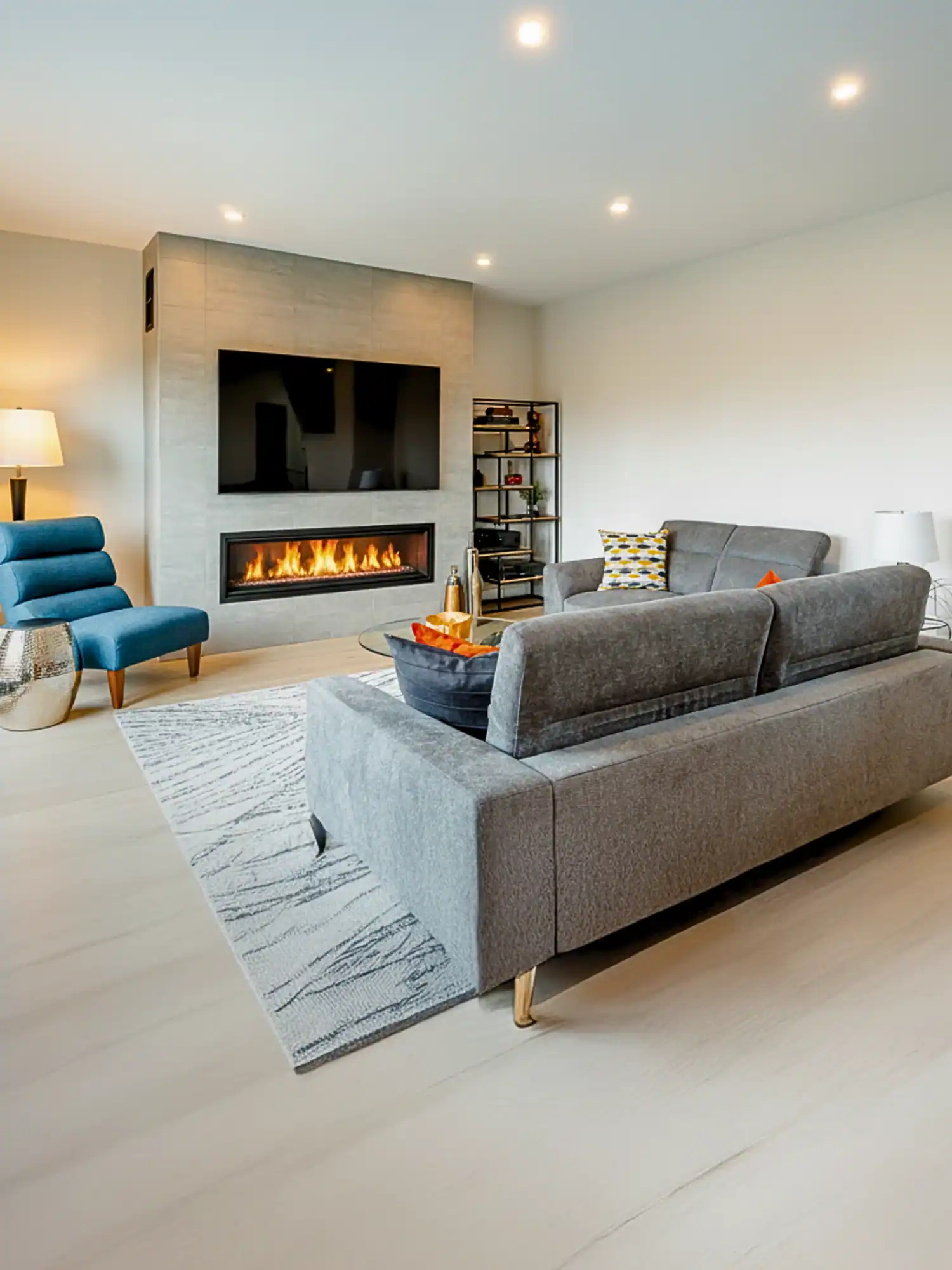 Richmond” class=”wp-image-12768″ />
Knob-and-tube is the overrun trigger we see most often in East Van bungalow renovations
Vancouver General Contractors
The hazards in this era are largely mechanical and thermal: knob-and-tube wiring is nearly universal in homes built before 1950, there is typically no insulation whatsoever in the exterior wall cavities (just air), and the plumbing is galvanized steel that has usually been corroding from the inside for 80 years. Many homes in this era also have character house overlay or outright heritage designation, which limits what you can change on the exterior without City approval.
Post-War Box Bungalows (1945–1965)
The post-war bungalow is a different animal: simpler roofline, minimal ornamentation, lower ceilings, and materials that reflect the construction economy of the 1950s and early 1960s. These homes were built quickly to house returning veterans and growing families. In the early 1960s, aluminum wiring was widely used as a substitute for copper when copper prices spiked — and it is found in a significant percentage of Vancouver bungalows built between 1962 and 1972. Asbestos-containing floor tiles (often 9″×9″ vinyl asbestos tile) were standard below-grade finish material right up to the late 1970s. Insulation, if present at all, is often degraded fiberglass batt that has settled or been damaged by moisture over the decades.
Post-war bungalows are generally not subject to character house overlay, which means exterior changes are simpler to permit. But their basement ceiling heights — often 6’2″ to 6’8″ raw — make legal suite development more straightforward than in pre-war homes, where 5’6″ basements are common.
Where Vancouver Bungalows Are Concentrated
The highest concentration of renovatable bungalows in Metro Vancouver runs through East Vancouver — Hastings-Sunrise, Grandview-Woodland, and Renfrew-Collingwood hold thousands of pre-war and post-war bungalows on standard 33-foot RS-1 lots. Kitsilano, Mount Pleasant, South Cambie, and South Granville also have significant bungalow inventory, though land values in those areas often make the economics even more compelling. The challenge that defines all of these homes is footprint: at 900 to 1,400 square feet on a single floor, a bungalow simply cannot house a growing family without either going up, going down, or both.
Common Hidden Problems in Vancouver Bungalows
The single most important thing to understand about renovating a pre-war or post-war Vancouver bungalow is that the budget you see before walls are opened is not the budget you will finish with. Every experienced Vancouver contractor knows that the moment you pull off the first sheet of drywall or lift the first section of flooring, surprises emerge. The table below covers the most common discoveries, which eras they appear in, and what they typically cost to resolve in 2026.
| Issue | Found In | Typical Cost to Remediate |
|---|---|---|
| Knob-and-tube wiring | Pre-1950 homes | $18,000–$40,000 full replacement |
| Aluminum wiring | 1960s construction | $8,000–$20,000 remediation |
| Galvanized steel plumbing | Pre-1970 homes | $12,000–$25,000 full replacement |
| Asbestos (floor tiles, insulation, pipe wrap) | Pre-1980 homes | $3,000–$25,000 abatement |
| No vapour barrier | All eras | $2,000–$6,000 to rectify |
| Uninhabitable basement (under 5’11” ceiling) | Pre-1945 homes | $35,000–$65,000 underpinning |
| Failed perimeter drainage | All eras | $8,000–$25,000 interior or exterior |
| Single-pane wood-sash windows | Pre-1970 homes | $12,000–$25,000 replacement |
| Inadequate or failing foundation | Pre-1940 homes | $20,000–$60,000 upgrade |
Knob-and-tube is the overrun trigger we see most often in East Van bungalow renovations. Homeowners plan a full kitchen and bathroom renovation, then open the walls and discover the entire home is wired with rubber-insulated cloth-jacketed circuits from 1928. Insurance companies in BC will not cover a home with active knob-and-tube unless it is in a sealed, unmodified condition — and once walls are open, that condition is broken. The rewire becomes mandatory, and it adds $18,000–$40,000 to the scope depending on the size of the home and the extent of finished basement space that needs to be threaded through. At VGC, we include a standard 15% contingency allowance in all fixed-price contracts for pre-1970 homes specifically because of this discovery pattern.
Asbestos deserves its own mention because the process is regulated and the costs vary widely. A pre-1980 bungalow with intact 9″×9″ vinyl asbestos floor tiles in the basement that are not being disturbed may not require abatement at all — encapsulation or covering is an accepted approach in some cases. But if tiles are damaged, or if you are opening walls that contain vermiculite insulation (a known asbestos carrier used in Attic insulation from the 1940s through the 1970s), regulated abatement by a licensed BC contractor is mandatory before any other trade enters. Costs range from $3,000 for a small tile abatement to $25,000 for a whole-home vermiculite removal.
Bungalow Renovation Scopes and Costs
Vancouver bungalow renovation costs in 2026 vary enormously depending on scope. The three tiers below represent the most common project types we execute, with realistic all-in budget ranges based on current Metro Vancouver labour and material pricing. These figures assume a standard 1,100–1,300 sq ft bungalow on a 33-foot lot in East Vancouver or Kitsilano and do not include the hidden problem costs outlined above unless specifically noted.
Tier 1: Cosmetic Refresh ($40,000–$80,000)
A cosmetic refresh addresses everything visible without touching structure, mechanical systems, or permits. For a bungalow in reasonable structural condition, this scope delivers a dramatically improved home that photographs well, commands higher rental rates, and competes effectively in the resale market at a fraction of a full renovation cost.
- Kitchen update: new cabinet doors and hardware, new countertops (quartz), paint, new faucet and under-mount sink — $15,000–$25,000
- Bathroom updates: new vanity, toilet, tub/shower surround tile, fixtures — $8,000–$15,000 per bathroom
- Douglas fir floor refinish: sand, stain, three-coat polyurethane — $6–$12 per sq ft
- Full interior paint (walls, ceilings, trim): $6,000–$12,000
- Light fixture upgrades throughout: $2,500–$5,000
- Minimal or no permits required for most scope items at this tier
The cosmetic refresh is ideal for investment property owners and owner-occupants who need to stay within a tight budget or who are preparing a property for sale within 12 months. It does not address mechanical deficiencies and will not satisfy an insurance company that requires knob-and-tube removal.
Tier 2: Full Interior Renovation ($120,000–$220,000)
The full interior renovation is the most common scope we execute for owner-occupants planning to live in their bungalow for 10 or more years. It addresses kitchens, bathrooms, and basement to a fully gut level, upgrades all mechanical systems to modern code, and typically delivers a permit-compliant, insured, move-in-ready home.
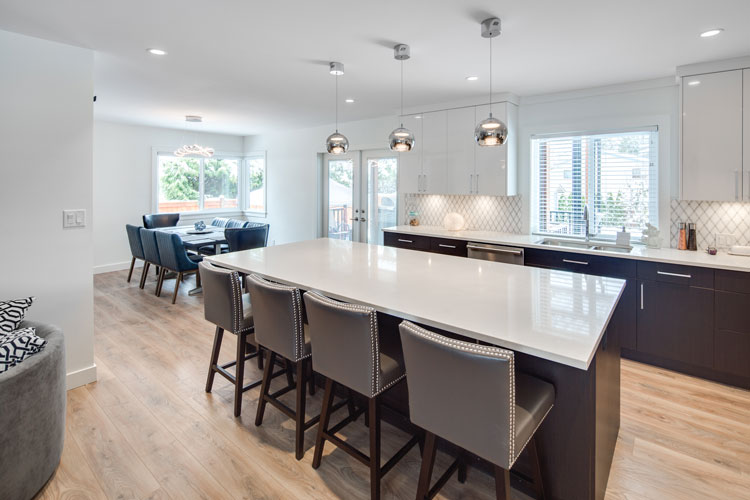
- Full kitchen gut and rebuild: new layout, new cabinetry, stone counters, appliances, tile backsplash — $55,000–$80,000
- Full bathroom gut (per bathroom): new tile, in-floor heat, custom shower, vanity, fixtures — $25,000–$40,000
- Basement development (if ceiling height allows): framing, insulation, electrical, drywall, flooring — $40,000–$65,000
- Electrical panel upgrade to 200A service: $3,000–$6,000
- Wall insulation (injection foam or batts from exterior): $12,000–$22,000
- Building, plumbing, and electrical permits required throughout
Note that Tier 2 does not include knob-and-tube rewire (if discovered), asbestos abatement, or foundation work. In pre-1950 homes, budget an additional 15–25% above the base Tier 2 number for these discoveries. A realistic all-in budget for a full interior renovation in a 1930s East Van bungalow with normal hidden-problem exposure is $160,000–$260,000.
Tier 3: Whole-Home Transformation ($220,000–$450,000)
The whole-home transformation combines everything in Tier 2 with structural expansion — a second storey addition, dormer, or full foundation underpinning — plus complete mechanical replacement and exterior envelope work. This is the scope that converts a 1,100 sq ft bungalow into a 1,800–2,400 sq ft modern family home while retaining the lot, the neighbourhood, and the original footprint.
- Everything included in Tier 2
- Second storey addition or full dormer: $150,000–$280,000 for 600–900 sq ft of new space
- Full foundation work including underpinning (if required): $40,000–$80,000
- Complete HVAC replacement with air-source heat pump: $18,000–$30,000
- Full plumbing and electrical replacement throughout
- Exterior: new siding, all new windows, new roof (architectural shingle or metal)
- Development permit required in addition to building permits; DCL (Development Cost Levy) may apply — see the Permits section below
Tier 3 projects typically require 8–14 months from permit submission to occupancy and involve temporary relocation for the homeowner. The financial case for Tier 3 is strong in most Vancouver submarkets — see the ROI section below for the numbers.
Heritage and Character House Overlay in Vancouver
If your bungalow was built before approximately 1940, there is a meaningful chance it carries a character house overlay under the Vancouver Zoning and Development By-law, or that it appears on the Vancouver Heritage Register. These designations do not prevent renovation — they do not even prevent full gut renovation of the interior — but they impose conditions on what you can change externally, and they affect your permit process in ways that can add cost and time.
Character House Overlay
A character house overlay means the City of Vancouver has identified the property as having architectural character worth retaining. Under this overlay, the exterior character-defining features — the front porch, original window proportions, siding type, roofline profile, and decorative trim elements — must be retained or restored rather than simply replaced with contemporary materials. The interior is completely unrestricted: you can gut every room, remove every non-structural wall, install entirely new mechanical systems, and reconfigure the entire floor plan without any character review.
Window replacement is the most common point of friction. If your bungalow has character overlay, you cannot simply swap the original wood-sash single-pane windows for a standard vinyl replacement window — the City requires that replacement windows match the original profile, proportions, and material type (or an approved equivalent). Custom wood-clad or fibreglass windows that replicate the original profile cost roughly $800–$1,400 per unit compared to $400–$700 for standard vinyl. For a bungalow with 10–14 windows, this difference adds $5,000–$10,000 to the window budget.
Heritage Designation
Full heritage designation (appearing on Schedule A or B of the Vancouver Heritage Register) is stricter. Any exterior change — including paint colour in some cases — requires Heritage Commission review and approval. The process involves a Heritage Alteration Permit application, which requires drawings prepared by an architect with heritage training, documentation of existing character-defining elements, and a written description of how proposed changes meet the Standards and Guidelines for the Conservation of Historic Places in Canada.
Heritage designation does carry a potential upside: the City of Vancouver’s Heritage Density Transfer and Bonus programs can allow owners of designated heritage properties to transfer unused FSR to other sites, or to receive a density bonus for retaining the heritage structure. This is a complex planning matter that requires a heritage architect and in some cases a development consultant, but in high-land-value neighbourhoods it can be financially significant. Check with a heritage consultant before assuming designation is purely a cost item.
How to Check Your Status
Search your address at the City of Vancouver’s heritage map (heritage.vancouver.ca) and cross-reference with the Development, Buildings and Licensing permit lookup tool. Your zoning certificate will note any character house overlay. If you are uncertain, VGC’s heritage specialist can conduct a pre-permit review before your project begins. Budget an additional $15,000–$40,000 on top of your renovation estimate if heritage review, custom window replication, or a heritage architect is required — the range depends on the extent of exterior work and the designation level.
Adding a Second Storey to a Vancouver Bungalow
The second-storey addition is the defining renovation move for Vancouver bungalows. It is how a 1,000 sq ft Craftsman on a 33×122 lot in Grandview-Woodland becomes a 2,100 sq ft family home worth $500,000 more than it was before. It is also one of the most technically demanding renovation projects a homeowner can undertake, and it should never be initiated without a full structural assessment of the existing home.
Pre-Conditions for Adding a Second Storey
Before a second storey can be designed, a structural engineer must assess whether the existing foundation, walls, and floor system can support the additional load. A structural assessment for a Vancouver bungalow costs $2,000–$4,000 and typically results in a report that identifies: foundation capacity (do the footing dimensions support a two-storey load?), shear wall requirements (what additional lateral bracing is needed to meet seismic code?), and bearing wall locations (which walls carry load to the foundation and which are partition walls that can be removed freely).
In the vast majority of pre-war Vancouver bungalows, a second storey addition triggers a seismic upgrade requirement. The original structure was not designed with modern lateral load resistance in mind, and Vancouver’s seismic zone requires shear wall systems that distribute earthquake forces safely. Shear wall upgrades in the context of a second-storey project typically cost $15,000–$35,000 and involve adding structural plywood panels to specific wall locations, connected to the foundation with hold-down hardware. This is not optional — the building inspector will require it as part of the structural permit review.
FSR and Zoning Check
Under the RS-1 zoning that governs most Vancouver single-family lots, the maximum Floor Space Ratio (FSR) is 0.6 — meaning the total above-grade floor area of the home (including the new second storey) cannot exceed 60% of the lot area. On a standard 33×122 lot (4,026 sq ft), that allows a maximum of approximately 2,416 sq ft of floor space. With a 1,000 sq ft main floor bungalow, you have roughly 1,400 sq ft of addition room before hitting the FSR limit. A 700–900 sq ft second storey addition is typically well within this envelope, but always calculate before designing — exceeding the FSR triggers a rezoning or variance application that adds months and cost to the timeline.
Construction Cost and Timeline
Second storey construction costs $180,000–$320,000 for a 600–900 sq ft addition in Metro Vancouver in 2026. This range includes: structural lift of the existing roof or full demolition and rebuild, second-storey framing and sheathing, new roof system, all new windows at upper level, insulation and air barrier, interior framing, mechanical rough-in, drywall, flooring, trim, and two or three new bedrooms and a full bath. It does not include the Tier 2 main-floor renovation work that almost always happens concurrently — budget both scopes together for a realistic total.
Plan for temporary relocation during construction. A second-storey addition on a bungalow is typically not liveable during the structural phase — the roof comes off, the house is open to weather, and the noise, dust, and safety conditions are incompatible with occupancy. Most families budget $3,000–$6,000 per month for rental accommodation and plan for 4–6 months of displacement. Budget this relocation cost explicitly in your financial plan; it is frequently omitted in initial project budgets and causes significant financial stress when it arrives.
Building permit processing at the City of Vancouver currently runs 8–16 weeks for single-family additions, depending on complexity and the current permit application backlog. Applications that require heritage review or a development permit (for FSR at or near the limit) take longer. Factor this into your timeline planning — beginning design work in January for a May permit submission and September construction start is a realistic schedule for a straightforward second-storey project.
The financial result: a Vancouver bungalow that undergoes a well-executed second-storey addition typically reaches 1,600–2,200 sq ft of above-grade space and carries a post-renovation market value $200,000–$400,000 higher than the pre-renovation bungalow on the same lot. In East Van and Kitsilano submarkets where the gap between a renovated and unrenovated bungalow can be $400,000–$600,000, the addition premium is well-supported by comparable sales.
Basement Expansion in Bungalows: The Ceiling Height Challenge
The basement is the second great expansion zone in a Vancouver bungalow — and for most owners, it represents the highest-ROI renovation available. A legal secondary suite in a finished basement adds $1,500–$2,500 per month in rental income and typically adds $160,000–$220,000 to resale value in East Vancouver. But the path to that suite runs directly through the most common structural obstacle in pre-war Vancouver bungalows: ceiling height.
Understanding Ceiling Height Requirements
The City of Vancouver requires a minimum finished ceiling height of 1.8 metres (5’11”) for habitable rooms in a secondary suite. That finished height means after the structural joists (typically 9″–10″ deep), any mechanical services running below the joists, and the drywall ceiling (typically 5/8″) are accounted for. A pre-1945 bungalow with a raw concrete floor-to-joist clearance of 6’0″ often finishes at 4’10″–5’2″ — well below the legal minimum. Even a basement with 6’6″ rough height may be borderline depending on mechanical routing.
Always measure the actual rough ceiling height in multiple locations (basements often have uneven slabs or grade variation), then subtract the expected joist depth, any dropped beams or mechanical services, and the ceiling finish. If the resulting finished height is under 5’11” in any habitable room, you have three options.
Options When Ceiling Height Is Insufficient
Benching ($18,000–$35,000): The perimeter of the basement slab is excavated and a concrete “bench” is formed along the walls, creating a lower floor level in the centre of the basement while leaving the perimeter at grade. This is less disruptive than full underpinning and works well when you only need 6–8 inches of additional height and the perimeter walls are in reasonable condition. The trade-off is that the benched perimeter area (typically 3–4 feet wide around the walls) becomes a step-up zone that affects furniture placement and usable floor area.
Full underpinning ($40,000–$65,000): The entire basement slab is removed and the existing foundation walls are extended downward in a sequential underpinning process, adding 24″–36″ of new depth throughout the basement. The result is a full-height basement that meets all legal suite requirements and adds genuinely liveable space. Full underpinning is a structural engineering project — it requires permits, engineer drawings, sequential excavation to avoid undermining adjacent wall sections, and new drainage at the lowered floor level. It adds significant weight and depth to the project, but the output is the most liveable and highest-value basement suite possible.
Basement storage only (no suite): If the ceiling height is insufficient and the budget does not support underpinning, the basement can still be finished as unheated storage, a home gym, or a utility room without meeting suite height requirements. This is permitted without a secondary suite permit but yields no rental income and limited value addition.
Egress Windows and CMHC Suite Loan
Almost all pre-war Vancouver bungalows require egress window installation as part of basement suite development. Each bedroom in the suite requires a window with a minimum clear opening of 0.35 sq m (3.76 sq ft), minimum clear opening height of 380mm, and minimum clear opening width of 450mm — and the sill must be accessible without assistance. In practice this means cutting through the existing concrete foundation wall in one or two locations and installing a new window well. Budget $3,000–$6,000 per egress window opening including concrete cutting, window supply and install, and window well.
CMHC’s Secondary Suite Loan Program offers eligible homeowners up to $80,000 at 2% interest (currently) to fund the construction of a legal secondary suite. For a full basement suite with underpinning, the CMHC loan can fund the majority of the project cost. VGC coordinates directly with homeowners on CMHC suite loan documentation — our contracts are structured to meet the program’s requirements for itemized cost breakdowns and phased draws.
Restoring Original Fir Floors in Vancouver Bungalows
One of the genuine gifts of owning a pre-war Vancouver bungalow is the original Douglas fir flooring. Old-growth Douglas fir, harvested from the forests of BC before the second world war, is a dense, tight-grained, deeply warm wood that cannot be replicated by any product on the market today. New-growth Douglas fir, even when it is available, has wider grain spacing and is softer and less stable than old-growth material. What you have under your 1930s bungalow’s carpet or linoleum is irreplaceable, and restoring it rather than covering it is almost always the right decision.
Condition Assessment
Before committing to restoration, assess the floor condition honestly. Peel back carpet in an inconspicuous corner and look for: stain penetration from pet urine (often visible as dark patches); previous floor finishes (layers of wax or oil that affect sanding behaviour); nail or screw holes from carpet tack strips and previous furniture; damage at thresholds between rooms (transitions where the subfloor was cut or bridged at some point); and cupping or crowning from moisture exposure. Minor staining, surface scratches, and old finish layers are entirely restorable with professional sanding. Deep urine staining that has penetrated 1/4″ into the wood, or significant cupping from chronic moisture, may require spot replacement.
Restoration Cost and Process
Professional floor restoration — drum sanding, edger sanding, stain application (optional), and three coats of oil-modified polyurethane or water-based finish — costs $6–$12 per sq ft in Metro Vancouver in 2026. For a 1,200 sq ft bungalow with fir floors throughout the main level, budget $7,200–$14,400 for a complete restoration. The higher end of that range applies when floors have extensive old finish buildup requiring multiple sanding passes, or when the homeowner wants a custom stain colour (which requires additional sample passes and dry time). The process takes 3–5 days for a standard bungalow main floor and requires the space to be vacated during sanding (dust is significant) and for 48–72 hours after the final coat.
If sections of the floor are too damaged to restore in place — a common situation at doorways, around old wall locations, or where the original subfloor was penetrated — spot repair with salvaged old-growth fir is possible. Salvaged old-growth fir is available from architectural salvage dealers in the Lower Mainland, and an experienced flooring contractor can splice new-old material into the existing floor with results that are often indistinguishable after staining. Budget $1,500–$4,000 for typical spot-repair work including salvaged material sourcing.
One technical note: if you are planning to add a basement suite and need to insulate between the main floor joists, do this work before sanding the floors above. Accessing the joist bays for insulation installation disturbs the subfloor, and sanding after insulation work ensures a clean final result. Do not cover original fir floors with new subfloor or underlayment unless absolutely required — every layer added reduces the usable height of already low bungalow rooms and devalues what is genuinely a premium feature.
Open Concept Conversion in Bungalows
The most requested single renovation in a Vancouver bungalow is the removal of the wall between the kitchen and living room — creating an open-concept main floor that feels dramatically larger and more connected than the original compartmentalized layout. It is also one of the most misunderstood renovations from a structural perspective, and the one most likely to have unexpected cost implications in a bungalow context.
Identifying the Bearing Wall
In a standard Vancouver bungalow, the central wall that runs parallel to the ridgeline of the roof is typically a bearing wall — it supports the floor joists above if there is a second storey, or the ceiling joists and roof structure if the home is single-storey. Even in a single-storey bungalow with no floor above, attic trusses or ridge beam framing often bears on interior walls. Do not assume a wall is non-bearing because there is nothing above it. A structural engineer should assess every interior wall removal in a pre-1970 home before work begins. This assessment costs $800–$1,500 and takes 1–3 days from site visit to written report.
The Beam Installation Process
Once the bearing wall is confirmed and the beam design is specified by the engineer (typically a glulam or LVL beam sized to the span), the physical work proceeds in a defined sequence: temporary shoring walls are erected on both sides of the wall to carry the load during construction; the existing wall framing is removed; new post locations are identified (usually at the termination points of the new beam, sometimes in the middle if the span exceeds what a single beam can carry without intermediate support); new footings are added under the posts if required (the original foundation footing may or may not be adequate for the concentrated load); the beam is installed and posts set; and finally the temporary shoring is removed and all finishes — floor patch at the old wall location, ceiling patch, wall patch on adjacent surfaces — are completed.
Total cost for an open-concept wall removal in a Vancouver bungalow, including engineering, permit, beam supply and install, posts, finish work, and floor/ceiling/wall patching: $15,000–$35,000. The wide range reflects beam span (a 12-foot opening needs a much larger beam than an 8-foot opening), the number of posts required, the extent of finish work, and whether the original fir floors need to be patched at the old wall location (they always do).
The resale premium for open-concept conversion in East Vancouver and Kitsilano is well-documented in REBGV comparable sales data: renovated bungalows with open main floors consistently sell $40,000–$80,000 above comparable homes with the original compartmentalized layout, all other features being equal. The renovation almost always pays for itself.
Permits for Bungalow Renovations in Vancouver
Understanding the permit requirements for your scope of work is essential to both budgeting and timeline planning. The following breakdown covers the most common renovation activities in Vancouver bungalows and their permit requirements as of 2026.
- No permit required: Paint, floor refinishing, fixture-for-fixture replacement (same location), cabinet door replacement, light fixture swaps on existing circuits
- Building permit: Wall removal (structural or otherwise), full kitchen gut with relocation of appliances, window replacement that changes opening size, deck addition or modification, dormer addition
- Plumbing permit: Any new plumbing rough-in, bathroom addition, kitchen sink or dishwasher relocation, new laundry connection
- Electrical permit: Panel upgrade, new circuit installation, moving or adding outlets or switches, new subpanel
- Building + development permit: Second storey addition, significant floor area additions, FSR close to the zoning maximum
- Secondary suite permit: Basement suite legalization, new secondary suite (even if existing space is already partially finished)
- Heritage Alteration Permit: Any exterior changes to a heritage-designated property; exterior changes to a character house (siding replacement, window changes, porch modifications)
One cost that surprises many homeowners planning significant additions: the Development Cost Levy (DCL). When a renovation results in a net increase in gross floor area, the City of Vancouver charges a DCL based on the square footage added. In 2025–2026, DCL rates in Vancouver for residential additions are approximately $45–$65 per sq ft of new space. A 900 sq ft second-storey addition can trigger a DCL of $40,500–$58,500 — a significant line item that must be budgeted before construction begins, not discovered at permit issuance. Your permit application will indicate whether DCL applies; VGC’s project managers review all permit applications for DCL exposure before contracts are signed.
If you are planning a renovation that requires multiple permit types, those applications can often be submitted concurrently but must each be approved by the relevant City department. Building permits for complex projects in Vancouver currently process in 8–16 weeks. Development permits (required for additions over certain FSR thresholds) can take 3–6 months. Plan your timeline accordingly — starting design work at least 6 months before your target construction start date is strongly recommended for any project that requires development permit review. For planning help, see our comprehensive renovation planning guide.
ROI on Vancouver Bungalow Renovations
The financial case for renovating a Vancouver bungalow rather than selling as-is or tearing down and rebuilding is, in most cases, compelling — particularly when a legal secondary suite is part of the scope. The table below presents current (2026) estimated cost and value-add data for the most common bungalow renovation types in Metro Vancouver, based on REBGV market data and comparable sales in East Van, Kitsilano, and adjacent submarkets.
| Renovation Type | Typical Cost | Estimated Value Added | Approximate ROI |
|---|---|---|---|
| Open concept main floor | $25,000 | $40,000–$70,000 | 160–280% |
| Full kitchen + bathroom renovation | $95,000 | $80,000–$130,000 | 84–137% |
| Legal basement suite | $80,000 | $160,000–$220,000 | 200–275% |
| Second storey addition | $280,000 | $280,000–$420,000 | 100–150% |
| Full transformation (all above combined) | $480,000 | $500,000–$750,000 | 104–156% |
To put these numbers in market context: East Vancouver bungalows in unrenovated or partially updated condition are currently trading at $1.3M–$1.6M depending on lot size, location, and condition. The same bungalow fully renovated with a legal suite, open main floor, and updated kitchen and bathrooms consistently trades at $1.8M–$2.2M. A bungalow with a second storey addition (bringing the home to 2,000+ sq ft) in excellent condition reaches $2.2M–$2.6M in desirable East Van neighbourhoods. The renovation premium — the difference in market value between the unrenovated and fully renovated property — is real, well-supported by comparable sales, and in most cases exceeds the renovation cost.
The caveat is execution risk. A renovation that runs over budget due to undiscovered knob-and-tube, asbestos abatement, or foundation work can erode the financial margin substantially. This is why VGC’s approach to pre-war bungalow projects always begins with a pre-construction assessment — a moisture survey, asbestos screening, electrical visual inspection, and structural walk-through — before any contract price is set. The hidden cost exposure in a pre-1950 bungalow is real and must be quantified before the financial case can be accurately evaluated. Reach out through our contact page to arrange a pre-construction assessment for your bungalow.
VGC’s Experience with Vancouver Bungalows
Vancouver General Contractors has completed more than 60 bungalow renovations across Metro Vancouver, with a concentration in East Vancouver, Kitsilano, and South Granville. That accumulated experience across pre-war Craftsman bungalows, post-war box homes, and character-overlay properties has shaped how we approach every new bungalow project — and it shows up in the details that protect homeowners from the most common and costly surprises.
Every VGC bungalow quote includes a pre-construction moisture assessment and asbestos screening. We do not deliver a price without knowing whether there are asbestos-containing materials in the scope area and whether there is evidence of active moisture intrusion at the foundation or in the wall assemblies. These assessments cost us time before contract signing, but they prevent the mid-project discoveries that destroy budgets and relationships. We also maintain a standing relationship with a structural engineer who specializes in Vancouver residential projects — which means engineer assessments for open-concept projects and second-storey additions are scheduled and delivered quickly rather than held up by the 6–8 week wait times that independent homeowners often encounter.
On heritage projects, VGC has a heritage specialist on staff with experience navigating character house submissions at the City of Vancouver. We have managed projects that required Heritage Alteration Permits, custom window replication to match original profiles, and heritage architect coordination — the complexity is known and manageable with the right team in place. Our fixed-price contracts for pre-1970 homes include VGC’s standard 15% contingency allowance, which covers the most common categories of hidden-problem discovery. Knob-and-tube is the most frequent overrun trigger; the contingency is sized specifically with that exposure in mind. For homeowners planning a basement suite, we coordinate directly on CMHC Secondary Suite Loan applications, and our contracts are structured to meet the program’s documentation requirements. Learn more about what we offer on our home renovation services page.
More Vancouver Housing Types Guides
Vancouver Special vs. Character Home Renovation: Key Differences in Approach and Cost

Condo vs. House Renovation in Vancouver: What's Different About Strata?
Townhouse vs. Detached Home Renovation in Vancouver: What Strata Changes About Your Project

Point Grey Mansion Renovation Luxury Heritage Combined
West Side Character Home Kerrisdale Dunbar Style
Ready to start your renovation?
Frequently Asked Questions About Vancouver Bungalow Renovations
How much does it cost to renovate a Vancouver bungalow?
A cosmetic refresh (new kitchen surfaces, bathroom fixtures, floor refinish, paint) costs $40,000–$80,000. A full interior renovation including gut kitchen and bathroom, basement development, and electrical/insulation upgrades costs $120,000–$220,000 before hidden-problem contingency. A whole-home transformation with a second storey addition costs $220,000–$450,000+. Pre-war bungalows should add 15–25% contingency for electrical, plumbing, or asbestos discoveries.
What is a character house overlay in Vancouver?
A character house overlay is a zoning designation applied to pre-1940 homes in Vancouver that requires exterior character-defining features — the porch, original window proportions, roofline, and siding type — to be retained or restored rather than replaced with standard contemporary materials. The interior of the home is completely unrestricted under the overlay. You can check your property’s status on the City of Vancouver heritage map at heritage.vancouver.ca.
Can I add a second storey to my bungalow in Vancouver?
Yes, in most cases. The pre-conditions are: an FSR calculation confirming the addition fits within the RS-1 0.6 FSR limit for your lot; a structural engineer assessment confirming the foundation and walls can support the additional load; and a building permit (plus development permit if near the FSR limit). Seismic upgrades are almost always required. The construction cost for a 600–900 sq ft second storey is $180,000–$320,000, and the project typically takes 10–14 months from design to occupancy.
How do I know if my bungalow has knob-and-tube wiring?
If your home was built before 1950, assume knob-and-tube is present until proven otherwise. Visual indicators include: ceramic knobs and ceramic tubes visible in the attic or basement ceiling; cloth-jacketed wiring with no ground wire; and a fuse panel (not a breaker panel) in the electrical room. A licensed electrician can conduct an inspection and confirm whether knob-and-tube is present and whether it has been modified or extended. Insurance companies in BC require disclosure of knob-and-tube and will often not cover a home with active knob-and-tube circuits.
What is the best renovation for a Vancouver bungalow?
From a pure ROI standpoint, a legal basement suite delivers the highest return — $200–$275 in value for every $100 spent — while also generating ongoing rental income. If adding a suite is not feasible due to ceiling height, the open-concept main floor conversion (kitchen-living wall removal) delivers the next-best combination of cost, lifestyle improvement, and resale premium. For families who need more bedrooms and space, a second storey addition is the transformational move that turns a bungalow into a full family home.
Do I need a permit to renovate a heritage house in Vancouver?
Interior renovations to a heritage house generally do not require heritage-specific permits — they follow the same building, plumbing, and electrical permit process as any renovation. Exterior changes to a heritage-designated property require a Heritage Alteration Permit, which involves heritage architect drawings and Heritage Commission review. Exterior changes to a character house overlay property require a building permit that specifically addresses how character features will be retained or replicated. Cosmetic interior work (paint, floor refinish, fixture swap) requires no permit regardless of heritage status.
How do I legalize my bungalow basement as a suite?
The process involves: (1) confirming the finished ceiling height meets the 1.8m minimum throughout habitable rooms; (2) confirming egress window compliance in all bedrooms; (3) confirming fire separation between the suite and the main dwelling (30-minute fire-rated assembly between floor levels); (4) separate electrical subpanel and smoke/CO detection in the suite; (5) applying for a secondary suite permit at the City of Vancouver. If the ceiling height is insufficient, underpinning or benching is required first. CMHC’s Secondary Suite Loan (up to $80,000 at 2%) can fund most of this work for eligible homeowners.
Are original fir floors worth restoring?
Yes — almost universally. Original Douglas fir from pre-war Vancouver homes is old-growth material that cannot be replicated. Professional restoration costs $6–$12 per sq ft (roughly $7,200–$14,400 for a standard bungalow main floor) and delivers floors that look better than any engineered or new-growth hardwood product available at the same price point. The exception is floors with deep urine staining or significant moisture damage — in those cases, spot repair with salvaged old-growth fir ($1,500–$4,000) before the sand-and-finish process is the practical solution.
Can I remove the wall between kitchen and living room in my bungalow?
Yes, but it requires a structural engineer assessment first. The central wall in a bungalow is often bearing — it supports roof or attic framing — and cannot be simply removed. The engineer will specify a beam and post design to carry the load across the new opening. With engineering and permit, the full cost of the wall removal, beam installation, and finish work is $15,000–$35,000 depending on span and finishing requirements. The resale premium in most Vancouver submarkets is $40,000–$80,000, making this one of the highest-ROI structural renovations available.
How long does a Vancouver bungalow renovation take?
A cosmetic refresh takes 6–10 weeks. A full interior renovation takes 4–6 months. A second-storey addition or whole-home transformation takes 10–16 months from design start to occupancy. Permit processing adds 8–16 weeks at the City of Vancouver (or longer for development permits). Pre-construction work — design, engineering, permit applications — should begin at least 4–6 months before the intended construction start date.
Does my bungalow have asbestos?
If your bungalow was built or renovated before 1980, asbestos-containing materials may be present. Common locations in Vancouver bungalows include: 9″×9″ vinyl floor tiles (especially in the basement), vermiculite attic insulation (Zonolite brand), pipe insulation wrap around older furnace ducting, and textured ceiling coatings (popcorn ceilings applied before 1980). The only way to confirm asbestos presence is laboratory testing of a sample by a licensed environmental consultant. Testing costs $300–$600 for a standard residential survey. VGC includes asbestos screening in every pre-construction assessment for pre-1980 homes.
What is the value of a renovated bungalow in East Vancouver?
Unrenovated East Van bungalows on standard 33-foot lots are currently selling at $1.3M–$1.6M depending on location and condition. Fully renovated bungalows with updated kitchen and bathrooms, open main floor, and a legal basement suite typically sell at $1.8M–$2.2M. Bungalows with a second storey addition bringing the home to 2,000+ sq ft in excellent condition reach $2.2M–$2.6M in desirable neighbourhoods like Hastings-Sunrise, Grandview-Woodland, and Mount Pleasant. The renovation premium generally supports the investment, particularly when a basement suite is included.
How do I get a permit for a character house renovation?
For interior-only work, apply through the City of Vancouver’s standard building permit process — no character-specific documentation is required. For exterior work on a character house overlay property, your building permit application must include drawings that show how character-defining features will be retained or replicated, and the City’s development planner will review compliance with the character retention standards. For heritage-designated properties, a separate Heritage Alteration Permit application with heritage architect drawings is required before the building permit can be issued. VGC’s heritage specialist manages this process for our clients.
Is it worth renovating or tearing down my Vancouver bungalow?
In most cases, renovation delivers better financial outcomes than demolition and new construction in Vancouver’s current market. New construction on a standard Vancouver lot costs $350–$500 per sq ft for a quality build, meaning a 2,400 sq ft new home costs $840,000–$1,200,000 to construct — before the cost of carrying the lot through a 12–18 month construction process. A whole-home bungalow transformation achieving the same finished size typically costs $350,000–$500,000 less. Exceptions include: homes with severe structural or foundation problems that make renovation impractical; lots where a laneway house or secondary suite cannot be added under the existing structure; and cases where the homeowner’s program requires more space than zoning allows on a retained structure. A pre-construction assessment with both options costed is the most reliable way to make this decision.
What is the CMHC secondary suite loan?
CMHC’s Secondary Suite Loan Program provides eligible Canadian homeowners with loans of up to $80,000 at a 2% annual interest rate (current rate — confirm with CMHC before applying) to construct or renovate a secondary suite in their primary residence. The loan is repayable over up to 10 years. Eligibility requires owner-occupancy of the primary unit, a household income below the program threshold (currently $209,420), and a registered property. Funds can be used for foundation work (underpinning), framing, mechanical, egress windows, and all other suite-related construction costs. VGC coordinates with homeowners on CMHC suite loan applications and structures our contracts to meet the program’s documentation requirements for draws and cost itemization.
Get a Free Renovation Quote
Metro Vancouver’s trusted general contractors. Free consultations across Vancouver, Burnaby, Richmond, North Shore & beyond.
Get Your Free Quote →VGC serves Vancouver and surrounding areas. View all renovation services in Vancouver →

Comments are closed