





West Vancouver Renovation Guide: Costs, Hillside Challenges & Luxury Trends (2026)
West Vancouver sits in a category of its own in the Canadian renovation market. As the municipality with the highest per-capita income in Canada — home to properties ranging from $2.5 million to $8 million and beyond — the expectations, complexities, and costs of renovating here differ fundamentally from anywhere else in Metro Vancouver. Whether you own a 1960s post-and-beam on a Hollyburn ridge, a British Properties estate home built in the mid-1970s, or a contemporary residence in Caulfeild, the District of West Vancouver imposes its own permit process, its hillside terrain adds unique structural challenges, and the luxury market demands a level of finish that most renovation budgets elsewhere never approach.
This guide covers everything you need to know about renovating in West Vancouver: realistic cost ranges for every project type, how the District’s permit process compares to the City of Vancouver, hillside construction premiums, mid-century modern preservation, seismic upgrade requirements, and the renovation trends that are defining the luxury market in 2026. If you’re planning a project in West Vancouver, understanding this landscape before you call a contractor will save you months of misaligned expectations and budget surprises.
West Vancouver’s Unique Renovation Market
No other renovation market in Metro Vancouver — arguably in Canada — operates under the same conditions as West Vancouver. The municipality consistently ranks first in Canada for per-capita income, and the housing stock reflects that history. Properties in British Properties, Hollyburn, Dundarave, Ambleside, Horseshoe Bay, and Caulfeild were built largely between the 1950s and 1980s, giving the area a dominant stock of mid-century modern and post-modern homes that are simultaneously architecturally significant and structurally aging.
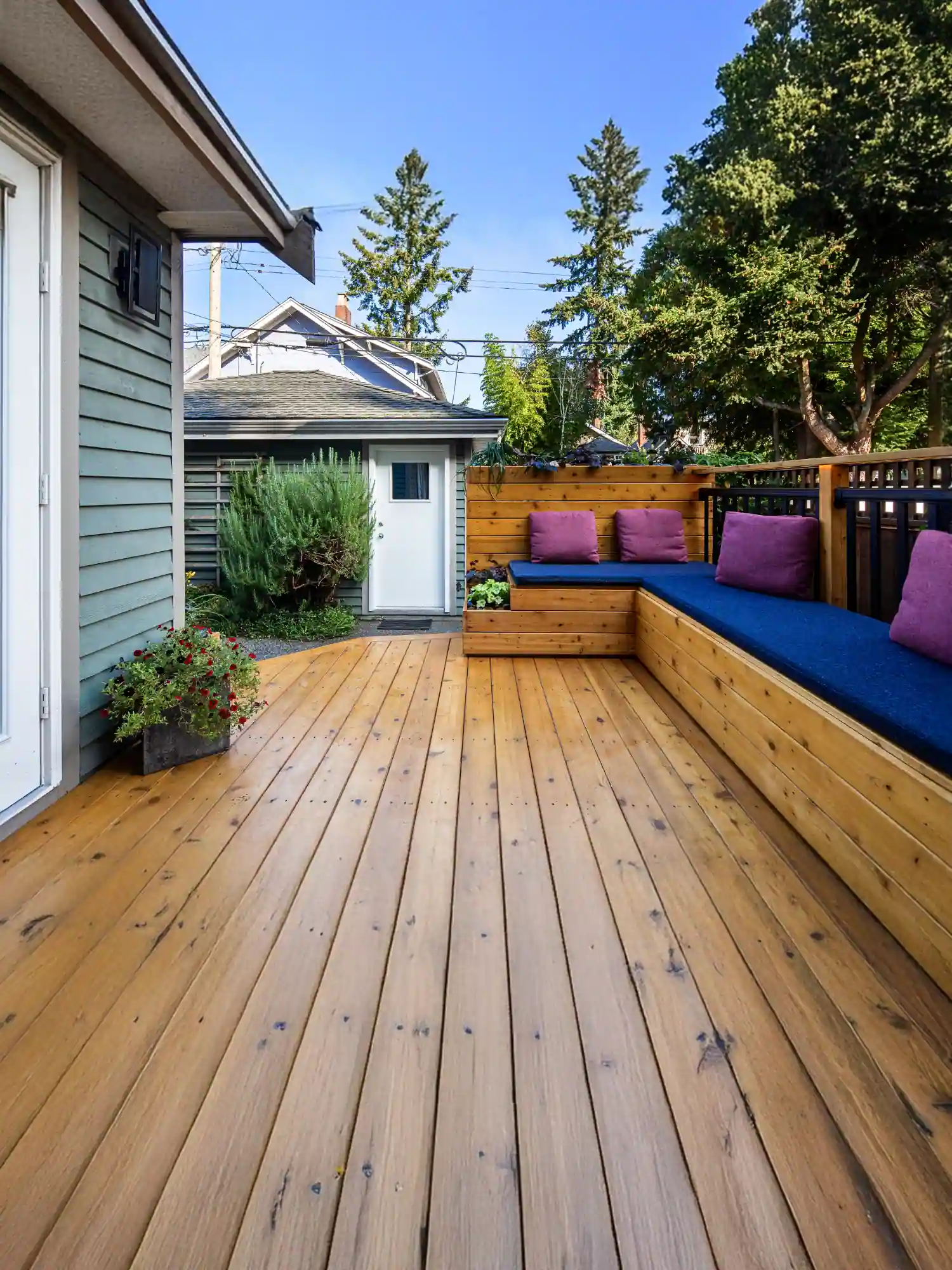 Surrey” class=”wp-image-12769″ />
The renovation calculus in West Vancouver is different from every other neighbourhood in the region
Vancouver General Contractors
British Pacific Properties — the master-planned development that transformed the British Properties into one of Canada’s most exclusive residential areas — produced thousands of custom and semi-custom homes on large, steeply sloped lots with commanding mountain and ocean views. These homes were built to a high standard for their era, but that era ended forty to sixty years ago. Today, their mechanical systems, electrical panels, insulation, windows, and structural connections all require varying degrees of updating.
The renovation calculus in West Vancouver is different from every other neighbourhood in the region. When the underlying land is worth $2.5 million to $5 million and the structure sitting on it is worth a further $1 million to $3 million, the cost-benefit analysis of renovation versus teardown is genuinely complex. Some homeowners choose to renovate to preserve architectural character or avoid the two to three year disruption of a full rebuild. Others use phased renovations to modernize mechanical and interior systems while preserving the bones. And some — particularly in the Dundarave and Ambleside areas — choose full teardowns with custom new builds. A qualified West Vancouver renovation contractor can help you understand which path makes the most financial and practical sense for your specific property.
What makes West Vancouver different for contractors as well: the clientele expects an entirely different level of finish, project management, and communication. Subcontractors who perform adequately on a $200,000 East Vancouver renovation may not meet the standards required for a $600,000 West Vancouver project. Material selections are typically European, high-end North American, or custom-fabricated. Timelines are often more flexible but tolerance for mistakes or poor communication is substantially lower. If you’re hiring a contractor for a West Van project, their references from comparable properties in the municipality matter enormously.
West Vancouver Renovation Costs by Project Type (2026)
The following cost ranges reflect current West Vancouver market conditions — they are not Metro Vancouver averages. Labour rates in West Van run 15–25% higher than City of Vancouver averages, material expectations are uniformly premium, and the hillside access and structural complexity of many properties adds further cost. Use these as planning figures; your actual quotes will depend on the specific scope, existing conditions, and finishes you select.
| Project Type | Mid-Range | Premium / Luxury |
|---|---|---|
| Kitchen renovation | $65,000–$110,000 | $110,000–$200,000+ |
| Bathroom renovation | $30,000–$55,000 | $55,000–$100,000+ |
| Master suite renovation | $45,000–$80,000 | $80,000–$150,000 |
| Full home renovation | $350,000–$700,000 | $700,000–$1,500,000+ |
| Addition / second storey | $350,000–$550,000 | $550,000–$900,000 |
| Seismic upgrade | $25,000–$45,000 | $45,000–$80,000 |
| Hillside access / retaining | $20,000–$60,000 | $60,000–$150,000+ |
| Home automation integration | $15,000–$30,000 | $30,000–$80,000 |
| Wine cellar | $20,000–$40,000 | $40,000–$80,000 |
| Home theatre | $40,000–$80,000 | $80,000–$150,000 |
| Heated terrace / outdoor living | $50,000–$100,000 | $100,000–$250,000+ |
These figures assume licensed, insured West Vancouver–experienced contractors pulling all required permits. They include design and engineering fees where required by the project type. They do not include furniture, landscaping, or significant structural discoveries that only become visible once demolition begins — always maintain a 15–20% contingency on any West Vancouver renovation project.
The most important cost variable to understand upfront is the condition of existing systems behind walls. Homes built in the 1960s and 1970s frequently contain knob-and-tube or aluminum wiring requiring full panel upgrade, galvanized supply pipes requiring replacement, and insulation well below current code minimums. None of these items appear in an estimate before demolition begins. A reputable contractor will flag these as conditional line items in their contract rather than discovering them as “surprises” mid-project.
District of West Vancouver Permit Process
The District of West Vancouver operates its own building department independent from the City of Vancouver, and the differences matter substantially if you’re used to the City’s permit process. West Vancouver is generally considered a more thorough but also more relationship-dependent permit authority. Projects that require discretionary approval — anything that changes the exterior appearance of a home visible from a street, alters massing, or involves development on sensitive slopes — go through additional layers of review that have no direct equivalent in the City of Vancouver.
For straightforward interior renovations that don’t affect the building envelope, structural members, or exterior appearance, the District’s permit process is comparable to other Metro Vancouver municipalities: submit drawings, receive permit, begin work, call for inspections. Typical timelines for interior projects run 4–8 weeks for permit issuance. However, the moment your project involves exterior changes — new windows in a different configuration, a deck, a carport, an addition, a new secondary suite, or any work on a visible façade — the timeline extends materially.
Major projects in West Vancouver should budget 10–16 weeks for permit approval from submission of complete documents. Projects that trigger Design Review Committee (DRC) review — which includes most projects involving exterior changes visible from a street in established residential areas — add a further 4–8 weeks to that timeline. The DRC reviews the architectural character of proposed changes, their relationship to the neighbourhood, and their impact on view corridors and the public realm. This is not a rubber stamp; the committee provides substantive feedback that often requires design revisions before approval.
Key permit requirements that differ from the City of Vancouver include:
- Development Permit: Required for exterior changes in most residential zones, not just in commercial or mixed-use areas as in Vancouver.
- Design Review Committee: Mandatory for projects in Character Areas (including Horseshoe Bay Village) and discretionary for visible exterior alterations in many standard residential zones.
- Geotechnical Assessment: Required for any work on slopes exceeding 20% grade, any work within 15 metres of a watercourse, and any additions or new structures. West Van’s hillside terrain makes this requirement extremely common — expect to budget $3,000–$8,000 for geotechnical assessment and letters of assurance.
- Engineer of Record: Structural drawings stamped by a registered professional engineer are required for any structural modifications. This applies to most renovation projects that touch existing post-and-beam connections, floor or roof framing, or that add load to existing foundations.
- Tree Protection: West Vancouver has a mature urban forest and actively enforces tree protection. Removal of protected trees (typically those exceeding a defined trunk diameter) requires a separate tree removal permit and may require replacement planting.
The practical implication for homeowners: start the permit process earlier than you think necessary. If your project requires geotechnical assessment and DRC review, you should be submitting permit drawings 5–6 months before you want construction to begin, not 5–6 weeks. A West Vancouver–experienced contractor or designer will know exactly which triggers apply to your specific project and can sequence the pre-construction timeline accordingly.
Hillside Terrain: West Vancouver’s Biggest Cost Variable
The topography that makes West Vancouver properties so visually dramatic — the steep grades, the view corridors, the cantilevered decks hanging over ravines — is also the single largest source of cost complexity in West Vancouver renovations. Flat-lot renovation cost models simply do not apply here. If you’re using a general Metro Vancouver renovation calculator to budget a West Vancouver project, you’re likely understating costs significantly.
The primary hillside cost factors are access, soil conditions, and structural complexity. Access means getting materials and equipment to and from a steep slope property. On a flat lot, a concrete truck parks at the curb and pumps directly to the pour location. On a 35% grade lot in the British Properties, the same concrete pour may require a long-reach pump truck, a separate equipment access plan approved by the District, and crew time managing materials on slope. These logistics add $15,000–$50,000 to a major renovation depending on slope severity, access road constraints, and project scope.
Soil stability is a more fundamental concern. West Vancouver’s geology is a mix of bedrock outcroppings, glacial till, and colluvial soils on the steeper slopes. Many properties sit on fills placed in the 1950s and 1960s that do not meet current standards. Any renovation that adds load to existing foundations — an addition, a second storey, a major structural upgrade — requires a geotechnical assessment confirming that existing foundations can carry the new load. Where they cannot, foundation upgrades are required before above-grade work can proceed. Foundation work on a steep slope, including micro-piling or helical pile installation where access is limited, runs $40,000–$100,000+ depending on scope.
Retaining walls are another common cost item on hillside properties. When renovation work affects the grade adjacent to a structure — a new driveway, a reconfigured lower level, a drainage improvement — the existing retaining walls must often be assessed and potentially rebuilt to current seismic standards. New retaining wall construction in West Vancouver ranges from $20,000–$60,000 for modest installations to $150,000+ for engineered walls on steep slopes with significant retained height. Any retaining wall exceeding 1.2 metres in height requires a building permit and engineer-stamped drawings.
View corridors add a different dimension of complexity: they influence what you can and cannot build in terms of height and massing. If your proposed addition or rooftop deck would intercept a neighbour’s view, the District’s zoning and design review process will address this. In some cases, West Vancouver zoning explicitly protects view corridors as part of lot-specific development conditions. Confirm view corridor restrictions with the District’s planning department before finalizing any design that increases building height or changes rooflines.
Renovating Mid-Century Modern Homes in West Vancouver
West Vancouver’s most architecturally distinctive housing stock is its mid-century modern inventory. Built primarily between 1955 and 1975, these homes reflect the Pacific Northwest modernist tradition: post-and-beam structure, clerestory windows that wash interior spaces with diffuse north light, flat or butterfly roofs with wide overhangs, and an indoor-outdoor relationship with the natural landscape that was genuinely revolutionary for the era. Many of the most celebrated examples are in the British Properties, Hollyburn, and upper Dundarave areas.
Renovating a mid-century modern home in West Vancouver requires a different mindset than renovating a standard 1970s bungalow. The architectural character of these homes — and frequently their market value — is directly tied to the preservation of original design elements. A MCM home with original post-and-beam exposed structure, clerestory windows intact, and the roof plane preserved commands a significantly higher market premium than the same home with those elements removed or compromised by insensitive renovation. The renovation question is not just “what do we want the home to look like?” but “what architectural elements define this home, and how do we build around them?”
Key mid-century modern preservation considerations include:
- Post-and-beam structure: Original Douglas fir or cedar post-and-beam connections are often the defining character element of the home. Preserving these requires careful engineering to route new mechanical systems around — not through — structural members. Where original connections are compromised, sympathetic repairs using matching species and joinery methods cost significantly more than modern steel plate repairs but preserve visual integrity.
- Clerestory windows: Original single-pane clerestory windows are the primary source of heat loss in most MCM homes. Replacing them with thermally broken aluminum units matching the original sight lines and profile runs $800–$1,500 per window — more than standard replacement windows but essential to maintaining the light quality the architecture depends on.
- Flat and butterfly roofs: These are the most expensive element to maintain or replace on MCM homes. A flat roof replacement on a 3,000 sq ft MCM home costs $35,000–$65,000 using torch-on membrane or TPO. Butterfly roofs — the inverted V profile that collects water at the centre — require careful drainage engineering and are particularly prone to failure if the original scuppers and internal drains are inadequate. Budget $45,000–$80,000 for a butterfly roof replacement with updated drainage.
- Open floor plans: Most MCM homes were designed with open great room configurations decades before open-concept became a standard renovation goal. Preserving this openness while upgrading to modern structural requirements — seismic connections, updated beam sizing — often requires concealed steel work within existing structural members.
The structural upgrade cost for unreinforced post-and-beam homes is a separate line item covered in the seismic section below, but it’s worth noting here that it is often the largest single cost item in a MCM renovation. A structural engineer experienced with timber frame and post-and-beam systems is essential — generic residential engineers frequently over-specify steel remediation on MCM structures because they are less familiar with the original system’s load paths.
West Vancouver Kitchen Renovations: The High-End Standard
Kitchen renovation in West Vancouver operates in a different world from what most renovation guides describe. The $30,000–$50,000 kitchen renovation that represents a solid mid-range project in East Vancouver is, in West Vancouver, an entry-level scope that typically involves stock cabinetry and mid-tier appliances — appropriate for a rental property or secondary suite, but not aligned with the expectations of a primary kitchen in a $3 million home.
The West Vancouver mid-range kitchen renovation — the project that a competent, experienced household would describe as “a proper renovation, not a full custom build” — runs $65,000–$110,000. This scope includes semi-custom cabinetry (think NEFF, Dura Supreme, or Cabico), quality quartz or engineered stone countertops, a waterfall island with seating, integrated appliances from brands like Bosch, Miele, or KitchenAid’s professional line, a statement range hood, and upgraded lighting with under-cabinet task lighting. It includes demolition, new drywall, tile work, plumbing rough-in and trim, electrical for dedicated appliance circuits, and a general contractor managing the full scope.
The premium West Vancouver kitchen — what you’d find in a British Properties home being renovated for sale or as a long-term primary residence — runs $110,000–$200,000+. This scope involves full custom cabinetry (often from local shops like Downsview or imported European manufacturers), Calacatta marble or book-matched quartzite countertops, Sub-Zero refrigeration, Wolf or La Cornue ranges, Miele integrated dishwashers, a custom-designed butler’s pantry, and architectural lighting that integrates with the home automation system. At this level, the kitchen designer’s fee alone runs $8,000–$15,000.
A distinctive characteristic of West Vancouver kitchen renovations is the emphasis on ocean and mountain view integration. Many kitchens in Dundarave, Ambleside, and the lower British Properties face Howe Sound or Burrard Inlet, and the renovation brief almost always includes maximizing those views — larger window openings, a kitchen island oriented to the view, the elimination of upper cabinetry on the view-facing wall. This window modification work adds $15,000–$40,000 to the scope (new headers, permit drawings, window supply and installation) but is considered non-negotiable in the luxury market.
Open-concept kitchen-living configurations are essentially the default expectation. If the existing home has a separated kitchen, nearly every renovation brief includes opening it to the living area. This structural work — removing load-bearing walls, installing engineered beams, rebuilding the ceiling plane — runs $20,000–$45,000 as a standalone scope, and is almost always included within a comprehensive kitchen renovation budget.
Seismic Upgrades: A West Vancouver-Specific Concern
West Vancouver sits in a high seismic hazard zone, and the housing stock most in need of seismic upgrading is disproportionately concentrated here. Post-and-beam construction — the structural system used in the vast majority of West Vancouver’s mid-century modern homes — is particularly vulnerable to seismic loading. Unlike platform-frame construction where plywood sheathing provides continuous shear resistance, post-and-beam relies on moment connections between posts and beams, and original 1960s connections were frequently insufficient by current standards.
The seismic upgrade question arises in West Vancouver renovations in two ways: voluntary upgrades initiated by homeowners who want their home properly secured, and mandatory upgrades triggered by the permit process. The District of West Vancouver, like the City of Vancouver, can require seismic upgrading as a condition of a renovation permit when the renovation scope exceeds a threshold proportion of the building’s value. For major renovations — full-home renovations, additions, second storeys — triggering mandatory seismic upgrade is common.
The process begins with a seismic assessment, performed by a structural engineer, costing $3,000–$6,000 for a typical West Vancouver home. The assessment identifies the specific deficiencies: inadequate post-to-beam connections, lack of shear walls in the lateral load resisting system, inadequate anchor bolts connecting the structure to the foundation, and in some cases, inadequate foundation capacity under seismic loading.
Seismic upgrade construction costs for post-and-beam homes in West Vancouver typically run $25,000–$60,000 for standard configurations. More complex situations — homes on steep slopes where the foundation configuration is irregular, homes with significant soft-story conditions (an open garage or carport at grade with living space above), or homes where the existing structural connections are extensively compromised — can reach $80,000–$120,000. The cost is driven primarily by the engineering solution: concealed steel connections retrofitted into existing timber framing are substantially more expensive than exposed connections, but are almost always required in MCM homes where the timber structure is an architectural feature.
There is a genuine financial argument for proactive seismic upgrading in West Vancouver even where it is not permit-required. On a $4 million property, the cost of a comprehensive seismic upgrade represents 1–2% of property value and provides meaningful protection against the most costly outcome of a major seismic event: structural failure and subsequent demolition of an irreplaceable property. Insurance does not cover earthquake damage for most homeowners without an expensive rider; the seismic upgrade is, in practical terms, a form of self-insurance.
Heritage Considerations and Design Review
West Vancouver’s approach to heritage is less formalized than the City of Vancouver’s Heritage Register system but no less consequential for renovation projects in the right areas. Rather than a heritage designation framework that applies to individual properties, the District’s primary heritage-sensitive tool is the Character Area designation and the Design Review Committee process, both of which can significantly influence what you are permitted to build.
Horseshoe Bay Village is the most defined of West Vancouver’s character areas. The village character plan governs the scale, massing, materials, and architectural expression of development within the village boundary. Renovations that change the exterior appearance of buildings within the village area — including residential properties on the village perimeter — require DRC review and must demonstrate consistency with the character plan’s design guidelines. In practice, this means that additions and exterior renovations in Horseshoe Bay must use materials, window proportions, and massing that are compatible with the village’s West Coast vernacular character.
The British Properties present a different heritage context. These are not heritage-designated properties in a formal sense, but many of the estate homes built in the 1950s through 1970s are considered by the architectural community and the real estate market to have significant design value. Demolitions and major alterations in the British Properties receive scrutiny from both the District and the broader community. Some specific homes — particularly those designed by prominent Pacific Northwest architects such as Arthur Erickson, Fred Hollingsworth, or Ron Thom — have informal landmark status in the architectural community and would face significant community opposition if substantially altered.
If your property was designed by a notable architect, or if it appears on any District or architectural survey of significant 20th century residential architecture in West Vancouver, obtain an architectural assessment before finalizing your renovation scope. The assessment will tell you which elements are architecturally significant, how to approach renovation without compromising that significance, and whether the District is likely to impose design conditions on your project. This is not bureaucratic constraint — in most cases, the architectural value the assessment identifies is also financial value that a well-executed renovation can preserve and enhance.
West Vancouver does offer heritage incentive programs for formally designated heritage properties, including density bonusing and relaxations of certain zoning requirements. These programs are underutilized because formal heritage designation requires owner consent and involves covenants registered on title. For the right property, however, the incentives can offset a significant portion of the additional cost of preservation-sensitive renovation. Contact the District’s planning department for current program details.
Renovation ROI in West Vancouver: A Different Calculus
The return-on-investment calculus for renovation is fundamentally different in West Vancouver than anywhere else in Metro Vancouver, and understanding this difference prevents both under-investing (leaving value on the table) and over-investing (spending on improvements that add no proportional value at this price point).
The core issue is percentage versus absolute value. A $65,000 kitchen renovation on a $1.5 million East Vancouver home represents 4.3% of property value and adds approximately $80,000–$95,000 in market value — a reasonable ROI. The same $65,000 kitchen renovation on a $4 million West Vancouver home represents 1.6% of property value. At this price point, buyers expect a kitchen that is commensurate with the home’s overall value — and a $65,000 kitchen on a $4 million property is not that kitchen. The renovation adds value, but less proportionally, because it doesn’t actually meet the market expectation for the home’s price tier.
Conversely, a $150,000 premium kitchen renovation on a $4 million West Vancouver property — representing 3.75% of value — is proportionally appropriate and will add $160,000–$200,000 in market value. The same $150,000 kitchen on a $1.5 million East Van property (10% of value) would grossly overshoot the market and recover only a fraction of cost.
| Renovation Type | Investment | Estimated Value Added | ROI % | Notes |
|---|---|---|---|---|
| Premium kitchen (full custom) | $150,000 | $160,000–$200,000 | 107–133% | Best ROI at West Van price point |
| Master bath + ensuite | $70,000 | $70,000–$90,000 | 100–129% | Heated floors, custom tile, steam |
| Full renovation (modern mechanical + finishes) | $500,000 | $450,000–$600,000 | 90–120% | Highly variable; scope-dependent |
| Seismic upgrade | $45,000 | $30,000–$50,000 | 67–111% | Value-add varies; insurance / safety value significant |
| Heated outdoor terrace | $100,000 | $80,000–$120,000 | 80–120% | Strong in view properties |
| Home automation | $40,000 | $25,000–$45,000 | 63–113% | Lifestyle value > market value |
| Addition (above grade) | $450,000 | $380,000–$520,000 | 84–116% | Strong if adding bedrooms/floor area |
The highest-ROI renovation decisions in West Vancouver consistently involve kitchen and master bath upgrades at a premium level, full mechanical replacement (which adds livability without adding obvious visual value but prevents negotiated discounts at sale), and outdoor living improvements on properties with ocean or mountain views. Wine cellars, home theatres, and car lift garages have strong lifestyle value but more modest financial returns — they appeal strongly to a specific buyer but do not broaden the buyer pool the way a spectacular kitchen or master suite does.
The renovation-versus-teardown calculation also belongs in this section. For homes that are structurally sound, architecturally distinctive, and in good general condition, renovation preserves value that a teardown destroys and adds new construction cost. For homes that are functionally obsolete — poor floor plan, compromised structure, failed systems, awkward relationship to the lot — the teardown-rebuild path often produces a better financial outcome despite the higher gross cost. Your contractor and realtor should both weigh in on this decision before you commit either way.
Luxury Renovation Trends in West Vancouver (2026)
The West Vancouver luxury renovation market in 2026 is defined by a handful of converging trends that reflect both changing lifestyle priorities and the maturation of residential technology. If you’re planning a significant renovation in the next twelve months, these are the project types generating the most interest and investment in the market.
Home Automation Integration ($15,000–$80,000): Smart home integration has moved from a novelty to an expectation in the West Vancouver luxury market. The most in-demand systems in 2026 combine Control4 or Crestron whole-home automation (lighting, HVAC, blinds, security, audio/video, door access) with integrated EV charging management, solar/battery monitoring, and generator backup control. A mid-tier system covering a 4,000 sq ft home runs $15,000–$30,000 for equipment and installation. A comprehensive system with full A/V distribution, motorized window coverings throughout, and integrated security runs $50,000–$80,000. The key is programming depth — hardware without thoughtful programming produces a system that homeowners abandon for manual control within six months. Budget for an experienced programmer, not just an installer.
Indoor-Outdoor Living ($50,000–$250,000+): West Vancouver’s climate — significantly milder than the eastern suburbs due to ocean proximity — makes indoor-outdoor renovation the highest lifestyle-value project for most properties. Current projects typically combine a cantilevered deck or terrace (engineered for the hillside condition), radiant floor heating in the deck surface or infrared ceiling heaters for year-round usability, frameless glass railings with unobstructed view lines, a full outdoor kitchen, and retractable glazed walls (NanaWall or similar) that eliminate the indoor-outdoor boundary in summer. On view properties, these projects consistently deliver the strongest combination of lifestyle value and market appeal.
Wine Cellars ($20,000–$80,000): Dedicated climate-controlled wine storage has become a standard amenity expectation in West Vancouver homes above $3.5 million. The most common format is a converted lower-level room with a custom racking system, a dedicated split-system refrigeration unit, and glass walls or doors for display. Entry-level installations with laminate racking and basic refrigeration run $20,000–$35,000. Premium installations with custom wood racking (mahogany or American walnut), stone or brick floors, and curated lighting run $50,000–$80,000. The cellar needs to maintain 55–58°F and 60–70% humidity year-round — the refrigeration unit selection and installation quality determine whether it actually achieves this reliably.
Home Theatres ($40,000–$150,000): The COVID-era investment in home entertainment spaces has matured into a more refined product. The 2026 West Vancouver home theatre is a purpose-built room with acoustic treatment (not just heavy curtains), a commercial-grade projector or large-format direct-view LED display, a Dolby Atmos 7.2.4 audio system, reclining theatre seating, integrated automation, and a design aesthetic that is more residential lounge than commercial cinema. Entry-level dedicated theatres run $40,000–$70,000. Fully custom installations with premium seating, acoustic panels finished in architectural fabrics, and a full Barco or Sony 4K laser projector run $100,000–$150,000+.
Car Lift Garages ($35,000–$80,000): West Vancouver’s hillside lots frequently produce garages that are constrained by grade — there is physically no room to build a conventional two-car garage on grade, but the collector of the household has six vehicles. Car lift systems (Rotary, Bendpak, or custom hydraulic units) are increasingly specified as part of garage renovations in the British Properties and upper Hollyburn areas. A four-post storage lift in an existing garage runs $8,000–$15,000 for the lift itself plus installation. A purpose-built sunken hydraulic lift system with matching floor finishes and full mechanical integration runs $35,000–$80,000 depending on capacity and design specification.
Primary Suite Expansion ($80,000–$150,000): The traditional master bedroom is being reimagined in West Vancouver as a complete private suite — a bedroom with a view-oriented sitting area, a hotel-calibre ensuite with heated stone floors, a steam shower, a freestanding soaking tub, dual vanities with integrated lighting, and a walk-in dressing room with custom millwork. When executed at this level, the primary suite addition or renovation represents one of the strongest single-room investments in the luxury market, consistently influencing buyer decisions more than almost any other space in the home.
Choosing the Right Contractor for a West Vancouver Renovation
The difference between a contractor who has completed two or three West Vancouver projects and one who operates primarily in this market is not subtle. West Vancouver renovation demands a contractor whose default assumptions about material quality, subcontractor selection, site management, and client communication are calibrated to this market. Bringing in a contractor whose primary experience is $150,000 townhouse renovations in Burnaby and asking them to manage a $600,000 West Vancouver project creates problems that become obvious only partway through construction — when subcontractors can’t meet specification, when the site is managed in ways that would be acceptable on a simpler project but aren’t appropriate in a $4 million home, or when communication breaks down because the contractor isn’t accustomed to the level of client engagement these projects require.
When evaluating contractors for a West Vancouver renovation, the key questions go beyond license and insurance:
- West Van–specific references: Ask for three references from completed West Vancouver projects of comparable scope and value. Call those references. Ask specifically about how the contractor handled problems (there are always problems), how they communicated during the project, and whether the final scope and final cost bore a reasonable relationship to the original estimate.
- Subcontractor relationships: Who does this contractor use for tile, custom millwork, mechanical, and electrical? Have they worked with these trades in West Vancouver specifically? Are these subcontractors licensed, insured, and experienced with the quality of installation required at this price point?
- Project management approach: Will you have a dedicated site supervisor, or is the principal of the company managing the site part-time across multiple projects? At the $350,000+ level, a dedicated site supervisor is a reasonable expectation.
- Dust and noise management: West Vancouver projects are in occupied high-value homes in established residential neighbourhoods. Containment systems, HEPA air filtration, scheduled delivery windows, and neighbour notification protocols matter here in a way they don’t on a vacant lower-priced property.
- Contract structure: Reputable contractors on large West Vancouver projects use detailed cost-plus or stipulated-sum contracts with full cost transparency, documented change order procedures, and clear payment schedules tied to construction milestones. Avoid vague lump-sum contracts with undefined allowances for materials.
The lowest-bid contractor is rarely the right choice in this market. The price gap between a qualified West Vancouver renovation contractor and a less experienced option may be 15–25%. On a $500,000 project, that’s $75,000–$125,000. That premium buys you a contractor whose subcontractors actually deliver the specified finish quality, whose project management keeps the timeline and budget under control, and whose references confirm that the project you’re about to invest in will look like the portfolio photos you were shown. The cost of a failed renovation — remediation, dispute resolution, re-work — substantially exceeds the savings from selecting the cheapest option.
Vancouver General Contractors has completed renovations throughout West Vancouver, from Horseshoe Bay to the British Properties. If you’re ready to discuss your project, contact our team for a consultation or visit our renovation guide to understand the full process from planning through completion. You can also review our home renovation services for a full overview of project types we manage.
More Neighbourhood Guides Guides

Renovation in Ladner, Delta: Heritage Homes, Agricultural Land Reserve & Rural Properties
Renovation in Maple Ridge: Acreage Properties, Rural Permits & Typical Costs

Renovation in Lynn Valley, North Vancouver: Family Homes & Hillside Considerations

Renovation in Deep Cove, North Vancouver: Unique Character & Coastal Property Tips

Renovation in Oakridge & Cambie Village, Vancouver: Densifying Corridor Guide 2026
Ready to start your renovation?
Frequently Asked Questions: West Vancouver Renovations
How long does it take to get a building permit in West Vancouver?
Interior renovations that don’t affect the structure or building envelope: 4–8 weeks from complete submission. Projects involving exterior changes, structural modifications, or additions: 10–16 weeks. Projects requiring Design Review Committee review (most visible exterior changes in established neighbourhoods): add 4–8 weeks. Projects requiring a geotechnical assessment on slopes: add 2–4 weeks for the assessment and engineer’s letter of assurance. Start the permit process 5–6 months before your target construction start date for any major project.
How much more does hillside access add to a West Vancouver renovation?
$15,000–$50,000 for most major renovations on sloped British Properties or Hollyburn lots. This covers the additional logistics of managing materials on grade, longer pump truck reaches for concrete, equipment mobilization on restricted access sites, and the additional crew time that flat-lot assumptions don’t account for. More complex situations — very steep grades, restricted road access, or properties requiring crane access — can add $50,000–$100,000+. A site visit is essential to estimate this accurately before finalizing a project budget.
Can I renovate a mid-century modern home in West Vancouver without losing its character?
Yes, absolutely — and preserving architectural character is generally the right financial decision as well. The key is working with a designer and contractor experienced with MCM architecture who understands which elements are character-defining (post-and-beam structure, clerestory windows, roof profile, indoor-outdoor connection) and how to modernize systems and finishes without compromising those elements. The structural and mechanical upgrade work can almost always be engineered to be concealed within or behind existing structural elements. Budget a 10–15% premium over standard renovation costs for the additional care and engineering required to preserve MCM character correctly.
Is a seismic upgrade required for my West Vancouver renovation?
It depends on the scope of your renovation. The District of West Vancouver, like other municipalities, can require seismic upgrading when renovation scope exceeds a threshold percentage of the building’s assessed value. For major renovations (typically those exceeding 50% of building value) or those involving structural modifications, seismic upgrade as a permit condition is common. For smaller renovations, it is not required but may be advisable. Any renovation touching existing post-and-beam structural connections should include an engineer’s assessment of whether those connections meet current standards — the remediation cost is much lower when done proactively as part of a renovation than reactively after a seismic event.
What is the Design Review Committee in West Vancouver and when does it apply?
The Design Review Committee (DRC) is an advisory body that reviews the architectural character, massing, materials, and site context of proposed developments and renovations that would change the exterior appearance of a building in West Vancouver. It applies to exterior renovations visible from a street in many residential zones, to all projects within designated Character Areas (including Horseshoe Bay Village), and to additions and new structures in many zoning districts. The DRC review adds 4–8 weeks to the permit timeline and often requires design revisions. A West Vancouver–experienced architect or designer will know how to design to DRC expectations and minimize revision cycles.
Should I renovate or tear down my West Vancouver home?
This is one of the most consequential decisions in West Vancouver real estate, and the answer depends on four factors: structural condition of the existing home, architectural significance, floor plan functionality, and financial comparison. Structurally sound, architecturally distinctive homes in good condition almost always favour renovation — you preserve irreplaceable character and avoid the two to three year timeline and $2 million+ cost of a custom new build. Functionally obsolete homes with poor floor plans, compromised structure, or failed systems — where renovation costs approach or exceed new construction cost per square foot — more often favour teardown. A structural assessment, architectural review, and comparative budget from a qualified contractor will give you the data to decide. Don’t make this choice based on emotion alone in either direction.
What renovation projects give the best return on investment in West Vancouver?
At West Vancouver price points, the highest-ROI renovations are premium kitchen renovations ($110,000–$200,000), master suite expansions with high-end ensuites ($80,000–$150,000), and outdoor living improvements on view properties ($75,000–$200,000). These projects directly influence buyer decisions and are proportionally appropriate for the price tier. Full mechanical replacement (new electrical, plumbing, HVAC, and windows) has strong ROI because it eliminates negotiation discounts at sale and reduces ongoing maintenance costs, even though it produces no visual “wow” factor. Home automation, wine cellars, and home theatres have strong lifestyle value but more modest financial returns — they appeal to a specific buyer segment rather than broadly expanding market value.
How do I deal with soil instability on a steeply sloped West Vancouver lot?
The first step is a geotechnical assessment by a registered geotechnical engineer, typically $3,000–$8,000. The assessment will characterize the soil conditions, identify any stability concerns, and specify the engineering requirements for your proposed work. If the assessment identifies inadequate bearing capacity or slope stability concerns, the remediation options typically include micro-piling (drilling deep into stable substrate), helical pile installation, grade beams, or in some cases soil nail walls. These are not cheap solutions — foundation work on steep West Vancouver slopes runs $40,000–$150,000+ depending on scope. But building on inadequately assessed or remediated slope soils creates catastrophic long-term risk, and the District will not issue permits without geotechnical clearance for slope work.
Are there heritage incentives for renovating older homes in West Vancouver?
The District of West Vancouver offers heritage incentive programs for formally designated heritage properties. Incentives can include density bonusing (allowing additional floor area in exchange for heritage conservation), relaxations of yard setbacks and other zoning requirements, and in some cases grants toward the additional cost of heritage-sensitive construction methods. These programs require owner consent and result in a heritage covenant registered on title. The programs are underutilized because homeowners are often unaware of them or concerned about the covenant. Contact the District’s planning department for current program terms — for the right property, the incentives can be substantial.
What permits are required for a deck on a hillside property in West Vancouver?
A building permit is required for any deck. On a hillside property, you will also likely need a geotechnical engineer’s assessment and letter of assurance confirming that the deck structure and its foundations do not create slope stability concerns. If the deck changes the exterior appearance of the home in a way visible from the street, a development permit may also be required, potentially triggering Design Review Committee review. Cantilevered decks — common on steep West Vancouver lots — require engineer-stamped structural drawings. The full permit process for a hillside deck typically runs 8–14 weeks from complete submission.
How much does a full home renovation cost in West Vancouver?
A comprehensive full-home renovation in West Vancouver — covering kitchen, bathrooms, primary suite, flooring, windows, mechanical systems, and interior finishes throughout — runs $350,000–$700,000 for a mid-range scope and $700,000–$1,500,000+ for a luxury scope on a 3,000–4,500 sq ft home. The wide range reflects the enormous variation in existing condition, finish specification, structural requirements, and hillside complexity. Projects involving seismic upgrading, geotechnical work, or significant structural changes add $50,000–$150,000 to these ranges. Get a thorough scope definition and detailed estimate before committing to a budget; vague estimates on West Van full-home renovations routinely understate final costs by 20–40% when existing conditions are not properly assessed upfront.
Do I need an architect for a West Vancouver renovation?
For structural modifications, additions, and any work requiring a development permit with Design Review Committee review: yes, an architect or registered building designer is strongly recommended and in many cases required to produce permit-ready drawings. For interior-only renovations that don’t affect the structure or building envelope: a skilled interior designer and general contractor can often manage the permit process without a full architectural engagement. However, in West Vancouver, the design quality expected by the market and the complexity of permit requirements make architectural involvement more often worthwhile than not, even for projects that don’t strictly require it. An architect experienced in West Van’s permit process and the Design Review Committee’s preferences can save you significantly more than their fee in avoided revision cycles.
How do West Vancouver renovation costs compare to City of Vancouver?
West Vancouver renovation costs run 15–30% higher than equivalent City of Vancouver projects. The premium comes from three sources: higher labour rates (skilled trades charge more for West Van work due to distance, site complexity, and the higher service standard expected), consistently premium material selections that accompany the market’s expectations, and the structural and access complexity of hillside sites. The permit process is also more thorough, adding design and engineering costs that are smaller or absent for comparable City of Vancouver projects. Budget accordingly — applying a City of Vancouver renovation estimate to a West Vancouver project will produce an inaccurate and optimistic budget.
What is the difference between a building permit and a development permit in West Vancouver?
A building permit authorizes the physical construction work — it confirms that the proposed work meets the BC Building Code and the District’s construction standards. A development permit authorizes the land use and design aspects of the project — it confirms that the proposed development is consistent with the zoning bylaw and, where applicable, with design guidelines. In the City of Vancouver, development permits are primarily required for commercial and multi-family projects. In West Vancouver, development permits are required for a broader range of residential projects, particularly those involving exterior changes. In many cases, both permits are required and run concurrently, but the development permit must be approved before the building permit is issued.
Can I add a secondary suite to my West Vancouver home?
Secondary suites are permitted in most West Vancouver single-family residential zones, subject to specific regulations regarding suite size, separate entrance, parking, and compliance with the BC Building Code for secondary suites (fire separation, egress windows, minimum ceiling height, smoke and CO detection). A building permit is required, and depending on the scope of work to create the suite, a development permit may also be needed. Older homes may require electrical and plumbing upgrades to meet current code before a secondary suite permit can be issued. Costs for a West Vancouver secondary suite conversion typically run $60,000–$120,000 depending on existing conditions and the extent of mechanical upgrading required.
How do I find a qualified contractor for a West Vancouver renovation?
Ask for references specifically from completed West Vancouver projects of comparable scope — not just Metro Vancouver references. Verify that the contractor holds a valid business licence in West Vancouver or the host municipality, carries a minimum of $5 million commercial general liability insurance, and has WorkSafeBC coverage in good standing. Check BBB standing and any BC Residential Builder licensing. Beyond credentials, evaluate their communication style during the estimate process: do they ask detailed questions about your existing conditions, or do they produce a number quickly without thorough investigation? The latter approach almost invariably produces change orders once construction begins. A qualified West Vancouver contractor will want to see the property thoroughly before providing any estimate.
Get a Free Renovation Quote
Metro Vancouver’s trusted general contractors. Free consultations across Vancouver, Burnaby, Richmond, North Shore & beyond.
Get Your Free Quote →Ready to start planning your West Vancouver renovation? Contact Vancouver General Contractors for a consultation, or explore our full Renovation Guide and home renovation services for more information on how we approach projects throughout Metro Vancouver.
Ready to start your project? Vancouver General Contractors (VGC) provides free, fixed-price quotes for homeowners across Metro Vancouver. Learn more about our West Vancouver renovation contractor services or request a free quote today.
VGC serves West Vancouver and surrounding areas. View all renovation services in West Vancouver →

Comments are closed