




Basement Renovation Cost in Vancouver: What to Budget for Every Scope (2026)
If you’re a Vancouver homeowner researching a basement renovation, the first question you’ll ask is: how much does it actually cost? The honest answer is that basement renovation cost in Vancouver spans a wide range — from roughly $40,000 for a basic livable development to over $200,000 for a full legal suite with underpinning and seismic upgrades. The right number depends on your existing conditions, your goals, and what the City of Vancouver requires you to include.
This guide breaks down every scope category with real 2026 pricing from Vancouver projects, explains the cost drivers that most contractors won’t discuss upfront, and helps you understand where you’re spending your money and why. Whether you want a finished rec room for your family, a legal secondary suite to generate rental income, or a full underpinned apartment — this is the most comprehensive basement renovation cost guide written specifically for the Metro Vancouver market.
Basement Renovation Costs in Vancouver: Quick Reference (2026)
Use this table to quickly orient yourself to the scope that matches your goals. Detailed breakdowns for each category appear below.
Pre-1980 Vancouver homes — and there are tens of thousands of them in East Van, Kitsilano, Grandview-Woodland
Vancouver General Contractors
| Scope | What’s Included | Cost Range |
|---|---|---|
| Basic development (unfinished → livable) | Framing, insulation, drywall, flooring, lighting | $40,000–$65,000 |
| Recreational/family room | Wet bar, media setup, premium finishes | $60,000–$90,000 |
| Legal secondary suite | Full suite to City of Vancouver specs | $70,000–$100,000 |
| Full suite + seismic + underpinning | Includes lowering slab, full compliance | $120,000–$200,000 |
| Basement apartment (owner not occupying) | Full legal suite, separate entrance, premium | $85,000–$130,000 |
These ranges reflect all-in contractor pricing for Metro Vancouver, including labour, materials, permits, and overhead. They do not include mortgage financing costs, design fees, or structural engineering where required.
What Drives Basement Renovation Costs in Vancouver
Vancouver basements are not the same as basements in Calgary, Toronto, or anywhere else in Canada. Several local factors make basement renovation here uniquely expensive — and uniquely rewarding when done correctly.
Ceiling Height: The Most Underestimated Cost Driver
Pre-1980 Vancouver homes — and there are tens of thousands of them in East Van, Kitsilano, Grandview-Woodland, and Mount Pleasant — were built with basements intended for mechanical equipment and storage. Ceiling heights of 5’10” to 6’8″ are common. Once you subtract the depth of floor joists, beams, and any mechanical runs, you’re often looking at 5’6″–6’0″ of actual usable headroom. That is not enough for a legal suite, and it’s uncomfortable for daily living. Gaining ceiling height means either slab lowering (full excavation of the existing concrete slab) or benching — both of which are major structural and concrete operations. This alone can add $18,000–$65,000 to a project.
Moisture Management: Vancouver’s Rainfall Reality
Vancouver receives approximately 1,150mm of rain annually — more annual precipitation than any other major Canadian city. Below-grade spaces in Vancouver accumulate moisture through multiple pathways: failed weeping tile, hydrostatic lateral pressure, window well drainage, and condensation on cold concrete. Any basement renovation that skips a proper moisture assessment risks a mould remediation bill within three to five years of completion. Waterproofing costs range from $8,000 for an interior drainage channel and sump pump to $55,000 for full exterior excavation and membrane application. It must be resolved before framing begins.
Permits: Required, Not Optional
The City of Vancouver requires a building permit for any finished basement development, and a separate secondary suite permit if you’re creating a self-contained rental unit. There are also separate electrical and plumbing permits. The combined cost typically runs $1,500–$6,000. More importantly, unpermitted basement suites carry a fine of up to $10,000 per day in the City of Vancouver, void your home insurance for that space, and must be disclosed to buyers on sale. Permit fees are not a place to cut costs.
Labour Rates: Below-Grade Gets No Discount
Some homeowners assume basement work is cheaper because it’s “out of sight.” In reality, licensed trades in Metro Vancouver charge the same hourly rates below-grade as above. A licensed electrician costs $95–$130/hour whether they’re working on the main floor or in the basement. A journeyman plumber is $110–$145/hour. There is no below-grade discount — and in tight crawl spaces or low-ceiling environments, work sometimes takes longer than equivalent above-grade scope.
Egress Windows: Required for All Habitable Space
Any bedroom, office, or living space in a finished basement requires at least one egress window with a minimum opening of 0.35 square metres (BC Building Code). Window wells, concrete cutting, waterproof well liners, and proper drainage make each egress window installation a $3,000–$8,000 line item. A two-bedroom legal suite may require three egress windows — a $9,000–$24,000 combined cost that surprises many homeowners.
Electrical Sub-Panel: Almost Always Required
A finished basement — even one without a secondary suite — typically adds 20–40 new electrical circuits (pot lights, outlets, bathroom, laundry, kitchen). The existing main panel in most older Vancouver homes cannot absorb this load. A new sub-panel installation by a Licensed Electrical Contractor runs $3,500–$7,000 before any wiring. For a secondary suite with its own meter, budget $5,000–$10,000 for the full electrical scope.
Radon: Low Risk in Vancouver, But Worth Testing
Metro Vancouver sits at lower radon risk than the BC Interior or parts of Alberta. That said, Health Canada recommends testing any below-grade living space. A DIY radon test kit costs approximately $30 and takes 90 days to complete. If levels exceed 200 Bq/m³, sub-slab depressurization systems run $1,500–$3,000. In our experience finishing hundreds of Vancouver basements, radon remediation is rarely required — but testing is cheap enough that skipping it is not worth the risk.
Basic Basement Development: $40,000–$65,000
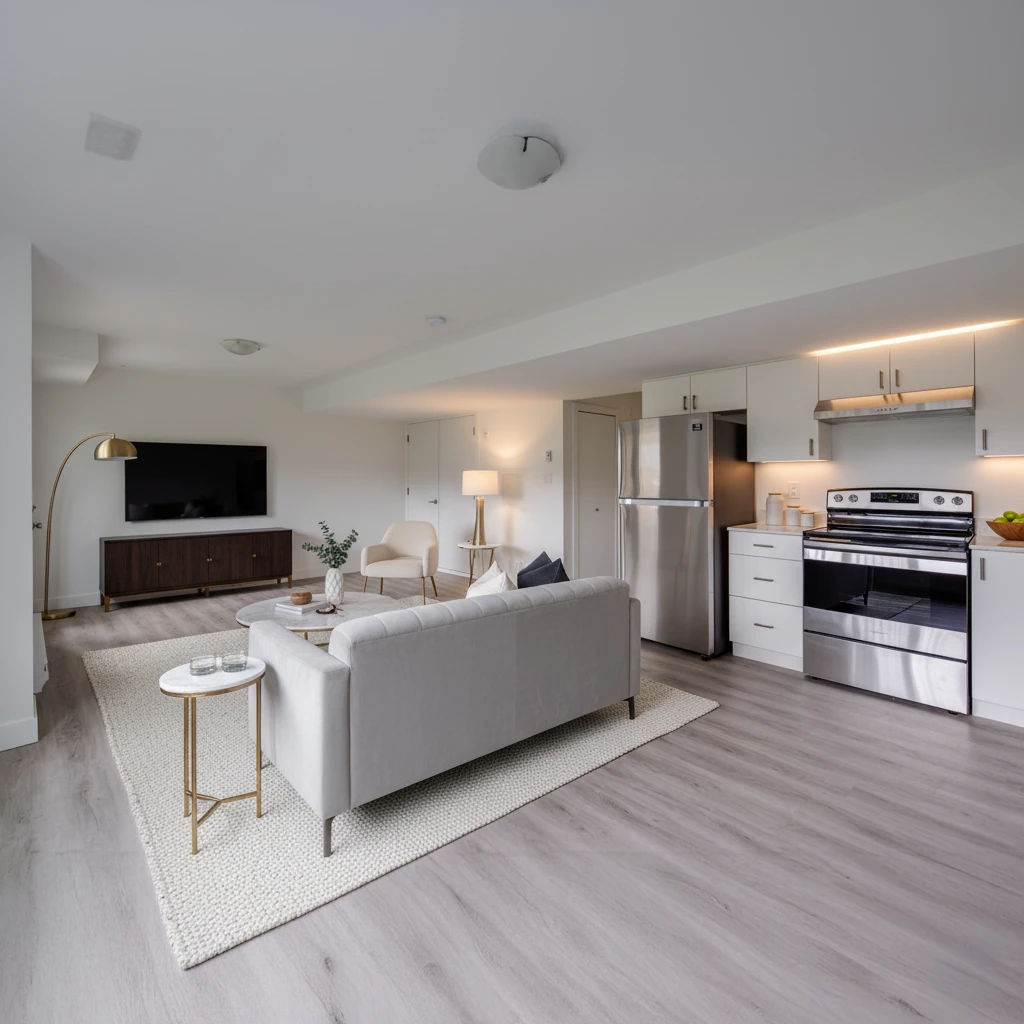
A basic basement development transforms an unfinished concrete shell into a clean, livable space — typically a family room, play area, or flex space. It does not include a secondary suite, separate entrance, or full kitchen. This scope works for homeowners who want usable square footage without the complexity or cost of a full suite.
What’s Included in Basic Development
- Interior wall framing with 2×4 studs and vapour barrier
- Roxul/Rockwool batt insulation (minimum R-20 for exterior walls per BC Energy Code)
- ½” drywall throughout, taped, mudded, and painted (two coats)
- Luxury vinyl plank or laminate flooring on concrete subfloor with underlayment
- Basic ceiling: either drop ceiling grid or drywall ceiling with access panels at mechanical
- Pot lights and general electrical outlets throughout
- Electrical sub-panel upgrade if required
What Is NOT Included
- Separate bathroom (add $12,000–$22,000 for a full bathroom rough-in and finish)
- Kitchen or wet bar (add $8,000–$25,000 depending on scope)
- Separate exterior entrance
- Egress windows beyond existing windows (add $3,000–$8,000 each)
- Waterproofing (assessed and priced separately before project begins)
Detailed Cost Breakdown: Basic Basement Development (approx. 800 sq ft)
| Item | Cost Range |
|---|---|
| Framing (interior walls, soffits, mechanical chases) | $4,000–$8,000 |
| Insulation (Roxul batts, vapour barrier) | $3,000–$6,000 |
| Drywall, mudding, and paint | $6,000–$12,000 |
| Flooring — LVP, 800 sq ft with underlayment | $4,000–$9,000 |
| Electrical (sub-panel upgrade + circuits + rough-in) | $4,000–$8,000 |
| Pot lights and fixtures | $1,500–$3,500 |
| Building permit | $800–$2,000 |
| Subtotal (materials + trade labour) | $23,300–$48,500 |
| General contractor overhead and profit (15–20%) | $3,500–$9,700 |
| All-in contractor total | $27,000–$58,000 |
The wide range within basic development reflects ceiling conditions (drop vs. drywall), finish quality (builder-grade LVP vs. premium wide-plank), and whether an electrical sub-panel upgrade is already complete. Projects at the higher end typically involve older homes with more complex framing, older electrical systems, and higher-quality finish specifications.
Legal Secondary Suite Basement: $70,000–$100,000
A legal secondary suite is the most financially rewarding basement renovation you can undertake in Metro Vancouver. Vancouver’s vacancy rate has hovered below 1% for years. A legal one-bedroom basement suite in East Vancouver, Burnaby, or Coquitlam commands $2,000–$2,400/month. A two-bedroom legal suite in the same areas typically rents for $2,500–$3,200/month. The renovation cost is typically recovered in three to five years — and the property value uplift is immediate.
City of Vancouver Legal Suite Requirements
To obtain secondary suite approval from the City of Vancouver, your renovation must meet all of the following minimum requirements:
- Minimum floor area of 37 square metres (approximately 398 sq ft)
- Ceiling height of 1.8m (5’11”) throughout, with 2.1m (6’11”) preferred for kitchen areas
- A separate exterior entrance directly to grade (not through the main dwelling)
- Egress windows in all bedrooms — minimum 0.35 sq m opening area
- Full kitchen with stove, refrigerator, and sink (cooking facilities required)
- Full bathroom (toilet, sink, shower or tub)
- One-hour fire separation from the main dwelling using Type X drywall
- Dedicated heat source independent of the main dwelling’s heating system
- Interconnected smoke detectors and carbon monoxide detectors
- Hardwired smoke alarm within 5 metres of any cooking facility
Detailed Cost Breakdown: Legal Secondary Suite (approx. 700 sq ft, one bedroom)
| Item | Cost Range |
|---|---|
| Permits (building permit + secondary suite permit) | $2,500–$5,000 |
| Egress windows (2–3 windows with well liners and drainage) | $6,000–$18,000 |
| Separate exterior entrance (door, steps, landing, grading) | $3,000–$8,000 |
| Fire separation (Type X drywall, fire-rated door at top of stairs) | $2,500–$5,000 |
| Electrical (sub-panel, AFCI breakers, dedicated circuits) | $5,000–$10,000 |
| Plumbing (bathroom rough-in, kitchen hookup, waste/vent stack) | $6,000–$14,000 |
| HVAC (dedicated heat source, HRV or exhaust, in-suite controls) | $4,000–$9,000 |
| Framing and insulation | $5,000–$10,000 |
| Drywall and paint | $5,000–$10,000 |
| Kitchen cabinets and appliances (mid-range) | $7,000–$18,000 |
| Bathroom finishes (tile, vanity, tub/shower, fixtures) | $5,000–$12,000 |
| Flooring — LVP throughout | $4,000–$9,000 |
| Exterior entrance (door hardware, lighting, address signage) | $2,500–$7,000 |
| Total (all-in contractor pricing) | $57,500–$124,000 |
The midpoint of this range — approximately $85,000–$90,000 — is our most common all-in quote for a compliant one-bedroom Vancouver basement suite in a post-1960 home with adequate ceiling height. Projects that land below $70,000 are typically smaller suites (under 550 sq ft) in homes with existing sub-panels and no egress window work required. Projects that exceed $100,000 usually involve ceiling height remediation, extensive plumbing relocations, or premium kitchen and bathroom finishes.
For more guidance on planning and financing your basement renovation, visit our Vancouver Renovation Guide.
Basement Waterproofing: Vancouver’s #1 Hidden Cost
No section of this guide matters more than this one. Waterproofing is the item most commonly omitted from basement renovation quotes — and the single most common cause of a $60,000 renovation becoming a $95,000 disaster three years later.
Vancouver receives approximately 1,150mm of rain annually, making it the wettest major city in Canada by precipitation volume. Below-grade concrete in Metro Vancouver is subjected to continuous hydrostatic pressure during the rainy season (October through April), lateral soil pressure from saturated clay, and drainage from failed or undersized window wells. The original weeping tile systems in homes built before 1980 are typically clay pipe — and most of it has collapsed, shifted, or been intruded by tree roots.
Signs of Moisture Problems Before You Renovate
- White efflorescence (chalky mineral deposits) on concrete walls or floor
- Staining at floor-wall junction (lateral water intrusion)
- Musty smell, especially after rain events
- Visible cracks in foundation walls, especially horizontal cracks (serious — indicates lateral pressure)
- Window wells that retain water after rain
- Rust stains from embedded rebar (sign of long-term moisture saturation)
Waterproofing Options and 2026 Cost Ranges
Interior drainage system (drainage channel + sump pump): $8,000–$18,000. A perimeter drainage channel is cut along the inside of the foundation walls, connected to a sump pit and pump. Water that infiltrates the wall is captured and directed out before it reaches the floor. This is a management strategy, not a prevention strategy — water still enters the wall, but it’s controlled. Appropriate for homes with minor to moderate moisture intrusion and adequate lot drainage.
Exterior waterproofing (full excavation): $25,000–$55,000. The foundation walls are fully excavated from outside. Old weeping tile is replaced, a drainage membrane and dimple board are applied to the exterior of the foundation wall, and a new drainage layer is installed. This is the correct solution for severe moisture intrusion, horizontal cracks, or active leaks. It requires significant landscaping restoration after completion.
Window well drain repair: $1,500–$4,000 per window. Window wells that lack proper drainage frequently fill with water during Vancouver’s rainy season and allow water to enter through the window frame. Each well requires its own gravel bed and perforated drain connected to the weeping tile system.
Our rule at VGC: Every basement renovation project begins with a moisture assessment. We have had clients come to us who skipped this step with a previous contractor — and needed $35,000 in mould remediation and structural drying three years after completing a $60,000 basement renovation. Finishing over moisture is not a renovation; it’s a construction of future problems.
Basement Ceiling Height in Vancouver: When You Need to Lower the Slab
Ceiling height is the structural reality that determines whether your basement renovation is a straightforward project or a complex excavation. The BC Building Code requires a minimum of 1.98m (6’6″) for habitable space in new construction. The City of Vancouver secondary suite bylaw sets a lower bar of 1.8m (5’11”) — but even that minimum is tight for daily living. Most contractors and the City itself will tell you that 2.1m (6’11”) is the preferred standard for a quality secondary suite.
Typical Basement Heights by Home Era in Vancouver
| Home Era | Typical Ceiling Height (floor to joist) | Legal Suite Compliant? |
|---|---|---|
| Pre-1940 (craftsman, heritage) | 5’6″–6’2″ | No — underpinning typically required |
| 1940–1960 | 6’2″–6’10” | Borderline — measure carefully, check beam depths |
| 1960–1985 | 7’0″–7’8″ | Yes — typically compliant |
| 1985–present | 7’6″–8’0″+ | Yes — comfortably compliant |
Note that “floor to joist” is not the same as your finished ceiling height. Subtract the floor assembly (typically 1.5″–2″ for underlayment and LVP), any drywall ceiling (½”), and mechanical clearance requirements. A basement that measures 6’10” floor to joist may finish at 6’5″ — which is below the 6’6″ BC Building Code minimum for new construction, though it may still qualify under the City of Vancouver’s 5’11” secondary suite minimum.
Slab Lowering Methods and Costs
Full slab excavation and underpinning: $35,000–$65,000. The existing concrete slab is broken up and removed. The footings are underpinned (deepened) to maintain structural support. The soil is excavated to the desired depth. New drainage, vapour barrier, and a poured concrete slab are installed. This method gains the most height and is required for homes where the existing footing depth does not allow benching.
Benching: $18,000–$35,000. Rather than deepening the footings, the floor is excavated in the centre of the basement, leaving a raised “bench” of soil along the perimeter walls that supports the existing footing. The resulting floor is not fully flat, but the centre of the space gains significant height. Some municipalities accept benched basements for suite compliance; the City of Vancouver requires the minimum height to be achieved throughout the habitable space, so benching may not qualify.
Joist profile optimization: In some homes, replacing deep engineered lumber (LVL beams, older sawn lumber) with I-joist or structural steel profiles in specific locations can gain 3–6 inches without any slab work. This is a structural engineering solution that should be evaluated by a Professional Engineer before any modification.
Basement Renovation Permits in Vancouver
Permits are not optional in Vancouver. They are not something a trustworthy contractor will suggest skipping. Here is a clear breakdown of what is required and what it costs.
Which Permits Do You Need?
- Building permit: Required for any finished basement development — framing, insulation, drywall, or adding any rooms. This applies even if you are not creating a suite.
- Secondary suite permit: A separate permit required in addition to the building permit if you are creating a self-contained rental unit. Triggers a separate inspection stream focused on suite compliance (ceiling height, egress, fire separation).
- Electrical permit: Issued separately by BC Safety Authority (Technical Safety BC). Required for any electrical rough-in, sub-panel installation, or new circuits. Your Licensed Electrical Contractor pulls this permit.
- Plumbing permit: Required for any new plumbing rough-in, including bathroom additions and kitchen connections. Your journeyman plumber pulls this permit.
Permit Costs and Timeline
Combined permit costs for a standard basement renovation in the City of Vancouver range from $1,500 to $6,000 depending on the valuation of the work. Secondary suite permits add approximately $500–$1,500 on top of the base building permit fee.
Timeline: standard building permit applications for basement renovations take 6–12 weeks in the City of Vancouver. Vancouver’s permit office is among the busiest in Canada. We recommend starting the permit application as early as possible — VGC handles the entire permit process for our clients as part of our project management scope.
Inspection Stages
The City of Vancouver will conduct inspections at four minimum stages: framing, rough-in (electrical and plumbing), insulation and vapour barrier, and final. You cannot proceed past each stage without passing the previous inspection. Budget for a two to four week delay at each inspection stage in your project schedule.
Ready to begin? Contact our team for a free basement renovation assessment and permit guidance.
Basement Renovation ROI in Metro Vancouver
Vancouver real estate has made basement renovation one of the highest-ROI home improvement investments in Canada. Here is a realistic analysis based on current Metro Vancouver property values and rental income.
ROI by Renovation Type
- Basic rec room / family room development: 70–90% ROI. A $40,000–$60,000 investment adds approximately $30,000–$50,000 to appraised property value. The square footage increase is valued, but an unrentable space has lower multiplier effect than a legal suite.
- Adding a bathroom to an unfinished basement: 85–120% ROI. One of the highest-return single additions in Vancouver real estate — a full bathroom added to any finished basement dramatically increases both rental potential and sale price.
- Legal secondary suite: 180–240% ROI. This is the standout investment. A $75,000–$95,000 renovation can add $150,000–$200,000 to the property value of a Vancouver detached home, in addition to generating $24,000–$38,000/year in rental income. The average payback period on the renovation cost is 2.5–4 years through rental income alone, ignoring the property value uplift entirely.
VGC Case Study: East Vancouver Legal Suite
A client in East Vancouver approached us with a 1958 bungalow — 6’4″ basement ceiling, no existing suite, original clay weeping tile, single electrical panel. Total renovation scope: interior drainage system ($12,000), egress windows ($14,000), separate side entrance ($6,500), full legal suite buildout including kitchen and bathroom ($39,500). All-in cost: $72,000. Results: suite permitted and rented at $2,100/month within three weeks of completion. Estimated property value increase based on comparable sales: $160,000–$180,000. Total value created: approximately $185,000–$205,000 on a $72,000 investment.
ROI is highest when you are creating a legal suite in a rental-constrained market — which describes every municipality in Metro Vancouver today. The Vancouver rental market has not shown meaningful vacancy improvement for over a decade. This is not speculative ROI; it is arithmetic.
DIY vs. Hiring a Contractor for Basement Renovation
The allure of a DIY basement renovation is understandable — framing, drywall, and painting seem approachable if you have basic construction skills. Here is an honest breakdown of what is legal and practical to DIY versus what requires licensed professionals in British Columbia.
What You Can DIY in BC Without a Permit
- Painting — any room, any surface, no permit required
- Flooring installation — LVP, laminate, carpet (floating or glued, no structural modification)
- Non-structural wall patching and cosmetic repairs
- Cabinetry and fixture installation that does not involve new plumbing or electrical connections
What Requires Licensed Trades in BC (Cannot Be DIY on Permitted Work)
- Electrical: A Licensed Electrical Contractor (LEC) is required for all permitted electrical work in BC. Homeowners may do their own electrical work on their own primary residence (owner-builder exemption) but must still obtain permits and pass Technical Safety BC inspections. For any suite or investment property, an LEC is required without exception.
- Plumbing: A licensed journeyman plumber is required for all rough-in work including new waste lines, vent stacks, and supply connections. Homeowner exemptions exist for minor repairs, not new rough-in for a suite.
- HVAC: Licensed mechanical contractors are required for duct installation, HRV connections, and gas appliance hookups.
- Structural modifications: Any modification to load-bearing walls, beams, or the foundation requires a Professional Engineer (P.Eng.) stamp in BC.
Risks of Unpermitted Basement Work in Vancouver
- City of Vancouver unpermitted suite fine: up to $10,000 per day
- Home insurance is void for the unpermitted space — any fire, flood, or liability claim related to the basement can be denied
- Real estate disclosure requirement: unpermitted suites must be disclosed to buyers, reducing sale price and marketability
- Mortgage and refinancing complications — lenders appraise based on legal square footage only
Partial DIY: A Practical Hybrid Approach
Some homeowners choose to engage a general contractor for the structural, trade, and permit work — then handle the painting, flooring, and trim installation themselves after the final inspection is complete. This hybrid approach can save 15–25% of total project cost. We support this model and can structure our contracts to accommodate owner-supplied finish labour after rough-in inspections pass.
Basement Renovation for Specific Goals
Not every basement renovation is a legal suite. Here are the costs and key considerations for the most common specialty scopes we complete within already-developed basements.
Home Theatre / Media Room: $15,000–$35,000
A home theatre in an existing finished basement is one of the more cost-effective specialty renovations. Key scope items: acoustic insulation in walls and ceiling ($2,500–$5,000), projector mount backing and conduit for AV wiring ($800–$2,000), blackout blind recesses built into window frames ($500–$1,500 per window), wet bar with bar fridge and sink ($6,000–$15,000), tiered platform for rear seating ($2,000–$5,000), dedicated 20-amp circuits for equipment ($1,500–$3,000). A well-executed media room adds meaningful value at resale — buyers in Vancouver’s family-oriented neighbourhoods respond strongly to entertainment-capable basement spaces.
Home Gym: $8,000–$18,000
A dedicated home gym within a finished basement requires rubber flooring ($4–$7 per sq ft installed for commercial-grade interlocking rubber tile), mirrored wall section on at least one wall ($1,500–$3,500 for a 10-foot section), dedicated 20-amp circuits for treadmill, elliptical, and other high-draw equipment ($1,000–$2,500), and upgraded HVAC exhaust to manage humidity and heat generated during exercise ($1,500–$3,500). Structural blocking is required if wall-mounted pull-up rigs or cable systems are part of the scope.
Home Office: $12,000–$22,000
A professional home office in a basement requires egress window compliance for the space to be legally habitable (required whether or not you call it a bedroom), dedicated 20-amp circuits (two minimum for workstation and peripheral equipment), Cat6 ethernet roughed in to desk locations ($800–$1,500), soundproofing consideration (Roxul Safe’n’Sound in partition walls, $1,500–$3,000 additional over standard insulation), and a quality ceiling with recess for video call lighting. The permitting requirements are the same as any finished basement room — a building permit is required regardless of the designated use.
In-Law Suite (Accessibility-Focused): $65,000–$95,000
An in-law suite meets the same construction standards as a secondary suite but incorporates accessibility design for aging-in-place use. Key modifications over a standard suite: wider doorways (minimum 32″ clear opening, ideally 36″ for wheelchair clearance) throughout, barrier-free walk-in shower with fold-down bench and grab bars ($3,000–$6,000 additional over standard shower), raised toilet height (17″–19″ comfort height), threshold-free transitions between flooring types, grab bars at toilet, shower, and tub (if applicable), and no exterior stair barriers — the entrance must reach grade without steps, which may require a concrete ramp or reconfigured entrance landing ($3,000–$8,000 depending on grade change). In-law suites may also qualify for a secondary suite designation, allowing rental income if the primary occupant situation changes.
How VGC Approaches Basement Renovation Projects
At Vancouver General Contractors, we have been renovating Metro Vancouver basements since our founding. Here is how we structure every basement renovation project to protect your investment and ensure the finished product performs the way you need it to — legally, structurally, and for the long term.
Step 1: Moisture Assessment Before Any Scope Is Finalized
Before we quote a single line item, we assess the existing moisture conditions in the basement. This includes a visual inspection of all foundation walls and the slab, checking for efflorescence, cracks, staining, and evidence of past water intrusion. If anything is inconclusive, we recommend a professional moisture test before finalizing scope. This step costs us time — but it protects clients from the most expensive mistake in basement renovation.
Step 2: Ceiling Height Measurement and Slab Recommendation
We take precise ceiling height measurements at multiple points throughout the basement — including beneath all beams, at duct soffits, and at the lowest point in the space. We calculate the finished ceiling height after accounting for floor assembly and ceiling drywall. If the finished height falls below the legal minimums, we present the client with a slab lowering recommendation and accurate cost to achieve compliance — before any contract is signed.
Step 3: Structural and Seismic Assessment (Pre-1960 Homes)
For homes built before 1960, we recommend an optional structural and seismic assessment before beginning any below-grade renovation. This is particularly relevant for pre-1940 homes where the original foundation may be unreinforced concrete or concrete block without rebar. Seismic upgrading adds $8,000–$25,000 to a project but is increasingly expected by insurers and is factored into property appraisals. If you are spending $80,000–$100,000 on a basement renovation, the incremental cost of seismic resilience is worth considering.
Non-Negotiable Inclusions
Every VGC basement renovation — regardless of budget — includes fire separation from the main dwelling, compliant egress windows in all habitable rooms, dedicated electrical panel capacity for the basement load, and proper vapour barrier installation on all exterior-adjacent walls. These are not options we present as upgrades. They are the baseline below which a basement renovation creates more liability than value.
CMHC Secondary Suite Loan
The Canada Mortgage and Housing Corporation (CMHC) Secondary Suite Loan Program provides eligible homeowners with up to $80,000 at 2% interest to create or renovate a secondary suite. This program is specifically designed to increase rental housing supply in high-demand Canadian markets — which includes all of Metro Vancouver. Eligibility requires that the suite will be rented at or below market rate and that the work meets all local building code and zoning requirements. We coordinate directly with CMHC on behalf of clients pursuing this financing. Our Renovation Guide has more detail on financing options.
Contract Structure and Payment Milestones
VGC contracts for basement renovation are fixed-price with milestone-based payments:
- 20% mobilization — due at contract signing. Covers permit application fees, material procurement, and mobilization.
- 40% at rough-in completion — framing, electrical rough-in, plumbing rough-in, and insulation complete and inspected.
- 30% at finishes completion — drywall, flooring, kitchen, and bathroom complete.
- 10% holdback — released at final inspection approval and your written confirmation of completion.
We do not ask for more than 20% upfront on any project. If a contractor asks for 50% or more before work begins, that is a significant warning sign.
Frequently Asked Questions: Basement Renovation Cost in Vancouver
How much does it cost to finish a basement in Vancouver?
Finishing an unfinished basement in Vancouver typically costs $40,000–$65,000 for a basic development (framing, insulation, drywall, flooring, and lighting in approximately 800 sq ft). This assumes adequate ceiling height, no waterproofing required, and no separate suite. Adding a bathroom adds $12,000–$22,000. Adding a full legal suite pushes the total to $70,000–$100,000 for a compliant renovation.
What is the average cost of a basement renovation in Vancouver?
The average all-in cost for a finished basement renovation in Metro Vancouver in 2026 is approximately $55,000–$75,000 for a non-suite development and $80,000–$100,000 for a legal secondary suite. The wide range reflects ceiling height conditions, moisture remediation requirements, finish quality, and whether a sub-panel upgrade is needed. Projects at the extremes (under $35,000 or over $150,000) are outliers rather than norms.
Do I need a permit for a basement renovation in Vancouver?
Yes. Any finished basement development in the City of Vancouver requires a building permit, regardless of whether it includes a suite. Separate permits are required for electrical, plumbing, and secondary suite work. Unpermitted work carries fines up to $10,000 per day, voids your home insurance for the space, and must be disclosed on sale. There is no legal path to a finished basement without permits in Vancouver.
How long does a basement renovation take?
A basic basement development (no suite) takes 8–12 weeks of construction once permits are issued. A legal secondary suite takes 12–18 weeks. Add 6–12 weeks for permit issuance before construction begins. Total timeline from contract to occupancy: approximately 4–7 months for a suite renovation, 3–5 months for basic development. Projects with slab lowering or exterior waterproofing add 3–6 weeks to the construction schedule.
Can I rent out my basement in Vancouver?
Yes — but only if the suite is legal. A legal secondary suite in the City of Vancouver requires a building permit, secondary suite permit, and compliance with all suite requirements (minimum size, ceiling height, egress, fire separation, separate entrance, full kitchen, dedicated heat). Renting an unpermitted suite is illegal and exposes you to significant financial and legal risk. In zones where secondary suites are permitted (most RS zoning in Vancouver), a legal suite is a straightforward path to rental income.
What ceiling height is required for a legal suite in Vancouver?
The City of Vancouver requires a minimum ceiling height of 1.8 metres (5’11”) throughout a secondary suite, with 2.1 metres (6’11”) preferred for kitchen areas. The BC Building Code requires 1.98 metres (6’6″) for new construction habitable space. If your existing basement does not meet the minimum, slab lowering or benching will be required before a suite permit can be issued. Most homes built after 1960 meet the 1.8m minimum without any slab work.
How do I waterproof my Vancouver basement?
Basement waterproofing in Vancouver should begin with a professional moisture assessment to identify the source and severity of water intrusion. For minor intrusion, an interior drainage channel with sump pump ($8,000–$18,000) is typically sufficient. For active leaks, lateral cracks, or failed weeping tile, full exterior waterproofing with membrane and drainage board ($25,000–$55,000) is the correct solution. Waterproofing must be completed before any finished renovation work begins — not after.
What is a legal secondary suite?
A legal secondary suite is a self-contained residential unit within a single-family home that has been built to code, fully permitted, and approved by the local municipality. In the City of Vancouver, it must meet minimum size, ceiling height, fire separation, egress, and kitchen/bathroom requirements. A legal suite can be rented, is insured as a residential unit, and adds documented value to the property. An illegal suite meets none of these criteria and creates ongoing liability for the owner.
How much does basement waterproofing cost in Vancouver?
Basement waterproofing costs in Vancouver range from $1,500–$4,000 for window well drain repair, $8,000–$18,000 for interior drainage channel and sump pump installation, and $25,000–$55,000 for full exterior excavation, membrane, and weeping tile replacement. The correct solution depends on the type, source, and severity of moisture intrusion. Skipping waterproofing before a basement renovation is the most expensive mistake a Vancouver homeowner can make.
Is a basement renovation worth it in Vancouver?
Yes — Vancouver basement renovations deliver among the highest returns on investment of any home improvement in Canada. A legal secondary suite generating $2,000–$2,500/month returns the renovation cost within 3–4 years through rental income alone, plus adds $150,000–$200,000 in appraised property value. Even a basic finished basement without a suite delivers 70–90% ROI at sale. In Metro Vancouver’s housing-constrained market, unused basement square footage is one of the most underutilised assets a homeowner can unlock.
Do I need egress windows in my basement?
Yes, if you are creating any habitable space in your basement — bedrooms, offices, living areas, or secondary suite rooms. The BC Building Code requires egress windows with a minimum opening of 0.35 square metres and a minimum height and width of 380mm each. Bedrooms in a secondary suite require an egress window by both the Building Code and the City of Vancouver’s suite bylaw. Each egress window installation costs $3,000–$8,000 depending on window well size, concrete cutting required, and drainage complexity.
Can I do a basement renovation myself?
You can legally DIY some elements of a basement renovation in BC — painting, flooring, non-structural finishing work. For permitted work, electrical requires a Licensed Electrical Contractor (LEC) unless you qualify for the homeowner owner-builder exemption on your primary residence. Plumbing rough-in requires a licensed journeyman plumber. Structural work requires engineer approval. If you are creating a secondary suite or rental unit, all work must be done by licensed trades. Partial DIY on finishing work (post-inspection) is a practical way to reduce total project cost.
What permits are required for a basement suite in Vancouver?
A basement suite in the City of Vancouver requires: (1) a building permit, (2) a secondary suite permit (separate from the building permit), (3) an electrical permit issued to your Licensed Electrical Contractor, and (4) a plumbing permit issued to your journeyman plumber. Total permit costs typically range from $2,500–$6,000. VGC handles all permit applications as part of our project scope — we submit, respond to queries, and attend inspections on your behalf.
How do I increase ceiling height in my basement?
There are three main approaches to increasing basement ceiling height in Vancouver. Full slab excavation and underpinning ($35,000–$65,000) is the most comprehensive method — the existing slab is removed, footings are deepened, and a new slab is poured at a lower elevation. Benching ($18,000–$35,000) excavates the centre of the basement floor while leaving a raised perimeter to support existing footings. Structural beam optimization (engineering consultation required) can gain 3–6 inches in specific locations by modifying the joist profile without slab work. The right method depends on your existing footing depth, how much height is needed, and your municipality’s requirements.
What is the CMHC secondary suite loan?
The CMHC Secondary Suite Loan Program provides eligible Canadian homeowners with loans of up to $80,000 at a 2% interest rate to create or renovate a secondary suite on their property. The program is designed to increase rental housing supply in cities with housing shortages — Vancouver is a primary target market. Eligibility requires that the suite will be rented at or below median market rent, that the homeowner occupies the primary dwelling, and that the renovation meets all local code and permit requirements. VGC assists clients in understanding eligibility and structuring their project to qualify.
Ready to get a real number for your basement? Contact Vancouver General Contractors for a detailed, no-obligation basement renovation quote. We serve Vancouver, Burnaby, North Vancouver, West Vancouver, Coquitlam, and all of Metro Vancouver.
Get a Free Renovation Quote
Metro Vancouver’s trusted general contractors. Free consultations across Vancouver, Burnaby, Richmond, North Shore & beyond.
Get Your Free Quote →
Comments are closed