




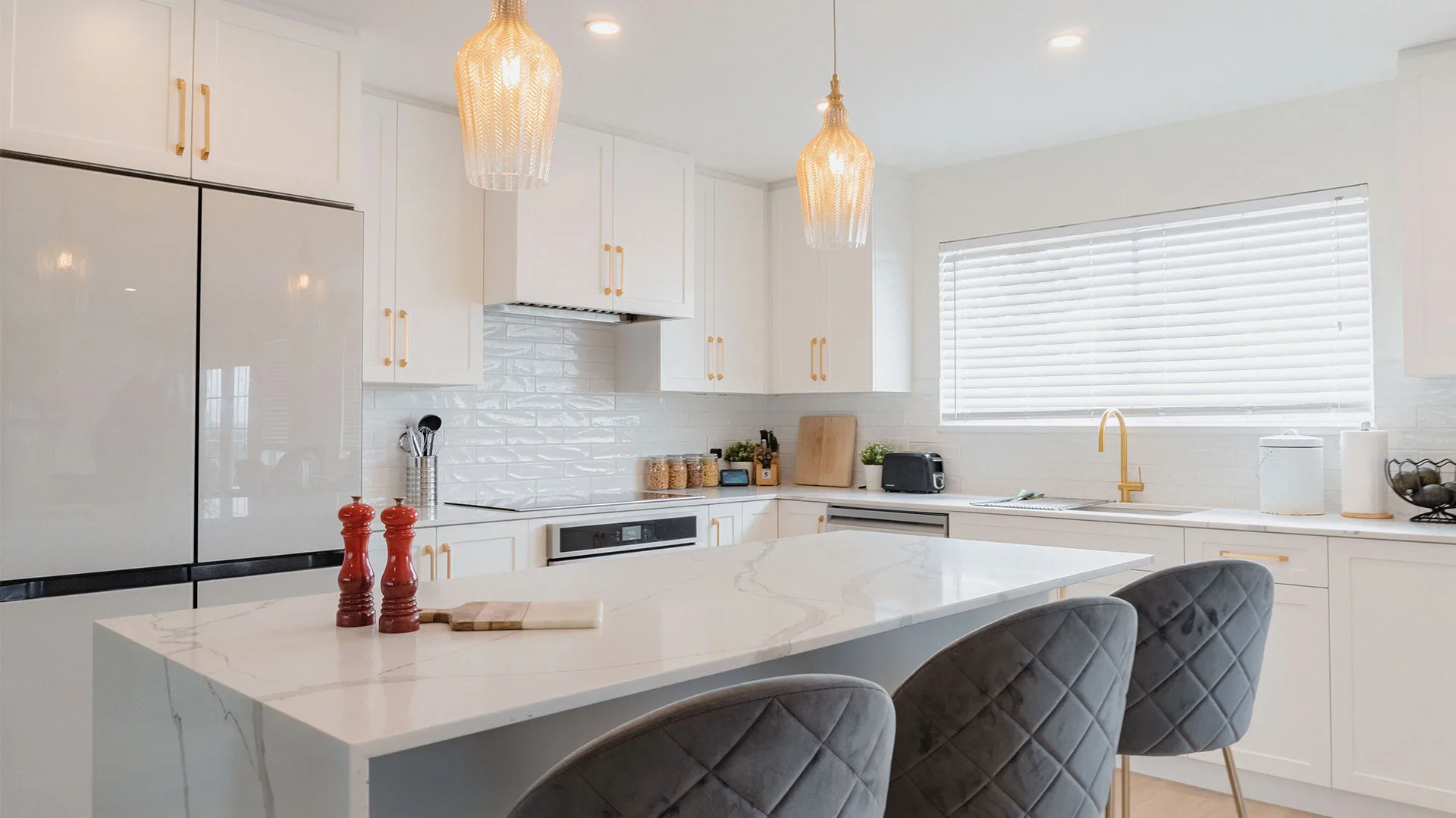
Kitchen Renovation Ideas for Vancouver Homes: Layouts, Trends, and Design Tips That Work in 2026
Your kitchen is the most-used room in your home — and in Vancouver, where rainy winters push families indoors for months at a time, it carries even more weight. Whether you are starting from a dark, closed-off galley in a 1960s East Van bungalow, a cramped condo kitchen in a Yaletown high-rise, or a dated open-concept in a Burnaby split-level, the right renovation can transform the way your household lives every single day.
This guide covers every dimension of kitchen renovation ideas for Vancouver homes: layouts that suit our housing stock, design trends that are actually landing in local builds right now, cabinet and countertop choices that hold up in real Vancouver kitchens, and practical planning guidance so you know what to expect before you break ground. Use it as your starting point, then connect with VGC for a site-specific design consultation.
Vancouver Kitchen Design in 2026: What’s Trending and What’s Timeless
Kitchen design moves in cycles. Some ideas burn bright for two or three years and then date a home badly; others have anchored beautiful kitchens for decades and will continue to do so. Knowing the difference before you spend $40,000–$100,000 is one of the most valuable things a renovation guide can offer.
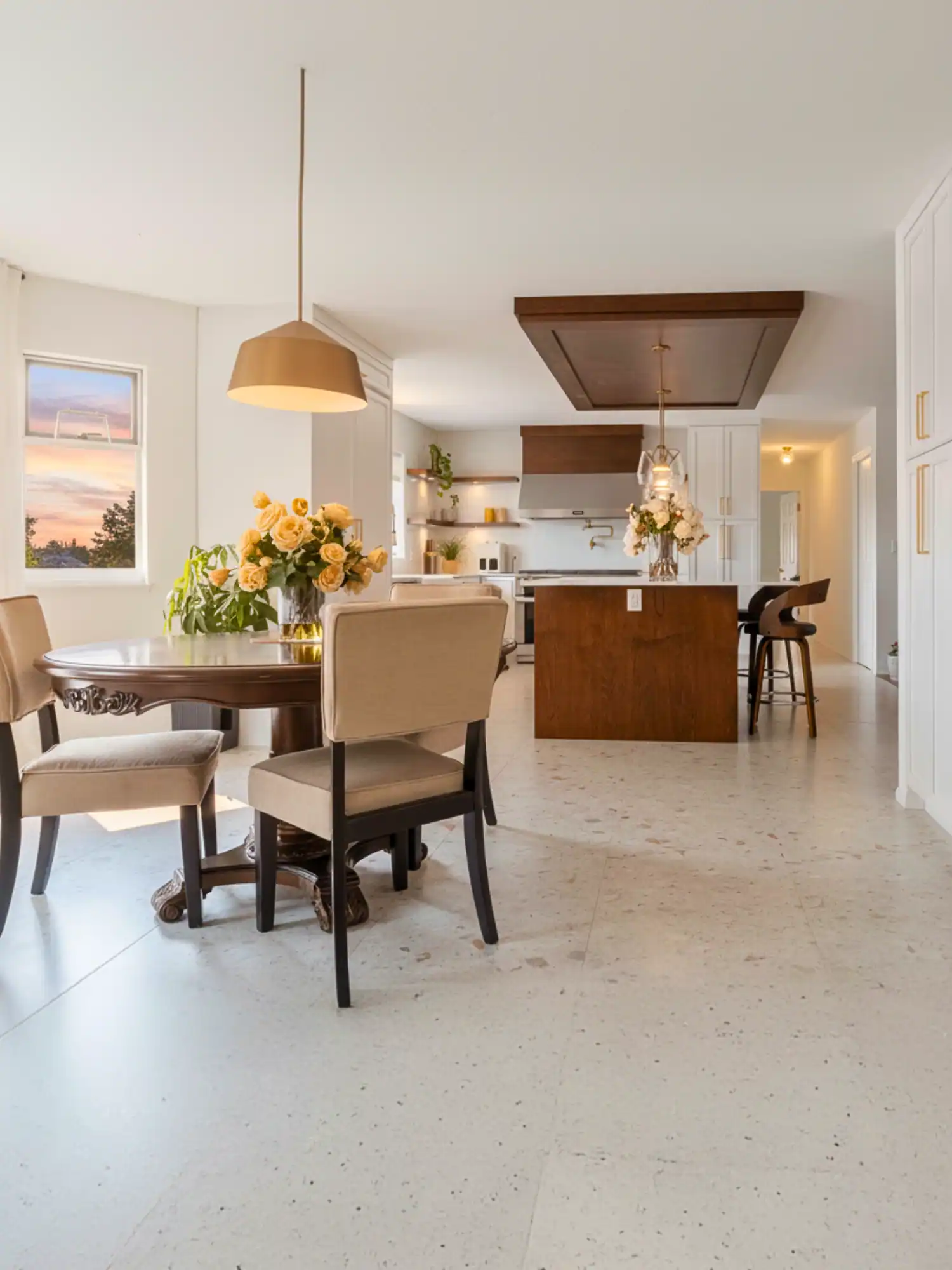
The all-farmhouse kitchen — shiplap, apron-front sink, open shelving on every wall, and a barn door to the pantry — peaked around 2019 and now reads as dated in Vancouver's urban context
Vancouver General Contractors
Trending in 2026
- Two-tone cabinetry — White or off-white uppers paired with natural wood, forest green, or navy lowers. The contrast breaks up visual mass in larger kitchens and adds depth in smaller ones. This look has been building since 2023 and is now the dominant choice in mid-to-high-end Vancouver renovations.
- Slab stone islands — A single dramatic slab of quartzite or book-matched porcelain on the island surface and waterfall sides. The island becomes a sculptural centrepiece rather than just a work surface.
- Statement range hoods — Plaster, curved steel, fluted wood, and custom sheetmetal hoods are replacing the builder-grade stainless box. A well-designed hood commands the room the way a fireplace does in a living area.
- Black matte fixtures — Matte black faucets, cabinet pulls, and appliance trim against white or light cabinets. Adds contrast without the upkeep of polished chrome.
- Handleless cabinetry — Integrated J-pull or push-to-open profiles on cabinet doors and drawers. Keeps the kitchen surface visually clean, particularly valued in smaller condo kitchens where every visual element competes for attention.
Timeless in Vancouver
- Shaker-style cabinets — The five-piece recessed-panel door has worked in every decade since the 1980s and suits everything from craftsman to contemporary. If you are uncertain about style, Shaker is always a safe choice.
- Quartz countertops — Non-porous, low maintenance, consistent colour and pattern. Over 85% of VGC mid-range kitchen builds use quartz. Calacatta white, Carrara White, and Silestone Lagoon remain top sellers year after year.
- Hardwood flooring running through from living to kitchen — Visual continuity from the living and dining areas into the kitchen makes the entire main floor feel larger. Engineered hardwood handles the humidity variations of a kitchen better than solid wood.
- White subway tile backsplash — The 3×6 subway tile in a brick pattern with grey grout has been in continuous production since 1904 for a reason. It is inexpensive, durable, easy to regrout, and works with nearly every cabinet and countertop combination.
What Vancouver Homeowners Are Prioritizing Right Now
Based on VGC’s 2025–2026 project roster, the top client priorities in order are: storage efficiency (especially in condos and older houses where kitchens were designed before modern appliance loads), island seating (open-plan family living means the island is where kids do homework, guests gather, and informal meals happen), and hidden appliances (panel-ready refrigerators and integrated dishwashers are increasingly requested even at mid-budget levels).
What’s Out
The all-farmhouse kitchen — shiplap, apron-front sink, open shelving on every wall, and a barn door to the pantry — peaked around 2019 and now reads as dated in Vancouver’s urban context. All-white kitchens are similarly showing their age; Vancouver’s cooking culture (families who actually cook daily, multicultural households with high-heat, oil-heavy cuisine) means white cabinet surfaces show wear, staining, and grease in high-use zones within three to five years. The trend has already shifted toward warm neutrals and two-tone palettes that are more forgiving in real use.
Kitchen Layouts That Work Best in Vancouver Homes
Layout is the skeleton of your kitchen — everything else is decoration hung on it. Getting the layout right for your specific footprint, your household’s cooking habits, and your home’s floor plan is the single most important decision in a kitchen renovation. Here are the five layouts VGC most commonly designs and installs across Vancouver, Burnaby, North Vancouver, and the Tri-Cities.
L-Shape Kitchen
Best for: Open concept main floors, most Vancouver home types — detached houses, townhouses, semi-detached.
Typical footprint: 100–160 sq ft
Key advantage: Two walls of cabinets create a natural work triangle between refrigerator, sink, and range. Leaves an open fourth side for island placement and easy social flow between kitchen and dining or living areas.
Key limitation: Corner cabinet space can be wasted without the right storage solution (a lazy Susan or pull-out system is essential).
The L-shape is the most popular layout VGC installs across Vancouver’s housing stock. It suits the 1960s–1990s bungalow and two-storey that makes up the bulk of East Van, Burnaby, and Coquitlam’s detached housing. It also works well in newer townhouses where the main floor is open concept. Adding a central island to an L-shape kitchen transforms it into what most clients describe as their dream kitchen layout.
Galley Kitchen
Best for: Condos and apartments, narrow secondary kitchens, rental suite kitchens.
Typical footprint: 60–80 sq ft
Key advantage: Two parallel runs of cabinets and counters facing each other. Exceptionally efficient — everything is within arm’s reach. Restaurants use galley layouts for professional efficiency.
Key limitation: No room for an island. Does not support open concept (the layout requires two facing walls). Can feel tunnel-like if the run is long and the width is narrow.
The galley is often the starting configuration VGC inherits in a condo or older Vancouver Special renovation. Where the floor plan permits removing or opening one end wall, VGC can convert a closed galley into a functional L-shape or peninsula layout — one of the highest-impact transformations available for a condo kitchen.
U-Shape Kitchen
Best for: Larger kitchen footprints, serious home cooks who want maximum storage and counter space.
Typical footprint: 150–200 sq ft
Key advantage: Three walls of cabinets and counters. Provides the most storage and prep surface of any layout. The interior of the U becomes a highly efficient work zone.
Key limitation: Can feel enclosed and closed-off, particularly in smaller versions of the layout. Works best when one wall of the U connects to an open dining area via a pass-through or lowered counter.
U-shape kitchens are common in North Shore detached homes where kitchen footprints are generous. Adding an opening in one wall of the U — often by removing a section of upper cabinets and installing a lowered counter — connects the kitchen to the dining room and converts a closed U into a semi-open plan that feels modern without a full wall removal.
Island Kitchen
Best for: Open concept homes, families with children, homeowners who entertain regularly.
Minimum clearance required: 900mm (36″) on all working sides; 1,050mm (42″) preferred on the chef’s side
Cost addition: $8,000–$20,000 over a comparable layout without an island
Seating: 3–5 bar stools on the social side; storage, appliance drawer, or wine fridge on the chef’s side
The island kitchen is the renovation goal cited most often by Vancouver homeowners. It functions simultaneously as extra counter space, a casual dining area, a homework station, and the social hub of an open-plan main floor. Sizing the island correctly for the available clearance is critical — an island that is too large for the room creates a pinch point that makes cooking feel cramped rather than expansive.
Peninsula Kitchen
Best for: Smaller condos and townhouses where a freestanding island would consume too much clearance space.
Typical application: 600–900 sq ft condo, older Vancouver townhouse
Key advantage: Attached at one end to a wall or cabinet run, the peninsula adds prep counter and seating without requiring full clearance on all four sides. Functions like an island but fits where an island cannot.
For clients who want island seating but do not have the floor plan to support it, the peninsula is consistently the right answer. VGC has installed peninsula kitchens in condos as small as 650 sq ft that provide seating for three and a full run of prep counter — a dramatic upgrade from the original galley configuration.
Small Kitchen Renovation Ideas for Vancouver Condos
The average Vancouver condo kitchen ranges from 60 to 90 square feet — roughly half the size of a kitchen in a detached house. Every design decision in a small kitchen has to work twice as hard. Here are the strategies VGC applies most consistently in condo kitchen renovations across downtown Vancouver, Yaletown, Mount Pleasant, and Burnaby’s high-rise corridors.
Maximize Vertical Space
Standard upper cabinets stop 18 inches below the ceiling, leaving a shelf of dead space above. In a 630 sq ft condo, that gap represents a meaningful percentage of your total storage volume. Cabinets run to ceiling height — stacked cabinets or a single tall door — reclaim that storage and make the wall feel taller, which expands the perceived size of the room. The top shelf can hold seasonal items or rarely used equipment accessed with a step stool.
Light and Bright: Colour, Fixtures, and Under-Cabinet LEDs
Light colours — white, soft grey, warm off-white — make small kitchens feel larger by reflecting both natural and artificial light. Pair light cabinets with undercabinet LED strip lighting to eliminate the shadow that falls on your work surfaces from overhead pot lights. A well-lit counter looks and feels more spacious than a poorly lit one, even at the same physical size. Undercabinet LED strips cost $300–$800 for a full condo kitchen and are one of the highest-value upgrades per dollar in a small kitchen renovation.
Full-Height Backsplash and Handle-Free Cabinets
A backsplash that runs from the counter all the way to the underside of the upper cabinets — rather than stopping partway — creates a continuous surface that visually lengthens the wall and makes the kitchen feel taller. Paired with handle-free cabinet doors (either an integrated J-pull or push-to-open hardware), the result is a kitchen surface with minimal visual interruption. Fewer elements competing for the eye’s attention makes the room read as larger.
Peninsula Instead of Island, Appliance Garage, Panel-Ready Appliances
Adding a 12–18 inch extension at the end of a counter run — either a small peninsula or a breakfast bar overhang — provides prep space and seating without the full clearance requirement of a freestanding island. An appliance garage (a dedicated cabinet with a lift-up or roll-up door that hides the toaster, coffee maker, and blender) removes countertop clutter and makes the kitchen look organized even when it isn’t. Panel-ready appliances — a refrigerator and dishwasher with matching cabinet panels — create visual continuity that makes the kitchen look larger by reducing the number of different surfaces competing for attention.
Budget for a full condo kitchen renovation in Vancouver: $28,000–$55,000 depending on scope, appliance grade, and material selections.
Open Concept Kitchen Ideas for Vancouver Homes
Removing the wall between the kitchen and the living or dining room is the single most requested renovation project VGC receives across all of Metro Vancouver. It transforms a home’s feel entirely — from separate, compartmentalized rooms to a connected, flowing living space where the cook is part of family life rather than isolated behind a wall.
The Design Problem Open Concept Creates
Once the kitchen is open to the living and dining areas, it is permanently on display. The mess of cooking — the pile of dishes, the open pantry door, the appliances on the counter — is visible from the sofa, the dining table, and the front door. This is not a reason to avoid open concept; it is a reason to design smart storage from the start so that the kitchen can be kept in reasonable order without heroic effort.
Defining the Kitchen Zone Without Walls
The island is the primary tool for defining the kitchen zone in an open concept floor plan. It creates a physical and visual boundary between the kitchen work area and the living or dining area without closing off the space. Pendant lights hung over the island reinforce the zone definition by bringing a lower ceiling plane — and warmer light — over the kitchen side. Flooring can go either way: continuing the same hardwood from living to kitchen creates maximum flow and perceived size, while switching to tile at the kitchen boundary delineates the zones more clearly. Both approaches work; the choice depends on whether the priority is flow or zone clarity.
Managing Mess with Smart Storage
Deep pot drawers (three-drawer base cabinets with no door) replace base cabinet doors for storing pots, pans, and lids — everything is accessible without crouching and rummaging. A pull-out pantry tower provides tall, narrow storage for dry goods that would otherwise live in visible stacks on open shelves. A built-in appliance garage keeps the counters clear of the equipment that makes a kitchen look chaotic from across the room.
The East Van Vancouver Special: A Case Study in Open Concept Transformation
The Vancouver Special — the distinctive two-storey house type that dominates East Vancouver’s residential streets — typically has a kitchen tucked into the rear corner of the main floor: dark, narrow, separated from the living room by a wall and from the dining room by a partial partition. Post-renovation, after removing the wall and reconfiguring the layout to an L-shape or U-shape with a central island, the kitchen becomes the hub of a great room that spans the full rear width of the house. Island seating for four creates an informal dining area that the original dining room rarely achieved. This transformation is one of the most dramatic — and most common — renovations VGC performs in East Vancouver.
Thinking through the full scope of what your renovation will involve? Our Vancouver Renovation Guide covers permits, timelines, and how to prepare for a major project from start to finish.
Kitchen Cabinet Ideas That Work for Vancouver’s Climate and Lifestyle
Cabinets represent 30–40% of a kitchen renovation budget and define the visual character of the space more than any other element. Making the right choice for door style, finish, and internal storage hardware sets the kitchen up to look great and function well for the next 15–20 years.
Cabinet Door Styles
| Style | Best for | VGC frequency |
|---|---|---|
| Shaker (5-piece recessed panel) | Craftsman, transitional, contemporary — virtually all home types | High — majority of builds |
| Flat panel / slab | Modern and contemporary homes, pairs with concrete or stone counters | Medium — growing in condos |
| Beadboard | Cottage, heritage craftsman — narrow application | Low — specific styles only |
Cabinet Finishes
- Painted thermally fused MDF — The most popular finish in Vancouver kitchen renovations. White or soft off-white uppers paired with a warm lower cabinet in a wood tone, forest green, or navy. Consistent colour, smooth surface, cleans easily.
- Stained wood — The full wood grain look, very popular on the North Shore and in West Vancouver where the mountain and forest aesthetic is at home. Oak, maple, and walnut are the most requested species.
- Two-tone — Off-white or warm white uppers with forest green, navy, or natural wood-tone lowers. This is the dominant trend of 2024–2026 in Vancouver and is landing well in everything from craftsman bungalows to contemporary high-rise condos.
Storage Innovations Worth the Investment
- Soft-close hinges and drawer slides — Standard on all VGC builds. Eliminates the slam, extends the life of cabinet boxes, and is the single most tactile marker of cabinet quality. Cost: $50–$150 per cabinet depending on hardware grade.
- Deep pot drawers — Three-drawer base cabinet (no door, full-extension drawer slides). More accessible, more organized, and more intuitive than a standard base cabinet with a door for storing pots, pans, and their lids.
- Pull-out pantry — A tall, narrow cabinet with full-extension pull-out shelves. Exceptional use of vertical space in a small kitchen. Everything is visible and accessible rather than buried behind a cabinet door.
- Corner solutions — Standard corner base cabinets waste 30–40% of their interior volume. A lazy Susan ($200–$400) is the minimum; a Blum Servo-Drive swing-out system ($1,500–$2,500) extracts the full corner volume. Do not leave a dead corner in a kitchen renovation.
- Under-sink organizer — A pull-out tray system for cleaning supplies under the sink. Turns the most chaotic storage zone in most kitchens into an organized, accessible space.
Kitchen Countertop Ideas for Vancouver Homes
Countertops are the work surface of your kitchen — they need to be durable enough for daily use and beautiful enough to anchor the design. The 2026 countertop landscape in Vancouver reflects a range of budgets, aesthetics, and practical priorities.
Quartz
Still the dominant choice across mid-range to upper-mid Vancouver kitchen renovations, quartz countertops are non-porous, require no sealing, and are consistent in colour and pattern across the full slab. Calacatta white (bold veining, white background), Carrara White (softer veining, grey tones), and Silestone Lagoon (aqua-tinted neutral) are the three patterns VGC installs most frequently. For small condo kitchens, a seamless quartz installation — minimizing the number of seams — creates a visually unbroken surface that reads as larger than the same size with seams.
Quartzite (Natural Stone)
For premium-level kitchen renovations, natural quartzite offers what no engineered stone can replicate: genuinely unique patterning from the geological process that formed it. No two slabs are identical. Taj Mahal and Super White are the two quartzite slabs VGC most often specifies on Westside Vancouver and West Vancouver projects. Quartzite requires sealing on installation and periodic maintenance, but its natural character is irreplaceable for clients who want a kitchen that is distinctly their own.
Butcher Block, Concrete, and Porcelain Slab
Butcher block is most effective when used as the island surface only — paired with white quartz perimeter counters, the warm wood provides contrast that white-on-white cannot. Concrete counters suit loft-style and industrial-aesthetic homes in Mount Pleasant and Strathcona. Porcelain slab — an ultra-compact surface with a thin profile and extremely high durability — is the fastest-growing countertop category in Vancouver, particularly for clients who want the look of a marble slab without the maintenance requirements of natural stone.
Waterfall Island
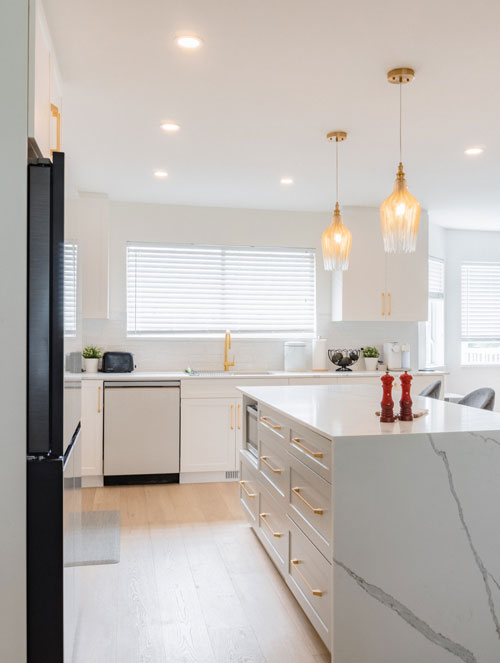
A waterfall countertop continues the island surface material down both (or one) sides of the island to the floor, creating a continuous stone panel. It is the most architecturally dramatic countertop treatment available and transforms the island from a functional element into a sculptural one. Budget addition: $2,000–$5,000 over a standard island top, depending on material and slab matching.
Kitchen Backsplash Ideas for Vancouver Homes
The backsplash covers the wall between the counter and the upper cabinets — typically 18 inches of vertical surface that offers one of the most cost-effective opportunities for design impact in a kitchen renovation. The material and pattern you choose here sets the tone for the entire kitchen’s aesthetic.
Classic Never-Fail: White Subway Tile
The 3×6 inch white ceramic subway tile in a brick (running bond) pattern with grey grout is the most consistently successful backsplash choice in Vancouver kitchen renovations. It works with white cabinets, wood-tone cabinets, green cabinets, every countertop colour, and every hardware finish. It is easy to regrout if the grout discolours over time. And it will not look dated in ten years. Grey grout is strongly preferred over white — it is far more practical in a kitchen that sees real daily cooking.
Statement Back Wall and Slab Backsplash
A full slab of quartz, book-matched porcelain, or natural quartzite behind the range creates a seamless, dramatic focal point. With no grout lines, a slab backsplash is easier to clean than tile in the splash zone behind the range and creates a premium look that elevates the entire kitchen. This is the most popular premium backsplash upgrade in VGC’s upper-range kitchen builds.
Zellige Tile and Herringbone Patterns
Zellige — handmade Moroccan ceramic tile with a slightly irregular surface and a subtle sheen — is trending in East Van craftsman renovations where homeowners want character and warmth rather than precision perfection. The natural variation in each tile catches light differently across the wall’s surface. Herringbone patterns — any tile type cut and laid at 45-degree angles in a V pattern — add movement and a premium aesthetic without requiring premium materials. A basic white ceramic tile in a herringbone pattern reads as more sophisticated than the same tile in a standard brick pattern.
Budget Reference
Material supply: $800–$5,000 for most kitchen backsplash areas. Installation: $1,500–$4,000 depending on tile complexity, pattern, and linear footage. The most expensive installation work involves book-matched slab cutting, herringbone pattern setting, or handmade tile with irregular sizing that requires careful layout and adjustment.
Kitchen Flooring Ideas for Vancouver Homes
Kitchen flooring has to survive dropped pots, spilled water, cooking grease, and the daily traffic of everyone in the household — while looking good for the next 15 years. The right choice depends heavily on what is already in the adjacent rooms and whether the kitchen is on a ground floor with potential moisture exposure.
Extending the Hardwood
The most popular flooring choice for renovated Vancouver kitchens is extending the existing hardwood or engineered hardwood from the living and dining areas seamlessly into the kitchen. The visual continuity created by a single floor material running through the entire main floor makes the space feel significantly larger than it is and removes the visual interruption of a transition strip at the kitchen threshold. Engineered hardwood handles kitchen humidity variations better than solid hardwood and is the preferred specification for open-concept kitchen flooring.
Porcelain Tile
Porcelain tile in the kitchen with hardwood in the living and dining areas delineates the zones with a clear boundary. This approach is particularly effective in open-concept homes where zone definition is desired — the flooring change does the work of defining the kitchen area without any physical barrier. Large-format tiles (24×24 or 12×24) with minimal grout joints look more contemporary and are easier to clean than smaller tiles with more grout lines. Avoid light-coloured grout anywhere near the cooking area — it will discolour rapidly and is nearly impossible to restore to its original appearance.
Luxury Vinyl Plank (LVP)
For rental suites, basement suites, and any kitchen on a ground floor slab where moisture intrusion is possible, fully waterproof LVP is the practical and economical answer. Modern LVP products are dimensionally stable, realistic in appearance, and durable enough for high-traffic kitchens. They are not the right choice for the main floor of a high-end renovation, but they are the right choice for a rental suite kitchen where durability and moisture resistance matter more than premium aesthetics.
Kitchen Lighting Ideas for Vancouver’s Dark Winters
Vancouver sees 166 rainy days per year. From October through March, natural light in a kitchen is often minimal even at midday — overcast skies, low sun angles, and the proximity of neighbouring houses all reduce the light that reaches interior spaces. A kitchen lighting system that compensates for this reality is not a luxury; it is a functional requirement for making the kitchen usable and pleasant during the six months of grey that define Vancouver’s climate.
The Three-Layer Lighting System
- Ambient lighting — Recessed pot lights on a dimmer, evenly distributed across the ceiling. Minimum 6 pot lights in a standard kitchen. Budget: $100–$150 per light installed. The dimmer is mandatory — it allows the ambient light level to shift from bright task lighting while cooking to a softer wash during casual dining or evening use.
- Task lighting — LED strip lights mounted under the upper cabinets, directed at the countertop work surface. This eliminates the shadow that the overhead pot lights cast when you stand at the counter — your own body blocks the ceiling light from reaching the counter. Undercabinet LED strips cost $50–$150 per meter installed; a full kitchen typically runs $300–$800. This is one of the most impactful per-dollar investments in kitchen function, particularly in Vancouver’s dark winters.
- Accent and statement lighting — Pendant lights hung over the island or peninsula. These serve a dual function: they provide focused light over the island surface and they provide visual character — the pendant style is one of the most visible design elements in a kitchen from across an open-plan main floor. Budget: $300–$1,500 per pendant. Use 2–3 pendants over a standard island, scaled to the island’s length.
Colour Temperature: Get This Right
Residential kitchens should use bulbs and fixtures rated at 2700K–3000K (warm white). This is the range that makes food look appealing, makes skin tones look healthy, and creates a warm, inviting atmosphere. Avoid anything above 3500K in a kitchen — the cooler blue tones above that threshold are correct for offices and commercial spaces but create a clinical, uninviting feel in a home kitchen. Specify the colour temperature to your electrician explicitly; do not leave it to the default selection on the job site.
Kitchen Renovation Process: From Idea to Completion in Vancouver
Understanding the sequence and timeline of a kitchen renovation helps set realistic expectations and prevents the most common source of client frustration: surprises. Here is the process VGC follows from first contact to completed project.
The Ten Steps
- Step 1 — Design consultation: VGC meets on-site, takes measurements, discusses the household’s priorities, constraints, and budget. This meeting establishes the scope of work and the design direction before any commitment is made.
- Step 2 — 3D renders and drawings: You see your new kitchen in three dimensions before any work begins. Layout options are explored, cabinet configurations are refined, and appliance placement is confirmed. This step eliminates the most expensive surprises.
- Step 3 — Cabinet order: Semi-custom cabinets typically require 6–10 weeks from order to delivery. Fully custom cabinet work can take 10–14 weeks. This is the longest lead-time item in most kitchen renovations and is why the design and ordering process begins as early as possible.
- Step 4 — Permit application (if required): Structural wall removal, significant electrical panel upgrades, or gas line relocation require a City of Vancouver (or Metro Vancouver municipality) building permit. Processing times range from 2 weeks for simple permits to 12 weeks for more complex scopes. VGC manages the permit application process on your behalf.
- Step 5 — Demolition and rough-in: Existing kitchen is removed. Plumbing is relocated if required, electrical circuits are added or upgraded for new appliance loads, HVAC modifications are made if the range hood requires new ductwork.
- Step 6 — Cabinet installation and countertop templating: Cabinets are installed level and square. Once cabinets are set, the countertop fabricator visits to create a precise template of the counter area before cutting the stone.
- Step 7 — Countertop fabrication and installation: 7–14 days after the template appointment, the fabricated countertop slabs are delivered and installed. This is typically the most anticipated day of the renovation.
- Step 8 — Tile backsplash and flooring: Backsplash tile is set and grouted. Flooring is installed or the existing flooring is extended into the kitchen space.
- Step 9 — Appliance installation and final connections: Appliances are set in their final positions, plumbing connections for the sink and dishwasher are made, gas or electrical connections for the range are completed, and the range hood is connected to the duct.
- Step 10 — Hardware, lighting, and punch list: Cabinet hardware is installed, pendant lights are hung and connected, undercabinet LEDs are wired, and the punch list — the documented list of any outstanding items — is worked through to completion.
Total Timeline
Permit-free renovation: 3–5 months from first consultation to project completion, including the cabinet lead time.
Permit-required renovation: 4–7 months, depending on the municipality’s permit processing time and the complexity of the structural or mechanical work involved.
Explore the full Vancouver home renovation services VGC provides, from kitchen and bathroom to full-home transformations.
Sustainable Kitchen Design Ideas for Vancouver Homeowners
Vancouver has one of the most progressive environmental regulatory frameworks in Canada, and many homeowners are motivated to align their renovation choices with those values. Sustainable kitchen design is not just an ethical choice — it is increasingly an economically rational one, supported by provincial rebate programs and rising energy costs.
Gas-to-Induction Conversion and CleanBC Rebates
Induction cooking has crossed a threshold of performance and cost where it is now VGC’s standard recommendation for kitchen renovations that include a range upgrade. Induction is faster than gas at high heat, more precise at low heat, produces no combustion byproducts in the kitchen (improving indoor air quality), and is inherently safer — the cooktop surface does not get hot from the element, only from contact with the pan. For condos where gas is not available, induction is the only serious high-performance cooking option. British Columbia’s CleanBC program provides rebates for switching from gas appliances to electric alternatives in some scenarios; check the current BC Hydro and FortisBC rebate schedules at the time of your renovation for applicable amounts.
LED Lighting and Low-VOC Cabinetry
LED lighting throughout the kitchen consumes approximately 90% less energy than the halogen pot lights common in Vancouver kitchens built before 2015, and it lasts 10 times longer. The payback period on upgrading to LED is measured in months, not years. Low-VOC cabinetry — formaldehyde-free MDF or solid wood meeting LEED v4 standards — matters for indoor air quality, particularly in Vancouver condos where ventilation is limited. Standard cabinet MDF can off-gas formaldehyde for months after installation; formaldehyde-free alternatives eliminate this concern.
Built-In Recycling and Composting
Vancouver’s three-stream waste system (garbage, recycling, organics/compost) requires dedicated storage for all three streams. A built-in pull-out recycling station ($200–$500) integrated into a base cabinet provides dedicated, organized storage that keeps bins out of sight and off the floor. Building in a slot for a composting container near the sink — sized to match the City of Vancouver’s green bin system — eliminates the countertop clutter of a standalone compost container. VGC includes these as standard planning items in all Vancouver kitchen renovations.
Frequently Asked Questions About Kitchen Renovation Ideas in Vancouver
What kitchen layout is best for a small Vancouver home?
For small Vancouver homes — detached houses in the 1,400–1,800 sq ft range, or townhouses — the L-shape layout with a peninsula (if the floor plan permits) is typically the best answer. It maximizes storage and counter space on two walls, keeps the work triangle efficient, and adds seating and prep space via the peninsula without requiring the clearance of a freestanding island.
What kitchen style adds the most value in Vancouver?
A clean, transitional kitchen — Shaker cabinets in white or soft off-white, quartz countertops, integrated appliances, quality hardware — consistently adds the most resale value in Vancouver’s market. It appeals to the widest buyer demographic and does not carry the polarizing risk of a very contemporary or very traditional design. Two-tone cabinetry (white uppers, natural or coloured lowers) is also broadly appealing and reads as current without being trend-dependent.
Should I get an island or peninsula in my Vancouver kitchen?
If you have minimum 900mm (36″) of clearance on all sides of a proposed island — ideally 1,050mm (42″) on the chef’s side — an island is the right choice. If clearance is tighter, a peninsula (attached at one end to the wall or cabinet run) provides the seating and prep surface of an island with a smaller footprint requirement. In condos under 800 sq ft, a peninsula is almost always the more practical choice.
What are the best kitchen cabinets for Vancouver homes?
For most Vancouver renovations: semi-custom Shaker-door cabinets in painted thermally fused MDF, with soft-close hardware throughout, deep pot drawers for base storage, and pull-out pantry towers where the floor plan allows. This combination delivers durability, versatility, and excellent function at a mid-range budget. At the premium level, solid wood with full custom sizing is the upgrade path.
What countertops are trending in Vancouver kitchens in 2026?
Quartz remains the dominant choice (Calacatta and Carrara patterns), with quartzite (Taj Mahal, Super White) gaining share in premium builds and porcelain slab growing as the fastest-rising category. Waterfall islands — where the countertop material continues down the sides of the island to the floor — are the most requested premium countertop treatment across VGC’s 2025–2026 project list.
How do I renovate a small condo kitchen in Vancouver?
Focus on vertical space (cabinets to ceiling), light colours, handleless cabinet fronts, full-height backsplash, undercabinet LED lighting, and a peninsula or breakfast bar overhang instead of a freestanding island. Panel-ready appliances and an appliance garage create visual continuity and eliminate countertop clutter. Budget $28,000–$55,000 for a full condo kitchen renovation in Vancouver.
What is the best kitchen backsplash for a Vancouver home?
For versatility, longevity, and value: white subway tile (3×6) in brick pattern with grey grout. For a premium, statement look: a full slab of quartz or book-matched porcelain behind the range. For character and warmth in a craftsman or heritage renovation: Zellige tile. All three are excellent choices for different aesthetics and budgets.
How do I add more light to my Vancouver kitchen?
Install the three-layer system: recessed pot lights (minimum 6) on a dimmer for ambient, LED strips under the upper cabinets for task lighting on the work surface, and pendant lights over the island for accent and statement. Specify 2700K–3000K colour temperature for all fixtures. This system addresses Vancouver’s dark-winter reality and is standard in all VGC kitchen builds.
What flooring is best for Vancouver kitchens?
For main floor open-concept kitchens: extend the engineered hardwood from the living and dining areas seamlessly into the kitchen for maximum visual flow. For ground-floor kitchens or basement suites with moisture risk: fully waterproof LVP. For kitchens where zone delineation from the living area is desired: large-format porcelain tile (24×24 or 12×24) with dark grout.
How long does a kitchen renovation take in Vancouver?
3–5 months for a permit-free kitchen renovation (from first consultation to completion, including cabinet lead time). 4–7 months for a renovation requiring a building permit. The cabinet order — typically 6–14 weeks depending on semi-custom vs. custom — is the primary timeline driver. Starting the design and ordering process early is the most effective way to compress the total timeline.
Is two-tone cabinetry a good choice for a Vancouver kitchen?
Yes — two-tone cabinetry (light uppers, darker or wood-tone lowers) is broadly appealing, adds visual depth, and is the dominant kitchen design trend in Vancouver for 2024–2026. It avoids the single-colour monotony of all-white kitchens while remaining more versatile than very bold or unusual colour combinations. It is unlikely to look dated in five years and reads as a deliberate design choice rather than a trend experiment.
What is the best kitchen layout for an open concept home?
The L-shape with a central island is the definitive answer for most open-concept Vancouver homes. The island defines the kitchen zone without closing it off, provides seating that faces into the living area (so the cook is part of the conversation), and adds storage and prep surface. For smaller footprints where a freestanding island is too large, an L-shape with a peninsula achieves the same effect with less clearance required.
How do I make a galley kitchen feel bigger?
Four practical moves: (1) Light-coloured cabinets and a light backsplash — visually expand the walls. (2) Handleless cabinet fronts — fewer visual interruptions along the cabinet runs. (3) Undercabinet LED lighting — eliminates shadow and opens up the work surface visually. (4) Where structurally possible, open one end of the galley (remove or open the wall at the end of the run) to connect it to the adjacent room and bring in borrowed light and visual depth.
What is a waterfall island countertop?
A waterfall island countertop is one where the counter material — typically quartz, quartzite, or porcelain slab — continues vertically down one or both sides of the island to the floor, creating a continuous plane. The effect is dramatic: the island reads as a sculptural element rather than a functional one. It requires careful slab matching at the mitre joint and adds $2,000–$5,000 to the island cost depending on material and the complexity of the corner treatment.
What are the current kitchen design trends in Vancouver?
The dominant trends in Vancouver kitchen design in 2026 are: two-tone cabinetry (light uppers, darker or wood-tone lowers), statement range hoods that anchor the design like a fireplace, slab stone or porcelain waterfall islands, handleless cabinet fronts, matte black fixtures and hardware, induction cooking (especially in condos), and panel-ready integrated appliances at mid-to-upper budget levels. Timeless choices — Shaker cabinets, quartz countertops, white subway tile backsplash, hardwood floors extended from living to kitchen — remain the safe foundation on which these trend elements are layered.
Ready to Start Your Kitchen Renovation in Vancouver?
Vancouver General Contractors has delivered kitchen renovations across Metro Vancouver — from East Van Vancouver Specials and North Shore detached homes to downtown condo conversions and Burnaby townhouses. Every project starts with a site visit, a real conversation about priorities and budget, and 3D drawings that let you see your new kitchen before any work begins.
If you are ready to move from ideas to a real plan, contact VGC today to schedule your kitchen design consultation. If you are still in the research phase, our Vancouver Renovation Guide covers everything you need to know about planning and budgeting a major renovation project from start to finish.
Get a Free Renovation Quote
Metro Vancouver’s trusted general contractors. Free consultations across Vancouver, Burnaby, Richmond, North Shore & beyond.
Get Your Free Quote →
Comments are closed