




Cost to Build a Custom Home in BC: 2026 Budgeting Guide
Your dream home shouldn’t be a moving financial target, yet construction costs in British Columbia climbed by 3% to 6% over the last twelve months. You’ve likely heard the horror stories of budgets spiraling out of control or permits stalling for months at city hall. It’s natural to feel anxious when the baseline cost to build custom home bc now ranges from C$450 to over C$800 per square foot in Vancouver, especially with new mandatory cooling requirements and Step 3 Energy Code compliance now in full effect.
For those considering these types of additions or major property updates, Capital Contracting offers specialized renovation expertise to ensure every part of the project meets high standards of craftsmanship.
We believe in building something worth keeping, which starts with total financial transparency. This guide provides a realistic breakdown of the 2026 landscape, including the temporary 20% reduction in Vancouver Development Cost Levies available until September 30, 2026. You’ll learn how to distinguish hard costs from the 15% to 25% in soft costs that often catch homeowners off guard. By the end, you’ll understand how our fixed-price approach eliminates the typical surprises of the industry, giving you the confidence to move from a broad vision to a tailored, exceptional reality.
Key Takeaways
- Identify the current cost to build custom home bc across different regions, from the accessible Fraser Valley to the high-demand Sea-to-Sky corridor.
- Distinguish between tangible hard costs and the essential soft costs, like permits and engineering, which typically add 15% to 25% to your total budget.
- Prepare for 2026 regulatory shifts, including the BC Energy Step Code and mandatory cooling requirements, to ensure your sleek new home is both compliant and comfortable.
- Compare the financial risks of cost-plus contracts against the security of fixed-price agreements to find the best way to safeguard your investment.
- Learn how a disciplined design-build process eliminates “budget creep” and transforms the construction journey into a transparent, stress-free experience.
Estimating the Cost to Build a Custom Home in BC for 2026
The 2026 construction market in British Columbia has reached a period of expensive stability. While the volatile price swings of previous years have subsided, they’ve been replaced by a “new normal” defined by high labour costs and strict regulatory requirements. Building a home today isn’t just about the price of lumber; it’s about navigating a complex landscape of energy efficiency and municipal variables. Understanding the cost to build custom home bc requires a clear-eyed look at how regional demands and legislative changes, such as the BC Energy Step Code, influence your bottom line.
You’ll find that the “Vancouver Premium” remains a significant factor in your budget planning. Building in the Lower Mainland typically costs 20% to 40% more than projects in the BC Interior. This gap is driven by higher trade wages, complex site logistics, and the rigorous permit processes of municipalities like Vancouver and Burnaby. For a standard 2,500 to 3,500 square foot family home, these regional differences can shift your total investment by hundreds of thousands of dollars. To manage these variables, we utilize sophisticated cost estimation methods that account for both the physical structure and the local regulatory climate.
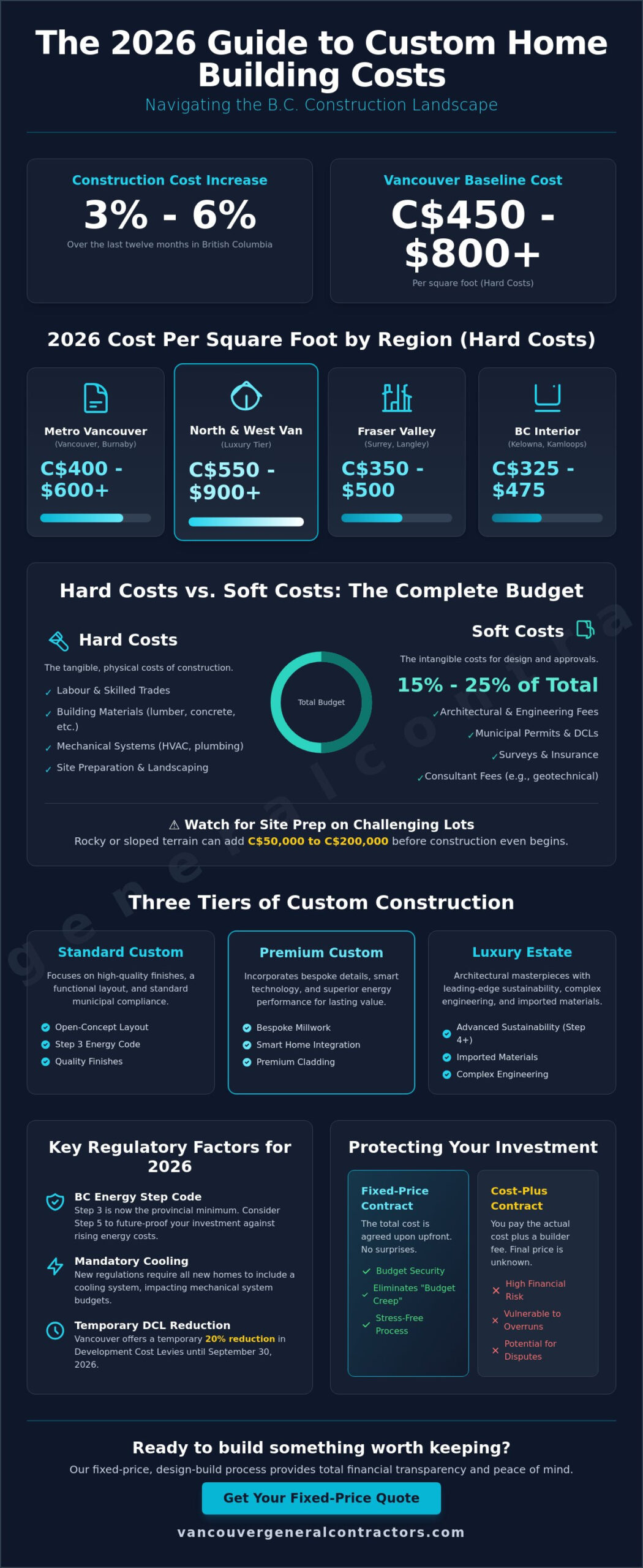
2026 Cost Per Square Foot Benchmarks by Region
These figures represent the hard costs of construction in May 2026. They reflect a 3% to 6% increase in industry costs over the past year, driven largely by persistent labour shortages and the specialized materials required for modern energy compliance.
- Metro Vancouver (Vancouver, Burnaby, Richmond): C$400 – C$600+ per sq ft.
- North & West Vancouver (Luxury Tier): C$550 – C$900+ per sq ft.
- Fraser Valley (Surrey, Langley, Abbotsford): C$350 – C$500 per sq ft.
- BC Interior (Kelowna, Kamloops): C$325 – C$475 per sq ft.
The Three Tiers of Custom Construction
Defining “custom” is essential for an accurate budget. A true bespoke home is designed around your specific lifestyle and lot topography, which differs greatly from a builder-grade spec home. We categorize these projects into three distinct tiers:
- Standard Custom: Focuses on high-quality finishes, standard municipal compliance (Step 3), and a functional, open-concept layout.
- Premium Custom: Includes bespoke millwork, integrated smart home technology, and enhanced curb appeal with premium cladding.
- Luxury Estate: These are architectural masterpieces featuring imported materials, advanced sustainability features (Step 4 or Net Zero), and complex structural engineering.
We believe in building something worth keeping. By identifying these tiers early, you can align your vision with a realistic financial framework, ensuring your project remains a source of pride rather than a source of stress.
Breaking Down Hard Costs vs. Soft Costs
Budgeting for a new build involves more than just selecting floor tiles and cabinetry. The total cost to build custom home bc is split between hard costs, which cover the physical construction, and soft costs, which handle the legal and design framework. In British Columbia, the terrain itself often dictates the starting point of your budget. If your lot features the rocky outcrops of the North Shore or the steep slopes of the Sea-to-Sky corridor, site preparation can instantly add C$50,000 to C$200,000 to your ledger before a single piece of lumber arrives. These “below-ground” expenses are why a thorough site assessment is your first line of defence against budget overruns.
Our Vancouver design-build process unifies these categories from the very beginning. By integrating architectural vision with construction reality, we prevent the “design-budget gap” that occurs when a beautiful blueprint proves too expensive to execute. This collaborative process ensures that every sleek finish and modern detail is accounted for within your fixed-price contract, providing the “no surprises” security we promise every client.
Hard Costs: Labour, Materials, and Logistics
As of May 2026, hard costs are heavily influenced by the push toward Net Zero Ready standards. While Step 3 of the BC Energy Step Code is the provincial minimum, many of our clients opt for Step 5 to future-proof their investment. This requires high-performance insulation, triple-pane glazing, and airtight construction techniques that demand specialized skilled labour. Mechanical systems have also evolved into a significant line item. To meet mandatory cooling requirements and zero-carbon goals, high-efficiency heat pumps and Heat Recovery Ventilator (HRV) systems are now standard features in every custom home we deliver.
Soft Costs: Permits, Design, and Engineering
Soft costs typically represent 15% to 25% of your total project investment. This includes architectural fees, 3D modelling, and the essential trio of BC engineering: structural, civil, and geotechnical. Municipal fees are the other major component. While the City of Vancouver has implemented a temporary 20% reduction in Development Cost Levies (DCLs) through September 30, 2026, standard Development Cost Charges (DCCs) in the region can still exceed C$80,000 for a single-family dwelling. Navigating these municipal variables requires a stable partner who understands the local permit landscape and can manage the logistical hurdles on your behalf.
We take pride in managing these complexities so you don’t have to. By identifying these fees early, we build a transparent financial roadmap that protects your lifestyle and your legacy.
The BC Factors: Step Code 5 and New Build Taxes
Building a house in British Columbia involves navigating a unique set of legislative requirements that directly impact your budget. Beyond the physical materials, the 2026 regulatory landscape introduces specific financial variables that can catch unprepared homeowners by surprise. Understanding the cost to build custom home bc means looking past the framing and into the “BC Factors” like the Energy Step Code and federal tax obligations. These aren’t just administrative hurdles; they’re structural and financial realities that define the longevity of your investment.
The shift toward higher efficiency isn’t just a trend. It’s a mandate designed to ensure your home remains an asset for decades. While previous years focused on lower tiers of compliance, the industry’s focus has sharpened on the highest performance levels. This evolution ensures your home is a lasting legacy, but it requires a more sophisticated approach to the building envelope and mechanical systems from the very first day of design.
BC Step Code 5: Building for the Future
Step Code 5 is the 2026 Net Zero Ready standard for residential construction in British Columbia. Achieving this level of efficiency requires an airtight building envelope and superior insulation that can increase initial hard costs by approximately 8% to 12%. However, the cost-to-benefit ratio remains favourable when you consider the long-term value. A Net Zero Ready home is significantly cheaper to heat and cool, protecting you from rising energy prices for the lifetime of the structure. We focus on high-performance glazing and advanced HRV systems to ensure your home meets these standards without compromising on sleek, modern aesthetics. Working with a dedicated sustainable home builder in Vancouver can help you navigate these efficiency requirements while maximizing available rebates and minimizing long-term operating costs.
Taxes and Rebates for BC Homeowners
Federal taxes represent one of the largest “hidden” costs in new construction. Unlike a resale home, a new build is subject to the 5% Goods and Services Tax (GST). On a C$1.5 million project, the GST adds C$75,000 to your total investment. It’s a significant figure that must be liquid and accounted for from the start of your project. Don’t let this tax catch you off guard during the final stages of your build.
There is some relief available through provincial programs and tax exemptions. The BC Newly Built Home Exemption can eliminate the Property Transfer Tax (PTT) for homes with a fair market value of up to C$1.1 million, with a partial exemption available up to C$1.15 million. Additionally, homeowners can leverage CleanBC rebates to offset the costs of high-efficiency heat pumps and windows. Navigating the GST New Housing Rebate criteria is also essential. As of 2026, first-time buyers may qualify for a full GST rebate on homes valued up to C$1 million, which can result in savings of up to C$50,000. We help you identify these opportunities early so you can maximize every dollar of your budget.
Fixed-Price vs. Cost-Plus: Protecting Your Investment
Choosing the right contract structure is just as critical as the architectural design itself. In a market where the cost to build custom home bc can fluctuate due to global supply chains and local labour shortages, your contract serves as your primary tool for risk management. Most homeowners are presented with two options: cost-plus or fixed-price. While both have their place in the industry, they offer vastly different levels of financial security and peace of mind. We believe that the construction process should be a partnership built on stability, not a series of expensive surprises.
A detailed Scope of Work (SOW) is the foundation of any successful project. Before any dirt is moved, every fixture, finish, and structural detail must be documented. Even with a robust contract, we recommend that every BC build maintains a 10% to 15% contingency buffer. This isn’t for the builder’s mistakes; it’s to provide you with the flexibility to make elective changes or to handle unforeseen site conditions that even the best geotechnical surveys might miss. Managing these variables with a disciplined approach is how we ensure your project remains a source of pride.
The Risk of Cost-Plus in a Volatile Market
The cost-plus model is often marketed as an “open book” approach, where the homeowner pays the actual cost of construction plus a set percentage for the builder’s fee. In the stable markets of the past, this offered flexibility. However, in 2026, this model shifts all financial risk onto the homeowner. If material prices spike or a sub-trade increases their rates mid-project, your budget simply expands to accommodate the increase. There is often little incentive for speed or efficiency, as the builder’s fee grows alongside the project’s total cost. “Surprises” during the excavation of a rocky North Vancouver lot can quickly lead to budget overruns of 20% or more under a cost-plus agreement.
The Fixed-Price Advantage
We advocate for the fixed-price model because it demands accountability from the builder. By the time we break ground, you know the exact cost of your tailored dream home. This certainty is made possible through our intensive pre-construction planning and 3D design and fixed-price renovation process. We do the hard work of vetting every cost and anticipating every challenge before the contract is signed. If a price spike occurs in the middle of the build, that is our responsibility to manage, not yours. This approach eliminates “budget creep” and allows you to focus on the excitement of the creative process rather than the anxiety of fluctuating invoices.
Transparency is the cornerstone of our “No Surprises” philosophy. If you are ready to move forward with a partner who prioritizes your financial security, view our fixed-price custom home services to see how we build something worth keeping. By removing the guesswork, we turn a complex logistical challenge into a predictable, rewarding journey.
Building Something Worth Keeping with Vancouver General Contractors
We’ve established that the cost to build custom home bc is a multifaceted equation. It’s not just a number on a page; it’s a reflection of municipal fees, energy standards, and material choices. At Vancouver General Contractors, we’ve spent years refining a process that replaces the typical anxiety of construction with a sense of security. Since our establishment in 2011, we’ve focused on a single mission: to build something worth keeping. This means prioritizing longevity, exceptional design, and, above all, financial transparency for our clients across Metro Vancouver.
Our role is to act as your mentor through the complex world of BC construction. We understand the fear of budget overruns because we’ve seen how traditional models fail homeowners. By utilizing a grounded, protective approach, we ensure your investment is shielded from the volatility of the market. We don’t just build structures; we create dream homes that serve as a lasting legacy for your family.
A Transparent Path to Your Dream Home
Our design-build model is the heart of our “No Surprises” guarantee. We don’t believe in handing you a set of plans that are impossible to fund. Instead, our team of designers and project managers work in tandem from the initial concept and 3D rendering phase. This collaboration ensures your vision remains grounded in the financial realities we’ve discussed, such as Step 5 compliance and municipal levies. Being “Baeumler Approved” and a “Best of Houzz” recipient isn’t just about accolades; it’s a testament to the vetted, elite status we bring to every project. You’ll work with specific team members who take personal accountability for your build, ensuring that the sleek, modern home you imagined is exactly what we deliver.
Start Your Custom Build Journey Today
Navigating the permit timelines of the Lower Mainland is a marathon, not a sprint. In 2026, early planning is more critical than ever. With the temporary 20% reduction in Vancouver’s DCLs set to expire on September 30, 2026, the window to maximize your budget is narrow. We strive to handle the logistical hurdles so you don’t have to, managing everything from geotechnical reports to final warranty inspections. Our industry-leading 2-year warranty provides a final layer of protection, cementing our commitment to your home’s permanent value. We invite you to sit down with our specialists to discuss your land, your vision, and your budget.
Book your custom home consultation with Vancouver General Contractors to begin your journey with a partner you can trust. Let’s turn your vision into a tailored reality that stands the test of time.
Start Building Your Legacy Today
Building a custom home in British Columbia is one of the most significant investments you’ll ever make. By now, you understand that the cost to build custom home bc is shaped by more than just square footage; it’s a balance of regional variables, high-performance Step Code 5 requirements, and the contract structure you choose. Navigating these 2026 market realities requires a partner who provides stability and professional authority in a complex industry. We believe your project should be defined by the excitement of design, not the anxiety of logistical hurdles.
Since 2011, Vancouver General Contractors has focused on transparency and accountability. We eliminate the typical anxieties of construction through our fixed-price guarantee and a methodical design-build approach. As a Baeumler Approved firm, we take pride in delivering exceptional results backed by an industry-leading 2-year warranty. You deserve a home that is a lasting legacy, built without the stress of budget creep or hidden surprises. Your journey toward an exceptional, tailored home starts with a clear financial roadmap.
Get a Fixed-Price Quote for Your Custom Build
More Uncategorized Guides
Energy Efficient Custom Home Design: A Vancouver Homeowner’s Guide
Modern Farmhouse Exterior Design Ideas: 25 Ways to Get the Look
Soundproofing a Basement Suite Ceiling: A Practical Guide

Creating a Basement Home Theatre: A Practical 2026 Planning Guide

Small Bathroom Remodel Ideas to Maximize Space: 15 Smart Solutions
Ready to start your renovation?
Frequently Asked Questions
How much does it cost to build a 3,000 sq ft house in Vancouver in 2026?
A 3,000 square foot home in Vancouver in 2026 typically starts at C$1,350,000 for hard costs alone, based on a baseline of C$450 per square foot. This figure can exceed C$2,400,000 for premium or luxury finishes. You must also account for soft costs like permits and engineering, which generally add 15% to 25% to the physical construction budget.
Is it cheaper to buy an existing home or build a custom one in BC?
Buying an existing home is often cheaper in terms of the initial purchase price, but building a custom home provides superior long-term value. New builds in 2026 meet much higher energy standards and include modern cooling requirements that older homes lack. You avoid the hidden costs of immediate renovations, making the cost to build custom home bc a strategic investment for future-proofing.
What are the most expensive parts of building a custom home in BC?
Site preparation and the building envelope are currently the most expensive components of a BC build. Excavating rocky or sloped terrain can add over C$50,000 instantly, while the high-performance insulation and triple-pane windows required for Step Code compliance represent a significant portion of the budget. Mechanical systems, specifically electric heat pumps and HRV units, also contribute to the higher initial investment.
How long does the permitting process take in Metro Vancouver?
Permitting in Metro Vancouver currently takes between 8 and 18 months to complete. The timeline varies significantly by municipality; Vancouver often sits at the higher end of that range while smaller districts may move faster. We manage this entire process for our clients to ensure that all documentation is submitted correctly the first time, which helps prevent avoidable delays at city hall.
Do I have to pay GST on a custom home build in British Columbia?
Yes, you must pay the 5% federal Goods and Services Tax (GST) on all new home construction in British Columbia. This tax applies to the total value of the build, though some homeowners may qualify for a partial rebate if the home is their primary residence and falls under specific price thresholds. We include this critical line item in our initial planning to ensure there are no surprises.
What is the BC Energy Step Code and how does it affect my budget?
The BC Energy Step Code is a provincial regulation that sets energy efficiency standards, moving toward “Net Zero Ready” by 2032. In 2026, most municipalities require Step 3 or higher, which necessitates better airtightness and superior insulation. While these requirements can increase your initial build budget by approximately 8%, they result in a more comfortable home with significantly lower monthly energy costs.
Can I build a laneway house at the same time as my custom home?
You can certainly build a laneway house simultaneously with your custom home, and doing so is highly recommended for efficiency. Building both structures at once allows you to share the costs of site mobilization, excavation, and utility trenching. This consolidated approach often reduces the per-square-foot cost of the laneway suite and minimizes the total duration of construction on your property.
What is the difference between a general contractor and a design-build firm?
A design-build firm manages your entire project from initial architectural concepts to the final warranty period under a single contract. In contrast, a traditional general contractor typically only handles the physical construction based on plans you’ve already obtained from an external architect. Our design-build approach provides better cost control and accountability because we bridge the gap between creative vision and construction reality.

Comments are closed