





How to Find a Vancouver Contractor by Comparing Costs and Timelines
The lowest bid won’t tell you whether a contractor understands your priorities. Finding a Vancouver contractor who listens starts with asking how they manage communication, then comparing written bids for the same scope, materials, payment milestones and schedule. The Canadian Home Builders’ Association advises asking for contact information for at least three past customers whose projects were similar in complexity to yours.
It’s reasonable to expect clear answers before your home becomes a construction site. A contractor should explain the proposed work, how the schedule is organized and who will keep you informed as the project progresses.
This guide offers practical questions and ways to assess communication, cost breakdowns, schedules, references and referrals. You’ll also learn how professional associations and experience with local projects can add useful context, helping you compare options and choose an approach that suits your renovation.
Key Takeaways
- Describe your priorities clearly, then notice whether the contractor captures them accurately and explains how they shape the project.
- Agree on how updates, questions and unexpected changes will be handled before work begins.
- Compare written bids against the same scope, materials, payment milestones and schedule, not just the bottom line.
- Ask for references from at least three customers whose projects were similar in complexity, as advised by the Canadian Home Builders’ Association.
- Use referrals and professional association standards as helpful context, while choosing a contractor whose communication and approach suit your renovation.
What Questions Should You Ask Vancouver General Contractors?
Find a Vancouver contractor who listens by explaining your priorities, then checking whether the proposed scope reflects them. Ask about similar projects, written warranties, schedules, payment terms and references before comparing bids.
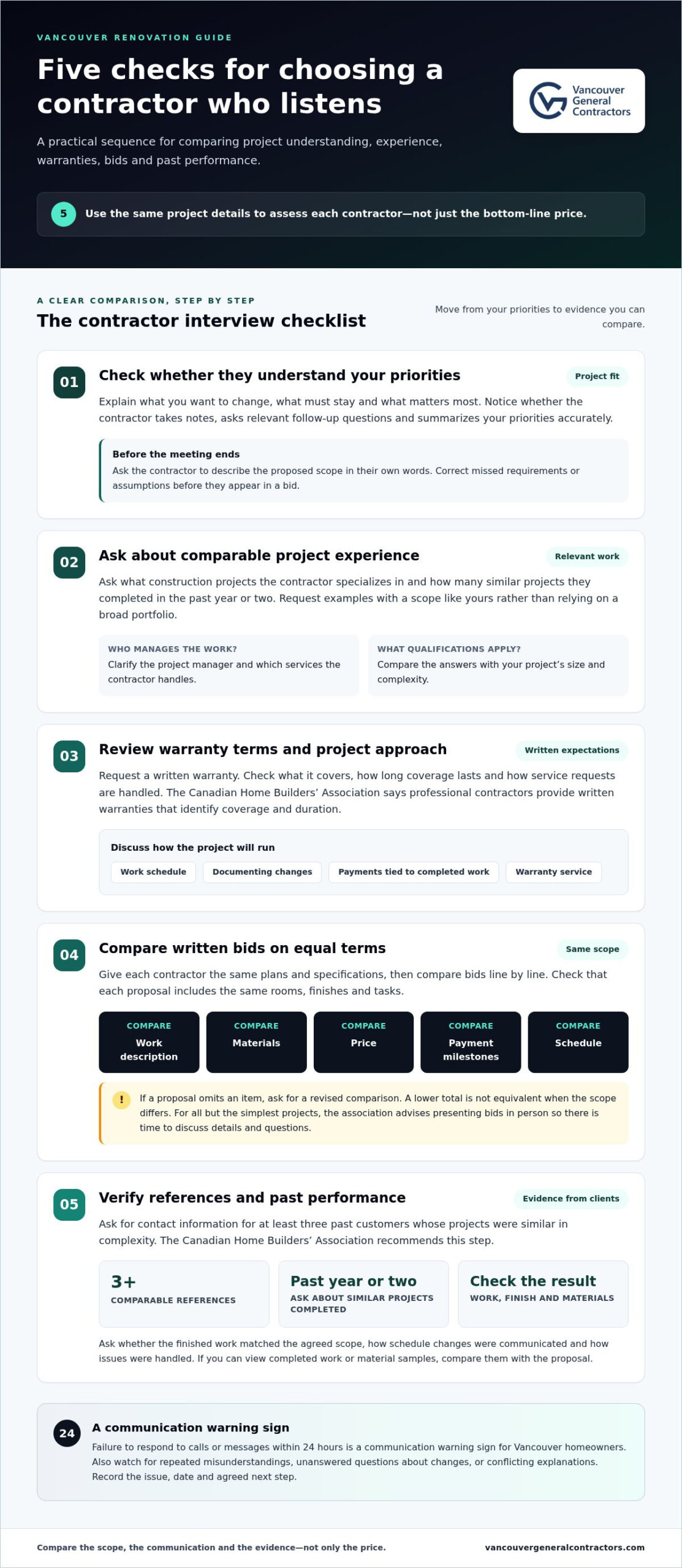
Use these five steps to turn a contractor interview into a practical comparison, not just a discussion about price.
Assess Listening and Project Understanding
Describe your project in three parts: what you want to change, what must stay and what matters most. For example, explain that a whole-home renovation should improve the kitchen while preserving a particular feature. Notice whether the contractor takes notes, asks relevant follow-up questions and summarizes your priorities accurately. Before the meeting ends, ask them to explain the proposed scope in their own words. It’s easier to correct a missed requirement or assumption before it appears in a bid.
Interview Contractors About Their Experience
Ask which construction projects the contractor specializes in and how many similar projects they completed in the past year or two. Request examples with a scope like yours instead of relying on a broad portfolio. Ask who will manage the work, which services the contractor handles and what qualifications apply. Compare the answers with your project’s size and complexity. A contractor experienced with a similar renovation can explain the sequence of work and likely decision points more clearly.
Review Warranties and Project Approach
Request a written warranty and read what it covers, how long coverage lasts and how service requests are handled. The Canadian Home Builders’ Association says professional contractors provide written warranties identifying coverage and duration. It also advises homeowners to ask for warranty terms and check references about warranty service. Discuss the project approach, including how work will be scheduled, how changes will be documented and how payments correspond to completed work. Clear answers help you understand expectations before construction begins.
Compare Bids and Project Details
Give each contractor the same plans and specifications, then compare written bids line by line. The Canadian Home Builders’ Association advises reviewing the work description, materials, price, payment milestones and schedule. Check whether each bid includes the same rooms, finishes and tasks. If a proposal omits an item, ask for a revised comparison rather than treating the lower total as equivalent. For all but the simplest projects, the association advises renovators to present bids in person, allowing time to discuss details and questions.
Check References and Past Project Performance
Request contact information for at least three past customers whose projects had similar complexity. The Canadian Home Builders’ Association recommends this step, along with asking how many comparable projects the contractor completed in the past year or two. Ask each reference whether the finished work matched the agreed scope, how schedule changes were communicated and how the contractor handled issues. If you can view completed work or material samples, compare them with the quality and finish described in the proposal.
Evaluating communication and responsiveness
Assess communication before construction begins, then agree on how information will flow during the work. These steps help you see whether a contractor listens, responds clearly and keeps decisions organized.
Assess Listening and Communication
Bring a short list of priorities to your next contractor meeting. Explain a decision that matters, such as keeping a room usable during part of the renovation. Notice whether the contractor asks focused questions, records your answer and reflects it accurately. When finding a Vancouver contractor who listens, watch how they handle a correction: do they update their understanding, or keep steering back to their original idea?
Review Project Communication and Management
Ask who will manage the project on-site and how you’ll reach that person. Agree on a communication method, update frequency and process for documenting decisions. During construction, weekly progress meetings and daily text updates can help keep information current. Clarify what each update covers, such as completed work, upcoming tasks, decisions needed and schedule changes. A defined routine makes it easier to follow progress without relying on scattered conversations.
Recognize Communication Breakdowns
Track whether messages receive clear answers and agreed actions. A failure to respond to calls or messages within 24 hours is a communication warning sign for Vancouver homeowners. Also pay attention to repeated misunderstandings, unanswered questions about changes, or different explanations from the site contact and contractor. Write down the issue, the date and the agreed next step. A pattern of unresolved problems deserves attention before it affects construction decisions.
- Set expectations for urgent decisions. Ask how the contractor will contact you if a site condition requires a timely choice. For example, agree whether a call or text should flag a decision, and request written confirmation of the selected option. This gives both sides a record of what was decided. It also helps distinguish routine progress notes from decisions that could affect materials, work sequencing or the project schedule.
- Test the process with a real example. Before work starts, describe a possible change, such as discovering an issue behind a wall. Ask who will explain the options, how cost or schedule changes will be documented, and when work can proceed. The contractor should explain the communication steps in plain language. If the answer is unclear, ask for a specific example from a completed project and note whether the explanation addresses your concern.
For a whole-home renovation, clear communication helps connect planning decisions with construction progress. Whole-home renovation planning is a useful next step when you’re ready to discuss how your project will be managed.
Checking cost breakdowns, timelines, and payment schedules
Compare complete written estimates, not headline totals. These steps help you understand what each bid includes and how payments, permits and scheduling affect the work.
- Match each estimate to the same project scope. Give contractors identical plans and specifications, then compare labour, materials, allowances, exclusions and payment milestones. The Canadian Home Builders’ Association advises reviewing the work description, materials, price, payment milestones and schedule. For example, check whether both bids include the same flooring, disposal and finishing work. Ask for any unclear item to be described in writing before comparing totals.
- Read the payment schedule before agreeing to a deposit. Look for payments tied to clear project stages, such as completed work or delivered materials, rather than dates alone. Confirm how approved changes affect the payment plan. Keep the signed contract, invoices and change records together so each payment can be matched to its purpose.
- Build a timeline around the actual work sequence. Ask for the planned start, major construction stages, decision deadlines and expected completion. In Vancouver, renovation permits can take 4-8 weeks, depending on project complexity; simple projects may take 4-6 weeks, while complex projects or heritage properties may take 8-12 weeks. Ask how permit timing fits the schedule, and whether material ordering or inspections shape the sequence.
- Test the plan for schedule reliability. Ask who coordinates trades, suppliers and deliveries, and how delays will be communicated. Popular items such as quality windows and doors can have 6-12 week lead times in Vancouver. Ask whether the timeline identifies those dependencies and what work can proceed while an item is pending. A useful schedule shows the order of tasks, not only a single projected finish date.
- Review contingencies and protection details. Treat a contingency as a planning reserve, not automatic approval for extra work. Ask how unexpected conditions are documented and authorized. Also review liability insurance and Workers’ Compensation coverage.
Before signing, read the contract alongside the estimate and timeline. Confirm that the scope, payment stages, permit responsibilities and change approvals are consistent across all three documents.
Checking local references and contractor histories
References show how a contractor handled real projects, not just how a proposal reads. Use the steps below to compare similar work, communication and follow-through in Vancouver.
- Choose references whose projects resemble yours. The Canadian Home Builders’ Association advises asking for contact information for at least three past customers whose projects had similar complexity. Match the examples to your renovation’s scale and type. A homeowner planning a whole-home renovation will learn more from a comparable project than from a small, unrelated repair. Ask how the contractor’s role and the finished scope compare with the work proposed for your home.
- Ask each homeowner the same detailed questions. Find out whether the completed work matched the agreed scope, how changes were explained and whether the schedule was updated when plans shifted. Ask how promptly the contractor answered questions and who provided progress updates. Consistent questions make it easier to compare answers across three references. For example, ask each person to describe an issue and how the contractor resolved it.
- Explore performance beyond the finished result. Ask whether the site was kept orderly, how the team handled household disruption and whether the final work matched the selected materials. If the homeowner raised a concern, ask what happened next and whether the response was clear. A polished finished space matters, but the reference’s account of decisions and problem-solving can reveal how the contractor worked throughout construction.
- Compare a contractor’s history with the project you need. Ask how many similar projects they completed in the past year or two, as the Canadian Home Builders’ Association advises. Request examples with comparable complexity, not simply attractive finishes. Then compare the contractor’s description with reference accounts and available past work. If a portfolio shows a kitchen renovation, ask which parts of the project the contractor managed and whether the scope resembles yours.
- Look for consistent patterns across sources. Read online reviews alongside reference conversations and examples of completed work. Note repeated comments about communication, schedule changes, workmanship or follow-up. One review describes one customer’s experience; several accounts can help you identify recurring themes. Record specific examples, such as whether the contractor explained a change before proceeding. Use that evidence to judge how the contractor’s past performance fits your priorities.
Finding reliable renovation contractors through referrals and professional associations
Referrals and association membership can add useful context to a home renovation search. Weigh them alongside project experience, references and the written agreement.
- Start with referrals tied to your project. Ask neighbours, colleagues or friends who recently completed a renovation which contractor they hired. Find out what work was done and whether the project resembles yours. A referral for a bathroom renovation, for example, may offer more relevant insight than one for unrelated work. Use the introduction to learn about the homeowner’s experience, not as a substitute for your own assessment.
- Consider whether you feel comfortable working together. The Canadian Home Builders’ Association recommends hiring a contractor only when you’re comfortable with them, trust them in your home and believe they’ll complete the project as promised. Notice whether conversations feel respectful and whether your concerns receive direct answers. A referral can open the door, but your own discussions should help you decide whether the working relationship feels suitable.
- Understand what an association or code represents. In many Canadian communities, local Home Builders’ Associations have adopted RenoMark. RenoMark requires members to agree to and follow a renovation-specific Code of Conduct. This can provide a useful standard for considering professional conduct. It doesn’t replace discussing your scope, reviewing contract terms or assessing whether the contractor’s experience fits your renovation.
- Read directory listings as a starting point, not a selection. The Home Performance Stakeholder Council says its contractor directory is informational, and homeowners remain responsible for interviewing and selecting a contractor who meets their needs. HPCN membership requires a code of conduct covering ethical business practices and customer service, valid business licences, general liability insurance and good standing with WorkSafeBC. These criteria offer context, not a decision on your behalf.
- Bring referrals and membership back to project-specific questions. The Canadian Home Builders’ Association advises asking for references and not hiring someone unwilling to provide them. It also recommends confirming business liability insurance and Workers’ Compensation coverage. Compare those answers with what references say about completed work, communication and follow-up. Use that combined picture to decide whether the contractor suits your project and expectations.
Ready to discuss renovation plans with a team? Start a conversation about your project.
Vancouver General Contractors: Home Additions
Vancouver General Contractors helps homeowners plan and deliver home additions through a design-build process that manages project phases from initial concept and 3D design to construction and permits. It’s a natural next step when your comparison points to a larger project that needs coordinated planning, clear scope and construction management.
Vancouver General Contractors also handles whole-home and condo renovations, as well as kitchen renovations. Bring your priorities, questions and project notes to a conversation about the right approach for your home. Contact Vancouver General Contractors to discuss your renovation or home addition.
Take the Next Step With Confidence
Your renovation plans deserve a clear brief that reflects how you want your home to work and feel. Before moving ahead, write down your priorities, decisions and questions that still need discussion. That gives your next conversation a practical starting point and helps keep your goals at the centre of planning.
Finding a Vancouver contractor who listens means choosing a working relationship that supports the decisions ahead, not just the construction itself. Vancouver General Contractors offers Home Additions, Whole Home Renovations and Condo Renovations, helping homeowners move from early ideas towards a coordinated project plan.
Share what you’re hoping to change, whether you’re planning a larger addition or reworking the home you already have. Contact Vancouver General Contractors today to discuss your project and take the next step toward a home that serves you well.
Frequently Asked Questions
Do you carry Workers’ Compensation and business liability insurance?
Before hiring, ask for documentation of business liability insurance and Workers’ Compensation coverage. The Canadian Home Builders’ Association advises homeowners to confirm both. Compare the business name on the documents with the name on your proposed contract, and review the coverage details and dates. This helps you understand which contractor and work the documents relate to before construction begins.
What warranty do you offer on your work?
Vancouver General Contractors includes a two-year warranty with every renovation. Ask for the written terms to understand what work is covered and how to submit a service request. For example, clarify how to report a concern after project completion and what information to provide. Keep the warranty with your contract and completion records so you can find the terms easily later.
What questions should I ask Vancouver contractors before hiring?
Ask who will oversee the work, how changes are approved and what happens if site conditions differ from the plan. For example, if demolition reveals an issue behind a wall, ask how the contractor will explain the options and document your decision. Also discuss how household disruption will be handled. These questions reveal how the working relationship will function beyond the initial estimate.
How do I check a contractor’s reviews, references, and past work in Vancouver?
Compare online reviews with conversations with past customers and examples of completed projects. The Canadian Home Builders’ Association advises getting contact information for at least three customers whose projects had similar complexity. Ask each reference about a specific challenge, the contractor’s response and the finished result. Then compare those accounts with the contractor’s project examples to see whether the work resembles your renovation.
How do I verify a contractor’s licence and insurance in British Columbia?
Identify which licences and insurance apply to the contractor’s work and local jurisdiction. Ask for the relevant business licence details and insurance documents, then compare the named business with the proposed contract. The Canadian Home Builders’ Association recommends confirming business liability insurance and Workers’ Compensation coverage. Keep copies with your project records so you can refer to the same documents during construction.
What should a Vancouver home renovation contract include?
A renovation contract should describe the scope, materials, timeline, payment schedule and other important terms in writing. Make sure it also explains how changes are priced, approved and recorded. For example, if you choose a different finish after work begins, the contract should provide a clear process for documenting the change. Read the agreement alongside the estimate to ensure their descriptions of the work align.
How should I compare quotes from Vancouver contractors?
Compare quotes prepared from the same plans and specifications, then examine what each total includes. The Canadian Home Builders’ Association recommends reviewing the work description, materials, price, payment milestones and schedule. Check whether allowances or exclusions differ; an item omitted from one quote can make its total look lower. Ask for clarification in writing before deciding whether the proposals describe equivalent work.
What are red flags when hiring a home renovation contractor in Vancouver?
Be cautious if a contractor refuses to provide references, offers a price that seems too good to be true or asks for cash payment without paperwork. The Canadian Home Builders’ Association advises eliminating contractors who offer a lower cash price without documentation. Also pay attention to unclear answers about scope or payment terms. A written record helps establish what was agreed before renovation work starts.
More Uncategorized Guides

Cost to Add a Master Bathroom in Port Coquitlam and How Long It Takes

Spa-Inspired Bathroom Renovation Ideas for West Vancouver Homes

Peace of Mind During a Home Renovation Starts With Planning

Kitchen Renovation Cost in Coquitlam by Project Scope

Cost to Remove a Load Bearing Wall in Burnaby: What Affects the Price

Comments are closed