




Quartz vs. Granite Countertops: Pros, Cons, and How to Choose
The most durable countertop isn’t automatically the right one for your kitchen. Quartz and granite can both suit a busy home, but their differences show up in daily cooking: hot cookware, spills, cleaning habits, and how much natural variation you want. That’s why comparing the quartz vs granite countertops pros and cons matters more than choosing by appearance alone.
If you’re weighing a consistent surface against the one-of-a-kind patterns of natural stone, you’re asking the right question. The best choice depends on your household’s routines and design priorities, not a blanket ranking. Quartz is non-porous and doesn’t need sealing; granite handles heat well but may need periodic sealing. Each has trade-offs worth understanding before you commit.
This guide compares durability, maintenance, appearance, and everyday use, then helps you connect your choice to the kitchen layout, cabinetry, and renovation plan. A coordinated Design → Plan → Build process considers countertop decisions alongside the rest of the kitchen, helping create a cohesive space for years of daily life.
Key Takeaways
- Understand the quartz vs granite countertops pros and cons by comparing composition, care, heat exposure, and natural variation.
- Match the surface to your cooking habits and cleanup preferences, rather than choosing on appearance alone.
- Compare samples in your kitchen’s lighting and consider colour, pattern, finish, seams, and cabinetry together.
- Review product-specific care instructions, since performance depends on the material, installation, and ongoing care.
- Plan countertop selection alongside your kitchen layout, cabinetry, and finishes for a cohesive renovation.
Quartz vs. granite countertops: what is the difference?
Quartz and granite differ in composition, appearance, and care. Granite is natural stone cut from a quarried slab, while a quartz countertop is an engineered surface made with quartz and other ingredients. It isn’t a solid slab of the mineral alone. This distinction helps explain why quartz can offer more controlled patterns, while granite’s markings reflect natural geological variation.
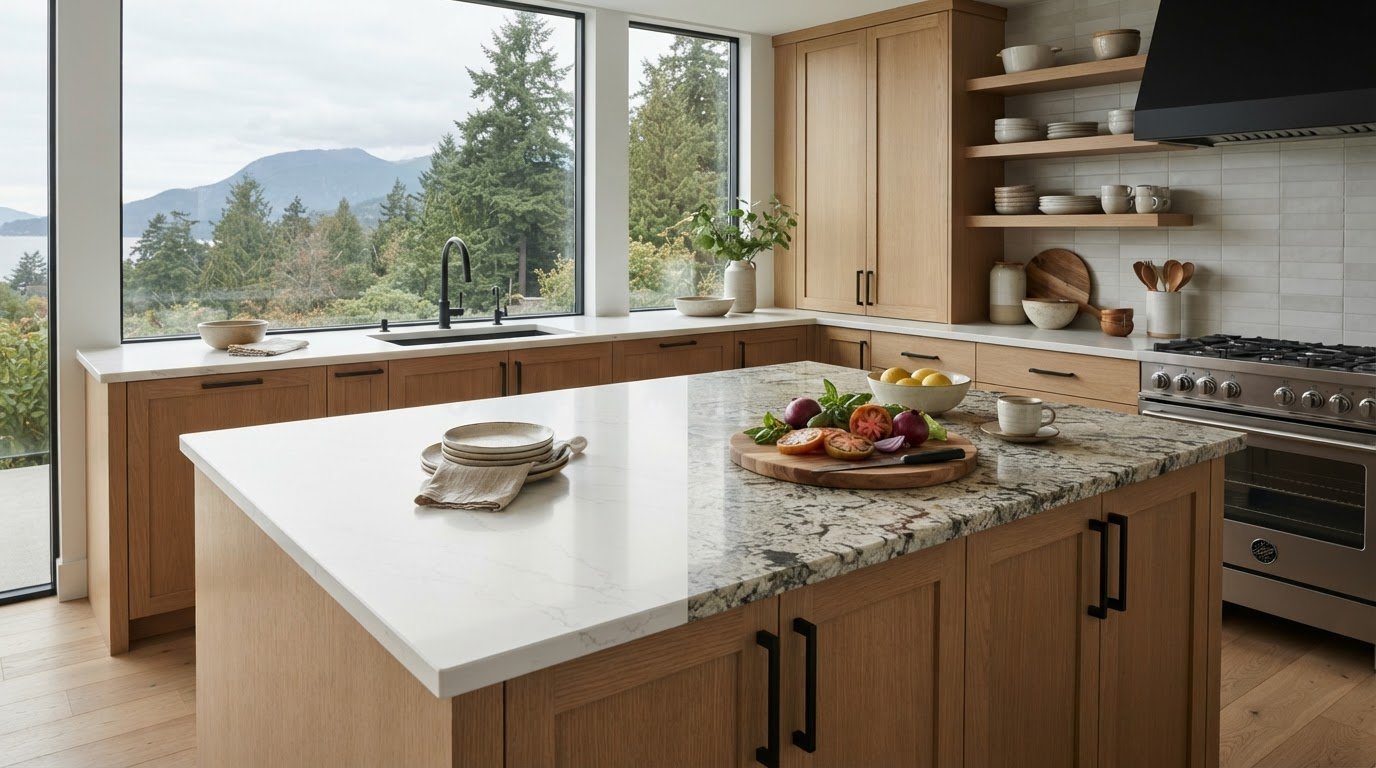
Both materials can anchor a kitchen design, but they present different choices during planning. Granite is selected from individual slabs, each with its own arrangement of mineral flecks, veins, and colour. Quartz is manufactured, which can make a chosen design easier to coordinate across different sections of a kitchen. For a general overview of countertop materials, including common uses and composition, see Wikipedia.
How quartz countertops are made
Quartz surfaces are engineered products. Depending on the product, manufacturing combines quartz with other materials, which may include resins and pigments, then forms the mixture into slabs. The precise composition isn’t identical across every manufacturer or product, so “quartz” describes a category rather than one universal recipe.
Manufacturing can create designs with a more consistent look across multiple slabs, from subtle patterns to more pronounced ones. Colour, pattern, finish, and exact composition vary by product. A sample is a useful starting point, but it won’t show how the design will look across a full countertop.
What makes granite a natural-stone countertop
Granite is natural stone quarried in large blocks and cut into slabs. Its patterns develop through geological processes, leaving mineral flecks, veins, and colour variations that can differ from one slab to another. Those markings make each slab distinct, rather than reproducing a single pattern throughout the surface.
A small sample may show the general colour and character, but it can’t capture every detail of a full slab. If a particular vein, movement, or tonal shift matters to your design, consider the slab’s larger pattern and how it will be positioned across the countertop.
These differences matter beyond the material label. A manufactured pattern may help create visual continuity between a kitchen island and perimeter counters, while granite’s natural variation can make the stone itself a focal point. Neither approach is inherently better. The right fit depends on whether you prefer a controlled, coordinated appearance or distinctive natural markings.
As you weigh the quartz vs granite countertops pros and cons, keep the full kitchen in view. Cabinet colour, lighting, backsplash, and countertop shape all affect how a surface reads. A small sample beside cabinetry gives you a first impression, but the larger pattern and finish may feel different across an installed area. Understanding the materials helps you compare those visual choices with greater confidence.
Quartz vs. granite pros and cons: durability, heat, and upkeep
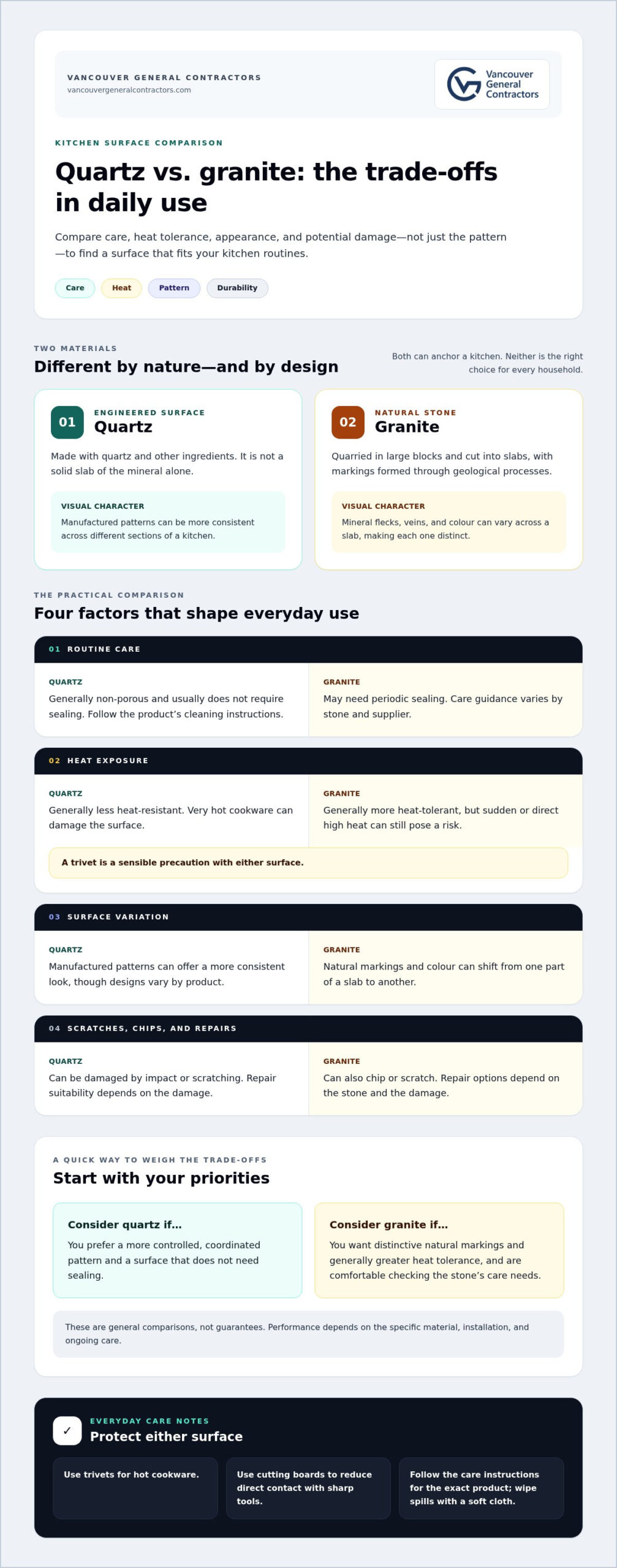
Both quartz and granite are durable countertop choices, but neither is immune to stains, scratches, chips, or heat damage. Quartz is generally non-porous and doesn’t require sealing, while granite may need periodic sealing depending on the stone. Granite typically tolerates heat better, but using a trivet for hot cookware is a sensible precaution with either surface.
The table offers a general comparison, not a guarantee for every slab or product. Performance depends on the specific material, its installation, and how it’s cared for.
| Consideration | Quartz | Granite |
|---|---|---|
| Routine care | Usually doesn’t require sealing; follow the product’s cleaning instructions. | May require periodic sealing; care guidance varies by stone and supplier. |
| Heat exposure | Very hot cookware can damage the surface, so use a trivet. | Generally more heat-tolerant, but sudden or direct high heat can still pose a risk. |
| Surface variation | Manufactured patterns can be more consistent, though designs vary. | Natural markings and colour can vary across a slab. |
| Scratches, chips, and repairs | Can be damaged by impact or scratching; repair suitability depends on the damage. | Can also chip or scratch; repair options depend on the stone and damage. |
Which countertop needs more routine care?
Quartz often suits households looking for a surface that doesn’t need sealing. Granite care is specific to the stone: some slabs may need sealing, and the appropriate care schedule depends on the product guidance. Review the care instructions for the exact product before deciding. For everyday cleaning, follow those directions and use a soft cloth to wipe up spills rather than assuming every cleaner is suitable.
Manufacturer care guidance matters because the right cleaning and maintenance routine depends on the exact surface, not just whether it’s called quartz or granite.
How to think about heat, scratches, and chips
Hot pans can create thermal stress or damage a countertop, and quartz is generally less heat-resistant than granite. Granite’s greater heat tolerance doesn’t make it invulnerable, so placing cookware directly on either surface can be a risk. Trivets and cutting boards help reduce direct contact with heat and sharp tools during everyday cooking.
Neither material is scratch-proof or chip-proof. The risk depends on the product, installation, and how the surface is used. A heavy impact near an edge, for example, can cause damage. If a chip or scratch occurs, repair options depend on the material and the extent and location of the damage. Consider the damage and the surface’s pattern and finish when assessing whether a repair will be noticeable.
These care and performance details are useful to consider as part of a kitchen renovation, where the countertop choice connects to the layout and other finishes. Vancouver General Contractors’ Design → Plan → Build process coordinates design choices with project planning and construction. Explore kitchen renovation planning as you consider how the surface will work in the finished space.
Which countertop suits your kitchen style and daily routine?
The best fit comes down to what you want to see and live with every day. If a coordinated, predictable pattern matters most, quartz may suit your design priorities. If you’re drawn to one-of-a-kind natural markings, granite may feel more at home. Cooking frequency and cleanup habits matter, too. Consider how often you prepare meals, whether spills tend to sit while you’re busy, and how comfortable you are following the surface’s care instructions.
Use these priorities to narrow your choice:
- Consistent appearance: Consider quartz if you want a more controlled pattern across adjoining counters or an island.
- Natural variation: Look at granite if distinctive veining, mineral flecks, and colour shifts are part of the appeal.
- Care preferences: Compare the selected products’ care guidance and decide which routine feels realistic for your household.
Decision rule: Choose the surface that best supports your highest-priority daily need, whether that’s a coordinated look, distinctive natural character, or a care routine you’re comfortable maintaining.
Choose quartz if consistency and design control matter most
Engineered patterns can provide a more uniform visual effect, which may work well if you want the island, perimeter counters, and backsplash to feel connected. Compare the specific colour and pattern with your cabinetry and flooring, rather than selecting from a small image alone. Before deciding, read the product’s care and performance information so the look you prefer also suits your expectations for daily use.
Choose granite if natural variation is part of the appeal
Granite’s natural markings can give an island or work surface a distinctive focal point, especially when veins or mineral flecks contrast with simpler cabinetry. Since each slab varies, view the actual slab where possible; a small sample may not show the full pattern or colour movement. Then consider whether the stone’s care requirements fit your household, not just whether you love its appearance.
Compare samples in your kitchen context
Make the comparison where the countertop will be installed. Kitchen lighting can change how a surface’s colour and pattern appear, and a sample viewed by itself won’t show how it relates to surrounding finishes. If full-size samples or slabs are available to view, use them to understand the overall visual effect before settling on a selection.
- Place the quartz or granite sample beside your cabinet door and flooring sample.
- Look at it in the kitchen during different lighting conditions, including daylight and evening light.
- Compare the finish and pattern at a distance, then up close, to see how much visual movement you notice.
- For granite, review the full slab when possible and consider where prominent markings would fall across the counter.
As you weigh the quartz vs granite countertops pros and cons, picture the material in the whole room and in your actual routine. A surface should complement the kitchen’s palette while feeling practical for the way your household cooks and cleans.
How to compare countertop samples before deciding
A sample can look appealing on its own and feel different beside your cabinets or under your kitchen lighting. Compare quartz and granite in the setting where they’ll be used, then consider the practical details that affect the finished result. This helps you assess colour, pattern, finish, visible seams, and how the selection fits the renovation as a whole.
Review samples in your own kitchen
Bring samples home and place them beside cabinetry, flooring, and paint colours. Look at them in daylight and under your kitchen’s evening lighting. Check the pattern from across the room, then up close. This is especially useful with granite, where a small piece may not show the full range of markings on a slab.
Use this sequence to compare options consistently:
- Set the scene. Place each sample beside cabinet and flooring samples, and consider how it relates to the backsplash, appliances, and hardware.
- Check colour in changing light. Look at the surface at different times of day and with the kitchen lights on. Notice whether its undertones complement or compete with nearby finishes.
- Assess pattern and scale. Step back to see the overall effect, then look closely at the details. Consider whether the pattern feels balanced across a large counter or island.
- Compare the finish. View the selected finish from different angles. Its appearance can influence how the colour and pattern read in the room.
- Think through seams. Review the planned countertop layout and where seams may be visible, particularly across an island or near a focal area. The slab and layout both matter.
- Review the full slab where possible. For natural stone, compare the actual slab rather than relying only on a small sample. Look at how prominent veins or colour shifts could fall across the counter.
Confirm practical details before the selection is final
Keep a record of the exact product and finish under consideration so the chosen sample can be matched to the renovation plan. Review its care guidance and performance information, then consider how edge choices and seam placement will work with the counter’s shape and layout. These details connect the visual choice to the installed surface.
A countertop doesn’t sit apart from the rest of the kitchen. Vancouver General Contractors’ kitchen design process coordinates surface selections with cabinetry, layout, finishes, and construction planning. Reviewing those elements together helps you make a considered choice and understand how it will look in the completed space.
If you’re planning a kitchen renovation, plan your kitchen renovation with the countertop decision in view. The quartz vs granite countertops pros and cons become easier to weigh when you compare actual samples, care requirements, and layout alongside the wider design.
Plan quartz or granite into a Vancouver kitchen renovation
A countertop works best when it’s chosen as part of the kitchen, not as a separate finishing decision. Its colour and pattern affect how cabinetry, backsplash, flooring, and lighting come together. The material and layout also shape construction planning, including the counter’s dimensions, edges, and seams. Bringing these choices together early helps create a cohesive design and coordinate decisions as the renovation moves forward.
Coordinate the countertop with the whole kitchen
Consider how the surface will look beside cabinet colours, flooring, backsplash, hardware, and appliances. A dramatic granite pattern may call for quieter surrounding finishes, while a more consistent quartz design may support a unified palette. Check samples in the kitchen’s lighting, then consider how the selected finish will work across the full counter area.
Material selection also connects to the project sequence. The kitchen layout and cabinetry plan inform the counter dimensions and placement, while edge details and visible seams affect the finished look. Vancouver General Contractors’ kitchen design process considers these choices alongside the wider renovation. For broader planning context, use the Vancouver kitchen renovation guide.
Bring the decision into a managed renovation process
Vancouver General Contractors provides full home renovation design-build, including kitchen renovations, interior design with 3-D virtual designs, project planning and permitting, construction, and finishing. The Design → Plan → Build process moves from developing design choices to planning the project, then carrying the work through construction and finishing.
That sequence gives the countertop decision a place in the broader plan. The team coordinates the selected surface with cabinetry, layout, and finishes, while accounting for practical details such as dimensions and seam placement. Fixed pricing with no hidden fees or surprises supports clarity as the renovation is planned.
Before finalizing quartz or granite, bring together the product details, sample, care guidance, and design decisions. Compare the quartz vs granite countertops pros and cons against the needs of your kitchen, then consider how the choice fits the full renovation rather than judging it in isolation. A well-planned surface should look at home in the space and suit the way you use it.
Vancouver General Contractors serves homeowners in Vancouver, Burnaby, Richmond, West Vancouver, North Vancouver, New Westminster, Coquitlam, Port Moody, Port Coquitlam, Surrey, and Delta. If you’re planning a kitchen renovation in the area, book a free home consultation to discuss the project and how your countertop choice can fit the wider design.
Make your countertop choice part of the bigger vision
Your kitchen should feel like it belongs to your home and support the way you want to use it for years to come. Let the countertop decision serve that vision, rather than treating it as a final detail chosen in isolation. Bring your preferences into the renovation plan, where design decisions can be considered alongside the work needed to create the finished space.
Vancouver General Contractors has served homeowners since 2011. Its Design → Plan → Build process brings design, planning, and construction together, and every renovation includes an industry-leading two-year warranty. That support can help you move from ideas to a coordinated kitchen renovation with greater clarity.
The quartz vs granite countertops pros and cons are most useful when they inform a space that feels distinctly yours. Share what matters most in your kitchen and take the next step with a free home consultation. A thoughtful plan can turn a countertop choice into part of a kitchen you’ll be glad to come home to.
More Uncategorized Guides

Architect vs Builder for a Custom Home: Which Path Fits Your Project?

Optimizing Energy Efficiency After a Major Reno: A Practical Guide

Hardwood Flooring Options for Home Renovations: Choose a Floor That Fits Your Home

Converting a Garage to Living Space in Coquitlam: 2026 Guide

Commercial Tenant Improvement Contractors in Port Coquitlam: 2026 Selection Guide
Ready to start your renovation?
Frequently Asked Questions
Can quartz or granite countertops be repaired if they chip?
A chip in either material may be repairable, but the result depends on its size, location, and the specific surface. Damage near an edge or sink cutout may need different treatment from a small chip in an open area. The material’s pattern and finish also affect how closely a repair can blend with the countertop.
Can quartz countertops be used outdoors?
Use a quartz product outdoors only if its manufacturer specifically approves that application. Sunlight and changing outdoor conditions may affect some engineered surfaces, so indoor suitability shouldn’t be assumed to mean outdoor suitability. For an outdoor kitchen or covered patio in Vancouver, review the product documentation for exposure limits and care requirements before designing around it. The right choice depends on the exact product and the conditions where it will be installed.
Can you replace a countertop without renovating the whole kitchen?
Yes, a countertop can sometimes be replaced without redoing the entire kitchen, provided the existing cabinets can support the new surface and the layout works. The change may still affect the sink, faucet, backsplash, or plumbing connections. For example, a different counter thickness can alter how the surface meets the backsplash. Assessing those adjoining details helps define whether a focused update suits your kitchen or a broader renovation makes more sense.
Does granite always need to be sealed?
No, sealing needs depend on the particular granite and its care guidance. Don’t assume every slab requires the same schedule or that sealing makes the stone immune to staining. Before choosing a product, review its maintenance instructions and follow them for the installed surface. If you already have granite and aren’t sure how it was treated, its condition and existing care information can help determine appropriate maintenance.
Are quartz countertops made entirely from natural quartz?
No. A quartz countertop is an engineered surface, not a solid slab made only from the natural mineral. Its composition varies by product and can include quartz along with other materials, such as resins and pigments. That’s why two products both described as quartz may differ in appearance and care instructions. Review the documentation for the specific surface you’re considering instead of relying on the category name alone.
Which countertop is easier to match with existing kitchen cabinets?
Quartz may be easier to coordinate if you want a controlled colour and pattern, but the best match depends on your cabinets and the exact product. For the quartz vs granite countertops pros and cons, consider how each sample looks beside your existing doors in the kitchen’s lighting. Granite can also complement existing cabinetry if you’re comfortable working with its natural variation. Compare samples with the backsplash and flooring, too.
Should I choose the countertop before or after kitchen cabinets?
Choose the countertop direction during design, before cabinet decisions are finalized, so colours, layout, and details can be coordinated. Final countertop measurements are typically taken once the cabinets are installed, since their actual position and dimensions inform the fit. Settling the material early while confirming final measurements at the appropriate construction stage helps avoid designing around assumptions, especially for islands, sink cutouts, and counter edges.

Comments are closed