





21 Crucial Questions to Ask a General Contractor Before Hiring in 2026
What if the most critical asset you hire isn’t a builder’s craftsmanship, but the stability of their project management process? In Vancouver’s 2026 construction landscape, a stunning portfolio is merely the starting point. The real challenge lies in navigating a complex environment of digital permitting and evolving municipal regulations. You likely feel the weight of these variables; worrying about hidden costs or the stress of managing multiple trades while your daily life is in flux. We realize that your home is more than a structure; it’s a legacy you’re building for your family.
By asking the right questions to ask a general contractor before hiring, you can transform a high-stakes gamble into a predictable, rewarding experience. This article promises to arm you with 21 expert-vetted questions designed to secure a fixed-price guarantee and a clear, reliable timeline. We will preview the essential vetting steps that distinguish a transparent expert from a salesperson, ensuring your renovation stays on track from the first permit application to the final walkthrough. Master the vetting process today to ensure your project remains on time, on budget, and entirely stress-free.
Key Takeaways
- Secure your project by verifying municipal business licences and active WorkSafeBC coverage to protect yourself from personal liability for on-site incidents.
- Identify the essential questions to ask a general contractor before hiring to determine who will serve as your single point of accountability throughout the project.
- Learn how to achieve financial transparency through a fixed-price guarantee that protects your budget from market volatility and hidden costs.
- Understand how to navigate the Vancouver permit maze and BC Energy Step Code requirements to ensure your renovation stays on a predictable timeline.
- Discover how a comprehensive design-build methodology uses 3D visualization to finalize every detail and eliminate guesswork before construction begins.
The Legal Essentials: Protecting Your Home and Liability
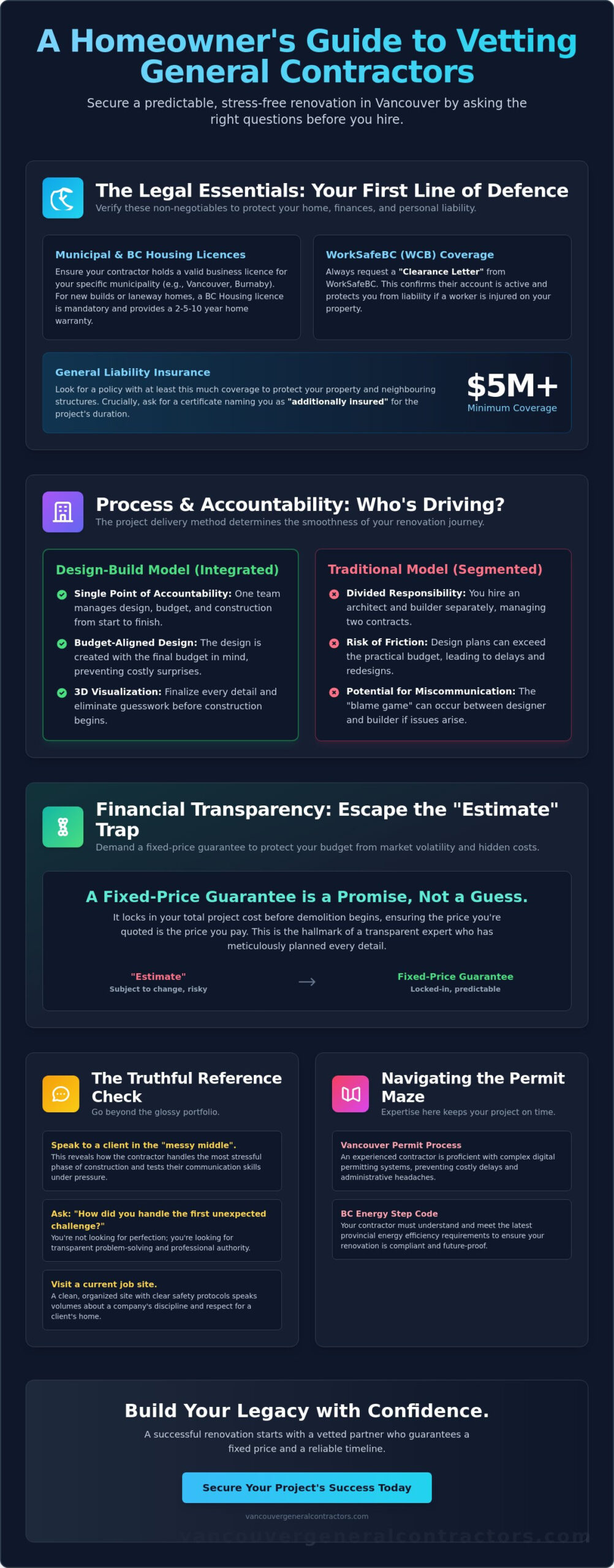
Hiring a partner for your home addition or whole home renovation is a significant financial and emotional commitment. Before you fall in love with a design concept, you must verify the legal foundation of the business. Understanding What is a General Contractor? is the first step in recognizing that their primary role is to manage risk on your behalf. If they lack the proper credentials, that risk transfers directly to you. This protective stance is vital in a complex industry where oversight keeps your investment secure.
Start by verifying their municipal business licence. In Metro Vancouver, a contractor based in Burnaby cannot legally operate in the City of Vancouver without a specific local licence or an Inter-municipal Business Licence. This isn’t just a matter of red tape; it’s about accountability to local building codes and bylaws. When compiling your list of questions to ask a general contractor before hiring, ensure you request their specific licence number for your municipality. For those building custom homes or laneway homes, you must also see a valid BC Housing licence. This provincial requirement ensures the builder has met competency standards and can provide the mandatory 2-5-10 year home warranty.
Insurance and WCB: Beyond the Basics
Standard liability insurance often falls short for high-end residential projects. You should look for a policy with at least $5 million in general liability coverage. This protects your property and neighbouring structures during major structural work or home additions. Always ask for a certificate of insurance that names you as “additionally insured” for the project’s duration. This simple document ensures the policy is active and covers your specific site. It’s a hallmark of a transparent expert to provide this without hesitation.
Equally vital is WorkSafeBC (WCB) coverage. If a worker is injured on your property and the contractor’s account isn’t in good standing, you could be held liable for healthcare costs and lost wages. Don’t take their word for it. Request a “clearance letter” from WorkSafeBC, which confirms their premiums are paid and their account is active. This protects your peace of mind and ensures the crew on your site is fully covered by the provincial safety net.
Reference Checks That Actually Reveal the Truth
Many homeowners make the mistake of only calling past clients who finished their projects years ago. To get a realistic view of the daily experience, ask to speak with a client whose project is currently in the “messy middle” phase. This is when the stress of construction is highest and the contractor’s communication skills are truly tested. It provides a grounded look at how they manage the logistical competence required for a large-scale build.
One of the most revealing questions to ask a general contractor before hiring is: “How did you handle the first unexpected challenge on this site?” Construction is never perfect. You aren’t looking for a contractor who claims to never have problems; you’re looking for the one who manages those problems with transparency and professional authority. If possible, visit a current job site. A clean, organized site with clear safety protocols tells you more about a company’s discipline than any glossy brochure ever could. This level of organization is a primary indicator of how they will treat your own home.
Process and Accountability: Who is Driving the Project?
The difference between a successful renovation and a stressful one often comes down to the delivery method. One of the primary questions to ask a general contractor before hiring is whether they operate under a design-build model or a traditional “bid-and-build” structure. In a traditional setup, you hire an architect independently and then find a builder to execute those plans. This often leads to friction if the design exceeds the budget or if the builder finds the drawings impractical for the site. By contrast, integrating design and construction under one roof ensures that the person drawing the lines is the same person responsible for the final budget.
Who will you actually speak to on a Tuesday afternoon when you have a question about the kitchen layout? Clarity on your single point of contact is essential for maintaining accountability. Some firms use the owner as the primary contact, while others assign a dedicated project manager or a site lead. You need to know if the person managing your budget is the same person overseeing the quality of the framing. This structural clarity is a core part of Financial Transparency: Avoiding the Estimate Trap, as it prevents the miscommunications that frequently lead to costly change orders.
In 2026, relying on verbal updates or scattered emails is no longer sufficient for high-end builds. Ask if the team utilizes modern project management software where you can view daily logs, schedule shifts, and see photo updates in real-time. This level of transparency is particularly important when managing specialized trades like electricians and plumbers. Vancouver’s labour market remains exceptionally tight; a professional contractor should have long-standing, stable relationships with vetted sub-contractors to ensure your project doesn’t stall while waiting for a trade to arrive. If you’re ready to see how a structured process can protect your investment, consider exploring our whole home renovation services.
The Design-Build Advantage
Integrating these phases prevents the “finger-pointing” that often occurs when an architect’s vision clashes with on-site reality. Many custom home builders Vancouver relies on prefer this model because it provides cost-certainty from the earliest sketches. When you ask about the transition from 3D renders to physical framing, you’re looking for a process where the technical specifications are locked in before the first hammer is swung. This methodology protects the aesthetic outcomes while grounding them in logistical reality.
Daily Communication and Logistics
Establish the frequency of formal project meetings early. Whether it’s a weekly site walkthrough or a bi-weekly video call, predictable communication alleviates anxiety. In dense neighbourhoods like Kitsilano or North Vancouver, logistics extend beyond your property line. Ask how the team manages noise complaints and neighbour relations to keep the project running smoothly. Site Supervision is the consistent presence of a dedicated lead on-site to ensure quality control and immediate problem-solving. This disciplined approach is what transforms a complex build into a stable, manageable experience for every homeowner.
Financial Transparency: Avoiding the “Estimate” Trap
Financial volatility is the single greatest source of anxiety in residential construction. To protect your investment, you must distinguish between a loose estimate and a binding commitment. A Fixed-Price Contract is a legal agreement where the contractor performs the defined scope for a set price, regardless of their internal cost fluctuations. This structure provides a protective shield against the rising costs of raw materials and labour. One of the most revealing questions to ask a general contractor before hiring is: “Is this a fixed-price contract or a cost-plus estimate?” While cost-plus models might seem flexible, they often leave the homeowner vulnerable to budget bloat as the project progresses.
Transparency should extend to the inevitable adjustments that occur during a build. Request a clear breakdown of how “Change Orders” are priced and approved. A professional partner will have a structured process where no additional work is performed without your written consent and a clear price tag. Similarly, your payment schedule should be tied to measurable milestones rather than arbitrary calendar dates. This ensures that capital is only released once specific progress, such as the completion of framing or the installation of drywall, has been verified on-site. This methodical approach builds trust and keeps the project’s momentum aligned with your financial contributions.
The Danger of Vague Allowances
Initial bids often hide the true cost of a project behind vague “allowances” for finishes like flooring, cabinetry, and lighting. These figures are frequently set intentionally low to make the total bid look more attractive. To ensure your kitchen renovation Vancouver budget remains realistic, insist on selecting high-quality materials during the design phase. Ask the contractor: “What percentage of your projects finish exactly at the initial contract price?” Their answer will reveal their commitment to cost-certainty and their ability to plan with precision.
Warranties and Long-Term Security
A contractor’s financial stability is often reflected in the strength of their post-completion support. You need to know if their warranty covers only the materials, which are often covered by manufacturers anyway, or if it includes labour and structural integrity. A comprehensive warranty is a promise of enduring quality. Before the final payment is released, ensure there is a scheduled “deficiency walkthrough” to identify and rectify any minor imperfections. This final step in our proprietary methodology ensures that the excitement of your new space is backed by the security of logistical competence and long-term accountability.
Navigating the Vancouver Permit Maze and Regulations
The City of Vancouver maintains one of the most rigorous permitting environments in North America. When considering questions to ask a general contractor before hiring, you must evaluate their technical literacy regarding the BC Energy Step Code. This provincial regulation significantly impacts your mechanical costs and insulation requirements; buildings must now meet higher efficiency standards than in previous years. A contractor who isn’t deeply familiar with these tiers could inadvertently cause expensive delays during the inspection phase. We realize that your goal is a high-performance home that meets these standards without sacrificing aesthetic design or budget stability.
Beyond the city core, you should inquire about their specific experience with planning departments in Burnaby, Richmond, or Coquitlam. Each municipality maintains unique bylaws regarding setbacks and site coverage. If you are interested in building a laneway house in Vancouver, ask how they manage the specific permit requirements that differ from a standard renovation. This is one of the essential questions to ask a general contractor before hiring to ensure they have an in-house team dedicated to the complex pre-construction phase. This internal management ensures every regulatory hurdle is cleared before any demolition begins.
Permit Timelines and Expectations
Municipal backlogs are a reality in 2026. You should ask for a realistic timeline that accounts for current wait times, which typically range from 8 to 12 weeks for standard residential projects. A transparent expert will explain the difference between a Development Permit, which reviews the form and character of your project, and a Building Permit, which focuses on safety and code compliance. In Vancouver, development permit fees are approximately $5,000; building permits start with a base fee of $729 plus tiered charges based on construction value. Don’t overlook local bylaws regarding tree protection and site drainage, as ignoring these can lead to significant fines or stop-work orders.
Specialized Vancouver Projects
Vancouver offers specific incentives for character home retention, which requires a nuanced understanding of municipal heritage guidelines. If you are planning home additions Vancouver families use to increase floor area, you must ask about structural engineering requirements. West Coast construction demands strict adherence to seismic requirements to ensure your home remains safe during an earthquake. This level of technical oversight is why we recommend partnering with a team that takes full responsibility for the project lifecycle. If you want to ensure your project meets every regulatory standard without the stress, book a professional consultation with our team.
The Vancouver General Contractors Difference: Fixed-Price Peace of Mind
Mastering the list of questions to ask a general contractor before hiring is a vital step in protecting your investment, but the ultimate goal is finding a partner who naturally embodies these professional standards. At Vancouver General Contractors, we operate as the “Transparent Expert” for every home renovation Vancouver families entrust to us. Our methodology is designed to absorb the complexity of the construction process so you don’t have to. We realize that the most successful projects are built on a foundation of trust and logistical competence.
One of the most significant ways we eliminate anxiety is through our immersive 3D design phase. This process allows you to walk through your new space virtually before a single hammer is swung. By finalizing every aesthetic and structural detail in the digital realm, we eliminate the guesswork that often leads to mid-project delays. This precision allows us to offer a fixed-price guarantee. In an era where material costs can fluctuate unexpectedly, our commitment to cost-certainty ensures that the price we agree upon is the price you pay. This protective stance is our signature in an industry often known for budget volatility.
A Single Point of Accountability
We believe that a high-end living environment requires high-level professional management. Our project managers serve as the dedicated mentors of your renovation journey, providing a single point of accountability from concept to completion. You won’t have to worry about the stress of managing multiple trades or chasing down sub-contractors. We utilize proprietary technology to keep you informed with daily logs and photo updates, ensuring you remain the driver of the vision while we handle the execution. Our commitment to excellence extends to the physical site as well; we maintain a clean, organized, and respectful environment that honours your property and your neighbours.
Your Next Steps to a Stress-Free Build
The transition from a broad vision to a granular execution plan begins with a professional consultation. During our initial site discovery and feasibility analysis, we examine the structural and regulatory realities of your property. This grounded approach ensures that your design is not only inspirational but also deeply practical and compliant with municipal bylaws. We take pride in creating high-end living environments that offer permanent value and durability. Trust is built through action. If you are ready to experience a renovation defined by stability and pride, Schedule your pre-construction consultation with Vancouver General Contractors today.
Build Your Legacy with Confidence
Your Vancouver home is a permanent investment in your family’s future. Navigating the legal essentials of WorkSafeBC and municipal licensing protects your liability, while embracing the design-build model ensures a single point of accountability for every phase. By utilizing these expert-vetted questions to ask a general contractor before hiring, you move from the anxiety of hidden costs to the security of a well-managed build. We realize that the most successful renovations are those where the homeowner feels informed and protected throughout the entire journey.
Our comprehensive design-build methodology is specifically designed to eliminate the guesswork and budget volatility of traditional construction. We stand behind our work with a fixed-price contract guarantee and an industry-leading warranty on all labour and materials. This commitment to financial transparency and logistical competence provides the stability you need to transform your vision into a reality. Take the first step toward a predictable, rewarding renovation experience by partnering with a team that values your peace of mind as much as you do.
Book Your Fixed-Price Consultation Today and discover the difference that a transparent, professional approach makes for your home.
More Uncategorized Guides

Building a Wheelchair-Accessible Bathroom in Burnaby: A Practical Homeowner’s Guide

Richmond Aging-in-Place Renovations: Long-Term Comfort

Small Condo Kitchen Design Ideas in Burnaby: 2026 Planning Guide

Condo Renovation Contractors in Vancouver: A Strata-Smart Buying Guide

Office Space Renovation Contractors in Surrey: A Practical Buying Guide
Ready to start your renovation?
Frequently Asked Questions
Do I really need a general contractor for a small kitchen renovation?
How do I check if a contractor is licensed in the City of Vancouver?
You can verify a business licence through the City of Vancouver’s online business licence search or by requesting the contractor’s licence number directly. Professional firms will gladly provide their credentials for your specific municipality. It’s vital to ensure they hold a valid licence for the area where your home is located, as this confirms they are accountable to local regulatory standards and building bylaws.
What is the difference between a quote and an estimate?
A quote is a binding commitment to perform a specific scope of work for a set price, whereas an estimate is a non-binding projection of costs. When preparing your questions to ask a general contractor before hiring, always insist on a detailed quote. This distinction is the core of financial transparency, protecting you from the budget volatility that often occurs when a project is based on loose, variable estimates.
Should I pay a deposit before the work begins?
A modest initial deposit is a standard industry practice used to secure your place in the contractor’s schedule and order long-lead materials. However, this payment should be a reasonable percentage of the total project value and clearly defined in your contract. Subsequent payments should always be tied to measurable milestones, ensuring that your financial contributions remain perfectly aligned with the actual progress made on your site.
What happens if my contractor finds a problem behind the walls?
If an unforeseen structural or mechanical issue is discovered during demolition, a professional contractor will document the problem and issue a formal change order. This document outlines the necessary repairs and the associated costs for your approval before any additional work begins. We recommend maintaining a contingency fund of 10 to 20 percent of your total budget to handle these rare but possible logistical challenges without stress.
Can I stay in my home during a whole-home renovation?
Staying in your home during a whole-home renovation is often impractical due to the loss of essential services like water and electricity. The noise, dust, and presence of crews can also significantly impact your daily quality of life. For large-scale projects, we recommend vacating the premises to ensure the work proceeds as quickly and safely as possible, allowing for a more efficient and thorough construction process.
How do I handle a disagreement with my contractor about the quality of work?
Address any concerns immediately by referencing the specific quality standards outlined in your signed agreement. A professional relationship is built on open communication and accountability. If a disagreement persists, utilize the formal deficiency walkthrough at the end of the project to identify and rectify issues. These steps are critical questions to ask a general contractor before hiring to ensure you have a clear path to resolution if expectations aren’t met.
What is the BC Energy Step Code and does it apply to my renovation?
The BC Energy Step Code is a provincial regulatory framework that establishes progressive performance requirements for energy efficiency in new construction and major renovations. It applies to projects involving significant changes to the building envelope or mechanical systems. Your contractor must ensure the design meets these specific tiers to pass municipal inspections, resulting in a high-performance home with lower long-term operating costs and increased comfort.

Comments are closed