




Avoiding Budget Overruns During Construction: The 2026 Vancouver Homeowner’s Guide
What if the most expensive part of your Vancouver home renovation isn’t the imported tile or the custom kitchen island, but the “unknowns” hidden behind your basement walls? Many homeowners in the Lower Mainland have come to accept that construction budgets are merely polite suggestions, bracing themselves for the inevitable 30% price hike that often follows a permit delay or a structural surprise. It’s a stressful way to build, and frankly, it’s unnecessary. We believe that avoiding budget overruns during construction is entirely possible when you replace vague estimates with a disciplined, transparent process.
You deserve to feel excitement rather than anxiety when you break ground on your custom home or addition. In this 2026 guide, you’ll learn how to achieve total cost-certainty by utilizing battle-tested pre-construction strategies and fixed-price contracts that lock in your project’s value. We’ll walk you through navigating the latest BC Energy Step Code requirements and municipal fee structures, ensuring your financial plan is as durable as the home we’re building together. By the end of this article, you’ll have a clear roadmap to a project that finishes on the agreed-upon price without the typical industry headaches.
Key Takeaways
- Learn to distinguish between a vague estimate and a binding quote to ensure your renovation or custom build starts with absolute financial clarity.
- Discover how a rigorous pre-construction phase is the most effective strategy for avoiding budget overruns during construction by accounting for every detail before work begins.
- Compare fixed-price and time-and-materials contracts to understand which model provides the most security and protection for your project’s bottom line.
- Master the professional change order process so you can manage unforeseen site conditions without losing control of your financial plan.
- Explore how the design-build methodology creates a seamless, transparent experience that provides total cost-certainty from the initial concept to the final walkthrough.
Why Construction Projects Go Over Budget: The Vancouver Reality
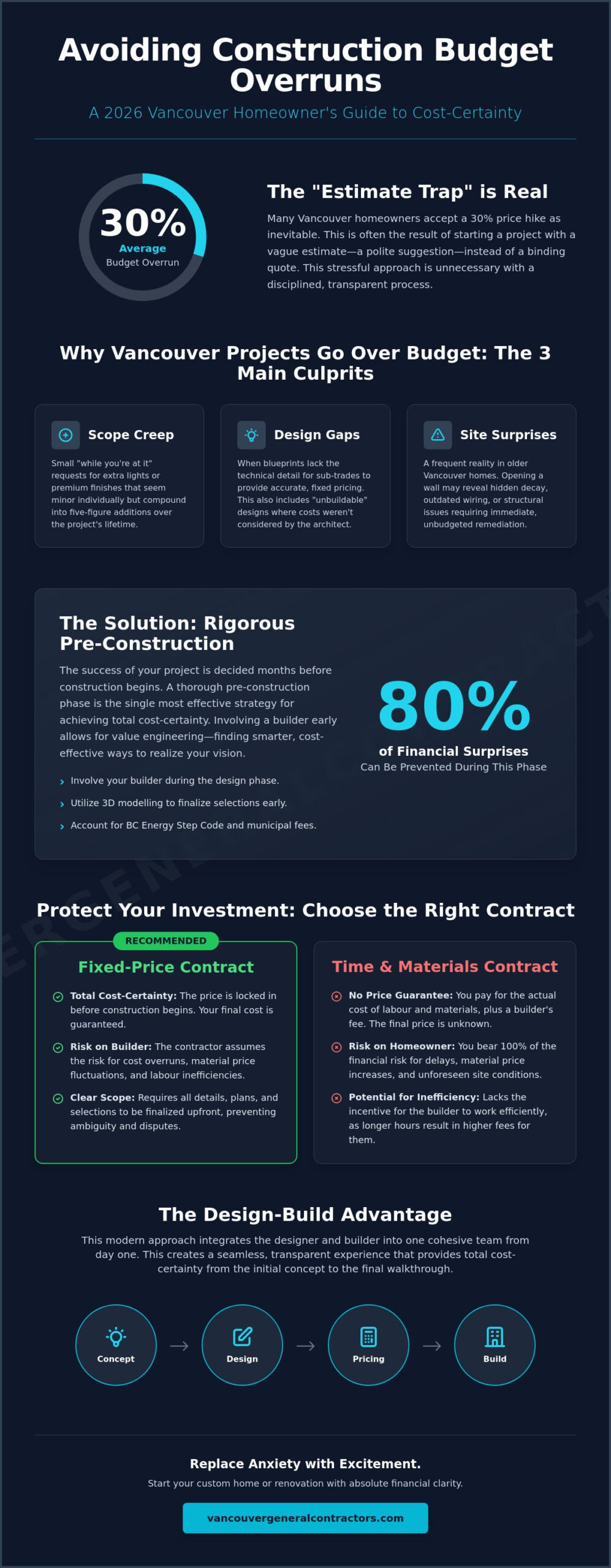
In the world of high-end residential construction, a cost overrun is defined as any expense that exceeds the total value established in your signed contract. While many homeowners view these spikes as an unavoidable tax on progress, they’re usually the result of preventable planning failures. Understanding why these costs emerge is the first step toward avoiding budget overruns during construction. In Vancouver, the primary catalyst is often the “Estimate Trap.” An estimate is an educated guess based on broad concepts, whereas a quote is a firm commitment based on granular data. When you proceed with a project based on a vague estimate, you’re essentially signing a blank cheque.
Market volatility adds another layer of complexity to the local landscape. By mid-2026, material costs in British Columbia have stabilized with escalation rates projected to stay below 2%, yet prices remain 15% to 35% higher than pre-pandemic benchmarks. This high baseline means there’s very little margin for error. Additionally, many projects suffer from “unbuildable” designs. This occurs when an architect creates a vision without consulting a builder on the practical costs of execution. Without this early collaboration, you may end up with a beautiful set of blueprints that your budget simply cannot support once the real-world sub-trade prices arrive.
The Three Main Culprits: Scope Creep, Design Gaps, and Site Surprises
Budget blowouts typically stem from three specific areas. First is scope creep, where small, “while you’re at it” requests for extra pot lights or premium finishes compound into five-figure additions. Second are design gaps, which occur when blueprints lack the technical detail required for sub-trades to provide accurate, fixed pricing. Finally, site surprises are a frequent reality in older Vancouver neighbourhoods like Kitsilano or East Van. Opening a wall in a 1920s character home often reveals hidden structural decay or outdated wiring that demands immediate, unbudgeted remediation before the project can move forward.
The Financial Impact of Vancouver Permit Delays
Time is quite literally money when you’re navigating the planning departments in the City of Vancouver or Burnaby. When municipal approvals stall, your project enters a state of expensive limbo. During this period, your carrying costs continue to mount without any physical progress on the site. Carrying costs are the ongoing expenses, such as mortgage interest, property taxes, and insurance, that a homeowner must pay while a property is under construction and uninhabitable. Avoiding budget overruns during construction requires a proactive strategy for permit management to keep these invisible costs from eroding your renovation fund before the first nail is even driven.
The Critical Role of Pre-Construction in Avoiding Budget Blowouts
The success of a renovation or custom build is rarely determined by the skill of the carpenter on-site; it’s decided months earlier in the boardroom. We view the pre-construction phase as the essential budget-saving stage where every single dollar is assigned a specific purpose before a hammer is ever swung. In fact, approximately 80% of all financial surprises can be prevented during this period. By shifting the focus from reactive problem-solving to proactive planning, homeowners can achieve a level of cost-certainty that the traditional “bid-and-build” model simply cannot offer.
One of the most effective ways of avoiding budget overruns during construction is to involve your builder during the design phase rather than bidding out finished plans. Builders have their fingers on the pulse of the current Vancouver market, understanding the real-time costs of labour and materials. This allows for a process called “Value Engineering.” This isn’t about cutting corners or reducing quality; it’s about finding more efficient, cost-effective ways to achieve your desired aesthetic. For example, a builder might suggest a specific structural modification that simplifies the HVAC installation required for BC Energy Step Code Step 3 compliance, saving thousands without compromising the home’s performance or beauty.
3D Design and Selection Clarity
Ambiguity is the enemy of a stable budget. Our use of advanced 3D modelling allows you to “walk through” your project digitally, identifying necessary changes while they only cost a few clicks of a mouse rather than a demolition crew. This clarity extends to your “selections,” which include everything from flooring to plumbing fixtures. By finalizing these choices before the contract is signed, we eliminate the dangerous “allowance” system. Allowances are essentially placeholders that often lead to price increases when the homeowner realizes the allocated amount doesn’t cover their actual preferences. Partnering with a team that prioritizes this level of detail ensures your vision remains financially viable. You can explore how we manage these complexities at vancouvergeneralcontractors.com.
A Pre-Construction Checklist for Vancouver Homeowners
- Step 1: Feasibility and Site Survey. We conduct a deep dive into your property to identify structural constraints and municipal zoning bylaws that could impact the build.
- Step 2: 3D Interior Design. This stage finalizes every visual and functional detail, ensuring the blueprints are a perfect reflection of your expectations.
- Step 3: Firm Sub-Trade Quotes. Rather than relying on rough square-footage estimates, we obtain firm quotes from specialized trades based on your finished 3D drawings.
- Step 4: Municipal Permit Security. We handle the coordination with the City of Vancouver to ensure the scope is legally compliant, reducing the risk of costly delays or work-stoppage orders.
Fixed-Price Contracts vs. Time and Materials: Which Protects You?
Choosing the right contract model is the single most important financial decision you’ll make after finalizing your design. While the industry often focuses on tracking expenses as they occur, true financial protection comes from establishing who carries the risk when challenges arise. In Vancouver’s competitive residential market, two primary models dominate: Time and Materials (often called Cost-Plus) and Fixed-Price. Understanding the mechanics of these agreements is fundamental to avoiding budget overruns during construction. One model offers a fluid, open-ended commitment, while the other provides a firm ceiling that protects your investment from the start.
Time and Materials contracts essentially place the entire financial burden on the homeowner. Under this arrangement, you pay for the actual cost of labour and materials plus a predetermined percentage for the contractor’s overhead and profit. If a sub-trade takes longer than expected or if a supplier increases their rates mid-project, your final bill grows accordingly. There’s little incentive for the builder to optimize efficiency because their fee is guaranteed regardless of how long the project takes. This lack of a price cap is the antithesis of cost-certainty and often leads to the very anxieties we strive to eliminate.
A Fixed-Price contract, conversely, requires the builder to assume the risk. This model forces a level of professional discipline that is often missing in Cost-Plus arrangements. Because the price is locked in, the contractor must be meticulous during the pre-construction phase we discussed earlier. They have to account for every nail, every hour of labour, and every municipal requirement before work begins. If they miscalculate, the cost comes out of their margin, not your pocket. This alignment of interests ensures that the builder is highly motivated to manage the schedule and resources with precision.
The Hidden Risks of “Estimate-Only” Quotes
We frequently encounter homeowners who have been led astray by “ballpark” figures. These casual estimates are often designed to look attractive on paper but lack a comprehensive scope of work. They frequently exclude critical components like municipal permits, professional landscaping, or even essential finishing hardware. This creates a false sense of security that evaporates once the real costs emerge. For a deeper look at how to navigate these early stages, we recommend consulting our Ultimate Guide to Home Renovation in Vancouver. Relying on a detailed, itemized quote rather than a rough estimate is the only way to ensure your project remains financially grounded.
Achieving Cost-Certainty Through Fixed-Price Agreements
Cost-certainty is the promise that the price you sign for is the price you’ll see on your final invoice. A robust fixed-price contract provides this peace of mind by including detailed specifications, clear construction timelines, and a transparent payment schedule. It acts as a shield against the material price volatility we noted earlier. Once the contract is executed, any subsequent spikes in the cost of lumber or steel are the builder’s responsibility to manage. This model transforms the construction process into a predictable financial journey, allowing you to focus on the excitement of your new space rather than the stress of a shifting bottom line. It’s the ultimate tool for avoiding budget overruns during construction while maintaining the high standards your home deserves.
Managing Scope Creep and Unforeseen Site Conditions
Even with the most rigorous pre-construction planning, the reality of building a home involves dynamic variables. New ideas might strike you as the walls go up, or a hidden structural issue could emerge once demolition begins. Managing these moments with a disciplined protocol is essential for avoiding budget overruns during construction. The most effective tool for this is the formal Change Order. A Change Order is a written agreement that documents a deviation from the original scope, detailing the specific cost and schedule impact. We don’t proceed with any additional work until this document is priced, reviewed, and signed by you. This process ensures there are never any surprise invoices at the end of the month.
We also recommend maintaining a contingency fund of 10% to 15% of the total project value. While our goal is to never touch this reserve, it provides a vital safety net for the truly unpredictable. It keeps the project moving forward without financial friction, allowing us to maintain the momentum we’ve built during the design stage. This transparency allows you to remain the driver of the process, making informed decisions rather than reactive ones.
The “Want vs. Need” Decision Framework
When a new idea arises mid-build, it’s helpful to evaluate it through a framework of long-term value. Ask yourself if the change improves the daily utility of the home or if it offers a significant return on investment. If the change is purely aesthetic and the budget is feeling pressure, consider phasing that specific element. For instance, you might prioritize high-end kitchen finishes now and delay an extensive landscaping plan or basement media room for a later date. Leading custom home builders in Vancouver use this phasing strategy to ensure the core vision of a project remains intact while staying within financial boundaries.
Dealing with Underground and Structural Surprises
Vancouver’s diverse architectural history brings unique challenges, especially in mature neighbourhoods. Opening up a home built before 1990 can reveal legacy issues like buried oil tanks, outdated knob-and-tube wiring, or hazardous materials. Professional hazmat testing is a mandatory step for any Vancouver renovation project involving a structure built before 1990. Identifying asbestos or lead through pre-construction testing allows us to build the remediation costs into the initial quote rather than treating them as emergency overruns later. By addressing these “underground” risks early, we protect your family’s health and your project’s financial stability, further aiding in avoiding budget overruns during construction.
If you’re ready to plan a project that prioritizes financial transparency and disciplined management, book a consultation with our team to discuss your vision.
The Vancouver General Contractors Advantage: Guaranteed Cost-Certainty
At the heart of every successful project is a relationship built on trust and radical transparency. While the previous sections of this guide have detailed the mechanics of planning and contracts, the true driver of a successful build is the delivery model you choose. Our proprietary Design-Build process is specifically engineered for avoiding budget overruns during construction by unifying every stage of the project lifecycle. We don’t just act as your builder; we serve as your stable partner and mentor through a complex industry, ensuring that your financial goals are respected from the first conceptual sketch to the final walkthrough.
The “Transparent Expert” approach means we’re honest about costs from day one. By housing designers, engineers, and builders under a single roof, we eliminate the communication gaps that often lead to “unbuildable” designs or mid-project structural surprises. When our design team proposes a feature, our construction team is right there to validate the cost and feasibility in real time. This integrated synergy protects your budget from the design gaps we discussed earlier. This commitment to excellence is backed by an industry-leading warranty, ensuring that the permanent value we create in your home is protected for years to come.
Our Fixed-Price Guarantee
We believe that financial anxiety has no place in a home renovation. Unlike builders who rely on vague allowances or “cost-plus” models that shift risk to the homeowner, we provide a comprehensive fixed-price contract once your design phase is complete. This agreement is a firm promise: there are no hidden fees and no “surprise” change orders for any item already included in your detailed scope of work. Whether we’re managing a complex whole-home transformation or a specialized Kitchen Renovation in Vancouver, our methodology ensures your final invoice matches your initial quote. This disciplined approach to financial management allows you to enjoy the creative process, knowing your investment is secure.
Start Your Stress-Free Renovation Today
The first step toward a predictable and successful build is a conversation about your vision. Our design-build process begins with a thorough feasibility study, where we identify potential municipal hurdles and structural constraints before they can impact your wallet. This methodical progression builds momentum and trust simultaneously, replacing the typical stress of construction with a sense of security and excitement. We take full responsibility for the project lifecycle so you don’t have to handle the unforeseen challenges alone. Ready to realize your dream home with total cost-certainty? Contact Vancouver General Contractors today.
Build Your Dream Home with Financial Certainty
The journey to a successful renovation or custom build shouldn’t be defined by financial stress. By prioritizing a rigorous pre-construction phase and choosing a fixed-price contract, you take the risk out of the equation. We have seen how avoiding budget overruns during construction is a direct result of disciplined planning and transparent communication. Our comprehensive 3-stage Design-Build methodology ensures every detail is accounted for before we break ground. This Red Dot Design Award-winning approach combines creative vision with logistical precision, allowing us to offer a Fixed-Price Contract Guarantee that protects your investment from start to finish.
You deserve a home that reflects your lifestyle without the burden of hidden costs or vague estimates. Let’s work together to create a space that stands as a lasting legacy for your family in Vancouver. Book Your Free Design-Build Consultation today and take the first step toward a predictable, high-end construction experience. We look forward to bringing your vision to life with the stability and expertise your project deserves.
More Uncategorized Guides

Building a Wheelchair-Accessible Bathroom in Burnaby: A Practical Homeowner’s Guide

Richmond Aging-in-Place Renovations: Long-Term Comfort

Small Condo Kitchen Design Ideas in Burnaby: 2026 Planning Guide

Condo Renovation Contractors in Vancouver: A Strata-Smart Buying Guide

Office Space Renovation Contractors in Surrey: A Practical Buying Guide
Ready to start your renovation?
Frequently Asked Questions
What is the most common cause of budget overruns in Vancouver renovations?
The primary culprit is fragmented planning that separates the design phase from the construction phase. When a builder isn’t involved during the initial architectural drawings, the resulting plans often lack the technical detail required for accurate pricing. This leads to expensive structural surprises or “unbuildable” designs that only become apparent after you’ve already committed to the project.
How much contingency should I add to my construction budget in 2026?
We recommend a contingency fund of 10% to 15% of your total project value. While a fixed-price contract protects you from many risks, this reserve is essential for handling truly unpredictable “site surprises.” In older Vancouver neighbourhoods, this fund often covers the remediation of hidden issues like structural decay, outdated wiring, or hazardous materials found behind heritage walls.
Does a fixed-price contract really mean the price won’t change?
Yes, the price remains locked for every item defined within the original scope of work. This model is the ultimate tool for avoiding budget overruns during construction because it shifts the financial risk of material price spikes or labour fluctuations from the homeowner to the builder. The only time the price changes is if you choose to add new features through a signed Change Order.
What happens if I want to change the design during construction?
Mid-project changes are managed through a formal Change Order process. This document outlines the specific cost and schedule impact of your request, ensuring you have total clarity before any new work begins. We utilize a “want vs. need” framework to help you evaluate these changes, ensuring your project remains financially grounded while still achieving your aesthetic goals.
Are Vancouver permit fees included in the construction budget?
Can 3D design actually save me money on my home build?
3D modelling is a powerful cost-saving tool because it allows you to identify and correct design errors before they become expensive physical mistakes. By “walking through” your home digitally, you can refine your layout and finalize selections like cabinetry and tile. This precision is vital for avoiding budget overruns during construction by eliminating the ambiguity that leads to mid-build changes.
What is the difference between a quote and an estimate in construction?
An estimate is a non-binding educated guess based on broad concepts, while a quote is a firm financial commitment based on detailed blueprints. Estimates often lead to the “Estimate Trap,” where costs escalate as details emerge. A professional quote involves getting firm pricing from sub-trades, providing you with the cost-certainty required for a stress-free build.
How do I know if my contractor is being transparent about material costs?
Look for a builder who provides a detailed, itemized breakdown rather than a single “ballpark” figure. Transparency is found in the details; a professional team will be open about current market volatility and how they lock in pricing with suppliers. This disciplined approach ensures that every dollar is accounted for, creating a stable partnership based on mutual trust.

Comments are closed