




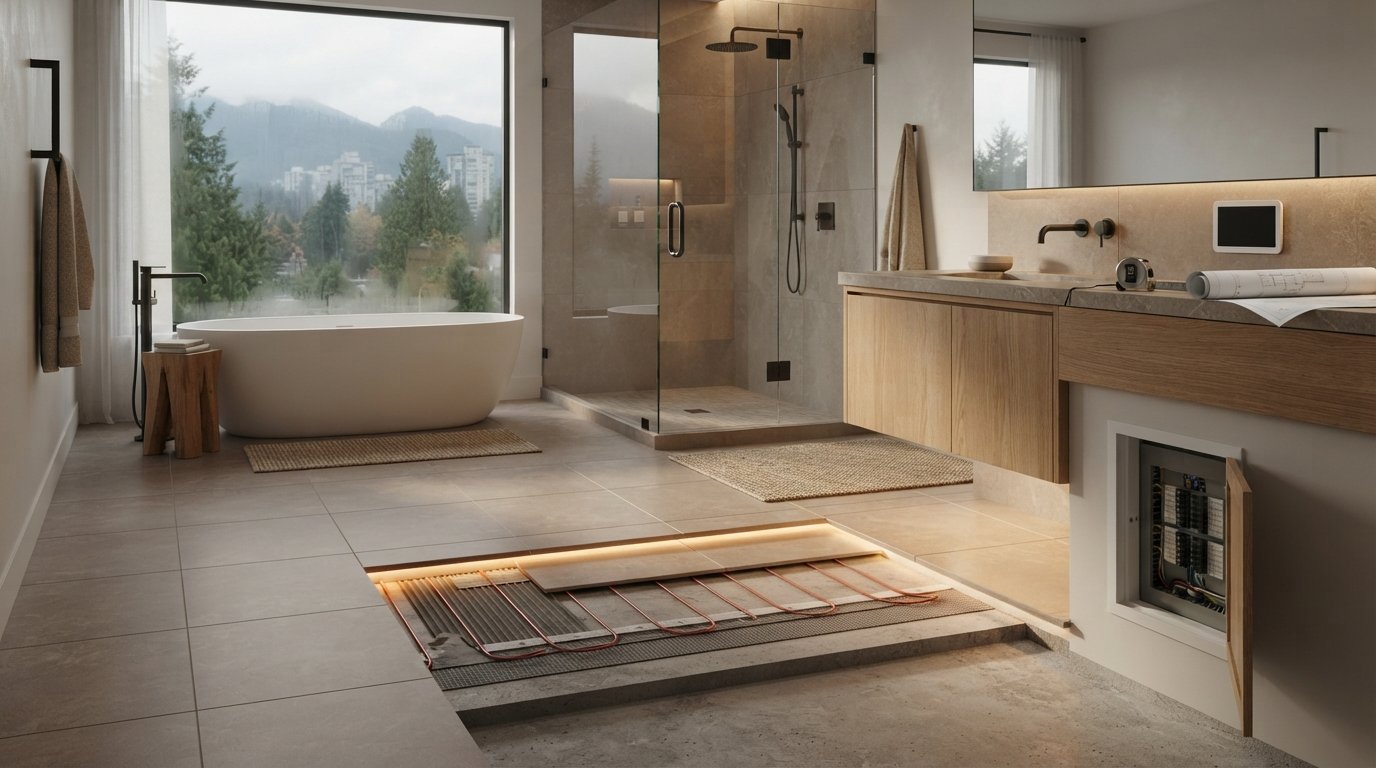
Heated Floors in Bathroom Cost: The 2026 Vancouver Homeowner’s Guide
Did you know that over 70 percent of high-end Metro Vancouver homebuyers now list radiant heating as a top three bathroom amenity? When you begin planning your renovation, the heated floors in bathroom cost is often the first figure you search for, yet it’s frequently the most misunderstood part of the budget. It’s perfectly normal to feel a bit of anxiety when considering how a new system might interact with your existing electrical panel, especially with the 2026 BC Hydro rate increases now in full effect.
You want a spa-like retreat that doesn’t lead to unpredictable monthly bills or a surprise invoice from an electrician halfway through the project. We’ve designed this guide to provide total clarity on what it actually takes to install and run radiant heat in a local home. You’ll discover the real-world impact of Step 2 electricity rates, the efficiency of smart Wi-Fi thermostats, and how a fixed-price approach eliminates the risk of budget volatility. Whether you’re upgrading a Yaletown condo or a legacy home in Kitsilano, you’ll gain the confidence to choose a system that delivers permanent value and daily comfort.
Key Takeaways
- Learn why electric systems are the preferred choice for Vancouver condo and detached home renovations compared to complex hydronic alternatives.
- Identify the primary factors that drive the all-in heated floors in bathroom cost, from high-quality uncoupling membranes to mandatory municipal electrical permits.
- Evaluate the long-term ROI of radiant heating and its minimal impact on your monthly BC Hydro bill when paired with modern smart technology.
- Gain a practical checklist for measuring your net heated area and assessing your home’s electrical panel capacity to avoid mid-project delays.
- Understand how a fixed-price design-build model ensures your luxury bathroom upgrade stays on budget without unforeseen technical complications or scope creep.
Understanding the Types of Radiant Floor Heating
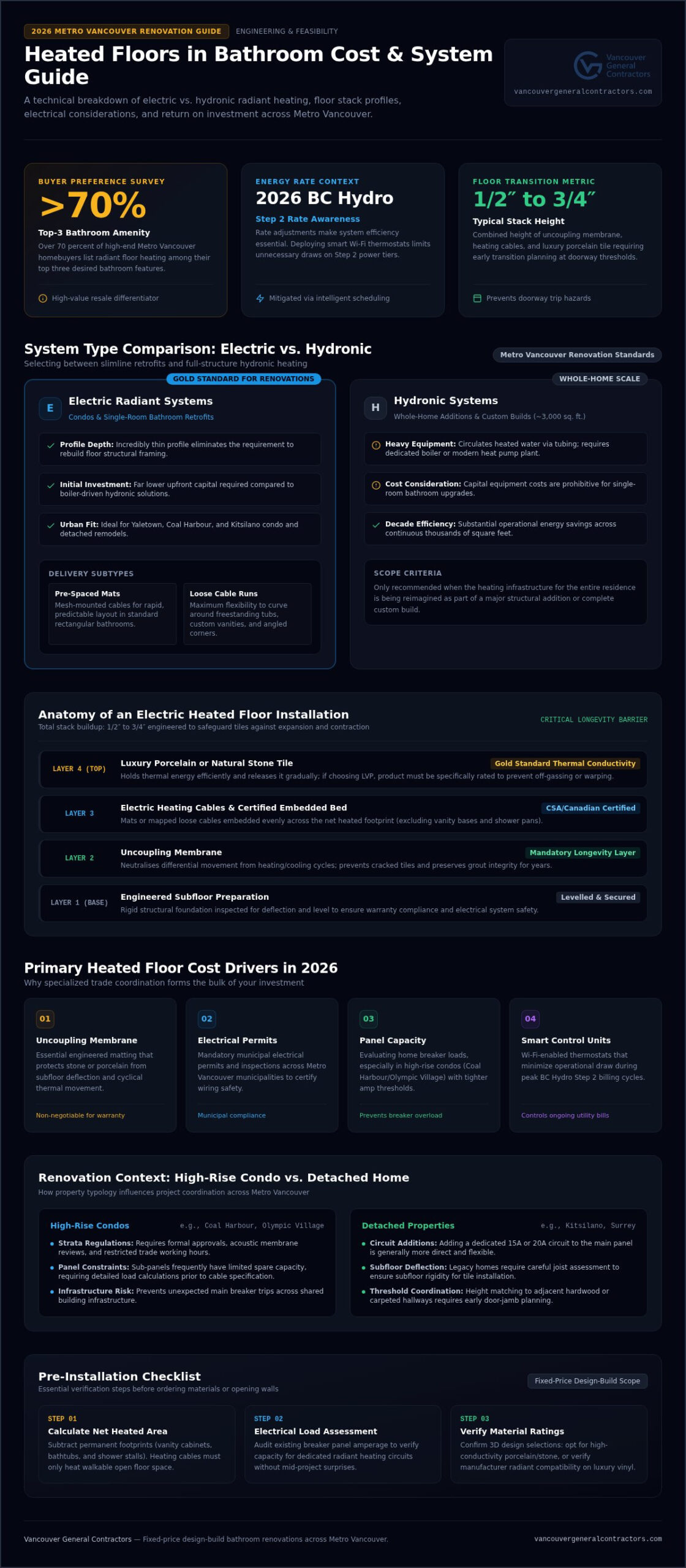
Choosing the right system is the first step in managing your heated floors in bathroom cost. In Metro Vancouver, electric radiant heat is the gold standard for renovations. It’s incredibly thin, meaning we don’t have to rebuild your entire floor structure just to add warmth. Hydronic systems, which circulate warm water through pipes, are usually reserved for new custom homes or massive bathroom renovations that involve a full home addition. These water-based systems require a boiler or heat pump, making them a heavy investment for a single room.
The “stack height” of your new floor is a critical technical factor. When we combine the uncoupling membrane, heating cables, and luxury porcelain tile, the floor level often rises by 1/2 inch to 3/4 inch. We plan for this transition early to avoid tripping hazards at the bathroom door. Using an uncoupling membrane is essential because it protects your tile from the natural expansion and contraction of the heating cycle. This layer ensures your grout stays intact for years, preserving the aesthetic value of your project. This technical overview of underfloor heating shows why these membranes are non-negotiable for longevity.
Electric Mat vs. Loose Cable Systems
When you look at electric options, you’ll choose between mats and loose cables. Heating mats come with the cable already spaced on a mesh, making installation fast and predictable for standard rectangular bathrooms. Loose cable systems offer more flexibility. If your bathroom has a unique shape, a freestanding tub, or a custom vanity, loose cables allow us to navigate those obstacles perfectly. While mats might save on labour time, loose cables often provide better coverage in complex spaces. Both options impact your overall heated floors in bathroom cost differently based on the time required for a certified installer to map out the run.
Hydronic Heating for Large-Scale Additions
If you’re planning a whole-home renovation or a significant addition, hydronic heating becomes a viable contender. These systems integrate with high-efficiency boilers or modern heat pumps to provide consistent warmth across thousands of square feet. For a single-room upgrade, the equipment costs are usually prohibitive. However, for a 3,000-square-foot custom build, the long-term energy efficiency realized can be substantial. It’s a “Whole Home” decision that prioritizes operational savings over decades rather than the lower upfront cost of an electric retrofit. We typically recommend this path only when the heating strategy for the entire residence is being reimagined.
Calculating the Heated Floors in Bathroom Cost for 2026
Determining your total investment requires looking beyond the price tag on a box of heating cables. In 2026, the heated floors in bathroom cost is driven largely by professional trade coordination rather than just the raw materials. While Canadian-certified heating kits and smart thermostats are essential components, the real value lies in the specialized labour required to prep the subfloor and integrate the system into your home’s electrical grid. A professional installation ensures that your warranty remains valid and your home stays protected against electrical faults.
Condo owners in Metro Vancouver face a specific set of challenges. If you’re renovating a unit in Coal Harbour or Olympic Village, your project must account for strata-specific requirements and often tighter electrical panel capacities. Unlike a detached home in Surrey where adding a new circuit might be straightforward, a high-rise renovation requires careful planning to ensure the building’s infrastructure can support the additional load without tripping main breakers. Analyzing the radiant floor heating cost and ROI helps homeowners weigh these logistical hurdles against the long-term value added to the property.
The Impact of Flooring Material on Total Cost
Your choice of finish significantly influences how well the system performs. Porcelain and natural stone are the gold standard for thermal conductivity; they hold heat efficiently and release it slowly. Pairing premium stone or tile flooring with artisan features, such as the hand-tiled vessel sinks crafted by Bespoke Basin Co., creates a cohesive, high-end aesthetic. If you prefer luxury vinyl plank (LVP), you must ensure the product is specifically rated for radiant heat. Using the wrong adhesive or an unrated plank can lead to off-gassing or warping, which ultimately compromises your renovation. Choosing the right materials during the 3D design phase prevents these costly errors later.
Electrical Requirements and Permit Fees in Metro Vancouver
Safety is paramount. The BC Electrical Code mandates a dedicated Class A GFCI-protected circuit for all bathroom heating. In the City of Vancouver, electrical permits are handled directly by the municipal inspection division, with fees generally ranging from $75 to $200 CAD. In surrounding areas like Burnaby, Richmond, or Surrey, permits fall under Technical Safety BC (TSBC) jurisdiction. Bypassing these permits with DIY work is a massive risk; it can void your home insurance and lead to significant liability if a fault occurs. Our team handles all permitting and coordination as part of our fixed-price bathroom renovations, so you don’t have to worry about hidden municipal fees.
Is It Worth It? ROI and Operational Costs
Many homeowners worry about their monthly bill after paying the initial heated floors in bathroom cost. In 2026, BC Hydro rates have seen a 3.75 percent increase, yet the actual impact of running a standard 40-square-foot system remains surprisingly manageable. Based on current Step 1 rates of 11.87¢ per kWh, you’ll likely spend between $0.17 and $0.27 CAD per day. Even if your household usage pushes you into Step 2 territory at 14.08¢ per kWh, your monthly cost typically stays between $6.00 and $11.00 CAD. It’s a modest investment for a system that effectively eliminates the chill of a damp West Coast winter.
Radiant heat functions as a strategic secondary source. By warming the objects in the room rather than just the air, it reduces the demand on your primary furnace or heat pump. This prevents air stratification and draft losses common in older character homes. The comfort factor is difficult to quantify, but stepping onto a warm floor when it’s raining outside provides a level of luxury that traditional baseboards can’t match. It transforms the bathroom from a utility space into a genuine retreat.
Smart Thermostats and Energy Management
Wi-Fi enabled thermostats are the standard for modern energy management. They allow for geo-fencing and precise scheduling to ensure you aren’t heating the room when the house is empty. Programmable models offer a lower entry price, but Wi-Fi units provide a better long-term ROI by allowing you to adjust settings remotely during peak BC Hydro rate periods. Modern sensors prevent energy waste by monitoring floor temperature directly to maintain a consistent heat level without overshooting your targets.
Resale Value in the Metro Vancouver Market
In our local real estate market, a renovated bathroom is a primary selling point. Data indicates that high-end remodels in Vancouver consistently yield an ROI of 60 to 70 percent. For custom home builders Vancouver, radiant heating is no longer an optional upgrade; it’s a standard expectation for luxury properties. These systems are designed for longevity, frequently outlasting the tiles installed above them, which gives potential buyers confidence in the home’s long-term infrastructure. Integrating this feature ensures your property stands out in a competitive market while providing immediate daily benefits.
Planning Your Installation: A Homeowner’s Checklist
A successful project begins long before the first tile is laid. To ensure your investment remains predictable, follow a structured planning process that accounts for both technical requirements and design aesthetics. Your total heated floors in bathroom cost is often determined by how well you prepare during the pre-construction phase. We utilize a comprehensive 3D design stage to map out these details, ensuring every cable is placed with precision to avoid cold spots or wasted energy.
- Step 1: Calculate Net Heated Area. You only need to heat the floor where you actually walk. Exclude the footprint of your vanity, bathtub, shower, and toilet to determine the exact amount of material required.
- Step 2: Check Electrical Capacity. Many older character homes in East Vancouver or Kitsilano have 100-amp panels that are already near capacity. We conduct a load calculation to see if a service upgrade to 200 amps is necessary before adding a dedicated heating circuit.
- Step 3: System Compatibility. Match your heating system to your sub-floor and finished material. Some luxury vinyl products have strict temperature limits that differ from porcelain tile.
- Step 4: Design Coordination. Work with your designer to place the thermostat at an ergonomic height. It should be easily accessible but not a visual distraction in your new spa-like environment.
- Step 5: Secure Permits. In the City of Vancouver, you must pull an electrical permit through their independent division. This is a non-negotiable step for home insurance and future resale value.
Avoiding Common Installation Mistakes
Precision is everything when it comes to radiant heat. You must never cut the heating cable to fit a space; doing so breaks the circuit and renders the entire system useless. We always install dual-sensor probes, which monitor both the floor and air temperature for the most accurate control. Proper thin-set application is equally vital. We ensure there are no air pockets around the cables, as these gaps can cause “hot spots” that lead to cable failure or cracked tiles over time.
Strata Considerations for Vancouver Condo Renovations
If you live in a multi-unit building, your strata bylaws will dictate specific rules for condo renovations. Many buildings require high-grade acoustic underlayments to prevent noise transfer to the units below. You’ll also need to provide specific documentation to the strata council, including proof of our specialized insurance and the municipal electrical permit. We manage this entire administrative process to ensure your project complies with all building regulations. To get started with a professional team that handles every detail, discuss your fixed-price renovation with us today.
The Vancouver General Contractors Advantage: Fixed-Price Luxury
Integrating radiant heat into a home isn’t just about laying wires; it’s about architectural synergy. Our design-build approach ensures that the heated floors in bathroom cost is accounted for from the very first sketch. By housing design, permitting, and construction under one roof, we eliminate the communication gaps that often lead to technical failures or budget overruns. We don’t just build bathrooms. We engineer high-end living environments where every component, from the subfloor insulation to the smart thermostat, works in harmony.
Our comprehensive project management takes the weight off your shoulders. We handle the intricate dance of scheduling certified tile setters alongside licensed electrical contractors. This coordination is vital in the Metro Vancouver market, where trade shortages can otherwise cause weeks of delays. We manage the independent electrical permits required by the City of Vancouver or Technical Safety BC, ensuring your bathroom renovation meets every regulatory standard without you having to navigate the municipal bureaucracy yourself.
Transparent Pricing and Cost-Certainty
Financial transparency is the cornerstone of our methodology. In an industry known for budget volatility, our fixed-price contracts provide a legal guarantee that your project stays on track. Internationally, turnkey and all-inclusive packages have set a clear benchmark for eliminating surprises—an approach exemplified by specialists like Baderomspakken AS | Totalrenovering av bad i Oslo til fastpris that provide fixed-price bathroom renovations. This “no-surprises” philosophy is particularly important for technical upgrades like radiant heating, where unforeseen subfloor rot or panel capacity limits can often trigger extra charges with other builders. We identify these variables during our 3D design phase, allowing you to visualize the exact heating layout and technical requirements before construction begins. This foresight ensures the heated floors in bathroom cost remains stable and predictable from start to finish.
Ready to Transform Your Bathroom?
Deciding to upgrade your home is a significant life experience, and we are committed to making it a seamless one. Our team provides the security of logistical competence paired with the excitement of creative design. With an industry-leading warranty on all our renovation work, you can trust that your heated floors will provide comfort and value for decades to come. We take full responsibility for the project lifecycle, acting as your stable partner from the initial vision to the final post-completion guarantee. Schedule your design consultation with Vancouver General Contractors today.
Investing in Lasting Comfort for Your Vancouver Home
Transforming your bathroom into a warm sanctuary is a strategic decision that balances daily luxury with long-term property value. We’ve explored how modern electric systems provide a low-profile solution for local renovations and how smart technology keeps your BC Hydro bills predictable despite recent rate increases. While the heated floors in bathroom cost involves specialized trade coordination and municipal permitting, the result is a high-end environment that stands out in the Metro Vancouver market.
Since 2011, we’ve helped homeowners navigate complex builds with our award-winning design-build methodology. Our fixed-price contract guarantee ensures that your vision is delivered without the anxiety of budget volatility or hidden electrical surprises. You deserve a partner who manages every detail, from the initial 3D layout to the final inspection, with total accountability. We invite you to take the next step toward a more comfortable home life today.
Book Your Fixed-Price Bathroom Renovation Consultation and let’s bring your vision to life with certainty and style.
More Uncategorized Guides
Building a Wheelchair-Accessible Bathroom in Burnaby: A Practical Homeowner’s Guide

Richmond Aging-in-Place Renovations: Long-Term Comfort

Small Condo Kitchen Design Ideas in Burnaby: 2026 Planning Guide

Condo Renovation Contractors in Vancouver: A Strata-Smart Buying Guide

Office Space Renovation Contractors in Surrey: A Practical Buying Guide
Ready to start your renovation?
Frequently Asked Questions
How much does it cost to run heated floors in a Vancouver bathroom monthly?
Monthly operating costs for a standard 40-square-foot bathroom typically range from $5.00 to $11.00 CAD. This estimate accounts for the 2026 BC Hydro tiered rates, where Step 1 is 11.87¢ per kWh and Step 2 is 14.08¢ per kWh. By utilizing a programmable Wi-Fi thermostat to schedule heating during morning and evening routines, you can keep your heated floors in bathroom cost manageable while enjoying consistent comfort throughout the damp Vancouver winters.
Can I install heated floors under existing tile without ripping it up?
No, you cannot install radiant heating on top of finished surfaces. The heating cables or mats must be embedded in thin-set mortar directly on the subfloor or an uncoupling membrane to transfer heat effectively. Adding a system requires removing your existing tile and grout. During our comprehensive bathroom renovations, we strip the floor to the joists to ensure the new heating layout is optimized and the substrate is perfectly level before laying new porcelain or stone.
Do heated floors in the bathroom require a special permit in Burnaby or Surrey?
Yes, every radiant heating installation in Metro Vancouver requires a dedicated electrical permit. In municipalities like Burnaby, Surrey, and Richmond, these permits are issued through Technical Safety BC (TSBC). However, the City of Vancouver operates its own independent electrical inspection division. As part of our design-build process, we manage all municipal coordination and permit applications, ensuring your project remains fully compliant with the BC Electrical Code and protected by your homeowner’s insurance policy.
What is the best flooring material to use with radiant floor heating?
Porcelain tile and natural stone are the most efficient conductors for radiant heat. These materials possess high thermal mass, meaning they absorb heat quickly and retain it for long periods. While luxury vinyl plank (LVP) and engineered hardwood can be used, they must be specifically rated for high temperatures to avoid warping or off-gassing. We help you select heat-rated materials during the 3D design phase to ensure your flooring choice maximizes the system’s performance and longevity.
Is electric or hydronic floor heating better for a Vancouver renovation?
Electric systems are almost always the superior choice for single-room renovations or condo upgrades. They feature a low profile that doesn’t significantly raise your floor height. Hydronic systems require a boiler or heat pump and thick concrete overpour, making them better suited for new custom home builds or large-scale additions. For most Metro Vancouver bathroom projects, electric radiant heat offers a much lower upfront heated floors in bathroom cost while providing the zoning flexibility homeowners desire.
How long do heated floor systems typically last?
Modern radiant heating systems are designed to last between 20 and 30 years, often outlasting the tiles installed above them. Leading manufacturers like nVent Nuheat and Schluter Systems offer warranties ranging from 15 to 25 years when installed by certified professionals. Because these systems have no moving parts, mechanical failure is extremely rare. We prioritize high-quality uncoupling membranes during installation to prevent substrate movement, which protects the heating cables from physical stress and ensures long-term durability.
Will heated floors increase the resale value of my Vancouver home?
Yes, radiant floor heating is one of the top three most requested amenities for homebuyers in the Metro Vancouver market. High-end bathroom renovations consistently provide a return on investment of 60 to 70 percent. In a competitive real estate landscape, features that emphasize spa-like luxury and energy efficiency help differentiate your property. Buyers view heated floors as a sign of a well-constructed, modern home, which can lead to faster sales and higher final offers.
What happens if the heating cable breaks under the tile?
If a cable is damaged during installation or due to significant house settling, specialized thermal imaging tools can locate the exact break point through the tile. This allows a technician to remove only one or two tiles to perform a surgical repair rather than ripping up the entire floor. To prevent this, our team conducts multiple resistance tests with an ohmmeter throughout the construction process, ensuring the system is fully functional before the final grout is applied.

Comments are closed