





How to Finance a Laneway House in BC: The 2026 Homeowner’s Guide
What if the biggest obstacle to your property’s potential isn’t the current 4.45% prime rate, but rather the way your bank perceives the project’s risk? Many homeowners across British Columbia feel a sense of hesitation when they look at strict appraisal rules for secondary suites and the fear of construction cost overruns. It’s natural to feel protective of your equity while wanting to realize new rental income. Understanding how to finance a laneway house in BC requires a shift from viewing the build as a simple debt to seeing it as a strategic asset at the centre of your financial future.
You’ve likely noticed that previous provincial grants are no longer accepting applications, which makes a professional roadmap more essential than ever. This guide provides a comprehensive breakdown of modern financing strategies for 2026, from leveraging home equity to utilizing specific CMHC refinance programs. You’ll learn how to secure a fixed-price contract to satisfy lenders and maximize your rental ROI. We’ll explore the transition from initial budgeting to long-term financial security, ensuring your laneway project becomes a legacy of value rather than a source of stress.
Key Takeaways
- Discover why fixed-price contracts are the most effective tool for ensuring bank appraisal accuracy and avoiding construction cost overruns.
- Learn how to finance a laneway house in bc by comparing the flexibility of Home Equity Lines of Credit (HELOCs) against structured construction mortgages.
- Understand the 2026 regulatory environment and why lenders favour the design-build model for its comprehensive project management and cost-certainty.
- Evaluate the long-term rental ROI of your project to transform your property into a high-yield asset that supports multigenerational living or retirement income.
- Master the step-by-step qualification process, starting with a professional equity assessment and securing a fixed-price quote from an expert builder.
Understanding the Laneway House Financing Landscape in BC for 2026
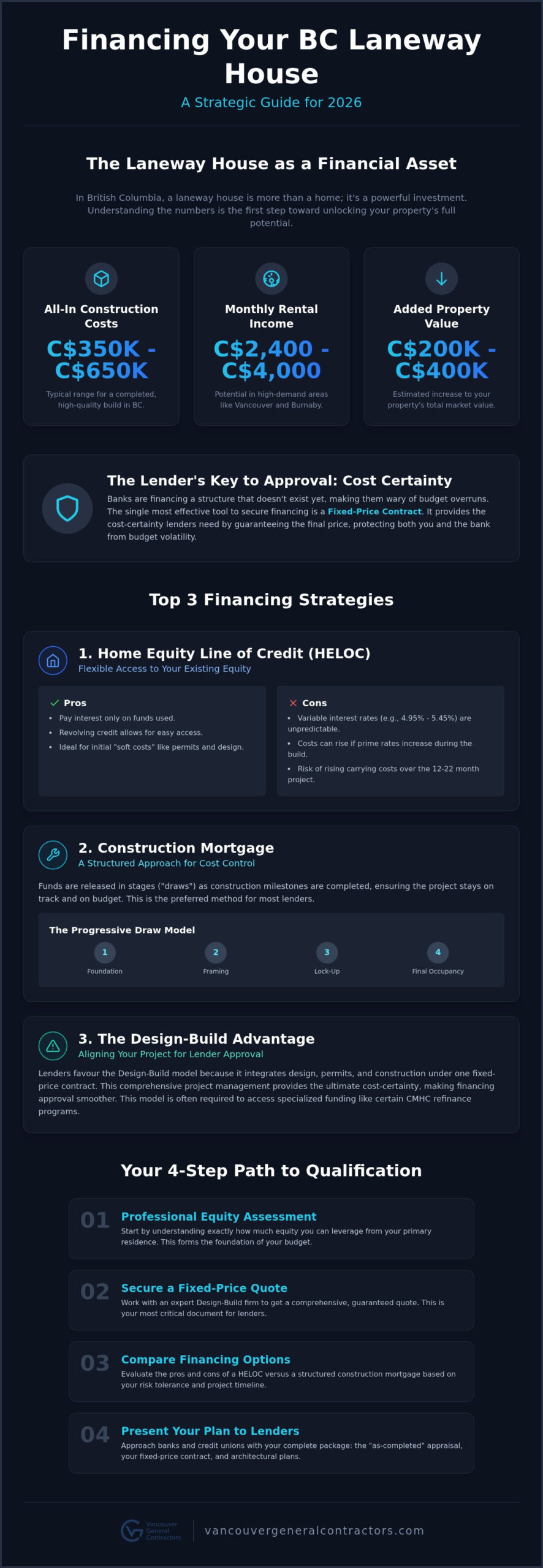
A Laneway house in 2026 is far more than just a backyard cottage; it’s a sophisticated financial asset designed to build long-term security. As British Columbia continues its provincial push for “gentle density” to address housing shortages, these detached suites have become a primary tool for homeowners to maximize their land’s potential. Whether you’re creating a space for multigenerational living or seeking high-yield rental income, the regulatory environment has shifted in your favour. However, with all-in construction costs typically ranging from C$350,000 to C$650,000, you need a specialized plan. Learning how to finance a laneway house in bc is now an exercise in equity-driven development, particularly for Metro Vancouver residents who have seen their property values rise significantly over the last decade.
Why BC Homeowners are Choosing Laneway Suites
The appeal of these structures is rooted in their versatility and the immediate financial relief they provide. In high-demand areas like Burnaby and Vancouver, a well-designed unit can generate between C$2,400 and C$4,000 in monthly rental income. This “mortgage helper” doesn’t just offset your primary residence costs; it fundamentally changes your debt-to-income ratio. Beyond immediate cash flow, these permanent structural additions are estimated to add between C$200,000 and C$400,000 to your property’s total value. It’s a legacy-building move that provides a high-end living environment for family members while protecting your financial future from market volatility.
The Unique Challenges of Financing Secondary Suites
Securing capital for a laneway build isn’t quite the same as getting a standard mortgage. Traditional lenders often hesitate because they’re financing a structure that doesn’t yet exist, and they’re wary of budget volatility. This is where “as-completed” appraisals become crucial in the BC lending market. Lenders need to see the projected value of your property once the suite is finished, rather than its current state. Navigating municipal zoning rules in Richmond, Surrey, and Coquitlam adds another layer of complexity, as each city has specific requirements for setbacks and utility connections that can impact your final budget. Because of these variables, banks look for high levels of cost-certainty before they’ll release funds. You’ll need a clear path forward that accounts for these regulatory hurdles and ensures your financing remains stable from the first permit to the final inspection.
Top 3 Financing Strategies for Your BC Laneway Build
Selecting the right financial vehicle is just as critical as the architectural design itself. While your home equity is the engine, the specific loan structure you choose determines your long-term cost-certainty. Most Metro Vancouver homeowners find success by blending flexibility with structured debt, ensuring they don’t overextend their primary mortgage while construction is underway. Understanding how to finance a laneway house in bc involves evaluating three primary paths, each with distinct advantages for your project’s lifecycle.
Home Equity Line of Credit (HELOC): Flexibility vs. Risk
For many residents in Burnaby or Vancouver, a HELOC is the most accessible tool because it leverages the existing equity in their primary residence. With the Bank of Canada’s prime rate sitting at 4.45% as of August 2026, typical HELOC rates hover between 4.95% and 5.45%. This option is ideal for managing “soft costs” like design fees and permit applications.
- Pros: You only pay interest on the funds you actually use, and the revolving nature allows for easy access to capital.
- Cons: Variable rates can be unpredictable; if interest rates climb during your 12 to 22 month build, your monthly carrying costs will rise.
Construction Mortgages: The Progressive Draw Model
A construction mortgage is a more structured approach where the bank releases funds in stages, or “draws,” as specific milestones are met. These typically occur at the foundation, framing, lock-up, and final occupancy stages. To secure approval, lenders almost always require a fixed-price contract from a professional builder. This document acts as a guarantee of cost-certainty, protecting both you and the bank from the budget volatility common in the industry. During the build, you generally make interest-only payments on the disbursed amount, which keeps your cash flow manageable until the unit is ready for a tenant.
The “Take-Out” Mortgage Transition
The most overlooked stage of financing is the “Take-Out” mortgage. Once construction is complete and you’ve secured an occupancy permit, you shouldn’t remain on a high-interest construction loan or a variable HELOC indefinitely. Instead, you transition the construction debt into a traditional, long-term mortgage. This “refinance and add” strategy allows you to lock in a lower fixed rate and potentially use the newly created rental income to qualify for better terms. It’s a methodical progression that moves you from the risk of construction to the security of a permanent asset.
Managing these complex transitions requires a partner who acts as a “Transparent Expert,” handling the logistical competence of the build so your lender remains confident. If you’re ready to see how your property’s equity can work for you, it’s a good idea to consult with a specialized laneway builder who understands the Metro Vancouver market.
BC Government Grants and Incentives in 2026
Government support for housing has shifted toward direct density incentives rather than simple cash grants. While the high-profile provincial programs of previous years have evolved, several financial levers remain available to help you reduce the total cost of your build. Understanding how to finance a laneway house in bc in 2026 requires a clear-eyed look at which incentives have concluded and which tax rebates can still be claimed to protect your project’s bottom line.
The BC Secondary Suite Incentive Program (SSIP)
The BC Secondary Suite Incentive Program (SSIP) functioned as a forgivable loan for homeowners, offering a maximum grant of C$40,000 to those who committed to below-market rental rates for five years. It’s vital for homeowners to recognize that this specific program stopped accepting new applications on March 30, 2025. While you might see outdated references to this C$40,000 grant online, it’s no longer a viable source of new capital for 2026 projects. If you’re currently managing a build that was approved under this program, your builder must provide specific occupancy documentation to ensure the loan remains forgivable. For new builders, the focus has shifted toward tax-based recovery and municipal fee reductions.
Federal GST Rebates and Rental Incentives
The most reliable financial incentive currently available is the Federal GST New Residential Rental Property Rebate. This program allows you to recover a portion of the GST paid on construction materials and labour, provided the laneway house is used as a long-term rental. Because this is a rebate rather than an upfront grant, you must still secure the full construction capital through your primary lender. Once the unit is tenanted, you can apply for this recovery, which acts as a significant cash injection to help pay down your construction mortgage or HELOC.
Municipal Rebates and Permit Fee Waivers
Local governments in Metro Vancouver are now the primary drivers of “finance-to-permit” efficiency. Many cities have realized that reducing the soft costs of construction is the fastest way to encourage new housing.
- Vancouver: The city has largely removed mandatory on-site parking requirements for laneway homes, which can save you between C$15,000 and C$30,000 in excavation and paving costs.
- Burnaby and Coquitlam: These municipalities have streamlined the “finance-to-permit” pipeline by offering expedited review processes for standardized laneway designs.
- New Westminster: Local incentives often include permit fee waivers or reduced utility connection fees for homeowners who meet specific energy-efficiency targets.
These municipal changes don’t provide cash in your hand, but they significantly lower the total amount you need to borrow. By reducing the project’s complexity and timeline, you minimize the period where you’re paying interest on a construction loan without a tenant in place.
How Design-Build Alignment Secures Better Financing
Banks are fundamentally risk-averse institutions. When you approach a lender to ask how to finance a laneway house in bc, they aren’t just evaluating your credit score; they’re scrutinizing the viability of the build itself. Traditional general contracting often leads to fragmented communication between the architect and the builder, creating budget “leakage” that makes loan officers hesitant. By contrast, the design-build model provides an integrated approach where the budget is established alongside the design. This alignment creates a level of cost-certainty that makes your project a much more attractive prospect for construction financing, as it demonstrates a professional and managed project lifecycle.
Eliminating the “Appraisal Gap”
An appraisal gap occurs when the bank’s valuation of your future laneway house is lower than the actual construction cost, leaving you to cover the difference out of pocket. This is a common pitfall with “cost-plus” contracts, where the final price is a moving target. To protect your equity, you need a fixed-price construction agreement. This document locks in the total investment before the first shovel hits the dirt. We use advanced 3D design and early-stage engineering to identify potential issues in the virtual world before they become expensive change orders in the real one. This meticulous pre-construction planning ensures the bank’s “as-completed” appraisal is based on reality, not guesswork.
The Role of Permits in Your Financing Timeline
The timing of your loan draws is inextricably linked to your municipal status. Lenders generally won’t release the first major draw of funds until a valid building permit is in place. Whether you’re navigating the specific bylaws in West Vancouver or the utility requirements in Delta, an integrated permit management service is essential. If your permit process stalls, your financing stalls, which can lead to missed construction windows and increased interest carrying costs. By managing the entire pipeline from initial concept to final permit, we ensure that your financing timeline remains uninterrupted. This seamless transition from the drawing board to the construction site is what defines our role as a stable partner in your project’s lifecycle. It’s a strategic way to manage how to finance a laneway house in bc while maintaining logistical competence.
Securing the capital for your build is only half the battle; ensuring that capital is deployed efficiently is where professional expertise becomes invaluable. If you’re ready to bridge the gap between your vision and financial feasibility, consult with our experts about your laneway project to see how our fixed-price model can provide the security you and your lender require.
Steps to Qualify for a Laneway House Loan in BC
Qualifying for a loan is a methodical process that rewards preparation and transparency. Before you approach a lender, you must move from a broad vision to a granular, documented plan. This ensures your bank sees a stable investment rather than a high-risk construction project. By following these five steps, you’ll understand exactly how to finance a laneway house in bc while maintaining control over your property’s equity.
- Step 1: Conduct an equity assessment. Most lenders allow you to borrow up to 80% of your home’s current value minus the existing mortgage. Knowing this number early prevents wasted time on designs that exceed your borrowing capacity.
- Step 2: Secure a fixed-price quote. Partnering with a reputable laneway builder is essential here. This document is the cornerstone of your application, as it eliminates the fear of budget volatility for the bank.
- Step 3: Order an “as-completed” appraisal. This report estimates the total property value once the laneway house is finished. This often unlocks significantly more capital than a standard refinance because it accounts for the value the new structure adds.
- Step 4: Navigate the mortgage stress test. Lenders will evaluate your ability to handle payments at a rate approximately 2% higher than your actual contract rate.
- Step 5: Finalize your draw schedule. This defines when the bank releases funds based on verified construction milestones, ensuring the project remains on track.
Calculating Your Debt-to-Income Ratio with Rental Projections
One of the most powerful tools in your qualification toolkit is the “rental offset.” In 2026, most BC banks allow you to use between 50% and 80% of your projected rental income to help you qualify for a larger loan. For instance, if your two-bedroom unit in Richmond is projected to rent for C$3,500, a bank might add C$2,800 to your monthly qualifying income. The difference between “gross” and “net” offsets depends on the lender, but having a professional rental market assessment can tip the scales in your favour. For 2026, the mortgage stress test remains a critical hurdle, requiring you to prove you can manage debt at a rate of at least 2% above your offered mortgage rate or a floor rate of 5.25%.
Documentation Checklist for Your Lender
Banks require a comprehensive package to move from pre-approval to a firm commitment. Your builder should provide high-value documentation that reinforces the project’s permanent value. This level of organization signals to the lender that you’re working with a specialized expert who takes full responsibility for the project lifecycle. You’ll need to gather:
- A signed fixed-price contract and detailed specification sheets.
- Full 3D architectural designs and engineering plans.
- Valid building permits or municipal approval letters from your local city hall.
- A current mortgage statement and proof of property tax standing.
By presenting a polished, professional package, you alleviate the typical anxieties banks have regarding large-scale construction. This disciplined approach is the most effective way to secure the capital needed to transform your backyard into a high-end living environment.
Build Your Future with Financial Certainty
Building a laneway house is a transformative life experience that requires a stable partner to handle the logistical hurdles. You’ve seen that the path to success lies in the synergy between architectural design and financial transparency. By choosing a design-build model, you eliminate the appraisal gaps that often derail traditional construction projects. Leveraging your equity through a fixed-price agreement ensures your lender remains confident from the initial permit to the final occupancy certificate.
Mastering how to finance a laneway house in bc is the first step toward creating a lasting legacy on your property. Whether you’re planning for multigenerational living or high-yield rental income, the right structure provides the security you need in a complex market. We provide a fixed-price guarantee for total cost-certainty and expert guidance through the BC permit maze, all backed by an industry-leading warranty for your long-term security. It’s time to turn your backyard into a sophisticated asset that serves your family for decades.
Ready to take the next step? Book a Free Design-Build Consultation for Your Laneway Project today. We look forward to helping you create a high-end living environment with absolute confidence.
More Uncategorized Guides

Building a Wheelchair-Accessible Bathroom in Burnaby: A Practical Homeowner’s Guide

Richmond Aging-in-Place Renovations: Long-Term Comfort

Small Condo Kitchen Design Ideas in Burnaby: 2026 Planning Guide

Condo Renovation Contractors in Vancouver: A Strata-Smart Buying Guide

Office Space Renovation Contractors in Surrey: A Practical Buying Guide
Ready to start your renovation?
Frequently Asked Questions
Can I use the rental income from a laneway house to qualify for the mortgage?
Yes, most Canadian lenders allow you to use a significant portion of projected rental income to help you qualify. Banks typically apply a rental offset of 50% to 80% of the market rate for a unit in your specific area. This additional income can strengthen your debt-to-income ratio, making it easier to manage how to finance a laneway house in bc while maintaining your primary mortgage.
How much does it cost to build a laneway house in BC in 2026?
The all-in cost for a professional laneway build in 2026 generally ranges from C$350,000 to C$650,000. These figures reflect the 12% to 18% increase in labour and materials observed since 2024. Your final budget depends on the complexity of the design, site conditions, and utility connections. Working with a builder who offers a fixed-price contract is the best way to ensure these costs remain predictable for your lender.
Does a laneway house increase property taxes in Vancouver or Burnaby?
Yes, adding a permanent structure like a laneway house will likely increase your annual property taxes. Because these suites can add between C$200,000 and C$400,000 to your property’s assessed value, BC Assessment will adjust your valuation accordingly. However, the substantial rental income generated by the new suite, often reaching C$4,000 per month, typically far outweighs the modest increase in your municipal tax bill.
What is the BC Secondary Suite Incentive Program, and do I qualify?
The BC Secondary Suite Incentive Program was a provincial initiative that offered a forgivable loan of up to C$40,000 for homeowners. It’s important to realize that this program is no longer accepting new applications as of March 30, 2025. Homeowners in 2026 should instead focus on traditional financing methods, such as HELOCs or construction loans, to fund their backyard development projects.
Can I finance a laneway house if I still have a mortgage on my main home?
You can certainly finance a new build even if you have an existing mortgage on your primary residence. Most homeowners utilize a Home Equity Line of Credit (HELOC) or a mortgage refinance to access the capital needed for construction. As long as your total debt doesn’t exceed 80% of your property’s appraised value, you can successfully navigate how to finance a laneway house in bc with an active mortgage.
What happens if construction costs exceed my approved loan amount?
If costs exceed your loan, you’re responsible for covering the difference out of pocket, which can lead to significant financial stress. This “appraisal gap” is a common risk with cost-plus contracts that have moving price targets. To protect yourself, we recommend securing a fixed-price construction agreement. This contract locks in your total costs from the start, providing the stability your bank requires to release funds without unexpected hurdles.
How long does the financing approval process take for a laneway build?
The financing approval process typically takes between four and eight weeks, depending on the complexity of your application. Lenders require time to review your “as-completed” appraisal, your builder’s fixed-price contract, and your current equity standing. Having a complete documentation package ready, including your 3D designs and municipal permit status, can significantly speed up the bank’s decision-making timeline and get your project moving faster.
Is a HELOC better than a construction loan for a small laneway project?
A HELOC is often better for homeowners with substantial equity because it offers lower interest rates and interest-only payment flexibility. However, for larger projects where equity is tighter, a construction loan provides a structured draw schedule that mirrors your build milestones. While construction loans have higher rates, usually between 6.5% and 9.5%, they offer a dedicated pool of capital that isn’t tied to your daily revolving credit.

Comments are closed