





Resolving Disputes and Understanding Vancouver Renovation Permit Requirements: A Homeowner’s Guide
With 89% of BC construction industry participants reporting late payments in the past year, it’s no surprise that many homeowners feel a sense of dread when project timelines begin to slip. You might be sitting in a half-finished kitchen, worrying about whether your contractor followed the latest vancouver renovation permit requirements or if a surprise property lien is lurking around the corner. It’s an exhausting position to be in, especially when you’re just looking for the security of a home that’s built to last and fully compliant with the BC Building Code.
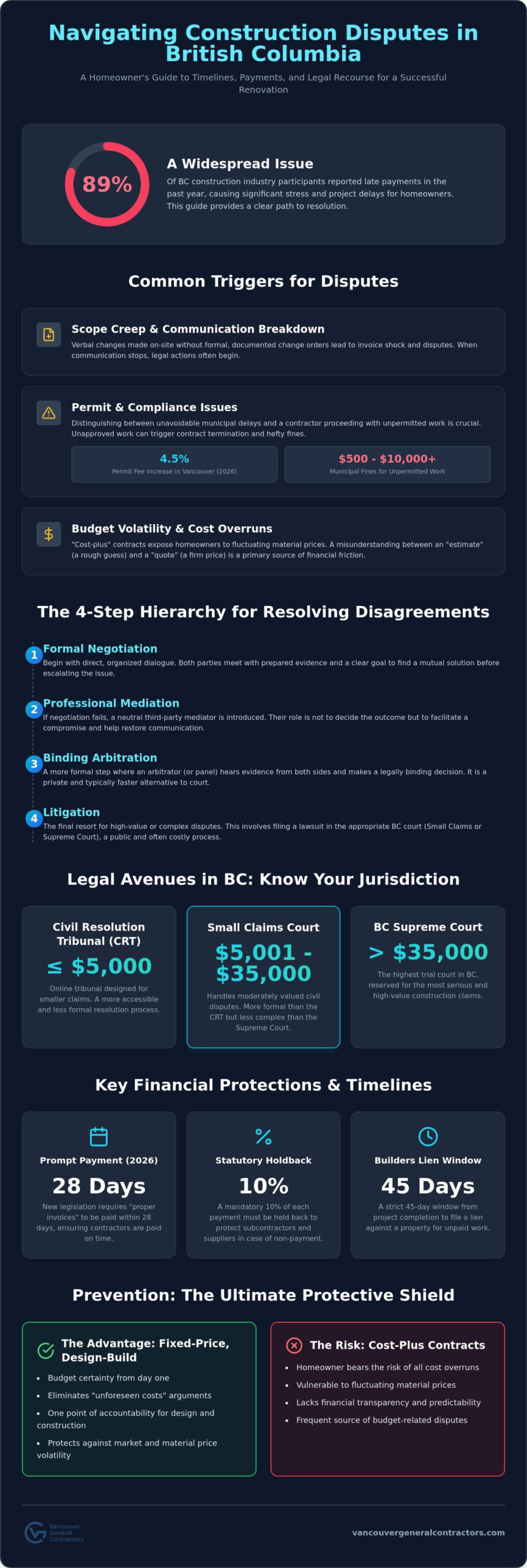
This guide is designed to replace that anxiety with the clarity of a transparent expert. You’ll learn how to navigate disagreements using the 2026 prompt payment legislation, which requires “proper invoices” to be settled within 28 days, and how to manage the mandatory 10% statutory holdback. We will walk through the steps to resolve financial disputes through the Civil Resolution Tribunal for claims up to $5,000 and explain how the City of Vancouver’s 4.5% permit fee increase for 2026 impacts your project’s bottom line. By the end, you’ll have a clear roadmap to a finished renovation and a fair settlement for all parties involved.
Key Takeaways
- Learn how to distinguish between contractor performance issues and municipal processing delays to determine the most effective path for dispute resolution.
- Understand the 2026 monetary thresholds for the Civil Resolution Tribunal and Small Claims Court to ensure your legal claims are filed in the correct jurisdiction.
- Navigate the latest vancouver renovation permit requirements and fee structures to protect your home from municipal fines and unpermitted work disclosures.
- Master the essential timelines of the BC Builders Lien Act, including the 10% statutory holdback and the 45-day window for filing or discharging liens.
- Discover how a fixed-price, design-build model serves as a protective shield against budget volatility and the most common triggers for construction disagreements.
Common Triggers for Construction Disputes and Vancouver Renovation Permit Requirements
Disputes rarely happen by accident. They are typically the result of a slow erosion of trust, often starting with a misunderstanding of the vancouver renovation permit requirements or a lack of clarity in the initial contract. To find a resolution, you must first identify the root cause of the friction. Is the issue poor workmanship that fails to meet the BC Building Code, or is it a timeline delay caused by supply chain volatility? Distinguishing between a contractor’s lack of diligence and external municipal delays is the first step toward a fair settlement.
In the Lower Mainland, the “Scope Creep” trap is a frequent culprit for project breakdown. This happens when verbal changes are made on-site without being documented in a formal change order. When the final invoice arrives, the homeowner is shocked by the costs, while the contractor feels unappreciated for the extra effort. This communication breakdown often leads to the most dangerous stage of a renovation: silence. When parties stop talking, legal tools like the Builders Lien Act often become the only remaining language of the project.
How Permit Delays Impact Your Project
Setting realistic expectations for a home renovation Vancouver project requires understanding the city’s current regulatory climate. With the City of Vancouver increasing permit fees by 4.5% in 2026 and implementing stricter digital tracking, the process can be slow. It’s vital to recognize when a permit holdup is entirely outside your contractor’s control; municipal backlogs are a reality of living in a high-demand urban centre. However, “unpermitted work” is a different matter. If a contractor proceeds without the necessary approvals, it creates a primary legal trigger for contract termination and can lead to municipal fines starting at $500 and reaching upwards of $10,000.
Budget Volatility and Cost Overruns
The distinction between an “estimate” and a “quote” is a critical legal nuance in BC. An estimate is a rough guess, whereas a quote is a firm commitment to a price. Many kitchen renovation Vancouver projects hit snags because they rely on older “cost-plus” contracts that leave homeowners vulnerable to fluctuating material prices. When costs spike, the lack of financial transparency creates immediate friction. Utilizing a fixed-price model is often the most effective way to eliminate these “unforeseen costs” arguments, ensuring that the vancouver renovation permit requirements and construction tasks stay within a predictable budget from day one.
The 4-Step Hierarchy for Resolving Contractor Disagreements in BC
When a renovation project begins to veer off course, it is essential to follow a structured hierarchy for resolution. This methodical approach protects your emotional well-being and your financial investment. Most disputes in British Columbia follow a four-stage progression, starting with collaborative negotiation and ending, if necessary, in the court system. By moving through these steps deliberately, you often find that a solution appears before expensive legal fees begin to mount. Understanding the official Vancouver Renovation Permit Requirements helps you determine if the contractor’s performance aligns with municipal standards, providing a factual basis for your concerns.
The hierarchy begins with Formal Negotiation, where both parties attempt to resolve the issue through direct dialogue. If this fails, Professional Mediation introduces a neutral third party to facilitate a compromise. For more entrenched disagreements, Binding Arbitration offers a private, faster alternative to the public court system. Finally, Litigation in the BC Supreme Court remains the last resort for high-value claims where no other resolution is possible. Following this path ensures you remain the driver of the process rather than a passenger in a chaotic legal battle.
Mastering the Art of Negotiation
Preparation is the foundation of any successful negotiation. Before you sit down with your contractor, organize your evidence by comparing the current state of the project against your initial contract and 3D designs. Take clear, dated photos of any workmanship concerns and keep a log of all timeline delays. Adopt a solution-oriented approach by focusing on how to fix the specific issue rather than assigning blame. A Notice of Dispute is a formal legal trigger that officially signals the commencement of the resolution process as defined within your construction agreement. Using this formal document shows the contractor that you are serious about accountability while still leaving the door open for a professional fix.
Mediation vs. Arbitration: Which fits your project?
Mediation is often the most cost-effective second step, as it allows both parties to find centre ground without a binding decision being forced upon them. However, for complex custom home builders Vancouver disputes involving significant structural changes or high-value contracts, arbitration is frequently preferred. Arbitration awards are final and legally enforceable in British Columbia, providing a level of certainty that mediation cannot offer. While private arbitration involves fees for the arbitrator, the speed of the process usually saves homeowners money compared to years of court delays. To avoid these hurdles entirely, it is often best to partner with Vancouver General Contractors who utilize fixed-price models to prevent financial friction from the start.
Legal Remedies in BC: CRT vs. Small Claims vs. Supreme Court
Determining where to file your claim is a matter of jurisdiction, which is essentially the legal authority of a specific body to hear your case. In British Columbia, the path you take depends entirely on the dollar amount at the centre of the disagreement. For smaller workmanship issues or minor contract breaches, the Civil Resolution Tribunal (CRT) is your first stop. If the dispute involves a mid-range project, Small Claims Court handles values between $5,001 and $35,000. For significant failures in large-scale home additions Vancouver, the BC Supreme Court is the necessary venue for claims exceeding $35,000. Understanding these boundaries ensures you don’t waste time or resources in the wrong forum.
Choosing the right venue is about more than just the money; it’s about the complexity of the evidence required. While a simple dispute over vancouver renovation permit requirements might be settled quickly through an online portal, a structural failure requires a more robust legal environment. Each level of the BC justice system offers different tools for discovery and expert testimony, which can be the deciding factor in whether you receive a fair financial settlement. Being organized and disciplined in your approach to these venues is exactly how a transparent expert protects their interests.
Using the Civil Resolution Tribunal (CRT)
The CRT is an accessible, lawyer-free path designed to be user-friendly. You can file a claim online from your own home in about fifteen minutes, making it the most efficient way to handle smaller disagreements. In 2026, the CRT remains the mandatory venue for most construction disputes valued at $5,000 or less. Decisions are typically reached within four to six months, which is significantly faster than traditional court timelines. It’s an ideal tool for resolving disagreements over finishing details or minor permit issuance fees that don’t justify the expense of a full trial.
When to Escalate to BC Supreme Court
When the “Value at Risk” is substantial, escalating to the BC Supreme Court becomes a strategic necessity. This is often the case for structural failures, major contract abandonments, or projects with significant land value implications. For example, building a laneway house in vancouver involves complex zoning and high capital investment. A total project failure in this category would likely exceed the $35,000 Small Claims limit. In the Supreme Court, expert witness testimony from structural engineers or specialized consultants is vital to prove negligence. While legal fees are higher, this venue provides the necessary framework to handle the high-stakes financial recovery required to protect your property’s permanent value.
Protecting Your Assets: Documentation and the Builders Lien Act
A Builders Lien is more than just a legal nuisance; it’s a formal claim against your property title that can halt a sale or prevent you from refinancing your home. In British Columbia, anyone who provides work or materials to your project has the right to file a lien if they aren’t paid. This includes everyone from the primary contractor down to the individual plumber or lumber yard. While meeting vancouver renovation permit requirements ensures your structure is legal, the Builders Lien Act ensures the financial side of the project remains transparent and fair for all parties involved.
The timeline for these claims is strict. Under the 2026 amendments to the Act, contractors and subcontractors have 45 days from the date of project completion or abandonment to file a lien. Consequently, the statutory holdback period has been adjusted to 46 days to ensure all potential claims are cleared before final funds are released. If you believe a lien has been filed in bad faith or contains errors, you have the right to challenge it. However, doing so requires a meticulous record of every interaction and payment made during the build.
The Essential Paper Trail
Your best defence against a lien or a financial dispute is a disciplined paper trail. This includes daily logs, progress photos, and time-stamped emails that track the project’s evolution. Verbal agreements are the primary source of friction in the Lower Mainland. To remain enforceable, every change to the original plan must be documented in a signed “Change Order” that outlines the specific cost and timeline impact. Retaining a 10% holdback from every progress payment is a statutory requirement in BC, serving as a protective pool of funds to satisfy potential lien claims without risking your personal assets.
Dealing with Subcontractor Liens
A common anxiety for homeowners is the “double payment” trap. This occurs when you pay your general contractor in full, but they fail to pay their subcontractors. Even if you’ve fulfilled your contract, an unpaid plumber can still place a lien on your home. To prevent this, always request a “Statutory Declaration” with every invoice. This is a legal document where the contractor swears under oath that all subcontractors and suppliers have been paid to date. If a lien is already on your title, the legal process for paying money into court allows you to clear the title immediately while the dispute is settled in the background. For a project managed with total accountability from start to finish, contact Vancouver General Contractors to discuss our transparent contract models.
Prevention: The Design-Build and Fixed-Price Advantage
Pre-construction planning is the foundation of this protective approach. By utilizing advanced 3D design technology, you can visualize every detail of your home before a single hammer is swung. This level of granular detail prevents the “Scope Creep” mentioned earlier, as field errors are identified and corrected in the virtual world rather than during active construction. An industry-leading warranty provides the long-term security that your investment has permanent value, shifting the focus from a mere transaction to a legacy-building experience. When a firm takes full responsibility for both the creative vision and the logistical execution, the typical anxieties of project abandonment or surprise costs simply evaporate.
Why Fixed-Pricing Stops Disputes Before They Start
The most common trigger for construction disagreements is financial ambiguity. Fixed-price contracts eliminate this friction by removing the incentive for contractors to “pad” invoices mid-project due to poor estimating. Unlike “cost-plus” models, which can leave you vulnerable to market spikes, a fixed-price agreement relies on a detailed, line-item budget that serves as a shared source of truth. This transparency creates a stable partnership where you know the final cost before breaking ground. It replaces the stress of budget volatility with the peace of mind that comes from absolute cost-certainty, allowing you to focus on the excitement of your home’s transformation.
Choosing a Partner, Not Just a Contractor
Vetting your builder for longevity is perhaps the most critical step in protecting your assets. Established firms with a deep history in the Lower Mainland are significantly less likely to abandon projects or mismanage vancouver renovation permit requirements. Professional project management plays a central role in conflict de-escalation; when challenges arise, a disciplined team handles them with logistical competence so you don’t have to. Choosing a partner who prioritizes accountability and relationship-building ensures that your renovation is a transformative life experience rather than a legal burden. Experience a stress-free renovation with our fixed-price guarantee.
Securing Your Home’s Future with Confidence
A successful renovation is more than just an aesthetic transformation; it is the result of disciplined planning and clear communication. By mastering the hierarchy of dispute resolution and understanding the nuances of the Builders Lien Act, you protect both your property title and your peace of mind. We’ve explored how navigating vancouver renovation permit requirements correctly from the start prevents municipal friction, while a robust documentation trail ensures you remain in control of your investment at every stage.
The most effective way to eliminate the stress of construction is to remove the triggers for conflict before they ever arise. Since 2011, our team has provided a stable partnership for homeowners through fixed-price contract certainty and a comprehensive design-build process. This approach, backed by an industry-leading warranty, ensures your vision is delivered without the typical anxieties of budget volatility or project delays.
Book a consultation to discuss your fixed-price renovation project today and experience the security of working with a partner who prioritizes your long-term satisfaction. Your dream home is within reach, and with the right expertise, the process can be as rewarding as the final result.
Frequently Asked Questions
Can I fire my contractor if they are behind schedule in Vancouver?
You can terminate a contract for delays, but only if the timeline slip constitutes a “material breach” of the agreement. Most BC contracts include a “time is of the essence” clause, yet you must first issue a formal notice providing the contractor a reasonable opportunity to cure the delay. If the holdup is caused by external factors like municipal backlogs or supply chain volatility, a court may find termination unjustified.
What is the maximum amount I can sue for in the BC Civil Resolution Tribunal?
The Civil Resolution Tribunal (CRT) has a monetary limit of $5,000 for most construction and small claims disputes. It is a mandatory first step for claims within this range, designed to be a lawyer-free, online process. For disputes valued between $5,001 and $35,000, you must escalate the matter to the BC Provincial Court, commonly known as Small Claims Court.
How long does a contractor have to file a lien in British Columbia?
Contractors, subcontractors, and workers have exactly 45 days to file a claim of lien after the project is completed, abandoned, or the head contract is terminated. This deadline is strictly enforced under the BC Builders Lien Act. If they miss this window, they lose their right to a charge against your property title, though they may still pursue the debt through standard litigation or the CRT.
Do I need a lawyer to resolve a construction dispute in Vancouver?
You aren’t required to have a lawyer for the CRT or Small Claims Court, as these venues are designed for self-representation. However, legal advice is highly recommended if your dispute involves complex vancouver renovation permit requirements or structural negligence. For claims exceeding $35,000 in the BC Supreme Court, the procedural complexity usually makes professional legal counsel a necessity to protect your assets effectively.
What should I do if a contractor leaves the job unfinished?
How does the 10% holdback work in a residential renovation?
Homeowners are legally obligated to retain 10% of every progress payment in a dedicated holdback account. This fund protects you from liens filed by subcontractors or suppliers who weren’t paid by your primary contractor. Under the 2026 amendments, you can release this money 46 days after the project is substantially complete, provided no liens have been registered against your property title during that window.
Can a contractor sue me if there is no written contract?
Yes, a contractor can sue based on a verbal agreement or the legal principle of “quantum meruit,” which entitles them to be paid a reasonable amount for work performed. Without a written document, however, proving the agreed-upon scope and price becomes a difficult “he-said, she-said” battle. This uncertainty is why established firms prioritize fixed-price, written contracts to ensure total financial transparency and accountability.
What is the difference between mediation and arbitration in BC?
Mediation is a collaborative, non-binding process where a neutral third party helps both sides reach a voluntary settlement. Arbitration is more formal and results in a final, binding decision that is enforceable by the courts. Both options are private and often faster than litigation, especially when resolving technical disagreements over vancouver renovation permit requirements or specific finishing standards defined in your project’s 3D design phase.
More Uncategorized Guides

Building a Wheelchair-Accessible Bathroom in Burnaby: A Practical Homeowner’s Guide

Richmond Aging-in-Place Renovations: Long-Term Comfort

Small Condo Kitchen Design Ideas in Burnaby: 2026 Planning Guide

Condo Renovation Contractors in Vancouver: A Strata-Smart Buying Guide

Office Space Renovation Contractors in Surrey: A Practical Buying Guide

Comments are closed