




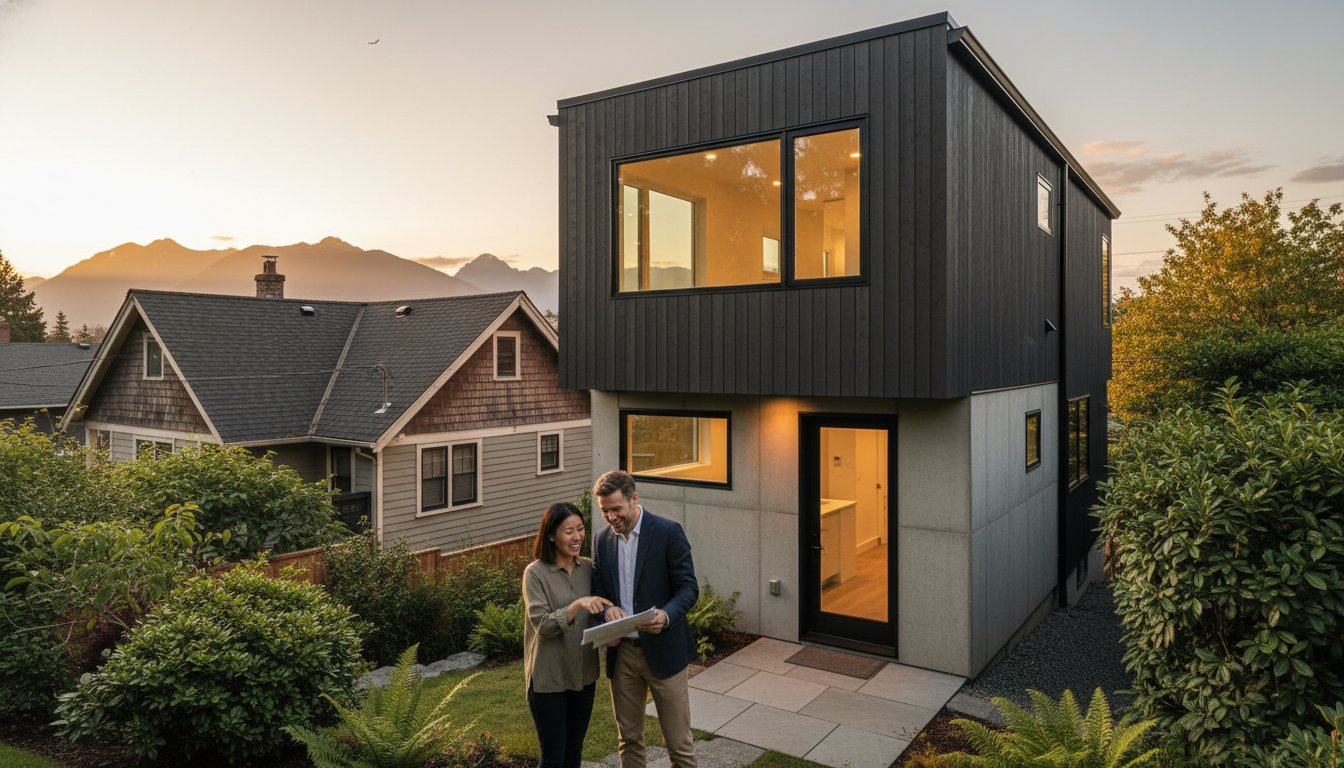
Vancouver Laneway Housing Guidelines: The 2026 Homeowner’s Reference
What if the most valuable square footage on your property isn’t actually inside your main house? While many see a backyard as a simple garden, savvy homeowners recognize it as a transformative opportunity to build lasting value. Mastering the 2026 vancouver laneway housing guidelines is no longer just about following city rules; it’s about strategically utilizing specific exclusions to maximize your new home’s livability and long-term durability.
We understand that the path from a vision to a finished structure often feels clouded by confusing zoning acronyms and the technical demands of the BC Energy Step Code. It’s natural to feel protective of your investment and wary of hidden permit costs that can disrupt a project’s rhythm. We’re here to provide the logistical competence and clear communication you need to move forward with absolute confidence. This reference guide breaks down the latest provincial Bill 44 impacts, verifies your lot eligibility, and clarifies exactly how much square footage you can realistically achieve. You’ll gain a methodical overview of the municipal application process, allowing you to focus on the excitement of design while we handle the complexities of regulatory compliance.
Key Takeaways
- Verify your lot’s eligibility under the updated R1-1 zoning categories to ensure your property meets the essential width and depth requirements for a legal build.
- Master the Floor Space Ratio (FSR) and height regulations to maximize your build’s livability while remaining compliant with 2026 municipal standards.
- Prepare for the mandatory transition to BC Energy Step Code Level 5 and the move toward sustainable, zero-emission heating for all new detached structures.
- Navigate the vancouver laneway housing guidelines through a methodical permit process that streamlines everything from pre-application to final engineering.
- Learn how a coordinated design-build approach provides the cost-certainty and logistical oversight required for a successful, high-end project lifecycle.
Understanding the 2026 Vancouver Laneway Housing Guidelines
A laneway house is a detached secondary dwelling unit typically located at the rear of a residential lot, providing a separate living space that opens onto the city’s back lanes. Under the current Vancouver Charter, these structures represent a strategic effort to increase urban density without compromising the aesthetic of established residential areas. The vancouver laneway housing guidelines prioritize this balance, ensuring that new builds contribute to the community’s character while offering much-needed housing diversity. Unlike secondary suites, which are contained within the primary residence, or coach houses, which often involve heritage revitalisation or strata titles, a laneway house remains a detached rental or family-oriented unit on a single-title lot.
The 2026 updates introduced a “Simplified Permitting” framework. This initiative aims to reduce the bureaucratic friction that previously slowed down construction. By streamlining the review process for standard residential lots, the City has made it easier for homeowners to plan their projects with greater predictability. Understanding the History of Laneway Housing in Vancouver reveals that while the program began as a modest experiment in 2009, it has evolved into a sophisticated system that now integrates high-performance building standards and refined architectural oversight.
The Shift to Standardized Housing Designs
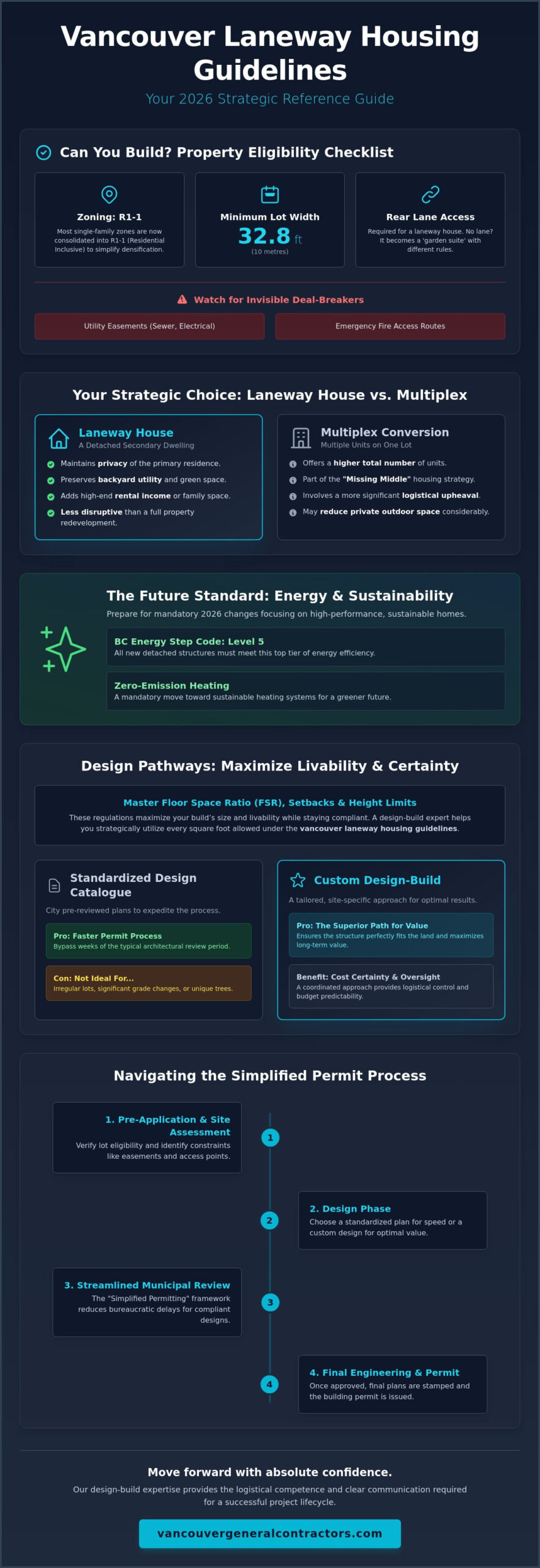
One of the most significant changes in the 2026 vancouver laneway housing guidelines is the introduction of the City’s pre-reviewed “design catalogue.” This collection of architectural plans has already undergone initial scrutiny by municipal planners. When you select a design from this catalogue, you effectively bypass several weeks of the typical architectural review period. It’s a methodical way to gain permit certainty early in the process. However, these standardized plans aren’t a universal solution. If your lot has an irregular shape, significant grade changes, or unique trees, a custom design-build approach remains the superior path to ensure the structure fits the land perfectly and maintains its long-term value.
Laneway vs. Multiplex: Choosing Your Path
The transition to R1-1 zoning, also known as Residential Inclusive zoning, has unified many of Vancouver’s traditional single-family areas. This policy change is a core component of the “Missing Middle” housing strategy, allowing for more units on a single lot. You now face a strategic choice: build a laneway house or pursue a multiplex conversion. While a multiplex can offer more total units, a laneway house is often the preferred choice for those who wish to maintain the privacy of their primary residence. It allows you to add a high-end, detached living environment while preserving your backyard’s utility. We see this as a protective investment. You gain rental income or space for family without the logistical upheaval of a full property redevelopment.
Zoning and Eligibility: Can You Build a Laneway House?
Zoning determines your project’s fate before the first shovel hits the dirt. Under the current vancouver laneway housing guidelines, the City has consolidated most traditional single-family zones into the R1-1 (Residential Inclusive) category. This shift, which replaced previous designations like RS-1, RS-5, and RS-6, was designed to simplify the path toward densification. However, being in an R1-1 zone doesn’t automatically guarantee a permit. Your lot must typically meet a minimum width of 32.8 feet (10 metres) to accommodate a standard build, though some exceptions exist for narrower parcels. If your property lacks a traditional rear lane, the building is technically classified as a garden suite, which triggers different access requirements and may limit your design options.
Invisible deal-breakers often lurk beneath the surface or overhead. Utility easements for sewer lines or electrical rights-of-way are non-negotiable; you cannot build permanent structures over these designated areas. Similarly, fire access is a critical safety pillar. If your property’s configuration prevents a clear line of sight or access for emergency crews, the City will likely reject the application. Identifying these constraints early is essential to avoid wasted design fees. For homeowners unsure about their property’s hidden restrictions, a professional expert site assessment can provide the clarity needed to move forward safely.
Lot Size and Site Coverage Limits
Site coverage is a delicate balancing act. The City generally limits the total coverage of all buildings on your lot, including the main house and the laneway home, to between 44% and 50% of the total lot area. You must also account for permeable surfaces. Vancouver’s rainwater management policies require a specific percentage of your backyard to remain “green” or porous to prevent urban flooding. Existing trees also dictate your building envelope. Significant or “protected” trees have critical root zones that can drastically shift where your laneway house can legally sit, often requiring custom foundation designs to ensure their survival.
Access and Safety Requirements
Safety regulations are the most rigid aspect of the 2026 bylaws. You must maintain a 0.9-metre unobstructed path from the front street to the laneway house to ensure fire crews can navigate the property in an emergency. This path cannot be blocked by air conditioning units, gas meters, or bay windows. Additionally, the distance between your primary residence and the new structure must typically be at least 16 feet (4.9 metres) to satisfy fire separation codes. Interestingly, the 2026 updates have largely removed mandatory on-site parking requirements for laneway homes, allowing you to trade a garage for more living space or a larger garden area.
Design Regulations: FSR, Setbacks, and Height Limits
The Floor Space Ratio (FSR) is the primary metric that dictates the scale of your project. Under current vancouver laneway housing guidelines, the standard FSR is typically 0.16 of your total lot area. For a standard 33′ x 122′ lot, this results in a maximum floor area of approximately 900 square feet (83.6 square metres). We view these limitations not as barriers, but as a framework for intelligent design. By understanding exactly how the City measures these spaces, we can ensure every square inch serves a purpose while maintaining a grounded, predictable project scope.
Height limits are equally specific and depend largely on your roof’s profile. A flat-roof structure is generally capped at 6.0 metres, while a sloped roof can reach up to 6.7 metres to accommodate a 1.5-storey layout. Setbacks are essential for maintaining harmony with your neighbours and providing adequate lane access. You must provide a minimum 0.9-metre setback from the rear property line and the side lines, though one side usually requires a 1.2-metre gap to facilitate better utility access and fire safety. These rules ensure that your new build feels like a natural extension of the neighbourhood rather than an imposition.
The 2026 “Green Bonus” is a significant development for homeowners prioritizing durability and long-term comfort. The City now allows for thicker, high-insulation walls without penalizing your total allowable floor area. You can build a more energy-efficient home with superior thermal performance without losing interior livability. It’s a protective measure that ensures your investment remains valuable as climate standards evolve, providing a level of cost-certainty by reducing future energy demands.
Maximizing Space with FSR Exclusions
Smart planning involves knowing what the City doesn’t count toward your FSR. You can often exclude crawl spaces under 1.2 metres in height and certain loft areas with limited headroom from your total square footage. Open-to-below spaces and porches also offer flexibility. The “8% rule” allows you to exclude up to 8% of your total allowable floor area for covered porches and balconies. Using a sloped roof strategically can also unlock “bonus” upper-floor area that doesn’t trigger the same massing penalties as a full second storey, allowing for a more spacious feel in a compact footprint.
Height and Massing Restrictions
Massing is about more than just height; it’s about being a stable partner in your community. The “shadowing” rule ensures your new build doesn’t unfairly block sunlight from adjacent backyards. To address this, the second floor often requires a “step-back,” where the upper level is physically narrower than the footprint below. When deciding between a basement or a slab-on-grade foundation, consider your site conditions carefully. While a basement adds significant cost, it’s often the most effective way to gain substantial extra space on smaller lots without violating municipal height caps.
Energy Step Code and Sustainability Standards
Building a laneway house in 2026 requires a fundamental shift in how we approach energy performance. The vancouver laneway housing guidelines now mandate compliance with BC Energy Step Code Level 5, which is currently the highest tier of the provincial framework. This standard effectively requires your new build to be “net-zero ready,” meaning the structure is so efficient it could theoretically produce as much energy as it consumes. One of the most significant shifts is the total ban on natural gas for space heating and domestic hot water in new detached units. Every project must now utilize zero-emission energy sources to align with the City’s long-term environmental targets.
Meeting these rigorous standards requires a methodical focus on the building envelope. We prioritize logistical competence by conducting mandatory airtightness testing, often called a Blower Door Test, at key stages of construction. This test measures exactly how much air leaks through the seals and joints of the house. To pass, the structure must hit a specific, low air-exchange rate. This level of precision is supported by high-performance windows and glazing. Triple-pane glass has become the baseline requirement to meet thermal performance minimums, ensuring your interior remains comfortable regardless of the season while protecting your investment from rising energy costs.
The Heat Pump Mandate
Electric heat pumps are now the non-negotiable standard for climate control in Vancouver. These systems provide both heating and cooling with incredible efficiency, but their installation requires specialized knowledge of municipal noise bylaws. You can’t simply place the exterior condenser unit anywhere. It must be positioned strategically to ensure decibel levels don’t disturb your neighbours, which often involves custom sound-dampening bases or specific yard placements. Various provincial incentives and rebates remain available for high-efficiency systems, helping to balance the initial equipment costs. If you want to ensure your project qualifies for every available credit, our team can help you design a sustainable laneway home that exceeds 2026 expectations.
Rainwater Management and Landscaping
Sustainability extends beyond the walls and into the soil. The City requires on-site water retention strategies to prevent the municipal sewer system from being overwhelmed during heavy rains. Your site plan will likely include dry wells or rain gardens designed to capture and slowly release runoff. Compliance with the “Green Factor” also dictates your landscaping choices. You must incorporate a specific percentage of native plants that thrive in our local climate and support biodiversity. Even your driveway and path materials are scrutinized; the guidelines typically require permeable surfaces like gravel or interlocking pavers to allow rainwater to soak directly into the ground rather than pooling on the surface.
Navigating the Permit Process with a Design-Build Expert
Securing a permit for your project is a multi-stage marathon that requires disciplined coordination and specialized expertise. The process begins with the Pre-Application phase, which we use to “test the waters” with the City of Vancouver. This initial check ensures your vision aligns with the vancouver laneway housing guidelines before you commit to significant design expenses. It’s a protective step that identifies potential roadblocks, such as site-specific utility constraints or tree protection requirements, early in the project lifecycle.
Once the concept is vetted, we move into the intensive technical phase. This involves the seamless integration of architectural, structural, and civil engineering drawings. In the 2026 regulatory environment, these plans must also detail your compliance with the BC Energy Step Code and rainwater management policies. Our role is to act as the central driver, managing these diverse consultants to ensure every drawing is synchronized. This methodical preparation reduces the likelihood of the City requesting revisions, which is the most common cause of permit delays.
The “Fixed-Price” advantage is perhaps the most vital component of our service. In an industry often plagued by budget volatility, we provide a stable partner through a transparent cost structure. By finalizing the project scope and material selections before construction begins, we offer the cost-certainty you need to feel secure. The process concludes only when we’ve cleared final inspections and secured the Occupancy Permit, the definitive milestone that transforms a construction site into a legal, high-end living environment.
Timeline Expectations for 2026
Planning your move-in date requires a realistic understanding of municipal rhythms. While a typical custom development permit can take 6 to 12 weeks and a building permit another 8 to 16 weeks, the total journey from consultation to move-in usually spans 12 to 18 months. However, opting for “Standardized Designs” from the City’s pre-reviewed catalogue can shave 3 to 5 months off the wait. We handle all interactions with the City’s Development and Building Services Centre, ensuring your application moves through the queue without unnecessary friction.
Why a Design-Build Partner is Essential
Managing a project of this scale independently often leads to the very anxieties we aim to eliminate. By choosing a design-build partner, you consolidate multiple consultants and contractors under one single point of accountability. This approach ensures the building a laneway house in vancouver process stays on budget and on schedule. We take full responsibility for the “Permit Maze,” handling the granular details of execution so you can focus on the excitement of your new space. Our long-standing tenure in the local industry serves as your guarantee of stability and enduring quality.
Transform Your Property with Confidence
Building a detached dwelling is a significant journey that requires both vision and logistical precision. By mastering the vancouver laneway housing guidelines, you’ve already taken the first step toward unlocking your lot’s hidden potential. From navigating the consolidated R1-1 zoning to meeting the rigorous requirements of BC Energy Step Code Level 5, the path to a successful build is defined by careful planning and expert oversight. We believe that adding a laneway house should be a transformative life experience, not a source of stress.
Our team provides the security of a fixed-price guarantee and absolute design-build transparency, ensuring your project remains on track and on budget. With our industry-leading warranty and a commitment to creating high-end living environments, we act as your stable partner from the initial pre-application phase to the final occupancy permit. You don’t have to navigate the permit maze alone. Ready to see what’s possible for your specific property? Book Your Free Laneway Feasibility Consultation today and let’s begin building your legacy together.
Frequently Asked Questions
Can I sell my laneway house separately from the main house in Vancouver?
No, you cannot sell a laneway house as a separate property. Under the current Vancouver Charter, these structures must remain on the same single title as the primary residence. They are intended as secondary rental units or family dwellings rather than strata-titled assets. This ensures the property remains a single investment while providing the benefits of increased density and rental income.
How much does a laneway house permit cost in 2026?
Homeowners should generally budget between $15,000 and $45,000 for municipal permits and Development Cost Charges (DCCs). These fees are separate from your architectural design and engineering costs, which typically range from $25,000 to $60,000. It’s vital to verify the specific fee schedule for your lot’s zoning at the start of the pre-application phase to ensure financial transparency.
What is the maximum size allowed for a laneway house on a standard 33-foot lot?
The maximum floor area is typically 0.16 FSR of the lot area, which equals approximately 900 square feet for a standard 33′ x 122′ lot. The vancouver laneway housing guidelines also mandate a minimum internal floor area of 280 square feet. We often use strategic exclusions for lofts and porches to help you maximize the usable space within these municipal limits.
Do I need to provide a parking space for my laneway house?
No, the 2026 bylaws have removed the mandatory requirement to provide on-site parking for laneway homes. This policy shift allows you to prioritize living space or garden areas over a traditional garage. You must still maintain a clear 0.9-metre unobstructed path from the front street to the rear unit to satisfy essential fire department access and safety requirements.
Is a basement allowed in a Vancouver laneway house?
Yes, you can include a basement in your design, provided it meets specific excavation and height regulations. While a basement increases the initial construction budget, it’s a methodical way to gain substantial extra square footage on smaller lots. This approach allows you to expand your living area without violating the 1.5-storey height cap for the structure’s visible massing.
How does the BC Energy Step Code affect my construction costs?
Complying with BC Energy Step Code Level 5 requires an investment in high-performance materials like triple-pane windows and advanced heat pump systems. While these components carry a higher upfront cost, they provide long-term cost-certainty by significantly reducing monthly energy bills. A superior building envelope also protects your property’s value as provincial sustainability standards continue to become more rigorous.
Can I build a laneway house if I already have a secondary suite in my basement?
Yes, the vancouver laneway housing guidelines permit a “triplex” configuration on most residential lots. This allows you to maintain a primary residence, a legal basement suite, and a detached laneway house on a single property. It’s a highly effective strategy for homeowners looking to maximize their rental potential or provide independent housing for multiple generations of family. To ensure your existing lower level meets current standards alongside your new build, working with experienced basement suite builders in Vancouver who understand the 2026 permit requirements is essential for a compliant, turn-key result.
What are the rules for renting out my laneway home as an investment?
You can rent your laneway house as a long-term residence, and these units often command a “detached premium” in the rental market. Current data shows two-bedroom units can rent for $2,700 to over $3,500 per month. If you’re considering short-term rentals, remember that Vancouver bylaws require the unit to be a primary residence, so you couldn’t list it while living in the main house.
More Uncategorized Guides
Building a Wheelchair-Accessible Bathroom in Burnaby: A Practical Homeowner’s Guide

Richmond Aging-in-Place Renovations: Long-Term Comfort

Small Condo Kitchen Design Ideas in Burnaby: 2026 Planning Guide

Condo Renovation Contractors in Vancouver: A Strata-Smart Buying Guide

Office Space Renovation Contractors in Surrey: A Practical Buying Guide

Comments are closed