





Course of Construction Insurance Explained: Protecting Your Vancouver Build
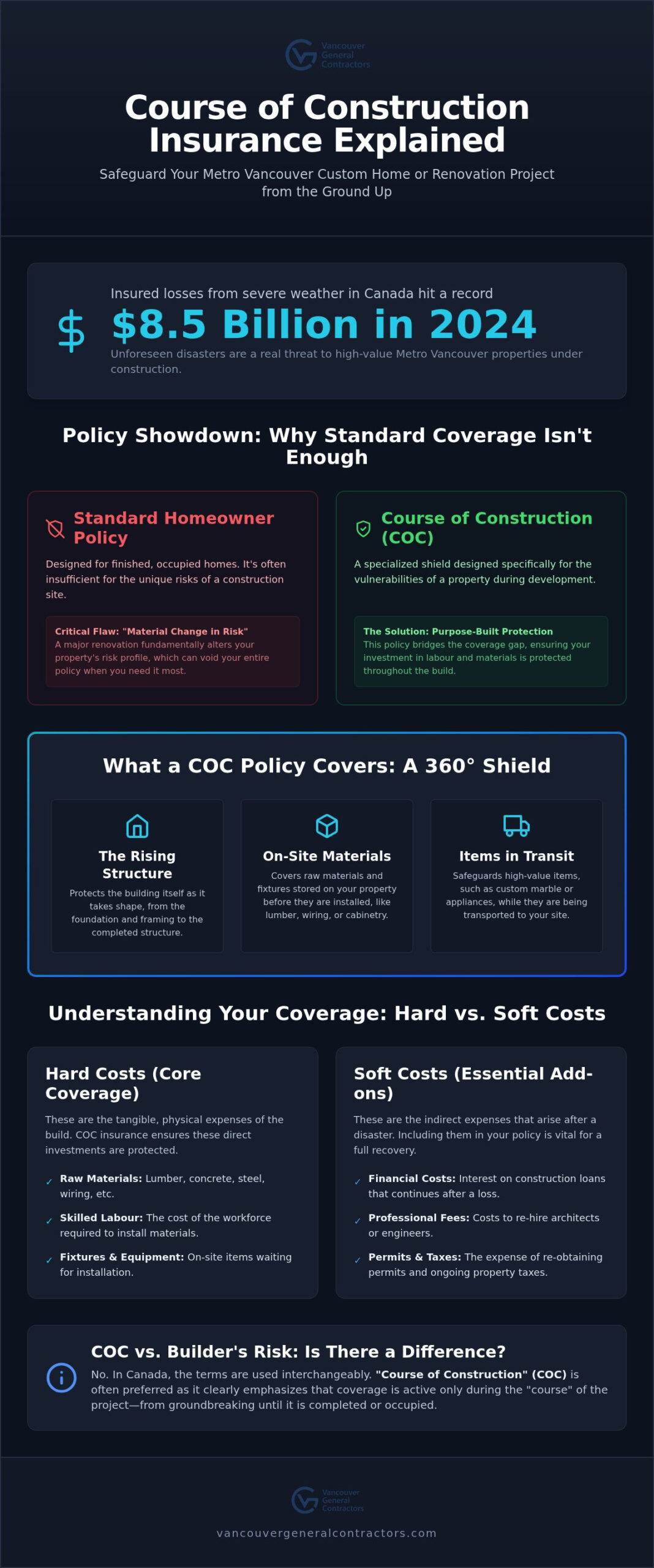
Would you gamble the entire equity of your Metro Vancouver home on a single “what if” scenario? Building a custom home or starting a major renovation is a significant milestone, yet many homeowners find themselves lying awake at night worrying about unforeseen disasters. With insured losses from severe weather in Canada hitting a record $8.5 billion in 2024, these anxieties aren’t just based on imagination. They’re grounded in a shifting climate and the reality of Vancouver’s high property values.
It’s natural to feel overwhelmed by technical jargon and the confusion over whether you or your builder should be the one signing the paperwork. You want to focus on the creative design of your new kitchen or the layout of your custom build, not the fine print of an insurance policy. This guide provides course of construction insurance explained so you can master these complexities and safeguard your investment with absolute confidence.
We’ll clarify exactly what is covered during your build, identify the precise moment to trigger your policy, and show you how to ensure your fixed-price contract aligns with your risk management strategy. By the end, you’ll have the clarity needed to protect your project from the ground up.
Key Takeaways
- Learn why a standard homeowner policy is often insufficient for major renovations due to the “Material Change in Risk” clause that can void your coverage.
- Get course of construction insurance explained to understand how it protects your structure, on-site materials, and items in transit from perils like fire and theft.
- Identify the specific factors that influence insurance premiums for custom builds in Metro Vancouver, including construction materials and site security measures.
- Discover how a fixed-price design-build methodology integrates proactive risk management to provide budget stability and eliminate hidden insurance surprises.
What is Course of Construction Insurance?
At its heart, Course of Construction (COC) insurance is a specialized shield for your property while it’s in its most vulnerable state: under development. Whether you’re adding a second storey to a Kitsilano character home or breaking ground on a new estate, this policy protects the physical assets of the project. Having course of construction insurance explained clearly is vital because it covers not just the rising structure, but also the materials sitting on your lawn and even high-end fixtures while they’re being transported to your site. For custom home builders in Vancouver, this isn’t just a recommendation; it’s a foundational requirement to ensure that a sudden setback doesn’t become a permanent financial collapse.
The policy ensures that every dollar you invest in labour and materials is accounted for. If a shipment of custom Italian marble is damaged on the Lions Gate Bridge, or if a midnight theft strips the copper wiring from your framed-in basement, the COC policy steps in. It provides the financial stability that allows a project to continue without forcing you to pay for the same work twice. This transparent approach to risk management is what keeps high-value builds on track in a volatile market.
The Core Purpose of COC Coverage
Standard property insurance is designed for finished, occupied homes. The moment you start a major renovation, the risk profile of your property changes. COC coverage bridges this gap by focusing on “hard costs.” These are the tangible expenses already poured into the build, including the raw materials and the skilled labour required to install them. By covering these investments, the policy ensures project continuity. If a catastrophic event like a fire occurs mid-build, you have the funds to clear the site and restart, rather than facing a total loss of your equity and hard work.
COC vs. Builder’s Risk: Is There a Difference?
You might hear your broker or contractor use different names for this protection. In Canada, Builder’s risk insurance and Course of Construction insurance are functionally identical. Some Vancouver brokers prefer the term COC because it emphasizes the “course” or the active timeline of the build. This distinction matters because the coverage only exists while work is actively progressing. You should realize that once the project is finished or occupied, the policy typically expires, and your standard homeowner insurance must take over to provide permanent protection for your new living environment.
What Does a Course of Construction Policy Cover?
Understanding the specific scope of your policy is the first step toward true financial peace of mind during a build. To have course of construction insurance explained effectively, you must look beyond the skeleton of the building itself. A comprehensive policy covers the rising structure, materials stored at temporary off-site locations, and even high-value fixtures while they’re in transit to your property. It’s vital to realize that your coverage must reflect the total replacement cost of the finished project. Relying on land value or initial purchase prices leaves a dangerous gap that could derail your investment if a total loss occurs mid-build.
Standard Perils and Common Add-ons
At its foundation, a policy protects against “named perils” including fire, lightning, explosions, and windstorms. Fire remains the most frequent and devastating claim in residential construction, often sparked by electrical faults or accidents during the framing stage. Beyond these basics, many homeowners choose to include “soft cost” coverage. This addition is essential because it handles the invisible drains on your budget after a disaster, such as ongoing property taxes, interest on construction loans, and the cost of re-obtaining municipal permits. As noted by Forbes Advisor on Builder’s Risk Insurance, these policies are highly flexible and should be tailored to the specific complexity of your home.
Theft and vandalism are also growing concerns, particularly during a home renovation in Vancouver where premium materials are often staged on-site. If a shipment of custom cabinetry or high-end appliances is stolen before installation, a robust policy ensures your fixed-price contract remains stable. You won’t be forced to dip into contingency funds to replace what was lost.
Metro Vancouver’s Unique Risk Profile
Building in the Lower Mainland requires a nuanced approach to risk that standard insurance templates often miss. In high-density areas like Kitsilano or East Vancouver, the proximity of neighbouring homes increases the risk of “exposure fires” where a problem next door threatens your project. Our coastal geography also demands specific considerations for seismic activity and localized flooding. Vancouver’s high labour costs further complicate the picture. If you need to rebuild in 2026, the price of local trades and specialized craftsmanship will be significantly higher than in other Canadian markets. Your policy must account for these local economic realities to ensure you aren’t under-insured.
Managing these intricate details is a core part of a professional build. If you’re feeling uncertain about your project’s protection, speaking with a transparent expert can help clarify how your insurance and construction contract work together to shield your equity.
Why Your Standard Homeowner Policy Isn’t Enough
A common misconception among Metro Vancouver homeowners is that their existing insurance policy remains a valid safety net during a major project. This assumption is dangerous. Most standard policies contain a “Material Change in Risk” clause. This legal requirement mandates that you notify your insurer of any significant changes to the property. Failure to do so can allow the insurer to void your entire policy, leaving you with zero coverage in the event of a claim. Having course of construction insurance explained in this context highlights that a standard policy is built for a finished home, not a work site.
Standard policies also carry structural exclusions. Once you remove a roof or compromise a load-bearing wall, your insurer may argue the building is no longer a “dwelling” in the traditional sense. This is particularly complex when building a laneway house in Vancouver. On a single lot, you now have one finished structure and one active construction site. Without specialized coverage, a mishap at the laneway build could potentially jeopardize the coverage for the primary residence.
The Danger of the ‘Renovation Exclusion’
Insurance providers in British Columbia differentiate strictly between minor cosmetic updates and major structural work. While painting or changing carpets might not trigger alarm bells, a kitchen renovation in Vancouver involving plumbing moves or wall removals often falls into the “major” category. If you move out during the project, your home might be classified as “vacant” or “unoccupied.” These statuses often trigger automatic policy cancellations after 30 days unless you have specific endorsements or a COC policy in place. You must realize that the risk of losing coverage for your existing structure is real if the project isn’t properly disclosed.
Wrap-Up Liability: The Essential Partner to COC
While COC protects the physical structure, it doesn’t address the legal risks of a busy construction site. This is where Wrap-Up Liability comes in. It acts as a comprehensive shield against third-party injuries or damage to neighbouring properties. Understanding the different Types of Construction Insurance is vital because Wrap-Up covers the “people” and “accidents,” while COC covers the “thing” you are building. By using a single Wrap-Up policy for the whole project, you avoid the “finger-pointing” that happens when multiple subcontractors’ individual policies clash after an incident. This provides a unified front of protection for your equity and your peace of mind.
How Much Does Construction Insurance Cost in BC?
While every project is unique, having course of construction insurance explained in financial terms helps you plan with precision. Generally, premiums in British Columbia range from 1% to 4% of the total construction cost, depending on the risk profile of the build. Unlike a standard home policy where rates are relatively static, construction premiums are dynamic. They respond to the total completed value of the project and the specific materials used. For example, a wood-frame structure often attracts higher premiums than steel or concrete due to the elevated fire risk during the framing stage. You’ll also need to be prepared for higher deductibles. In the construction insurance market, deductibles for specific perils like water damage or earthquake can be significantly higher than those on a typical residential policy, reflecting the increased exposure of an open site.
Key Factors Driving Your Premium
The most significant driver is the total completed value of the project. This is especially true for home additions in Vancouver, where the value of the existing structure must be integrated with the new work to ensure seamless coverage. The duration of your build also plays a critical role. A twelve-month project carries more risk than a six-month one, and insurers price accordingly. However, you can actively influence these costs. Implementing robust site security measures, such as perimeter fencing, motion-activated lighting, and monitored alarm systems, can lead to more favourable rates. Insurers value a proactive approach to loss prevention. A contractor with a proven safety record and disciplined site management can further reassure underwriters and potentially lower your costs.
The Value of a Single-Source Policy
One common point of confusion is whether the homeowner or the general contractor should purchase the policy. While some smaller firms may offer to handle it, there’s often a distinct advantage to the homeowner holding the policy directly. This ensures that the coverage remains in force even if a contractor needs to be replaced. It also prevents administrative markups that some firms might add to the premium. At Vancouver General Contractors, we believe in total financial transparency. We integrate these considerations into our fixed-price methodology so there aren’t any hidden surprises. This approach ensures your budget remains stable while your investment is fully protected. If you want to ensure your build is backed by this level of professional oversight, contact our team to discuss your project.
Managing Risk with Vancouver General Contractors
At Vancouver General Contractors, we realize that a successful build is defined by the meticulous planning that happens before the first shovel hits the dirt. Our design-build methodology, established in 2011, is built on the principle of total accountability. We don’t just manage the creative design; we manage the logistical and financial safety net that surrounds it. By having course of construction insurance explained within our proprietary multi-stage process, we ensure that risk management is a proactive strategy rather than a reactive fix. We coordinate directly with municipal authorities across Metro Vancouver to ensure every permit requirement aligns with your insurance obligations, protecting you from the bureaucratic friction that often stalls custom builds or major renovations.
Insurance in the Design-Build Lifecycle
Risk assessment begins the moment we start the 3D design and engineering phase. We don’t wait for construction to begin to think about protection. Our team vets every subcontractor to ensure they carry their own professional coverage, creating multiple layers of protection that shield your equity. This rigour ensures that when we eventually transition from the active build phase to your permanent homeowner policy, there are no gaps or “grey areas” that could leave you exposed. We act as your mentor through this transition, ensuring the long-term stability of your new living environment is never in question.
The Peace of Mind of Fixed Pricing
The most significant source of anxiety in construction is budget volatility. Our fixed-price contracts are designed to eliminate this fear entirely. We include the necessary insurance considerations and risk management protocols within our initial fee structure, so you never face a hidden surcharge or an unexpected premium spike mid-project. This financial transparency is a core part of our “Transparent Expert” persona. It allows you to focus on the excitement of your new home rather than the stress of logistical competence.
Once the project is complete, our industry-leading warranty serves as the final layer of protection, reinforcing our commitment to the enduring quality of our work. Your investment is safe, predictable, and managed by specialized experts who take full responsibility for the project lifecycle from start to finish. Start your stress-free renovation journey today and experience the confidence that comes with disciplined, expert-led construction management.
Secure Your Vancouver Investment with Confidence
Protect your investment by moving beyond the confusion of standard homeowner policies. You’ve seen the risks of under-insurance and the importance of having course of construction insurance explained to keep your equity safe. Whether you’re planning a whole home renovation or a custom build, the right coverage ensures that unforeseen events like fire or theft don’t derail your financial future. You deserve a partner who manages these technical complexities so you can focus on the creative journey of your build.
Since 2011, we’ve helped homeowners across Metro Vancouver navigate these challenges with total transparency. Our design-build methodology provides the certainty of a fixed-price contract. This approach ensures that insurance and risk management are integrated from day one of the planning process. When you partner with us, you gain the security of an industry-leading construction warranty and the expertise of a team dedicated to a stress-free project lifecycle.
Ready to build with certainty? Book a Consultation with Vancouver’s Design-Build Experts to start your project with a stable partner who prioritizes your peace of mind and long-term security.
More Uncategorized Guides





Ready to start your renovation?
Frequently Asked Questions
Do I need Course of Construction insurance for a small bathroom renovation?
Yes, you generally need to notify your insurer even for a bathroom renovation. While minor cosmetic updates might be covered, any project involving structural changes or plumbing moves constitutes a material change in risk. If you are undertaking a bathroom renovation in Burnaby or Richmond, your insurer must be informed to ensure your coverage remains valid. Having course of construction insurance explained in this context helps you avoid the risk of a voided policy during a claim.
When should a Course of Construction policy actually start?
A policy should be triggered the moment any physical work begins on your property. This includes the demolition phase or when materials are first delivered to your site in North Vancouver or Surrey. Waiting until framing is complete leaves you exposed during the most high-risk early stages of the build. You must ensure the policy is active before the first trade arrives to maintain a continuous shield over your investment equity and project assets.
Can I just use my contractor’s insurance instead of buying my own?
No, relying solely on your contractor’s insurance is a common mistake that leaves homeowners vulnerable. A general contractor carries Commercial General Liability to cover their own errors and third-party injuries. However, it doesn’t protect the physical structure of your home from perils like fire or windstorm. You need your own policy to cover the actual property assets, ensuring you have direct control over the claim process if a disaster occurs mid-build.
What happens if a fire occurs and I don’t have COC insurance?
Without this coverage, you face the very real possibility of a total financial loss. If a fire occurs during a major project and your insurer wasn’t notified of the construction, they can void your standard homeowner policy entirely. This is why having course of construction insurance explained is so critical for Vancouver residents. You could be left responsible for the remaining mortgage on a property that no longer exists, with no insurance payout available to rebuild.
Does COC insurance cover my personal belongings if I’m living in the home during construction?
Typically, COC insurance is designed to protect the building materials and the structure rather than your personal contents. If you remain in your home during a kitchen or basement renovation, you must coordinate with your broker to maintain a contents endorsement on your primary policy. COC policies focus on the “hard costs” of the construction project itself. They don’t usually extend to your furniture, electronics, or other personal items stored within the work zone.
Is earthquake coverage included automatically in BC construction policies?
Earthquake coverage is rarely automatic and usually requires a specific endorsement in British Columbia. Given the seismic profile of the Lower Mainland, adding this protection is a vital step for any custom home or large-scale renovation. You should realize that standard construction policies often exclude earth movement unless you explicitly request the coverage. Always verify the specific deductibles for earthquake damage, as they are often higher than standard fire or theft deductibles.
How do I determine the ‘replacement cost’ for my insurance application?
Replacement cost should reflect the total completed value of the project, not the current market value of the land. This includes the cost of all materials, specialized labour, and the professional fees defined in your fixed-price contract. When we manage your build, we provide a detailed breakdown of these costs during the design phase. This transparency ensures your insurance application is accurate and reflects the true investment required to rebuild from scratch in Vancouver’s market.
What is the difference between COC and General Liability insurance?
The difference lies in what is being protected. Course of Construction insurance covers the “property” or the physical building assets. In contrast, General Liability insurance covers “people” and “legal actions” resulting from accidents or injuries on the site. Both are essential components of a secure project. While COC ensures you can rebuild after a fire, General Liability protects you from the financial fallout of a lawsuit if a visitor or worker is injured on-site.

Comments are closed