





How to Budget for a Home Renovation in Vancouver: The 2026 Homeowner’s Guide
What if the most expensive part of your Vancouver renovation isn’t the Italian marble or the custom millwork, but the “unknowns” hiding behind your drywall and inside City Hall? You’ve likely heard the horror stories of “cost-plus” contracts that spiral out of control or permit delays that turn a six-month project into a year-long ordeal. It’s natural to feel anxious when the local market feels like a moving target. We realize that your home is your most significant legacy, and the fear of budget bloat is a valid concern for any homeowner in 2026.
This guide will show you exactly how to budget for a home renovation vancouver using a strategic framework designed to replace “The Vancouver Tax” with total cost certainty. You’ll gain a clear understanding of current cost tiers and learn how to manage municipal permit timelines across Metro Vancouver with confidence. We’ll preview how a fixed-price agreement and a meticulous 3D design phase can protect your finances from the hidden structural issues common in our city’s older homes. By the end of this article, you’ll have the roadmap needed to transform your living space into a high-end environment without the stress of unforeseen financial complications.
Key Takeaways
- Understand how the “Vancouver Tax” and current 2026 labour trends uniquely influence your project’s bottom line and regulatory timelines.
- Learn how to budget for a home renovation vancouver by distinguishing between simple cosmetic updates and comprehensive structural overhauls.
- Use a pre-construction feasibility study to identify hidden infrastructure risks, such as outdated wiring or seismic requirements, before they impact your finances.
- Discover why the design-build model provides superior cost certainty and transparency compared to the traditional “three quotes” bidding method.
Understanding the 2026 Vancouver Renovation Market
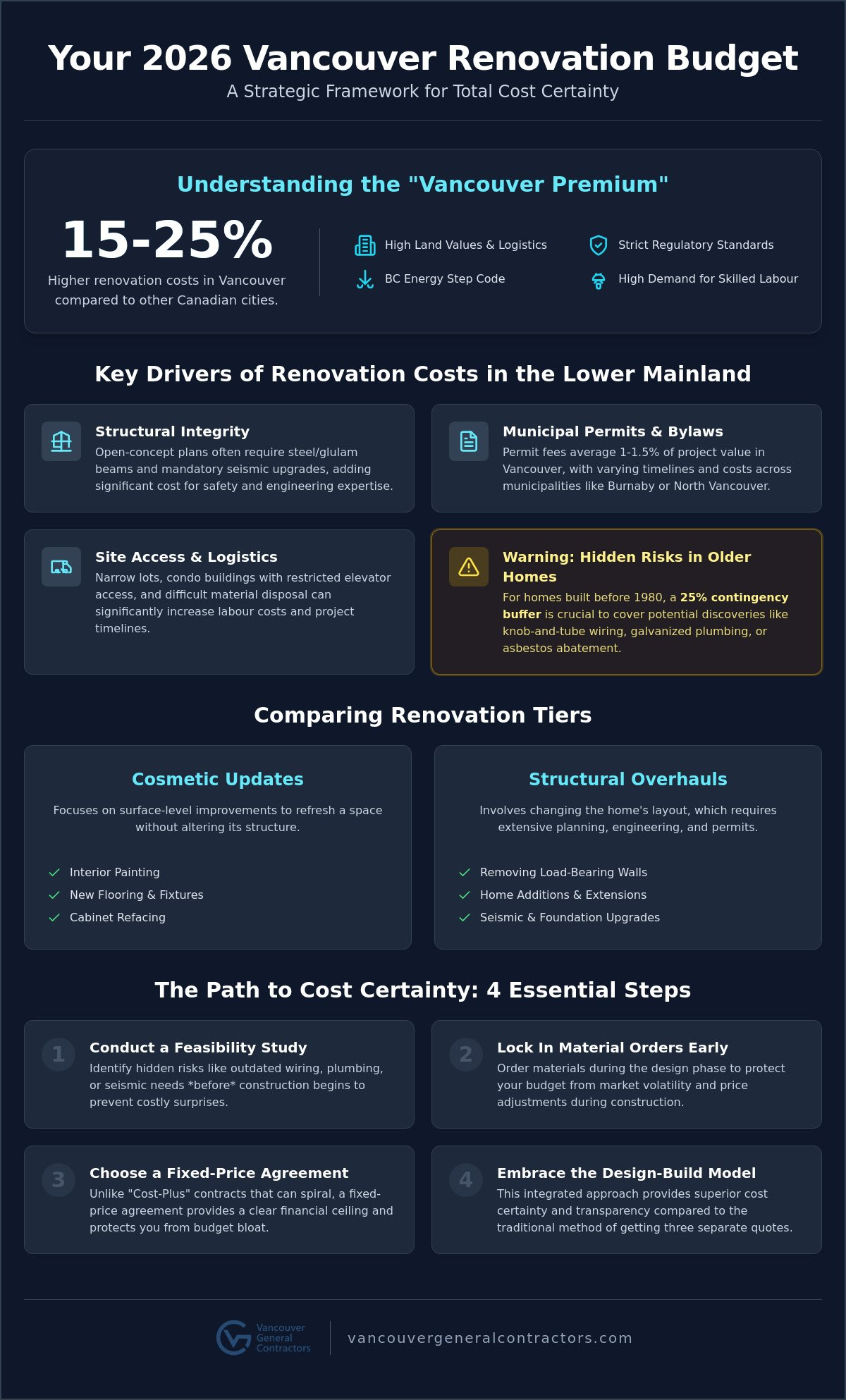
Vancouver’s home improvement industry is currently shaped by a unique convergence of high demand and strict regulatory standards. If you’re researching how to budget for a home renovation vancouver, you’ve likely realized that national averages simply don’t apply here. Local projects carry a 15 to 25 percent cost premium compared to other Canadian cities. This isn’t just about the price of lumber; it’s a reflection of our region’s high land values, complex logistics, and the rigorous BC Energy Step Code requirements that now mandate high-performance building envelopes. These energy standards improve your home’s long-term value, but they do require a higher initial investment in specialized insulation and high-efficiency windows.
In 2026, supply chains have reached a level of stability we haven’t seen in years. However, the cost of skilled labour continues to rise. Red Seal carpenters and specialized trades like electricians and plumbers in Metro Vancouver are in high demand, making “ballpark” figures risky. A generic estimate often fails to account for the specific seismic upgrades or structural reinforcements required to create the open-concept spaces so many Vancouverites desire. When you’re planning a major overhaul, you’re not just paying for materials; you’re investing in the specialized expertise required to navigate our specific geographic and regulatory landscape.
The Role of Municipal Permits and Bylaws
Navigating the permit process is a significant variable in your financial planning. While Vancouver typically sees residential building permit fees around 1 to 1.5 percent of the project’s declared value, neighbouring Burnaby or North Vancouver may have different fee structures and processing timelines. Beyond the fees, the bylaws themselves drive costs. For instance, character home retention incentives can provide floor-space bonuses, but they often require expensive seismic upgrades to meet modern safety standards. Budgeting for these “unknowns” during the application phase is essential for maintaining your project’s financial health and avoiding mid-project delays.
Inflation-Proofing Your 2026 Project
Protecting your investment in a volatile market requires a shift in strategy. We’ve found that locking in material orders during the design phase is one of the most effective ways to shield your bottom line from price adjustments during construction. Many homeowners are also moving away from traditional “Cost-Plus” contracts, which offer little protection against budget bloat. Instead, the focus has shifted toward fixed-price agreements that provide a clear financial ceiling. In the context of the 2026 market, cost certainty is the result of a disciplined design-build process that accounts for every fixture, finish, and structural requirement before construction begins.
Key Drivers of Renovation Costs in the Lower Mainland
Many homeowners start their planning by looking at national averages. This is a mistake. According to the Residential Renovation Price Index, costs in major urban centres like Vancouver have reached a new baseline that requires local expertise to navigate. Mastering how to budget for a home renovation vancouver involves looking past the surface aesthetics and understanding the structural and logistical realities of our region. You aren’t just paying for new cabinets; you’re often paying for the invisible infrastructure that keeps a home safe and efficient.
Structural integrity is a primary cost driver. If you’re planning an open-concept main floor, you’ll likely need significant steel or glulam beam installations to replace load-bearing walls. In many cases, municipal permits also trigger mandatory seismic upgrades. These safety measures are essential in our coastal environment, but they require a specialized labour force. For homes built before 1980, we advise a 25 percent contingency buffer. This accounts for the high probability of discovering outdated knob-and-tube wiring, galvanized plumbing, or hazardous materials like asbestos that require professional abatement before work can continue.
Site access is another factor that often surprises homeowners. A renovation in a narrow East Vancouver lot or a West End condo carries higher labour costs due to the sheer difficulty of moving materials and disposing of waste. If a contractor can’t place a disposal bin on-site or has to navigate restricted elevator hours, the project timeline expands. This logistical complexity is why a comprehensive design and pre-construction phase is so vital; it allows us to identify these hurdles before the first hammer swings.
Scope vs. Square Footage: The Accuracy Debate
Using square foot pricing is a dangerous metric for custom Vancouver renovations. A 500-square-foot basement finishing project is vastly different from a 500-square-foot kitchen and bath overhaul. These “wet rooms” are the most expensive areas of a home because they involve multiple trades in a small footprint. If your design requires “moving the stack”—relocating the primary plumbing lines in a multi-storey home—your budget will shift significantly to accommodate the specialized labour and structural modifications involved.
Energy Efficiency and Sustainability Requirements
By 2026, meeting the BC Energy Step Code is a standard part of any major renovation budget. Investing in high-performance windows and advanced insulation isn’t just a regulatory hurdle; it’s a way to future-proof your home’s value. We’re seeing a massive shift toward heat pump installations and electric vehicle charging infrastructure. While these systems require a higher initial investment, municipal and provincial rebates can often offset a portion of the costs, providing a long-term return through lower utility bills and increased resale appeal.
Renovation Tiers: From Cosmetic Refreshes to Luxury Overhauls
Determining your project’s scope is the first step in mastering how to budget for a home renovation vancouver. We categorize projects into three distinct tiers to help you align your vision with realistic financial expectations. A Tier 1 Cosmetic Refresh focuses on surface-level aesthetics like premium paint, high-quality flooring, and updated lighting fixtures. This level improves daily living without the need for major structural permits. Tier 2 represents a Comprehensive Remodel, involving full kitchen and bathroom guts with minor layout adjustments. Here, you’ll invest in quality quartz countertops and semi-custom cabinetry. Finally, Tier 3 is a Luxury Transformation, encompassing structural wall removals, home additions, and bespoke millwork. Understanding these tiers is essential when learning how to budget for a home renovation vancouver, as it allows you to prioritize high-impact changes over temporary fixes. For a deeper dive into the logistics of these tiers, our Ultimate Guide to Home Renovation in Vancouver provides extensive planning context.
Whole-Home vs. Room-Specific Budgeting
There’s a significant economy of scale when you choose to renovate an entire home at once rather than tackling individual rooms over several years. Mobilizing trades, securing permits, and ordering materials in bulk reduces the per-square-foot cost. In a kitchen, your budget is primarily driven by custom cabinetry and professional-grade appliances. For bathrooms, the gap between a standard tub and a custom curbless steam shower with intricate tile work can alter your bottom line by thousands. We recommend reviewing B.C. government renovation incentives early on; these tax credits and rebates for energy-efficient upgrades can significantly offset your net investment.
Budgeting for Additions and Laneway Homes
Expanding your footprint through an addition or a detached structure requires a different financial approach. Vancouver’s unique terrain, ranging from hard rock to soft clay, makes foundation and excavation costs a major variable. You must also account for municipal utility connection fees, which are mandatory for new detached living spaces. If you’re considering a secondary suite to generate rental income, our guide on Building a Laneway House in Vancouver explores these specific costs and the long-term ROI in today’s market. Whether you’re adding a sunroom or a full garden suite, these projects demand a specialized understanding of local zoning and engineering requirements.
5 Essential Steps to Building a Realistic Renovation Budget
Creating a financial plan that stands up to the realities of the local market requires more than just a spreadsheet. It demands a disciplined approach that accounts for both your lifestyle aspirations and the technical requirements of your property. If you’re wondering how to budget for a home renovation vancouver, following these five steps will help you move from an initial concept to a fixed-price reality with total transparency.
- Step 1: Define Your “Must-Haves” vs. “Nice-to-Haves.” Establish a baseline by separating essential structural repairs or layout changes from aesthetic upgrades like premium hardware or high-end appliances.
- Step 2: Conduct a Pre-Construction Feasibility Study. This involves a professional assessment of your home’s current systems to identify potential structural or regulatory hurdles before you commit to a design.
- Step 3: Allocate a 15 to 20 Percent Contingency Fund. This is your financial safety net for “behind-the-wall” issues that only become visible once demolition begins.
- Step 4: Account for “Soft Costs.” Budget for expenses beyond construction, including municipal permit fees, structural engineering reports, and temporary housing if you need to move out during the project.
- Step 5: Select a Design-Build Partner. Unifying the design and construction phases ensures that your vision stays aligned with your financial framework from day one.
The 15-20% Contingency: Why It Is Non-Negotiable
In North Vancouver and Burnaby, character homes often hide surprises that aren’t apparent during a walkthrough. You might discover outdated clay sewer pipes or structural “renovations” from previous decades that don’t meet current BC Building Code standards. Managing the emotional stress of using your contingency fund is easier when you realize its purpose. A contingency is a sign of a professional budget, not a failing one; it represents a proactive commitment to doing the job right the first time without compromising on quality.
Visualizing the Budget Through 3D Design
One of the most effective ways to prevent budget bloat is through detailed 3D renderings created during the pre-construction phase. These visualizations allow you to see exactly how specific materials and layouts will look, which prevents costly change orders once construction is underway. For example, our guide to Kitchen Renovation Vancouver illustrates how selecting cabinetry and stone surfaces in a digital environment helps lock in pricing early. This approach is mirrored by leaders in kitchen remodeling beaverton or, who use similar planning tools to ensure budget accuracy for their clients. By making these decisions before the first hammer swings, you ensure that every dollar spent contributes to the final aesthetic you desire.
Ready to move past the guesswork and secure a predictable price for your project? We invite you to connect with our team for a professional budget consultation and take the first step toward a transparent renovation experience.
Achieving Cost Certainty with Fixed-Price Design-Build
The traditional advice for homeowners has always been to collect at least three separate quotes before selecting a contractor. While this sounds like a prudent financial strategy, it often leads to the “low-bid” trap. In a market as nuanced as ours, a significantly lower estimate usually indicates a lack of thorough pre-construction planning or a failure to account for the structural realities we’ve discussed. When you are learning how to budget for a home renovation vancouver, it’s vital to realize that the most accurate price comes from an integrated team that understands every technical detail before the contract is signed.
The design-build model solves the problem of budget volatility by unifying architecture, interior design, and construction under one roof. At Vancouver General Contractors, we use this integrated approach to eliminate the communication gaps that typically lead to expensive change orders. By involving our construction managers during the creative design phase, we ensure that every aesthetic choice is grounded in logistical reality. This synergy allows us to provide a fixed-price agreement that locks in your costs, providing a level of transparency that is often missing in the local industry.
Protecting your investment goes beyond the construction phase. Our process includes comprehensive project management and an industry-leading warranty that serves as a signature of our commitment to your home’s longevity. We take full responsibility for the project lifecycle, from managing municipal permit applications to the final walkthrough. This stability allows you to focus on the excitement of your home’s transformation while we handle the complexities of the 2026 regulatory environment.
Fixed-Price vs. Cost-Plus: Which is Safer?
In the fluctuating economy of 2026, a “Cost-Plus” agreement can be a source of significant anxiety. These contracts pass every unexpected price increase in labour or materials directly to you, the homeowner, making it impossible to know your final total until the project is finished. We believe that cost certainty is a fundamental right for our clients. By utilizing a fixed-price contract, we shift the financial risk away from your family and onto our firm. This model ensures that once the design is finalized and the price is set, your budget remains secure regardless of market shifts.
Next Steps: Your Vancouver Renovation Journey
Realizing your home’s potential starts with a grounded conversation about your goals and your property’s unique characteristics. To make the most of your initial consultation, we recommend preparing a list of your non-negotiable priorities and gathering any existing property documents, such as site surveys or original floor plans. This information helps our team conduct a more effective feasibility assessment from day one. When you’re ready to move forward with a partner who values transparency and accountability, start your fixed-price renovation with Vancouver General Contractors. We are here to guide you through a methodical, predictable, and ultimately transformative experience that turns your house into a high-end living environment designed to last for generations.
Secure Your Future with a Predictable Renovation
Mastering how to budget for a home renovation vancouver is about more than just numbers; it’s about choosing a process that respects your investment and your time. By moving away from the uncertainty of “cost-plus” bids and embracing a fixed-price model, you protect your family from the hidden structural and regulatory surprises common in the Lower Mainland. Our comprehensive 3D design-build process ensures that every detail is visualized and priced before construction begins, turning a complex logistical challenge into a rewarding creative journey.
Since 2011, we have served Metro Vancouver by prioritizing transparency and accountability in every project. We realize that a home is a permanent legacy, and we are committed to delivering high-end living environments that maintain their value for generations. When you are ready to replace anxiety with logistical competence, we are here to act as your stable partner. Take the first step toward your transformative home experience today.
Request a Fixed-Price Renovation Quote and discover the security of a project managed with absolute cost certainty.
More Uncategorized Guides

Building a Wheelchair-Accessible Bathroom in Burnaby: A Practical Homeowner’s Guide

Richmond Aging-in-Place Renovations: Long-Term Comfort

Small Condo Kitchen Design Ideas in Burnaby: 2026 Planning Guide

Condo Renovation Contractors in Vancouver: A Strata-Smart Buying Guide

Office Space Renovation Contractors in Surrey: A Practical Buying Guide
Ready to start your renovation?
Frequently Asked Questions
How much does a whole-home renovation cost per square foot in Vancouver in 2026?
A comprehensive whole-home renovation in Metro Vancouver typically ranges from $150 to over $350 per square foot. This variation depends on the complexity of structural changes and the level of finishes selected. Projects involving seismic upgrades or high-performance building envelopes required by the BC Energy Step Code will naturally sit at the higher end of this spectrum.
What is the “Vancouver Tax” in home renovations?
The “Vancouver Tax” is a term used to describe the 15 to 25 percent cost premium associated with local construction compared to national averages. This premium is the result of higher labour rates for Red Seal trades, rigorous municipal permit fees, and the logistical challenges of working on narrow lots or in high-density neighbourhoods.
How long does it take to get a renovation permit in Metro Vancouver?
Permit processing times vary by municipality, with the City of Vancouver typically taking 4 to 8 weeks for residential renovations. Neighbouring Burnaby often processes applications in 3 to 6 weeks, while Surrey can be as quick as 2 to 4 weeks. These timelines are influenced by the project’s complexity and whether the home has a heritage designation.
Should I include a contingency fund in my renovation budget?
Yes, including a contingency fund of at least 10 to 15 percent is essential when learning how to budget for a home renovation vancouver. For character homes built before 1980, we recommend a 25 percent buffer. This protects your investment from the high probability of discovering outdated infrastructure or hazardous materials once demolition begins.
Is it cheaper to build an addition or renovate existing space?
Renovating within your home’s existing footprint is generally more cost-effective than building an addition. New additions require expensive foundation work, excavation, and utility connections that can significantly increase the per-square-foot cost. Reconfiguring your current layout allows you to maximize value while avoiding the complexities of new structural footprints.
What are the most expensive parts of a home renovation?
Kitchens and bathrooms are the most expensive areas due to the density of plumbing, electrical, and high-end finishes required. Beyond these “wet rooms,” structural modifications such as removing load-bearing walls or performing mandatory seismic upgrades represent the largest investments in a project’s invisible infrastructure.
How does a fixed-price contract protect my budget?
A fixed-price contract provides cost certainty by establishing a total project fee before construction starts, which is a vital part of how to budget for a home renovation vancouver. Unlike cost-plus agreements, this model shifts the risk of material price spikes or labour fluctuations to the contractor, ensuring your final price remains predictable and transparent.
Are there grants available for energy-efficient renovations in BC?
Yes, homeowners in British Columbia can access several financial incentives, such as the CleanBC program, which offers rebates for high-efficiency heat pumps and insulation. These grants are designed to offset the initial cost of meeting 2026 energy standards, providing a long-term return through reduced utility bills and increased property value.

Comments are closed