




Red Flags When Hiring a Home Builder: How to Protect Your Vancouver Investment
The most expensive mistake in a Vancouver custom home project isn’t a structural error; it’s the decision to proceed without a transparent, fixed-price pre-construction framework. While the excitement of a new kitchen or a laneway home is infectious, ignoring the subtle red flags when hiring a home builder can quickly turn a dream into a financial burden. You likely feel the weight of Vancouver’s complex regulatory environment, especially with the 4.5 percent permit fee increase for 2026 and the mandatory Zero Carbon Step Code requirements now in full effect. It’s completely understandable to worry about hidden costs appearing mid-project or whether your chosen partner truly understands the nuances of the local building by-law.
We’re here to replace that anxiety with professional authority by providing a clear framework for vetting your construction partner. You’ll learn to recognize warning signs like vague budget estimates, a lack of documented safety protocols, or an avoidance of mandatory 2-5-10 warranty discussions. We will walk through the essential markers of a reliable builder, placing transparency at the centre of your decision-making process. By the end of this article, you’ll have the confidence to choose a partner who offers not just a structure, but a predictable and protected investment for your family’s future.
Key Takeaways
- Learn why a “one-page estimate” lacks the transparency required for complex Vancouver projects and how to spot a builder who avoids detailed documentation.
- Protect yourself from liability by identifying the legal and financial red flags when hiring a home builder, including “cash-only” requests and missing WorkSafeBC coverage.
- Discover why a builder’s request for you to pull your own permits is a sign of accountability avoidance that can derail your project’s timeline and compliance.
- Identify the operational warning signs on a job site, such as the lack of a dedicated project manager, that often lead to poor craftsmanship and budget overruns.
- Understand how a structured design-build approach with a fixed-price guarantee provides the security and organization needed to realize your vision without unexpected costs.
Initial Consultation Red Flags: Beyond the First Impression
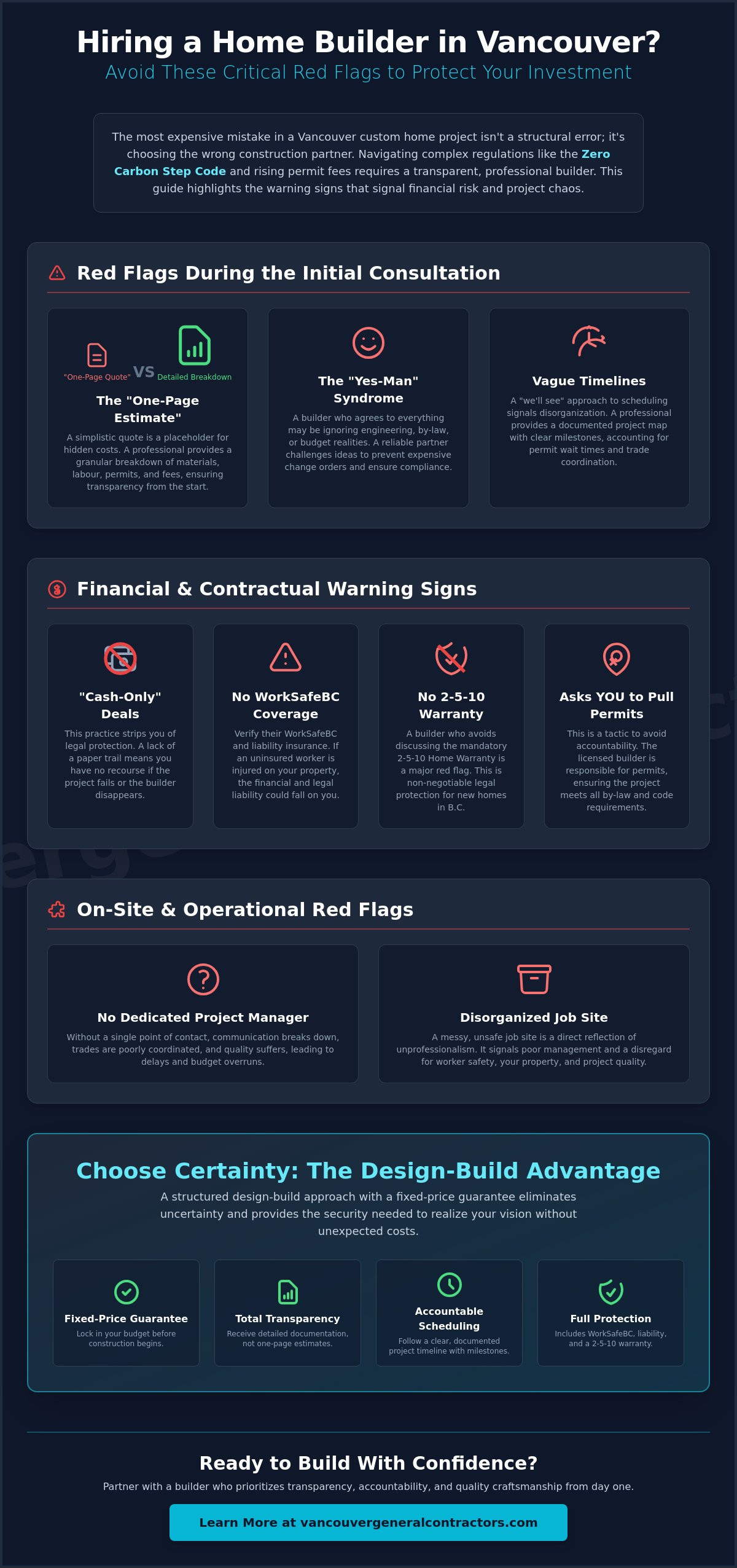
A red flag in residential construction is rarely a single event. Instead, it’s a systemic lack of transparency that signals future chaos. When you start your search, identifying red flags when hiring a home builder begins with how they present information during your first meeting. If a builder provides a quote that fits on a single page, realize that this is a major warning sign. In a city like Vancouver, where the Building By-law (VBBL) requires meticulous compliance, a vague estimate is essentially a placeholder for future “hidden costs.” A professional builder should provide a granular breakdown of materials, labour, and regulatory fees. By understanding the role of a general contractor, you recognize that their primary job is to manage the intricate details of your project lifecycle. If those details are missing from the start, they won’t magically appear once the walls are open.
Watch for builders who seem overly desperate to start. While responsiveness is a virtue, a builder who can “start tomorrow” without conducting due diligence on your site or reviewing the BC Zero Carbon Step Code requirements is likely skipping essential pre-construction steps. They should also possess a robust portfolio of local references. Metro Vancouver’s terrain and regulatory environment are unique. A builder who hasn’t successfully navigated a project in your specific municipality may struggle with local inspectors, specific zoning requirements, or soil conditions unique to the West Coast.
The “Yes-Man” Syndrome: Why Unrealistic Promises Cost More
It’s tempting to hire the builder who says “yes” to every design whim and budget constraint. However, this is often a precursor to expensive change orders. A reliable partner will challenge your ideas based on engineering realities or permit limitations. If they agree to remove a load-bearing wall or install a gas range in a new build without discussing the current electrification mandates, they aren’t being helpful; they’re being reckless. We define the “Yes-Man” red flag as a direct precursor to future change orders that will erode your budget. True expertise involves saying “no” when a request compromises the structural integrity or legal compliance of your home.
Vague Timelines and the “We’ll See” Mentality
Construction is a sequence of dependencies. If a builder relies on a “we’ll see” approach rather than a documented project management schedule, expect significant delays. A professional timeline isn’t a rough guess. It’s a structured map of milestones that accounts for permit wait times and trade availability. This level of organization is especially critical for custom home builders vancouver projects where multiple trades must be coordinated perfectly. If a builder cannot show you a proprietary methodology for tracking these phases, your project is at risk of becoming a “money pit” scenario. Identifying these red flags when hiring a home builder early on ensures your chosen partner has a transparent process for keeping the build on schedule.
Financial and Contractual Warning Signs: Protecting Your Investment
Financial integrity is the bedrock of a successful construction project. When you encounter red flags when hiring a home builder, they often manifest first in the payment structure. A builder who asks for a “cash-only” deal to avoid GST isn’t just offering a discount; they’re stripping you of legal protection. Without a paper trail, you have no recourse if the project fails or if the builder disappears. This lack of transparency usually extends to insurance. Every professional builder must carry comprehensive liability insurance and maintain active WorkSafeBC coverage. With the April 1, 2026, amendments to OHS regulations regarding heat exposure and respirators, the liability for non-compliance is higher than ever. Additionally, for any major work exceeding $100,000, your builder must file a Notice of Project at least 24 hours before work starts. If an uninsured worker is injured on your property, the financial burden could fall directly on you.
Professional builders also provide a clear 2-5-10 warranty as required by the Homeowner Protection Act. If a builder is vague about these mandatory protections, it’s a sign they may not be properly registered or licensed in British Columbia. Similarly, be wary of demands for large upfront deposits. A standard, ethical payment schedule is tied to measurable milestones, ensuring that you only pay for work that has actually been completed. This protects your cash flow and maintains the builder’s accountability throughout the project lifecycle.
The Cost-Plus Trap vs. Fixed-Price Certainty
Many homeowners are lured into “Cost-Plus” contracts, believing they’ll save money if the project goes under budget. In reality, these contracts often lack an incentive for the builder to control expenses. Every price increase in materials or labour simply gets passed to you, often with an additional percentage on top. This model can quickly turn your build into a “money pit” scenario. At VGC, we advocate for Fixed-Price contracts to eliminate these “hidden surprises” and provide absolute budget security from the outset.
| Feature | Fixed-Price Contract | Cost-Plus Contract |
|---|---|---|
| Budget Predictability | High; price is set before work begins. | Low; costs fluctuate with the market. |
| Financial Risk | Borne by the builder. | Borne entirely by the homeowner. |
| Transparency | Full cost-certainty from day one. | Requires constant auditing of receipts. |
The “No Contract” or “Handshake” Agreement
A handshake might feel like a sign of trust, but in construction, it’s a recipe for disaster. Every detail, from the specific colour of your kitchen grout to the grade of lumber used in the framing, must be documented. Verbal change orders are one of the most common sources of legal disputes in the industry. For complex whole home renovations, a comprehensive contract functions as the ultimate source of truth. If you want to ensure your investment is protected by a team that values financial accountability, consider speaking with Vancouver General Contractors about our transparent methodology.
The “Permit Shortcut” and Pre-Construction Gaps
One of the most dangerous red flags when hiring a home builder is the suggestion that you, the homeowner, should pull the building permits. This request isn’t a helpful shortcut; it’s a strategic move to shift all legal and operational accountability onto your shoulders. In the City of Vancouver, where the Building By-law (VBBL) is significantly stricter than the provincial code, the permit holder is the primary party responsible for compliance. If a builder avoids this process, they are likely dodging the scrutiny of municipal inspectors or hiding a lack of proper provincial licensing. Professional builders act as the driver of the process, managing the complexity of the 2026 permit fee increases and ensuring every structural detail meets the latest safety standards.
Ignoring zoning bylaws is equally catastrophic for your investment. Vancouver’s Development Cost Levies (DCLs) can reach up to $30 per square foot in certain zones; miscalculating these or ignoring set-back requirements can result in heavy fines or even a court-ordered demolition of a non-compliant addition. The “start now, permit later” lie is a project-ending mistake. Municipalities are increasingly vigilant, and beginning work without approved plans can lead to an immediate stop-work order and a permanent black mark on your property’s title. True expertise involves a methodical approach to these administrative hurdles before a single sledgehammer is swung.
Navigating the Metro Vancouver Permit Maze
Every municipality in the Lower Mainland has its own set of unique hurdles. Whether you are dealing with the specific environmental requirements in North Vancouver or the complex rezoning workshop fees in Vancouver, which can cost up to $15,000 for complex projects in 2026, you need a builder with a dedicated pre-construction phase. A professional team handles the engineering coordination and city hall negotiations so the client doesn’t have to. You can find more detail on these municipal nuances in our Vancouver permit maze guide.
Skipping the Design Phase
Building without a visual “source of truth” is a recipe for budget bloat and aesthetic disappointment. The traditional “design-then-bid” model often creates a conflict between the architect and the builder when costs exceed the initial estimate. In contrast, a design-build approach integrates these phases, ensuring that structural feasibility and material costs are considered from day one. A major red flag is a builder who refuses to provide 3D renderings or detailed material selections before construction begins. Detailed 3D design prevents “realize-too-late” errors in kitchen renovations, ensuring your cabinetry and appliance layout work perfectly before any materials are ordered.
Operational Red Flags: Site Safety and Project Management
The physical state of a construction site is a direct reflection of a builder’s internal discipline. When identifying red flags when hiring a home builder, you should look beyond the blueprints and observe the daily operations. A disorganized job site is more than just an eyesore; it’s a systemic failure that indicates a lack of respect for your materials and your property. Piles of debris and improperly stored lumber lead to moisture damage and structural compromises before the walls are even finished. If a builder cannot manage a broom, they certainly cannot manage the complex logistics of a high-end renovation.
Safety standards are equally telling. As of April 1, 2026, WorkSafeBC has implemented stricter OHS regulations regarding personal protective equipment and heat exposure. If you see workers without proper respirators or safety headgear, it’s a sign that the builder is cutting corners on legal compliance. These lapses can lead to immediate site shutdowns by inspectors and significant financial penalties, which were adjusted for inflation on January 1, 2026. Sub-contractor churn is another warning sign. If you notice a revolving door of unvetted tradespeople every week, it suggests the builder lacks established, long-term relationships with the city’s best craftsmen. This instability often leads to inconsistent quality and missed deadlines.
The Missing Foreman and “Ghost” Projects
The “Paper Contractor” is a common industry pitfall where a builder sells you on their expertise but never actually visits the site. They delegate the entire project to under-qualified sub-contractors without providing a dedicated on-site project manager to catch errors. This lack of daily oversight is particularly dangerous for complex laneway house builds, where tight quarters and municipal service connections require constant supervision. VGC’s project management model ensures a single point of accountability, providing the stable leadership your investment deserves throughout the build.
Lack of Progress Communication
You should expect more than just vague excuses regarding material delays or weather. A professional builder utilizes project management software to provide weekly photo updates and detailed progress reports. If your builder avoids documentation or becomes defensive when asked for a schedule update, they’re likely hiding a lack of organization. Transparency shouldn’t be a luxury; it should be a fundamental part of the service. If you’re ready to partner with a team that prioritizes site safety and clear communication, contact Vancouver General Contractors to discuss your project today.
Choosing Certainty: The Design-Build Advantage in Metro Vancouver
The traditional “design-then-bid” model often creates a fragmented environment where the architect and the builder work in silos. This fragmentation is where the “blame game” begins. When a design exceeds the budget or a structural element is unbuildable, the homeowner is often caught in the middle. Transitioning from identifying red flags when hiring a home builder to launching your project requires a model that prioritizes unity. The design-build approach eliminates this friction by housing design, engineering, and construction under one roof. This single point of accountability ensures that your vision is filtered through the lens of budgetary reality from the very first sketch. This integrated methodology is a hallmark of elite firms like NOORICO, which provides specialized residential construction and design services in the Greater Toronto Area.
In the current market, where material costs fluctuate and the BC Zero Carbon Step Code mandates full electrification for new builds, a fixed-price guarantee is your best protection. A structured pre-construction phase acts as insurance against project failure. It allows for the meticulous planning of energy-efficient systems and the procurement of materials before the first shovel hits the ground. By the time construction starts, every variable has been accounted for, moving you from a state of “flag spotting” to a confident project launch.
The Vancouver General Contractors Difference
Our proprietary multi-stage methodology is designed to alleviate the typical anxieties of residential construction. We move methodically from the initial concept to detailed 3D design, followed by a transparent fixed-price agreement. This process ensures that the aesthetic outcomes we promise are matched by logistical competence. Every project we deliver is backed by the mandatory 2-5-10 warranty, providing two years for materials and labour, five years for the building envelope, and ten years for structural defects. We invite you to see our design-build process in action to understand how we maintain cost-certainty in a complex industry.
Your Next Steps for a Stress-Free Build
To ensure your chosen partner is a stable expert rather than a liability, use this checklist during your first meeting:
- Permit History: Ask for specific examples of projects they’ve permitted in your municipality within the last 12 months.
- Sub-Contractor Vetting: Inquire about their long-term relationships with trades and how they verify WorkSafeBC compliance.
- Pre-Construction Fees: A professional builder will charge for a detailed pre-construction phase; a “free estimate” is often one of the biggest red flags when hiring a home builder.
- Warranty Documentation: Request a copy of their HPO (Homeowner Protection Office) registration.
Building a home in Vancouver should be a transformative life experience, not a source of constant stress. By choosing a partner who values transparency and personal accountability, you protect your investment and your peace of mind. If you’re ready to move forward with a team that takes full responsibility for your project’s success, book a discovery session with us today.
Securing Your Vancouver Home Investment
Navigating the local construction market requires more than just a vision; it demands a partner who values accountability as much as aesthetics. By recognizing the critical red flags when hiring a home builder, from vague one-page quotes to the avoidance of municipal permit responsibilities, you’ve already taken the most important step in protecting your equity. A successful project in Metro Vancouver relies on a structured methodology that addresses the 2026 regulatory changes and electrification mandates long before construction begins.
We provide the stability you need through our comprehensive design-build process and fixed-price construction contracts. This approach eliminates the typical anxieties of budget volatility and ensures your project is protected by an industry-leading project warranty. You deserve a partner who manages the complex permit maze and trade coordination so you can focus on the excitement of your new living environment. Take the next step toward a predictable, high-quality build today.
Book Your Fixed-Price Consultation with Vancouver General Contractors and start your journey with a transparent expert who puts your security first. We look forward to helping you realize your home’s permanent value.
More Uncategorized Guides





Ready to start your renovation?
Frequently Asked Questions
Is a significantly lower quote than other builders a red flag?
Yes, an unusually low quote is a major warning sign that often indicates a lack of scope clarity or an intention to use lower-quality materials. In the Vancouver market, meeting the mandatory Zero Carbon Step Code and Building By-law standards has a baseline cost that all professional builders must respect. If one estimate is significantly lower, the builder is likely cutting corners on labour compliance or planning to recoup the difference through aggressive change orders mid-project.
Can I hire a builder who doesn’t have a local office in Vancouver?
It is generally unwise to hire a builder without a local presence in Metro Vancouver. Our region has unique seismic requirements, soil conditions, and municipal by-laws that differ significantly from the provincial building code. A local office demonstrates a commitment to the community and ensures the builder has established relationships with municipal inspectors and vetted local tradespeople who understand the nuances of the West Coast climate.
What should I do if a builder asks me to pay for materials directly?
You should decline this request as it shifts the logistical and legal liability for the supply chain onto your shoulders. Professional builders manage their own procurement to ensure material quality and timely delivery. When a builder asks you to pay directly, it often suggests they lack the cash flow or credit standing required to manage a project’s financial lifecycle, which is a significant indicator of instability.
Is it a red flag if a builder wants to start work before the contract is signed?
Starting work without a signed contract is one of the most dangerous red flags when hiring a home builder. A comprehensive contract is your only legal protection regarding the project’s scope, budget, and 2-5-10 warranty coverage. Proceeding without one creates a “handshake” environment where you have no recourse if the builder fails to meet safety standards or abandons the site before completion.
How can I verify if a builder actually has WorkSafeBC coverage?
You can verify a builder’s standing by requesting a “Clearance Letter” directly from the WorkSafeBC website using their legal business name. This document confirms that their account is active and that they are up to date on their premiums. Verifying this coverage is essential because if an injury occurs on your property and the builder is not covered, the financial and legal liability may fall on you as the homeowner.
Should I be worried if a builder doesn’t use 3D design software?
While not a legal requirement, the absence of 3D design increases the risk of expensive “realize-too-late” errors. 2D blueprints are often difficult for homeowners to interpret, leading to surprises regarding space flow or material colours once construction is underway. A professional design-build firm uses 3D renderings as a visual source of truth to ensure the final product matches your expectations before any materials are ordered.
What happens if a builder refuses to provide a fixed-price contract?
Refusing a fixed-price contract is a common signal that a builder intends to pass all market volatility and management inefficiencies directly to you. This is one of the primary red flags when hiring a home builder because it leaves your investment vulnerable to unlimited budget bloat. Without the security of a fixed price, you lose the ability to accurately plan your finances and protect your home’s equity from unforeseen complications.
Is it normal for a home builder to have no online reviews or portfolio?
No, it is not normal for an established professional builder to lack a documented history of their work. In a high-stakes industry like custom home building, a visible portfolio and verified client testimonials are essential markers of stability and competence. A lack of online presence may suggest the builder is operating under a new name to avoid the reputation of past project failures or legal disputes.

Comments are closed