





Home Renovation Insurance Requirements in BC: The 2026 Homeowner’s Guide
What if your insurance provider could legally walk away from a major claim the moment a sledgehammer hits your drywall? It’s a chilling thought for any homeowner, yet many projects begin without a clear understanding of the home renovation insurance requirements bc residents must follow. You deserve to feel the excitement of a whole-home transformation without the underlying anxiety of a “material change in risk” voiding your coverage. We realize that the logistical side of construction often feels opaque, especially when you’re trying to untangle the web of WorkSafeBC compliance and private policy obligations.
This guide provides the technical expertise and transparent advice you need to protect your investment throughout 2026. We will examine the latest provincial regulations, explain the nuances of contractor versus homeowner responsibilities, and provide a clear checklist to verify insurance credentials. This methodical approach ensures you can move forward with the cost-certainty and peace of mind that your project is grounded in financial security and professional accountability, allowing you to focus on the creative journey of building your future home.
Key Takeaways
- Understand how a “material change in risk” can void your existing policy and why notifying your insurer before demolition is a critical first step.
- Navigate the specific home renovation insurance requirements bc residents face, including the necessity of Course of Construction coverage for major structural projects.
- Learn how to verify a contractor’s Commercial General Liability and the importance of “Completed Operations” coverage for your long-term financial security.
- Clarify your legal responsibilities regarding WorkSafeBC and realize the vital connection between valid municipal permits and your insurance protection.
- Discover how a professional design-build process manages regulatory hurdles and insurance coordination to provide a predictable, fixed-price renovation experience.
Why Standard Home Insurance Isn’t Enough for BC Renovations
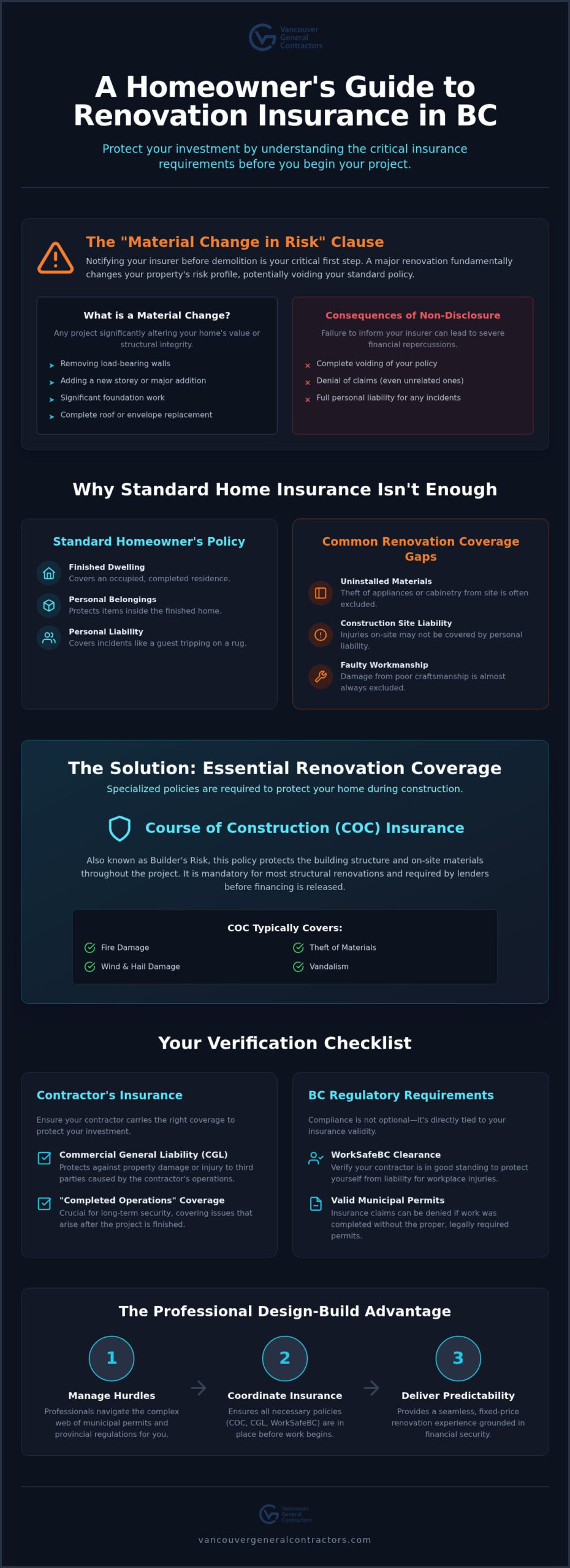
A standard homeowner’s policy is designed for a finished, occupied residence, not a dynamic construction site. Once you begin a major project, the risk profile of your property shifts fundamentally. Failing to understand the specific home renovation insurance requirements bc insurers demand can leave you exposed to significant financial loss. Most homeowners assume their coverage remains intact as long as they pay their premiums, but a renovation often triggers clauses that can render a policy useless when you need it most. This isn’t just about protecting the new kitchen; it’s about ensuring the entire structure remains solvent in the eyes of your provider.
The “Material Change” Clause Explained
A “material change” is any project that significantly alters the home’s value or structural integrity, effectively changing the risk the insurer originally agreed to cover. In British Columbia, providers draw a sharp line between cosmetic updates like painting or flooring and structural overhauls like removing load-bearing walls or adding a second storey. If you don’t disclose these changes before work begins, the consequences are severe. Your insurer may choose to void the policy entirely or deny a specific claim, such as a fire or flood, even if the renovation didn’t directly cause the incident. We realize this sounds daunting, but transparency is your greatest asset in maintaining protection.
The unique climate in Metro Vancouver adds another layer of complexity. Renovating during our notorious rainy season increases the risk of water ingress, especially during envelope repairs or roof replacements. Standard policies often exclude damage resulting from “seepage” or “gradual water entry” that occurs while a home is under construction. Without the right endorsements, you could be left to foot the bill for expensive structural drying and mould remediation if a sudden downpour hits an exposed roofline.
Common Coverage Gaps in Basic Policies
Basic home insurance typically protects your personal belongings, but it rarely extends to uninstalled fixtures or materials. If high-end appliances or custom cabinetry are stolen from your garage before installation, your standard policy might exclude them because they aren’t yet part of the “dwelling.” To bridge these gaps, professionals often recommend Course of Construction insurance, which provides specialized protection for materials and the structure during the build process.
Other frequent gaps include:
- Liability Shifts: Standard liability coverage protects you from a guest tripping on a rug, but it may not cover injuries that occur on what is legally defined as a “construction site.”
- Faulty Workmanship: Most basic policies explicitly exclude damage caused by poor craftsmanship or design errors, making it vital to have the right professional oversight.
- Vandalism: Construction sites are frequent targets for graffiti or intentional damage, risks that many residential policies exclude once a home is under renovation.
Essential Coverage Types: Course of Construction and Liability
Securing the right policy is the most effective way to protect your legacy while your property is in transition. While standard insurance handles the “before” and “after,” specific products fill the gap during the “during.” Understanding the home renovation insurance requirements bc homeowners must meet involves looking beyond your basic policy. You need coverage that acknowledges the house is no longer a static residence but a dynamic work in progress. This often requires a combination of specialized policies and increased liability limits to reflect the higher risks and values associated with modern construction in British Columbia.
What is Course of Construction (COC) Insurance?
Course of Construction insurance, frequently called Builder’s Risk, is a specialized policy that protects the building and the materials on-site from start to finish. This coverage becomes mandatory for any project involving structural changes, additions, or high-value interior overhauls. It protects against common perils like fire, wind, vandalism, and lightning damage. Most Canadian lenders require proof of a COC policy before they will release any renovation financing, as they need to ensure their collateral is protected during the build. While some contractors offer this as part of their package, homeowners often choose to purchase it themselves to maintain direct control over the claim process and ensure the entire existing structure is included.
Don’t forget about your personal belongings. If you’re moving furniture into storage or a different wing of the house, your standard contents insurance may need an update. Standard policies often have low limits for items not physically inside the main dwelling, so confirm your coverage levels before moving high-value items out of their usual spots.
Increasing Your Personal Liability Limits
In the Vancouver real estate market, a standard $1 million liability limit is rarely sufficient. A single accident involving a neighbour’s property or a passerby could result in a lawsuit that quickly exceeds that amount. We recommend increasing your liability to at least $2 million, or even $5 million for a whole home renovation. This protects your personal assets from the financial fallout of construction-related accidents. It’s also vital to ensure your contractor meets BC Regulatory Requirements: WorkSafeBC to prevent personal liability for worker injuries. Our team at Vancouver General Contractors prioritizes this transparency, ensuring every project is fully compliant from day one. If you want to see how we manage these details, you can explore our comprehensive renovation planning guide.
The Contractor’s Insurance Checklist: Protecting Your Investment
The physical work of a renovation carries inherent risks that your personal policy isn’t designed to absorb. To meet the full scope of home renovation insurance requirements bc homeowners must demand, you need to verify that your chosen partner carries robust Commercial General Liability (CGL). This isn’t a mere formality; it’s the primary shield between your assets and the financial fallout of on-site accidents. While many contractors claim to be “fully insured,” the reality often varies between a basic policy and comprehensive, professional-grade coverage that stands up to the complexities of a major build.
Verifying Commercial General Liability (CGL)
Don’t rely on a verbal promise or a photocopied document. You should request a Certificate of Insurance (COI) sent directly from the contractor’s insurance broker. This ensures the policy is active and hasn’t lapsed due to missed payments. For major projects, we recommend looking for custom home builders in Vancouver who carry a minimum of $2,000,000 in aggregate coverage. You should also ask to be named as an “Additionally Insured” party on their policy. This status grants you direct protection, providing a layer of security if a third party names you in a lawsuit related to the contractor’s work on your property.
A critical but often overlooked component is “Completed Operations” coverage. While standard CGL covers incidents that happen during construction, Completed Operations protects you if a flaw in the workmanship causes damage after the project is finished. Without this, a pipe burst occurring six months post-renovation might not be covered by the contractor’s insurance, leaving you to navigate a complex and potentially denied claim with your own residential provider.
The Necessity of Professional Indemnity
In a design-build environment, the risks begin long before the first nail is driven. Professional Indemnity, or Errors and Omissions (E&O) insurance, is vital for firms that handle the architectural and planning phases. If a structural design flaw is discovered mid-construction, standard liability insurance won’t cover the costs to redesign and rectify the error. E&O insurance provides the financial backing to solve these complex problems without stalling your project or draining your contingency fund. This differs from a workmanship warranty, which is a promise to fix defects; insurance is the financial engine that ensures that promise can actually be kept.
Hiring unlicensed “handyman services” often seems like a cost-saving measure, but these operators frequently lack professional-grade insurance and active WorkSafeBC accounts. As the homeowner, Protecting Your Investment means realizing that you could be held personally liable for their injuries or damages they cause to your neighbours. By choosing a partner that manages all home renovation insurance requirements bc necessitates, you trade the anxiety of “what if” for the security of a project managed by vetted, accountable experts.
BC Regulatory Requirements: WorkSafeBC and Municipal Permits
Compliance with provincial and municipal regulations is not just a legal hurdle; it is the foundation of your insurance validity. In British Columbia, the intersection of safety standards and home renovation insurance requirements bc homeowners must navigate is often where projects succeed or fail financially. If you overlook a single permit or fail to verify a worker’s status, you risk more than just a city fine. You risk the total voidance of your insurance policy if a claim arises from unpermitted work or an uninsured workplace injury.
WorkSafeBC: Your Responsibilities as a “Prime Contractor”
Under BC law, every construction site must have a designated “Prime Contractor” responsible for safety. If you hire multiple independent trades rather than a single general contractor, you automatically assume this role and the significant legal liabilities that come with it. This includes the responsibility to ensure every person on your property is covered by WorkSafeBC. Even though the average base premium rate for 2026 remains stable at $1.55 per $100 of payroll, the cost of being caught without coverage is immense. You could be held personally responsible for the long-term healthcare and disability costs of an injured worker. Before any work begins, you must request a WorkSafeBC clearance letter online to verify your contractor’s account is active and in good standing. We realize this is a heavy administrative burden, which is why we handle these regulatory filings as part of our comprehensive management process.
Permits and Insurance: A Non-Negotiable Connection
Unpermitted work is the most common reason for denied insurance claims in Metro Vancouver. Insurance providers view unpermitted electrical, plumbing, or structural changes as a breach of contract because they haven’t been vetted for safety by a municipal inspector. If a fire starts due to wiring that wasn’t inspected, your provider has strong legal grounds to walk away from the claim. Validating your project through the proper channels ensures that all work meets the current BC Building Code and local bylaws, providing a paper trail that protects your home’s value and your policy’s integrity.
Managing the Vancouver permit maze requires a methodical approach to municipal coordination. From understanding the 2026 fee structures to navigating the new PST requirements on architectural services, the logistical load is heavy. Our team takes full responsibility for this lifecycle, ensuring every inspection is booked and every permit is closed out correctly. To ensure your next project is legally and financially secure, let our experts manage the permit and insurance coordination for you.
The Vancouver General Contractors Advantage: Stress-Free Delivery
Managing the intersection of design, municipal bylaws, and provincial insurance mandates is a complex undertaking that requires more than just construction skill. It demands a methodical, disciplined approach to project management. Our design-build methodology was developed to solve the very anxieties we’ve discussed, from the fear of denied claims to the confusion over home renovation insurance requirements bc homeowners often face. By integrating regulatory compliance and insurance coordination into our initial planning phase, we ensure that your project is legally and financially protected before the first shovel hits the ground.
Fixed-Price Security and Transparency
One of the most significant risks in any major build is “budget creep,” which doesn’t just hurt your wallet; it complicates your insurance coverage. Most insurers base their premiums and coverage limits on the estimated value of the work. If your costs spiral out of control mid-project, you may find yourself underinsured at the exact moment a loss occurs. Our fixed-price construction contracts eliminate this volatility. You’ll know the total value of your investment from day one, allowing you to provide your insurance provider with precise figures for your policy updates.
This financial transparency creates a robust paper trail. We provide detailed contracts and clear receipts for every stage of the project, which are essential if you ever need to substantiate a claim. This level of organization provides the cost-certainty that modern homeowners demand in an industry often known for its lack of predictability. It allows you to focus on the creative excitement of your project while we handle the granular details of logistical competence.
A Legacy of Trust in Metro Vancouver
With over 15 years of experience building in British Columbia, our team has developed a deep understanding of local regulations and the specific needs of Vancouver properties. We don’t just build structures; we create high-end living environments designed to endure. This commitment to longevity extends to our industry-leading warranty, which provides a layer of security that goes far beyond standard insurance. While insurance protects you against sudden accidents, our warranty protects the permanent value of our craftsmanship.
Hiring a professional team means you aren’t just getting a builder; you’re gaining a partner who takes full responsibility for the project lifecycle. We act as the Prime Contractor, assuming the legal safety obligations and ensuring every sub-trade is fully vetted and WorkSafeBC-compliant. This comprehensive management mitigates the risks of personal liability and ensures your renovation remains a transformative life experience rather than a source of stress. To see how our stable, protective approach can secure your investment, contact us today for a stress-free consultation on your whole home renovation.
Secure Your Vision for 2026 and Beyond
Ensuring your project meets all home renovation insurance requirements bc mandates is the final, essential step in moving from design to reality. By addressing “material change” clauses and verifying contractor liability before the first hammer falls, you protect your home’s legacy from unforeseen financial complications. You shouldn’t have to carry the burden of municipal permit management or WorkSafeBC compliance on your own. It’s a logistical weight that belongs in the hands of specialized experts who prioritize transparency and accountability.
Our team provides the stability you need through our fixed-price contract guarantee and industry-leading warranty. We’re fully insured and WorkSafeBC compliant, taking full responsibility for the project lifecycle so you don’t have to. This methodical approach transforms a complex regulatory challenge into a predictable, rewarding life experience. Request a Fixed-Price Quote for Your Vancouver Renovation today and build with the confidence that your investment is fully protected. Your dream home deserves a foundation of security and professional excellence that stands the test of time.
More Uncategorized Guides





Ready to start your renovation?
Frequently Asked Questions
Do I need to tell my insurance company if I’m doing a small kitchen renovation?
Yes, you should always notify your provider. Even a cosmetic kitchen update in Burnaby can be viewed as a “material change in risk” that alters the home’s value. Failing to disclose these home renovation insurance requirements bc providers mandate could lead to a voided policy. It’s best to get written confirmation that your coverage remains active before you remove a single cabinet or appliance from your home.
What happens if my contractor doesn’t have insurance in BC?
If your contractor is uninsured, you assume the full financial and legal liability for any accidents. This means you could be personally responsible for property damage to your neighbours or injuries that occur on your site. Without a contractor’s Commercial General Liability policy, your personal assets are at risk. We recommend only hiring teams that provide a verified Certificate of Insurance directly from their broker to ensure your protection.
Is WorkSafeBC mandatory for home renovations in Vancouver?
WorkSafeBC is mandatory for almost every renovation project in the Metro Vancouver area. If you hire a firm, they must have an active account in good standing. If you hire independent trades, you might legally become the “Prime Contractor,” making you responsible for their safety and premiums. Always verify a contractor’s clearance letter online. This step ensures you aren’t held liable for workplace injuries that occur during your project.
Does home insurance cover damage caused by my contractor?
Standard home insurance policies usually exclude damage resulting from faulty workmanship or design errors. If your contractor accidentally causes a flood or structural issue, their professional liability insurance should cover the repairs. This is why we emphasize the importance of “Completed Operations” coverage. It provides a safety net for issues that appear after the project is finished, ensuring you don’t have to pay for a professional’s mistake out of pocket.
What is Course of Construction insurance and do I really need it?
Course of Construction insurance is a specialized policy that protects your home while it is being built or renovated. It covers unique risks like the theft of uninstalled materials and vandalism, which standard policies often exclude. If your project involves structural changes or a significant increase in property value, most Richmond lenders will require proof of this coverage. It provides the security needed to protect your investment during the most vulnerable phases of construction.
How much does renovation insurance typically cost in BC?
The cost of renovation insurance depends on the scope of your project, the home’s location, and the total value of the work. Factors like structural changes or the duration of the build will influence the final price. While we don’t provide specific insurance quotes, our fixed-price contracts help your insurer accurately assess the project’s value. This transparency ensures you aren’t overpaying for coverage while maintaining the protection your high-end living environment requires.
Can I be sued if a worker gets injured on my property during a renovation?
You can be sued if a worker is injured and the proper WorkSafeBC coverage isn’t in place. Without this provincial protection, a homeowner may be held liable for medical expenses and long-term disability costs. Hiring a fully compliant team like Vancouver General Contractors removes this risk. We take full responsibility for worker safety and provincial compliance, allowing you to focus on the creative design process without worrying about personal legal exposure.
Will my home insurance premium go up after a renovation?
Your premium will likely increase because your home’s replacement value has grown. A whole-home renovation or a new addition in North Vancouver makes the structure more valuable to rebuild in the event of a total loss. We provide the detailed documentation and final contracts your insurer needs to update your policy accurately. This ensures your newly transformed home is fully protected at its true market value once the project is complete.

Comments are closed