





Laneway House Cost Vancouver: The 2026 All-In Budgeting Guide
The 18% surge in construction labour and material costs since 2024 has turned the dream of a backyard suite into a complex financial puzzle. You’ve likely felt the weight of these inflationary pressures or found yourself tangled in the notorious Vancouver permit maze. It’s exhausting to plan for a project when municipal fees and regulatory requirements feel like moving targets.
We believe your experience should be defined by transparency rather than surprises. This guide provides a definitive 2026 breakdown of the laneway house cost vancouver to help you realize your vision with absolute cost-certainty. You’ll gain a clear understanding of the all-in budget requirements, from BC Step Code compliance to utility connections. We’ll also explore how a fixed-price building partner can protect your investment while maximizing the long-term rental ROI of your new suite.
Key Takeaways
- Realize the critical difference between “construction-only” quotes and a true all-in budget to avoid unexpected financial strain during your build.
- Identify how Vancouver’s unique geography and modern high-efficiency standards impact your hard costs for excavation and building envelopes.
- Navigate the complex landscape of municipal fees, including Development Cost Charges (DCCs) and amenity contributions, that often catch homeowners off guard.
- Calculate your potential return on investment by comparing current rental market premiums against long-term property value appreciation.
- Discover how a fixed-price, design-build model provides the ultimate protection against the fluctuating laneway house cost vancouver homeowners face in 2026.
The Reality of Laneway House Costs in Vancouver for 2026
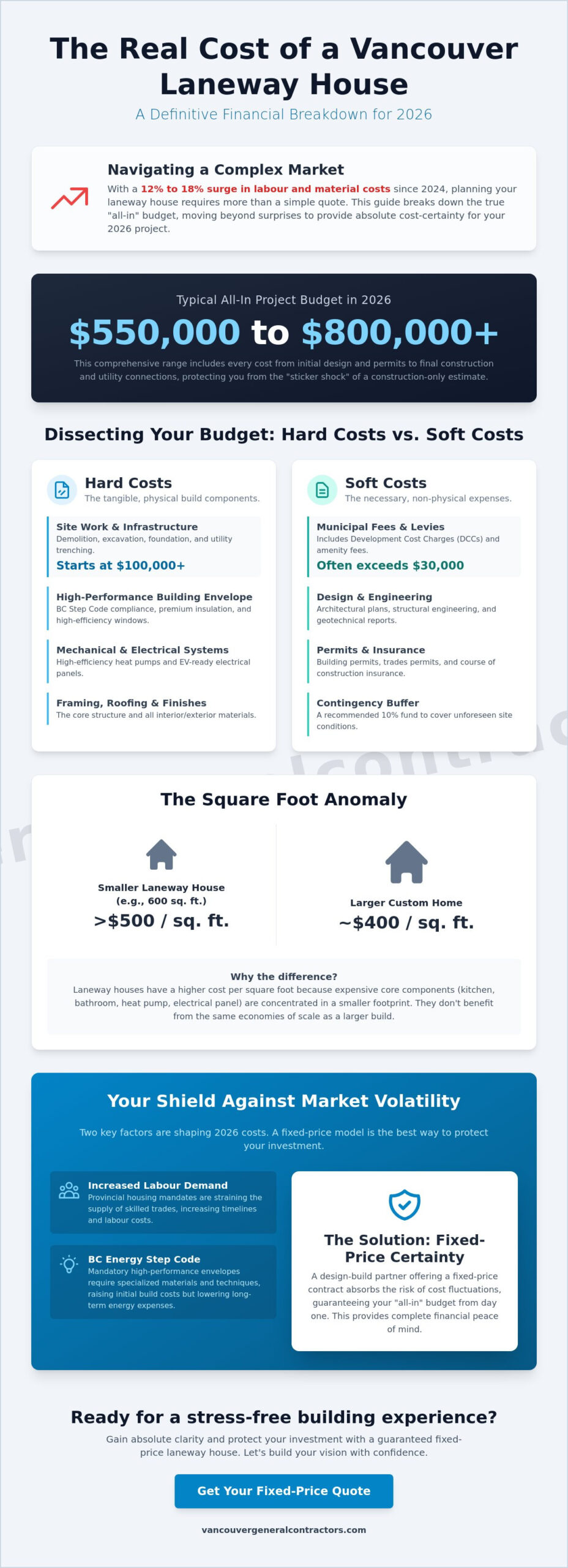
Understanding the laneway house cost vancouver requires a shift from viewing a project as a simple building to seeing it as a complex infrastructure puzzle. Many homeowners start with a “construction-only” quote, which usually covers the basic structure and finishes. However, a true all-in budget in 2026 accounts for every dollar spent from the first architectural sketch to the moment the tenant moves in. In the current Metro Vancouver market, these comprehensive costs typically range from $550,000 to $800,000 or more. This reflects a documented 12% to 18% increase in costs since 2024, driven by persistent labour shortages and material inflation.
While larger custom homes often benefit from economies of scale, a laneway house carries higher per-square-foot costs. This is because every small build still requires expensive core components such as a kitchen, bathroom, and sophisticated mechanical systems. Whether you build 600 or 1,000 square feet, the price of the heat pump and the electrical panel remains relatively constant. This concentration of high-value systems in a small footprint is why smaller builds often see construction costs exceeding $500 per square foot, whereas larger units might sit closer to $400.
Why 2026 is a Unique Year for Vancouver Construction
Recent provincial housing mandates have flooded the market with new development applications, significantly increasing the demand for skilled local labour. While material prices have stabilized somewhat compared to previous years, the shortage of specialized trades in the Lower Mainland continues to drive up project timelines. Additionally, the mandatory adoption of the BC Energy Step Code now requires high-performance envelopes. These airtight structures demand premium insulation and high-efficiency windows. We view these as essential investments in the longevity and energy-certainty of your property rather than just additional expenses.
The “Sticker Shock” Factor: Hard Costs vs. Soft Costs
Distinguishing between hard and soft costs is essential for financial peace of mind. Hard costs include the physical components of the build: the foundation, framing, mechanical systems, and interior finishes. Soft costs, which can account for a significant portion of your budget, include architectural design, structural engineering, and municipal levies. Vancouver’s Development Cost Charges (DCCs) alone can be a substantial hurdle, often exceeding $30,000 per project. We always recommend a 10% contingency buffer to handle the unexpected. This disciplined approach ensures that unforeseen site conditions don’t compromise the quality or completion of your project, providing you with a stable partner in a complex industry.
Hard Costs: Breaking Down the Physical Build
Hard costs represent the tangible components of your project. They are the materials you touch and the labour required to assemble them. When calculating the laneway house cost vancouver, it’s vital to recognize that these physical expenses have shifted significantly due to new energy regulations and specialized infrastructure needs. Building a high-performance home requires more than just standard lumber and drywall; it demands a sophisticated approach to the building envelope and mechanical systems to ensure long-term durability. We view these costs as the essential building blocks of a permanent, high-value asset.
Site Work and Infrastructure: The Foundation of Your Budget
Your budget begins beneath the surface. Most Vancouver lots require the demolition of an existing garage or shed before any new construction can start. Beyond simple removal, site preparation includes excavation and utility trenching to connect your new home to city water, sewer, and gas lines. If you’re building in neighbourhoods with notoriously rocky soil, such as parts of the West Side, geotechnical requirements can add substantial complexity. Research indicates that site work, including demolition, excavation, foundation, and utility installation, can cost at least $100,000. This makes it one of the most critical variables in your early planning stages.
The building envelope is another area where 2026 standards have raised the bar. To meet the BC Energy Step Code, we utilize high-efficiency windows and advanced insulation techniques that create an airtight seal. This investment reduces your future energy bills and ensures the home remains comfortable through Vancouver’s damp winters. Mechanical systems have also evolved. Gas furnaces are largely replaced by high-efficiency heat pumps, and we now integrate electrical panel upgrades to support EV charging stations as a standard expectation for modern living. For those seeking clarity on these technical requirements, exploring our expertise in laneway homes can provide a helpful starting point.
Kitchens and Bathrooms: Where the Money Goes
Kitchens and bathrooms are the most expensive rooms per square foot in any home. In a laneway house, these costs are compressed into a smaller footprint, which doesn’t necessarily make them cheaper. Plumbing, high-quality appliances, and custom millwork remain fixed expenses regardless of the room’s size. We focus on space-saving cabinetry solutions that maximize every inch of storage without sacrificing aesthetic value. Choosing durable, high-end fixtures is a strategic move for rental units. These materials withstand the wear and tear of multiple tenants and help maintain a premium rental rate, ultimately increasing your long-term ROI.
Finally, exterior finishes must balance personal taste with the City of Vancouver’s specific design guidelines. These regulations often dictate material choices to ensure the laneway home complements the character of the existing neighbourhood. By selecting materials that are both beautiful and weather-resistant, you protect your investment from the West Coast’s unique climate challenges while adding significant curb appeal to your property.
The “Hidden” Soft Costs: Permits, Fees, and Levies
While the physical structure is the most visible part of your investment, the “soft costs” often present the most significant budgeting challenge. These administrative and professional expenses are essential for a legal, compliant build. Calculating the total laneway house cost vancouver homeowners should expect requires a deep dive into municipal ledger books. In 2026, design and permitting typically require a budget of $25,000 to $60,000 before the first shovel hits the ground. This includes essential fees for architectural design, which can range from $15,000 to $40,000, and structural engineering, which usually adds another $5,000 to $8,000.
Municipal levies represent another substantial hurdle. City of Vancouver Development Cost Charges (DCCs) can exceed $30,000, while total city fees and infrastructure upgrades often add $45,000 or more to your bottom line. Beyond the city hall desk, you’ll need a team of specialized consultants. This includes an Energy Advisor to ensure BC Step Code compliance, costing between $3,000 and $5,000, as well as arborists and surveyors. Even your electrical service requires a rethink. Modern EV-ready homes often necessitate a jump from a standard 200A service to a 400A requirement to handle the combined load of two dwellings and high-speed charging.
Navigating the Vancouver Permit Maze
The timeline for approval is a critical factor in your financial planning. Current wait times for permits generally span 3 to 6 months, and these delays can impact your financing costs if you’re carrying a loan. We prioritize “Permit-Ready” designs to minimize the risk of costly revisions or city-mandated changes mid-process. Understanding the vancouver laneway housing guidelines is essential for any homeowner planning a build, as these rules govern everything from lot eligibility to zoning requirements that directly affect your permit timeline and budget. Understanding the legal basement suite requirements Vancouver owners must follow is a helpful baseline, but laneway rules involve distinct infrastructure levies that require expert navigation to avoid budget volatility.
Regional Variations: Burnaby, Richmond, and Surrey
Costs shift noticeably as you move across the Metro Vancouver border. Richmond’s specific flood plain and soil requirements often necessitate more expensive foundation engineering compared to Vancouver’s rocky terrain. Meanwhile, Burnaby’s approach to “garden suites” involves different setback and density rules than Vancouver’s traditional laneway models. DCCs also vary significantly; what you pay in Surrey may be entirely different from the fees in the city centre. We manage these regional nuances for you, ensuring that your budget is tailored to the specific regulatory landscape of your neighbourhood.
Calculating ROI: Is a Laneway House Worth the Cost?
While the initial laneway house cost vancouver homeowners face is substantial, the long-term financial trajectory often justifies the outlay. In 2026, a studio or one-bedroom unit in the city typically commands between $2,000 and $2,800 per month. Larger two-bedroom builds can generate up to $3,200. This consistent cash flow allows many property owners to pay back their construction costs within 8 to 12 years. Beyond rental income, the equity gains are equally compelling. BC Assessment typically adds 60% to 80% of the build cost to your property value. Real-world sales data shows that homes with legal laneway suites sell at a 12% to 22% premium compared to those without them.
Financing these projects in 2026 often involves a Home Equity Line of Credit (HELOC). Current rates are typically the prime rate plus 0.5% to 1.0%. It’s also vital to account for tax implications. New builds are subject to GST, and a $400,000 suite may add approximately $1,040 to your annual property taxes. While rental rates in Burnaby or Surrey may sit slightly lower than in Vancouver’s core, the lower entry cost in those regions often results in a comparable yield for savvy investors.
Laneway Home as a Strategic Investment
Viewing a laneway home as an investment involves looking beyond the monthly cheque. It functions as a powerful “mortgage helper,” effectively subsidizing the carrying costs of your primary residence. We also see a rise in multi-generational use cases. Families use these suites to provide housing for adult children or as a high-end alternative to elderly care facilities. This flexibility preserves family wealth and provides security in an expensive housing market. It’s a transformative life experience that creates permanent value for your estate.
Design Choices That Maximize Value
To maximize your return, design choices must be intentional. Flexible layouts are in high demand; a “one-bedroom plus flex” configuration often attracts a wider range of tenants than a rigid two-bedroom setup. Outdoor living space is another significant value driver. Patios and balconies aren’t just aesthetic additions. They command higher rents in Vancouver’s competitive market. Integrating smart home technology also helps attract high-value professional tenants who prioritize security and energy efficiency. These thoughtful details transform a simple structure into a premium living environment. If you’re ready to explore how these variables impact your specific property, we invite you to consult with our experts in custom homes and laneway suites.
The Vancouver General Contractors Solution: Fixed-Price Certainty
The primary challenge with any laneway house cost vancouver project is the inherent volatility of the construction market. Traditional project delivery often involves separate contracts for design and construction, which frequently leads to budget overruns and miscommunication. Our Design-Build model functions as the antidote to this uncertainty. By integrating architectural planning and construction management under one roof, we eliminate the gaps where hidden costs typically hide. This unified approach allows us to provide a Fixed-Price Guarantee, ensuring that the price we agree upon at the start is the price you pay at the finish.
We leverage a sophisticated 3D design process to anchor your budget before a single nail is driven. This technology allows you to visualize every detail of your new home, from the structural layout to the final interior finishes. It’s a transparent way to make informed decisions about your investment, ensuring that the aesthetic outcome aligns perfectly with your financial goals. We take full responsibility for the project lifecycle, managing everything from the initial complexities of building a laneway house in Vancouver to the final occupancy permit. Our role is to be your stable partner in a complex industry, protecting your interests at every stage.
Transparency in Pre-Construction
Success begins long before excavation. We conduct detailed feasibility studies to identify site-specific risks, such as soil conditions or utility constraints, early in the process. By coordinating architectural and engineering requirements internally, we prevent the costly revisions that often plague less organized builds. You’ll receive clear communication on municipal fee schedules and infrastructure levies, ensuring your all-in budget is realistic and comprehensive from day one. This disciplined preparation is how we maintain our reputation as the “Transparent Expert” in the Lower Mainland.
Quality Assurance and Warranty
Our commitment to your project extends far beyond the final inspection. We follow a “No Surprises” philosophy that prioritizes personal accountability and long-term stewardship of your property. You can monitor your project’s progress in real-time through our dedicated management platform, which provides regular updates and keeps communication lines open. Every build is backed by our industry-leading warranty, providing you with the security of knowing your high-end living environment is built to endure. We pride ourselves on creating permanent value for Vancouver homeowners through logistical competence and creative excellence. Book your fixed-price laneway consultation today.
Realizing Your Vision with Cost-Certainty
Navigating the laneway house cost vancouver homeowners face in 2026 requires a disciplined approach to both design and finance. We’ve explored how a realistic all-in budget must account for evolving BC Step Code requirements and municipal levies that often surprise the unprepared. By focusing on high-quality materials and flexible layouts, you aren’t just adding a suite; you’re creating a permanent asset that generates significant rental income and enhances your property’s long-term value.
Our team is here to manage the complex logistics so you don’t have to. With our full 3D design-build management and industry-leading construction warranty, we turn the anxiety of a major build into a predictable, rewarding journey. We provide the fixed-price contract certainty needed to protect your investment from market volatility. We’re ready to help you build a legacy you can be proud of.
Request a Fixed-Price Quote for Your Vancouver Laneway House
Your property holds incredible potential, and we look forward to helping you unlock it with confidence and professional authority.
More Uncategorized Guides

Building a Wheelchair-Accessible Bathroom in Burnaby: A Practical Homeowner’s Guide

Richmond Aging-in-Place Renovations: Long-Term Comfort

Small Condo Kitchen Design Ideas in Burnaby: 2026 Planning Guide

Condo Renovation Contractors in Vancouver: A Strata-Smart Buying Guide

Office Space Renovation Contractors in Surrey: A Practical Buying Guide
Ready to start your renovation?
Frequently Asked Questions
How much does a laneway house cost per square foot in Vancouver in 2026?
Construction costs generally range between $250 and $400 per square foot depending on the level of finishes and your specific neighbourhood. For smaller builds under 1,000 square feet, this figure often exceeds $500 per square foot because high-value mechanical systems are concentrated in a tighter footprint. These figures reflect the 12% to 18% increase in labour and material costs observed across the Lower Mainland since 2024.
What are the hidden costs of building a laneway house?
Hidden costs often include site preparation and utility infrastructure, which can add between $15,000 and $50,000 to your overall budget. Municipal levies and Development Cost Charges (DCCs) are other significant variables that frequently exceed $30,000 in the City of Vancouver. You should also account for professional consultant fees, such as energy modellers and arborists, who are essential for ensuring compliance with the latest BC Step Code and tree protection bylaws.
Do I need to upgrade my electrical panel for a laneway house?
Yes, most projects require an upgrade to a 400A service to accommodate the combined electrical load of two separate dwellings and modern EV charging requirements. This ensures your property remains future-proof and meets the high-performance standards expected for new builds in 2026. We coordinate directly with BC Hydro to ensure your power supply is both reliable and compliant with current safety regulations.
How long does the permit process take for a Vancouver laneway home?
The design and permitting phase typically spans 3 to 6 months in the City of Vancouver. This timeline depends on the complexity of your site and the current volume of applications at city hall. We focus on “Permit-Ready” designs that align with municipal guidelines to minimize the risk of revisions, helping to keep your overall project timeline within the standard 12 to 18-month window from initial consultation to move-in.
Can I build a laneway house in Burnaby or Richmond?
Yes, new Single-Family and Duplex (SSMUH) zoning rules now permit laneway houses, often called garden suites in these areas, on most single-family lots across Metro Vancouver. However, each municipality has unique requirements that affect the laneway house cost vancouver owners might expect elsewhere. Richmond often involves specific flood plain engineering, while Burnaby has its own setbacks and density rules that we navigate on your behalf.
Does a laneway house increase my property taxes?
Your annual property taxes will increase because a new dwelling adds significant value to your assessed property. Based on Vancouver’s current residential mill rate of approximately 0.26%, a $400,000 laneway house would add about $1,040 per year in taxes. While this is an added expense, it’s typically offset by the substantial monthly rental income or the 12% to 22% premium added to your home’s market value.
What is the difference between a laneway house and a coach house?
In the Metro Vancouver context, these terms are often used interchangeably, but they have distinct municipal roots. A laneway house is a detached dwelling built on a pre-existing single-family lot, usually fronting the lane. A coach house is a term more frequently used in North Vancouver or West Vancouver to describe similar structures that sometimes involve heritage retention or specific accessory building rules. Both provide excellent multi-generational housing solutions.
Is it cheaper to build a basement suite or a laneway house?
Building a basement suite is generally more cost-effective because the primary structure, foundation, and roof are already in place. A laneway house requires entirely new infrastructure, including excavation, utility trenching, and a high-performance envelope. However, a laneway house typically commands a higher rental premium and offers greater property value appreciation, making it a superior long-term investment for many homeowners seeking to maximize their equity. Homeowners weighing these options should consult with experienced basement suite builders in Vancouver to understand the full scope of permit requirements, conversion fees, and regulatory compliance before committing to either path.

Comments are closed