





Mastering the Art: Communicating Effectively With Your General Contractor in Vancouver
The most expensive mistake in a Vancouver home renovation isn’t a premium marble slab or a structural change; it is the silence that grows between a homeowner and their builder. While many believe that a successful project relies solely on craftsmanship, the reality is that elite results are driven by a rigorous, transparent system of information exchange. You likely already realize that navigating the 2026 Vancouver Building Bylaw or managing the three-month average for major renovation permits requires more than just luck. It’s natural to feel anxious about hidden costs or technical jargon that makes you feel like an outsider in your own home.
We understand that you want to be a valued partner in this process, not just a source of funding. This article provides the professional frameworks and local market insights necessary for communicating effectively with your general contractor to ensure your vision stays on track and on budget. We will preview the specific strategies used to maintain a predictable schedule, eliminate financial surprises, and foster a collaborative relationship that protects your legacy and your peace of mind.
Key Takeaways
- Establish a single point of contact and select specific communication mediums to prevent message drift and ensure every detail is documented.
- Discover how the design-build model fosters a collaborative environment where designers and builders work together to keep your project technically and financially feasible.
- Master the art of communicating effectively with your general contractor to navigate Vancouver-specific hurdles like municipal permit timelines and Lower Mainland weather shifts.
- Implement the “Change Order” rule to protect your budget and ensure no deviation from the original plan occurs without written, mutual consent.
- Learn why fixed-price contracts and milestone-based payment schedules are the ultimate tools for establishing financial transparency and long-term trust.
Establishing Clear Communication Channels and Protocols
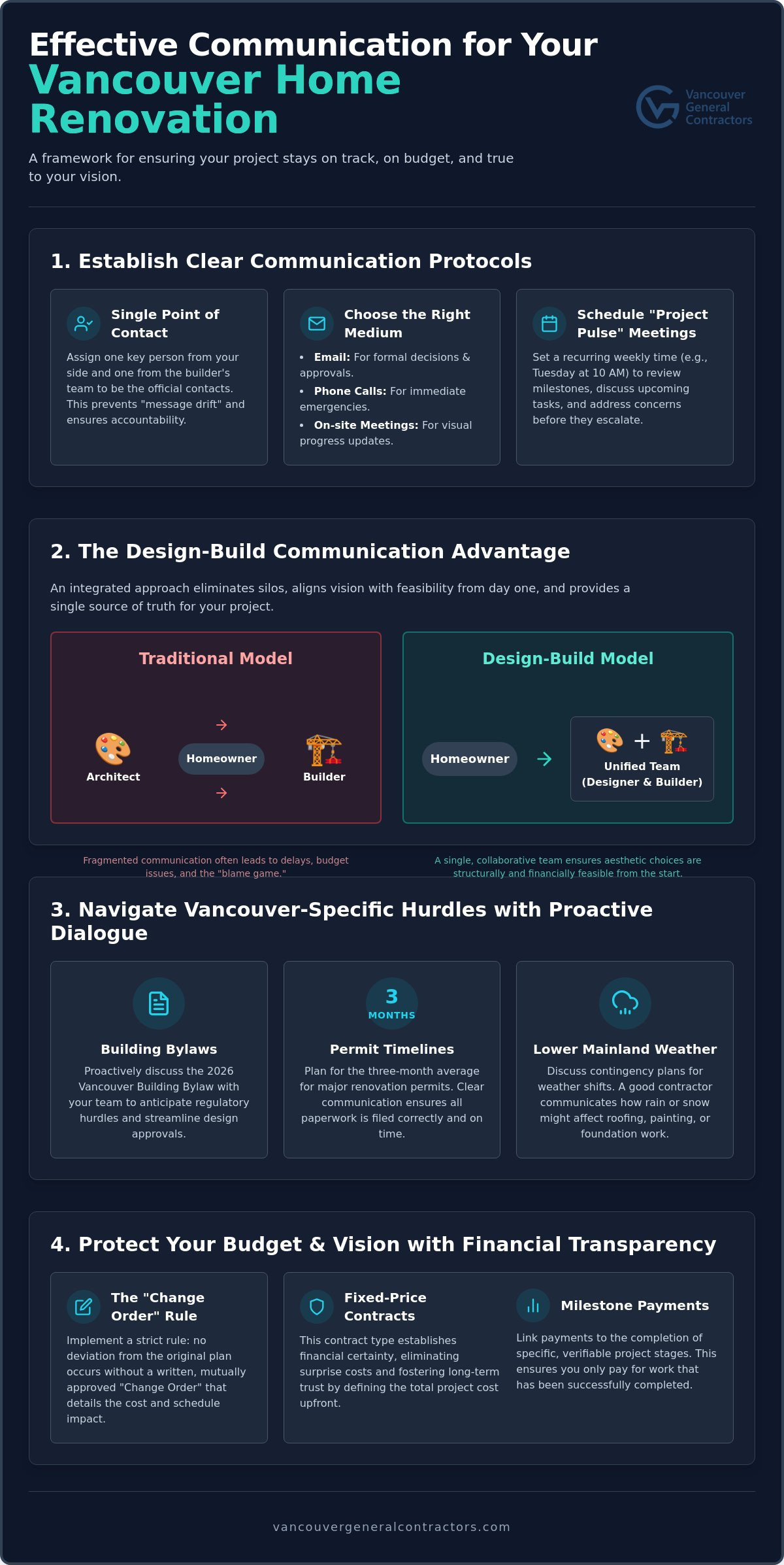
A successful home renovation is built on a foundation of trust, but that trust is maintained through a rigorous system of information exchange. Communicating effectively with your general contractor requires more than just occasional chats; it demands a structured framework that eliminates ambiguity. We view this framework as the bedrock of professional construction management, ensuring that every design choice and technical adjustment is documented and understood by all parties. Without these guardrails, even the most inspired projects can fall victim to misaligned expectations.
To prevent “message drift,” identify a single point of contact for both the homeowner and the construction team. When too many voices enter the conversation, critical details regarding your condo or kitchen renovation can easily be lost. We recommend choosing the right medium for every message. Use email for formal documentation and budget approvals, phone calls for immediate emergencies, and on-site meetings for visual progress updates. This discipline ensures that a digital paper trail exists for every decision made on your property, providing security for your investment.
Consistency builds confidence. We advocate for a recurring “Project Pulse” meeting, such as every Tuesday at 10 AM, to review milestones and upcoming tasks. These sessions provide a dedicated space to address concerns before they escalate into site-wide frustrations. It is also vital to define what constitutes an “emergency” versus a “standard” inquiry. Respecting professional boundaries ensures that when an actual urgent issue arises, such as a site security breach or a major leak, your team is ready to prioritize it immediately.
The Role of Technology in Modern Renovation
Modern builds benefit immensely from specialized project management software. These platforms centralize photos, daily logs, and schedules in one accessible location. We utilize shared digital folders for permits, insurance documents, and material selections to keep everyone aligned. While texting is convenient for quick logistics, avoid using SMS for major decisions or financial approvals. Text messages are difficult to archive and often lead to misunderstandings that can derail your budget or timeline. Keeping everything in a central hub ensures that your project’s history is preserved and transparent.
Setting Response Time Expectations
Clarity regarding availability reduces anxiety during the construction phase. Agree on a reasonable window for non-urgent replies, typically between 24 and 48 business hours. This allows your contractor to focus on the craftsmanship of your custom home or laneway house without constant interruptions. Establish clear after-hours protocols specifically for site security or urgent weather concerns to ensure your home remains protected. A well-defined communication protocol serves as the operating system for a successful renovation.
The Design-Build Communication Advantage
The traditional construction model often creates a fragmented dialogue where the homeowner is caught between an independent architect and a builder. This silos information, leading to the infamous “blame game” when a design element proves impossible to execute on-site. By choosing an integrated design-build approach, you fundamentally change the nature of communicating effectively with your general contractor. The designer and the builder sit at the same table from day one, ensuring that every aesthetic choice is grounded in structural reality and financial feasibility.
This synergy is particularly powerful during the permit phase. Instead of waiting months for a design to be rejected by municipal authorities, an integrated team anticipates regulatory hurdles based on the latest Vancouver Building Bylaws. They streamline the transition from pre-construction to the active build site by maintaining a single source of truth. One of the most effective visual communication tools in this model is the use of 3D renderings. These high-fidelity models allow you to walk through your renovation before a single hammer is swung, aligning expectations and preventing costly mid-project changes.
Unified Responsibility and Accountability
Having one contract for both the design and construction phases simplifies your lines of communication significantly. You don’t have to mediate disputes or interpret technical jargon between two different companies. This model is a hallmark of custom home builders vancouver who prioritize transparency. It ensures that structural changes aren’t lost in translation as they move from the drawing board to the foundation. When everyone is on the same team, accountability is absolute and the process feels like a partnership rather than a series of transactions.
Early Budget Realization
Financial transparency is often where communication breaks down in traditional builds. In a design-build framework, cost-certainty is established during the creative phase. This allows you to effectively supervise the project’s evolution without the fear of sticker shock later. A fixed-price contract serves as a definitive communication of project scope, clearly outlining what is included and what is not. The design-build process acts as a single source of truth for the homeowner, providing a reliable roadmap for the entire journey. If you are ready to experience this level of clarity, consider how a structured renovation methodology can protect your investment and your peace of mind.
Navigating Local Vancouver Challenges Through Proactive Dialogue
Building in the Lower Mainland presents a specific set of variables that can catch unprepared homeowners off guard. From the “atmospheric rivers” of November to the intricate zoning changes introduced by provincial legislation in early 2026, local context is everything. Communicating effectively with your general contractor involves more than discussing the floor plan; it requires a proactive dialogue about the external factors that influence your timeline and budget. Whether you are navigating the “Permit Maze” in Burnaby, Richmond, or Surrey, your builder should provide a realistic roadmap that accounts for the 12 to 28 weeks typically required for complex residential permits in today’s market.
Weather is another primary driver of schedule shifts in Vancouver. A professional contractor doesn’t just hope for sun; they communicate “Rain-Day” protocols clearly. You should know exactly how your team handles site protection during a downpour and how they will notify you if a concrete pour or roofing phase must be rescheduled. Beyond the site itself, maintaining positive neighbour relations is a shared responsibility. Discussing noise mitigation, parking for trades, and site cleanliness before the first excavator arrives helps prevent local complaints that can lead to city-mandated work stoppages.
Finally, keep the conversation open regarding material lead times. While lumber prices have stabilized as of July 2026, specialized metals and materials sourced from the United States remain subject to trade-related volatility. Your contractor should provide regular updates on supply chain status to ensure that long-lead items, like custom windows or high-end appliances, are ordered well in advance to keep the project moving forward.
The Permit and Inspection Conversation
Your contractor should provide consistent updates as your project reaches City of Vancouver inspection milestones. These regulatory check-ins are critical for maintaining the momentum of your home renovation vancouver. If a project hits a regulatory hurdle in West or North Vancouver, ask for a clear explanation of the city’s feedback and the specific steps being taken to resolve it. Transparency during these moments prevents the anxiety of feeling like your project is stuck in a municipal vacuum.
Seasonal Considerations for the North Shore and Beyond
The geography of the North Shore often brings more intense weather than the rest of the city. Discuss site protection and hoarding strategies for the wet winter months to ensure your home’s interior remains dry during structural transitions. Conversely, during the summer heat, communicate regarding the specific windows needed for exterior painting or roofing to ensure materials cure correctly. Proper planning ensures the project stays “on centre” regardless of the seasonal logistical challenges typical of our West Coast environment.
Managing Project Changes and Resolving Conflicts Gracefully
Even with the most meticulous planning, high-end renovations are dynamic. Communicating effectively with your general contractor during the active build phase means being prepared for the unexpected with a structured response. Whether you decide to upgrade your kitchen cabinetry mid-way through or your team discovers outdated wiring behind a lath-and-plaster wall, how you manage these shifts determines the project’s long-term health. We rely on the “Change Order” rule: never authorize a deviation from the original plan without a signed, written document. This protocol isn’t about bureaucracy; it’s about protecting the clarity and trust that define a successful partnership.
It is helpful to distinguish between “aesthetic changes,” which are driven by your evolving vision, and “unforeseen site conditions.” The latter are technical surprises that even the most thorough pre-construction inspection might not reveal. Addressing these concerns immediately prevents them from snowballing into site-wide frustrations. By maintaining a professional and collaborative tone, you ensure that every adjustment is viewed as a shared challenge to be solved rather than a source of friction. If you value this level of disciplined management, explore our transparent renovation process to see how we protect your investment.
The Formal Change Order Process
A structured change order process keeps your budget and timeline from drifting off course. It follows three essential steps:
- Step 1: Identify the specific need for a change and its immediate impact on the project schedule.
- Step 2: Review the cost adjustment in detail and secure written approval before any new work begins.
- Step 3: Update the master project schedule to reflect the new timeline, ensuring all trades are realigned.
Conflict Resolution Strategies
Conflicts often arise from a lack of options rather than a lack of intent. We recommend a “Solution-First” approach. If a problem occurs, ask your contractor for three distinct options to solve it rather than simply identifying the issue. This shifts the energy from blame to collaboration. For emotional decisions regarding your home, don’t hesitate to use “cooling off” periods. Taking twenty-four hours to process a budget adjustment or a schedule shift prevents impulsive reactions and leads to better outcomes. Documentation is the best insurance policy for a healthy contractor relationship. By keeping a clear record of every decision, you ensure that your home remains a source of pride rather than a source of stress.
The Value of Financial Transparency and Fixed-Price Contracts
In the context of communicating effectively with your general contractor, financial clarity is the most vital dialogue you will ever have. While technical updates and design choices are important, the foundation of a stress-free renovation is the elimination of fiscal ambiguity. A fixed-price contract serves as the ultimate communication of trust; it is a professional promise that your vision will be delivered for a specific, agreed-upon investment. At Vancouver General Contractors, we prioritize cost-certainty because we believe that your home transformation should be defined by excitement, not by the anxiety of a runaway budget.
The “Pre-Construction Phase” is where this financial transparency is forged. During this period, every material selection, structural requirement, and municipal permit cost is meticulously calculated. By investing time in this granular planning, we remove the guesswork that often leads to surprise invoices later. This structured approach ensures that the “operating system” of your project is calibrated for success before a single hammer is swung on your property. It transforms the financial conversation from a series of stressful negotiations into a predictable, milestone-based roadmap.
Breaking Down the Fixed-Price Model
The fixed-price model is designed to protect homeowners from the “cost-plus” volatility common in Metro Vancouver’s construction industry. In a cost-plus scenario, you are often responsible for fluctuating material prices and labour overruns, which can lead to significant financial strain. Our fixed-price approach includes labour, materials, professional project management, and all necessary permits in one transparent total. For example, when executing a kitchen renovation vancouver clients benefit from knowing their final costs upfront. This allows you to allocate your resources with confidence, knowing that the price we agree upon is the price you will pay.
Long-Term Partnership and Warranties
Our commitment to communication extends far beyond the active construction phase. We believe in building high-end living environments that offer permanent value, which is why we establish clear expectations for post-construction support. The “Handover Meeting” is a critical final milestone where we conduct a comprehensive walkthrough and provide you with a complete documentation package. This package includes your industry-leading warranty, ensuring you have a direct line of contact for any future needs. We view every project as the start of a long-term partnership built on stability and accountability. If you are ready to experience a renovation defined by elite communication and financial integrity, start your stress-free renovation journey with Vancouver General Contractors today.
Build With Confidence and Absolute Clarity
A high-end renovation represents a profound investment in your property and your family’s future. Success depends on moving beyond casual conversations toward a structured system that eliminates ambiguity. Communicating effectively with your general contractor is the most powerful tool you have to navigate complex municipal bylaws and avoid the volatility of the local market. By integrating design and construction under one roof, you ensure that every aesthetic choice is both beautiful and buildable.
You deserve a partnership defined by accountability and professional discipline. Our comprehensive 3D design-build process allows you to visualize every detail before construction starts, while our fixed-price contract guarantee provides the financial certainty you need to remain stress-free. With an industry-leading warranty and a commitment to transparent project management, we take full responsibility for your project’s lifecycle so you don’t have to.
Book Your Free Consultation and Experience Transparent Design-Build Excellence
Your dream home is well within reach when you partner with a team that values integrity and clear dialogue as much as you do. We look forward to helping you build a legacy that lasts for generations.
More Uncategorized Guides





Ready to start your renovation?
Frequently Asked Questions
How often should I expect updates from my general contractor?
You should expect a formal update at least once per week. This usually occurs during a recurring meeting where you review milestones and upcoming tasks. Communicating effectively with your general contractor ensures that you stay informed about site progress without needing to micromanage the daily details. Consistent communication builds trust and prevents the anxiety often associated with the quiet phases of a major build or home addition.
What is the best way to document conversations during a home renovation?
The most effective way to document conversations is through a centralized project management platform or a dedicated email thread. Every verbal decision made during a site visit should be followed by a written summary sent to all parties. This creates a permanent digital record for your condo or whole home renovation, ensuring that technical specifications and budget approvals are never lost in translation or forgotten as the project evolves.
What should I do if my contractor stops responding to my emails?
If your contractor stops responding to digital messages, you should attempt a phone call or visit the site during scheduled hours. Silence often signals a bottleneck in the field rather than neglect; however, it is vital to re-establish the agreed-upon communication protocols immediately. Professional builders prioritize accountability and will work with you to ensure that response time expectations are met to keep your renovation on track and stress-free.
How do I tell my contractor I am unhappy with the quality of work?
You should raise quality concerns as soon as they are identified rather than waiting for the final walkthrough. Use a collaborative tone and provide specific examples of where the work deviates from the agreed-upon design or technical standards. By addressing small issues early, you prevent them from becoming site-wide frustrations. A professional team will appreciate the opportunity to rectify a detail before it impacts the next stage of construction.
Should I communicate directly with the tradespeople or only the general contractor?
You should communicate exclusively with your general contractor or designated project manager. Speaking directly to tradespeople can lead to “message drift” and confusing instructions that may void warranties or cause safety issues. Your contractor is responsible for the entire project lifecycle and must coordinate all sub-trades to maintain the schedule. Keeping a single point of contact is the best way of communicating effectively with your general contractor.
What happens if a change to the project is needed due to a Vancouver permit requirement?
If a regulatory shift, such as an update to the Vancouver Building Bylaw, necessitates a change, your contractor should issue a formal Change Order. This document outlines the technical requirement, the cost adjustment, and any impact on the delivery date. Transparency during these moments is essential. A knowledgeable builder will explain the municipal feedback clearly so you understand exactly why the modification is required for compliance and safety.
How can I avoid misunderstandings regarding material selections and finishes?
Utilize 3D renderings and a shared digital folder to centralize all material selections and finishes. Seeing a visual representation of your kitchen or bathroom renovation before construction begins aligns expectations and reduces the risk of “sticker shock.” Ensure that every finish is documented with a specific SKU or model number in your contract to eliminate any ambiguity regarding the quality or aesthetic of the final installation.
Is it okay to change my mind about a design choice once construction has started?
It is possible to change your mind, but realize that mid-project shifts often require a Change Order and can lead to delays. Once construction has started, materials may have already been ordered or structural work completed. Your contractor will help you evaluate the feasibility and cost of the change. While we strive for flexibility, maintaining the original plan is the most reliable way to stay on budget and on schedule.

Comments are closed