

Should I Renovate My House or Move? Compare the Costs
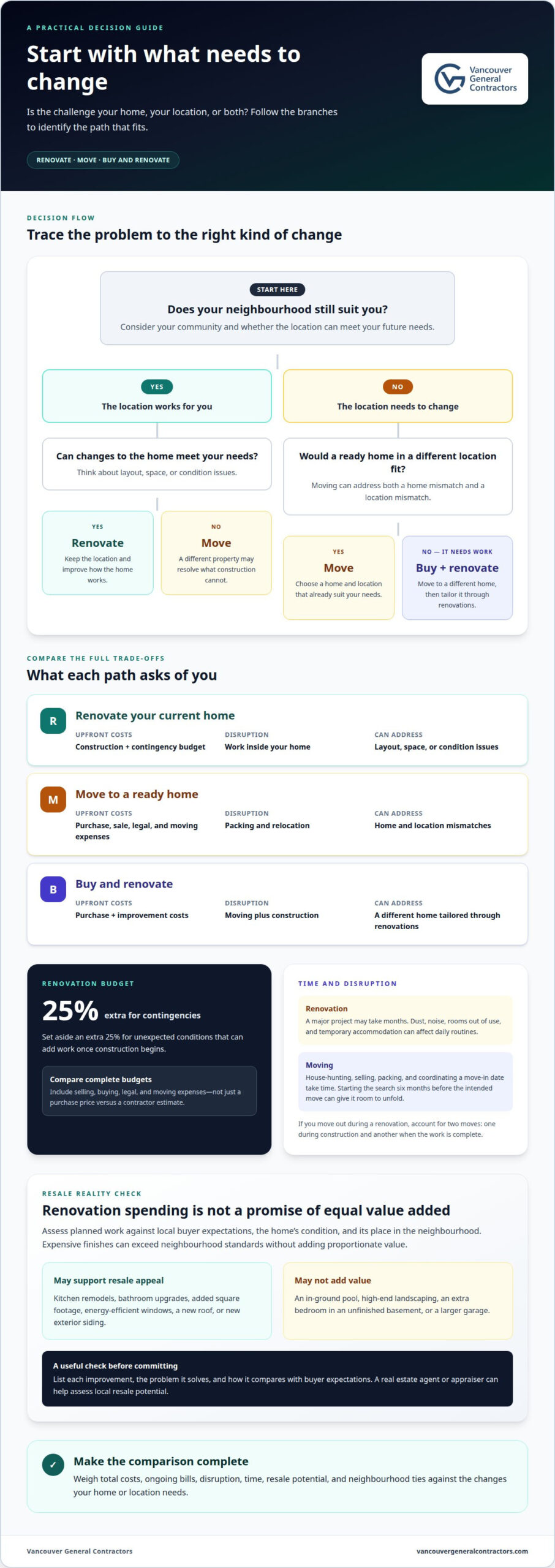
If you’re deciding whether you should renovate your house or move, start by identifying what needs to change: the home, the location, or both. Renovating may make sense when your neighbourhood still suits you and changes to the home can meet your needs. Moving may be a better fit when the location or the property itself can’t support the life you want.
It’s a major decision, and comparing renovation estimates only with a new home’s purchase price can leave out important costs and trade-offs. Time, disruption, resale value, and ties to your neighbourhood all matter.
This guide compares renovating, moving, and buying a home that needs work. Weigh the financial and practical trade-offs, consider how long you plan to stay, and use a clear decision guide to find the option that best fits your needs.
Key Takeaways
- Compare the full cost of moving with the scope of renovation work, not just the purchase price and contractor estimate.
- Factor in construction disruption, temporary living arrangements, and the time each option may take.
- Assess resale potential against neighbourhood expectations; renovation spending doesn’t necessarily translate into an equivalent increase in value.
- Weigh the value of staying close to your community against whether your home’s location will meet future needs, including risks highlighted by Policy Horizons Canada.
What are the pros and cons of renovating?
Renovating can improve how your home works without giving up its location. Moving may solve problems construction can’t, but it brings transaction and relocation costs. If you’re asking, “Should I renovate my house or move?”, compare how each option would change your daily life.
| Option | Upfront costs | Disruption | What it can solve |
|---|---|---|---|
| Renovate your current home | Construction and contingency budget | Work inside your home | Layout, space, or condition issues |
| Move to a ready home | Purchase, sale, legal, and moving expenses | Packing and relocation | Home and location mismatches |
| Buy and renovate | Purchase and improvement costs | Moving plus construction | A different home tailored through renovations |
Renovation Costs and Budget Contingencies
A renovation budget centres on the work needed, such as changing a kitchen layout or finishing a basement. Homeowners are advised to set aside an extra 25% for contingencies, since unexpected conditions can add work once construction begins. Moving costs differ: they cover selling, buying, and relocating rather than improving a home you already own. To decide whether I should renovate my house or move, compare complete budgets, not just headline estimates.
Ongoing Costs of Staying or Moving
Property taxes, utilities, insurance, and maintenance depend on the home and its location. A move can change each expense: a different property may have a different tax bill, utility use, insurance needs, or upkeep. Staying means keeping the same property and its existing costs, although renovations may affect energy use or future maintenance. Compare current bills with expected costs for the home you’d move into, not just the purchase and renovation totals.
Renovation Disruption
Renovation costs involve more than construction spending. Dust, noise, and rooms taken out of use can disrupt daily routines, especially if you remain at home during the work. A major project may take months and could require temporary accommodation. Moving instead involves packing and settling into a different home. If you need to move out during a renovation, account for two moves: one during construction and another when the work is complete.
Choose by comparing the full costs and disruption of each option with the changes your home or location needs.
Comparing the stress and time involved in renovating or moving
Renovation concentrates disruption in a familiar home; moving shifts the pressure to selling, house-hunting, and settling elsewhere. Compare which demands better fit your schedule and household routines.
Stress of Renovating
Construction can mean noise, dust, restricted access to rooms, and daily decisions about how the work affects your household. A kitchen project, for example, can make meal preparation harder while the room is unavailable. Staying preserves familiar routines and nearby connections, but living around construction can wear on household members. Decisions during construction can also feel stressful, especially when changes affect the agreed scope or sequence. A defined plan clarifies what happens first and which spaces remain usable.
Moving Advantages and Disadvantages
Moving can offer a faster route to a layout or location that already suits your needs. It also replaces construction decisions with the demands of selling, searching, packing, and coordinating a new home. Starting your house hunt six months before your intended move can give the search room to unfold. Mortgage changes can add another task: ending or changing an existing mortgage may involve costs, depending on its terms.
Delays affect the two choices differently. Renovation schedules can shift as work progresses, while a move depends on coordinating a sale, a suitable purchase, and a move-in date. For either path, identify fixed commitments such as work, school, or a lease, then map them against the likely sequence. This makes practical pressures easier to see.
If construction remains the better fit, structured renovation planning can help clarify the project sequence and household impacts before work begins. Choose renovation when you can accommodate the work and the changed home meets your needs. Choose moving when a different property or location resolves needs construction cannot.
Estimating renovations’ potential effect on resale value
Renovation spending doesn’t necessarily create an equivalent increase in market value. Estimate the potential resale benefit by comparing the planned work with local buyer expectations, your home’s condition, and its place in the neighbourhood.
Start with the home’s location and size, then consider what buyers nearby typically expect. A renovated kitchen may appeal to buyers, but expensive finishes can exceed neighbourhood standards without adding proportionate value. If you may sell within a year or two, compare the likely benefit with the disruption and the time you have to enjoy the improvements.
Some projects are more likely than others to support resale appeal. Kitchen remodels, bathroom upgrades, and added square footage are generally among the improvements that recoup investment best. A modernized kitchen, functional bathroom, energy-efficient windows, new roof, or new exterior siding can also add value. These are possibilities, not a promise that every dollar spent will be returned at sale.
By contrast, an in-ground pool, high-end landscaping, an extra bedroom in an unfinished basement, or a larger garage may not add value. Assess each feature in relation to the property and its neighbourhood. For example, an added bedroom may improve daily use, but buyers’ expectations and the home’s overall size still shape its market appeal.
To estimate the likely effect, list the work, identify the problem each improvement solves, and compare it with buyer expectations. A real estate agent or appraiser can help assess local resale potential. A relationship banker or mortgage loan officer can also help you weigh whether the investment fits your financial plans.
Permits and building-code requirements depend on the project and its location. Ask your municipality whether the planned renovation is allowed and whether permits are required, then include those requirements in the project scope before estimating resale value.
Evaluating attachment to the neighbourhood
Assess whether your current home’s layout and location will meet your needs over the next five to ten years. List likely changes, such as working from home, needing another bedroom, or relying more on nearby services. Then decide which needs the home’s layout can address and which depend on location.
Neighbourhood ties can have practical value. Consider your commute, school district, familiar routines, and access to friends or family. The Federal/Provincial/Territorial Ministers Responsible for Seniors Forum also recommends considering how easily you can reach community facilities. Compare those daily connections with what another neighbourhood could offer.
Separate attachment to the house from attachment to its surroundings. If you value the neighbourhood but need more usable space, changing the layout may address the mismatch. If your commute or access to essential places no longer works, renovations can’t change the home’s location. Write down which needs each option would solve.
Location also involves future conditions. According to Policy Horizons Canada, wildfires and floods have forced tens of thousands of British Columbians to move over the last 5 years. Consider whether your home’s location will continue to meet your needs as circumstances change, alongside its community connections and everyday convenience.
Use a simple comparison: list your household’s expected needs, mark each as a layout or location issue, then identify which changes renovation could address. If most needs involve rooms, storage, or flow, staying may fit. If they centre on commuting, schools, or access to community facilities, moving deserves serious consideration.
If your neighbourhood still fits but your home needs a new layout, plan a whole-home renovation around the way you expect to live.
Vancouver General Contractors
Vancouver General Contractors helps homeowners assess whether renovation can make their current home work better. If your neighbourhood still suits you but your home needs more space or a different layout, a home addition or whole-home renovation may address the gap. For a focused change, kitchen renovations can improve how a key part of your home functions.
Its design-build process brings project planning and construction together, from initial concept and 3D design through permits and construction. This gives you a structured way to explore the scope and practical requirements of a renovation before deciding how to proceed. It’s a useful next step when you’re weighing changes to your home against the disruption of moving.
To discuss your renovation plans, contact Vancouver General Contractors.
Turn your priorities into a clear next step
If you’re still asking whether you should renovate your house or move, define what a successful decision needs to deliver. Write down the changes that would improve daily life, the parts of your current location you want to keep, and the compromises you won’t accept. This turns a difficult choice into a practical brief for assessing whether renovation can meet your needs.
If renovation remains an option, Vancouver General Contractors can help explore the project scope through Home Additions, Whole Home Renovations, or Condo Renovations. The next conversation can focus on what you want to change and how the work could support your plans, without assuming renovation is automatically the right answer.
Contact Vancouver General Contractors to discuss your renovation plans. A thoughtful decision starts with the future you want your home to support.
Frequently Asked Questions
Should You Renovate or Move?
Renovate if the home’s shortcomings can be corrected and you want to stay in its location. Moving may suit you better if the property’s basic constraints or the surrounding area conflict with your priorities. Write down the outcomes you need, such as an accessible entry or a shorter commute, then identify which option can realistically deliver each one.
Should You Renovate Your Home or Buy a New One?
Choose renovation if you value your current property and can change the features causing friction. Buying a different home lets you select a layout and setting that already suit you, though eligible buyers may be able to include improvements in a mortgage through a purchase-and-renovate loan. Compare that possibility with buying a home that needs no immediate work.
How Do You Know When It’s Time to Move?
Consider moving when your core needs depend on a different location or a property your current home can’t reasonably become. For example, a long commute may remain a problem even after adding a room or changing the layout. Look for recurring conflicts in your household’s routines, then distinguish issues construction could solve from those tied to the address.
How do I compare the total cost of renovating versus buying a different home in Canada?
Build separate budgets for each option using the same planning horizon. For renovation, include the defined work, contingency funds, temporary accommodation, and ongoing ownership costs. For a purchase, include sale and purchase transactions, legal costs, moving, mortgage changes, and any immediate improvements. Add expected taxes, utilities, insurance, and maintenance for the property you’d own under each choice.
What is the average cost of common home renovations in Canada by project?
A single national average can mislead because a cosmetic kitchen update differs greatly from a layout change involving structural work. Compare estimates by project type, such as kitchens, bathrooms, basements, additions, and whole-home work. First define the size, materials, finishes, and required work for each. Then compare estimates with matching scopes rather than treating unlike projects as equivalent.
How can I estimate whether renovations will increase my home’s resale value?
Use recent comparable sales in your area as a reality check, focusing on homes with similar size, condition, and features. Note which improvements appear in competing listings, then distinguish buyer appeal from personal enjoyment. Keep a clear record of the renovation scope and materials. This makes it easier to discuss the project with a local real estate professional without assuming that spending equals added value.


Trusted by Canada’s
Top Building Experts
“I only put my name on companies I’d hire myself.”
Business
Guarantee
Approved
More Uncategorized Guides