





What Does a General Contractor’s Warranty Cover? The 2026 Vancouver Homeowner’s Guide
What if that stunning new home addition develops a structural crack or a persistent leak just months after the final inspection? For many Vancouver homeowners, the anxiety of a contractor disappearing when things go wrong is a heavy burden that often overshadows the excitement of a renovation. It is a valid concern; you want to know that the permanent value you were promised is backed by more than just a polite smile. When you ask what does a general contractor’s warranty cover, you are looking for more than a simple list of repairs. You are seeking a guarantee of stability and professional accountability in a complex industry.
You likely already believe that a premium renovation should be a legacy, not a source of hidden repair costs or logistical stress. We promise to show you how British Columbia’s 2-5-10 home warranty insurance acts as a multi-layered shield for your investment, providing specific protections for everything from your electrical systems to the building envelope. This guide breaks down the mandatory legal requirements of the Homeowner Protection Act, explains why a fixed-price contract with a professional GC is your best defence, and helps you distinguish between a temporary fix and a lifetime of security.
Key Takeaways
- Gain clarity on the BC Homeowner Protection Act and why the mandatory 2-5-10 warranty is the gold standard for protecting your home investment.
- Discover exactly what does a general contractor’s warranty cover regarding labour and materials, ensuring you can differentiate between structural defects and simple manufacturer issues.
- Learn to identify common exclusions, such as standard wear and tear, and understand your responsibility for ongoing maintenance to protect your warranty rights.
- Realize the value of a single point of accountability through a design-build approach that eliminates the gap between architectural plans and site execution.
Understanding the Basics: What is a General Contractor’s Warranty?
A construction warranty is far more than a simple handshake or a verbal promise of quality; it is a legally binding commitment to the performance and durability of your home. To truly grasp What is a General Contractor’s Warranty? you must view it as a contractual shield that protects your financial investment from the unpredictable nature of building projects. It establishes a clear framework for accountability, ensuring that the work delivered meets specific professional standards and stays that way for years to come.
Homeowners often use the terms “guarantee” and “warranty” interchangeably, but in the Vancouver construction market, the distinction is vital. A guarantee is typically a broad promise of satisfaction, while a warranty is a specific, enforceable obligation to repair or replace defects within a set timeframe. When you are asking what does a general contractor’s warranty cover, you are looking for the technical details of how a firm will remedy issues with labour, materials, or structural integrity without charging you a cent more than your original contract price.
When partnering with leading custom home builders Vancouver families trust, a written warranty becomes the cornerstone of the entire project. It provides the peace of mind necessary to invest in high-end designs, knowing that the aesthetic beauty is matched by technical excellence. This coverage generally rests on three pillars: the quality of the labour performed, the durability of the materials installed, and the long-term structural integrity of the build itself.
Express vs. Implied Warranties
To understand the full scope of your protection, you must distinguish between express and implied warranties. Express warranties are the specific, written promises integrated directly into your fixed-price contract. These are clear and actionable. In contrast, implied warranties are the “fit for habitation” standards mandated by Canadian common law. Relying solely on implied warranties is a risky strategy for homeowners because these standards are often vague and can lead to lengthy, expensive legal disputes. A professional general contractor will always provide an express warranty to eliminate any ambiguity about their responsibility.
The Role of the General Contractor as the Single Point of Contact
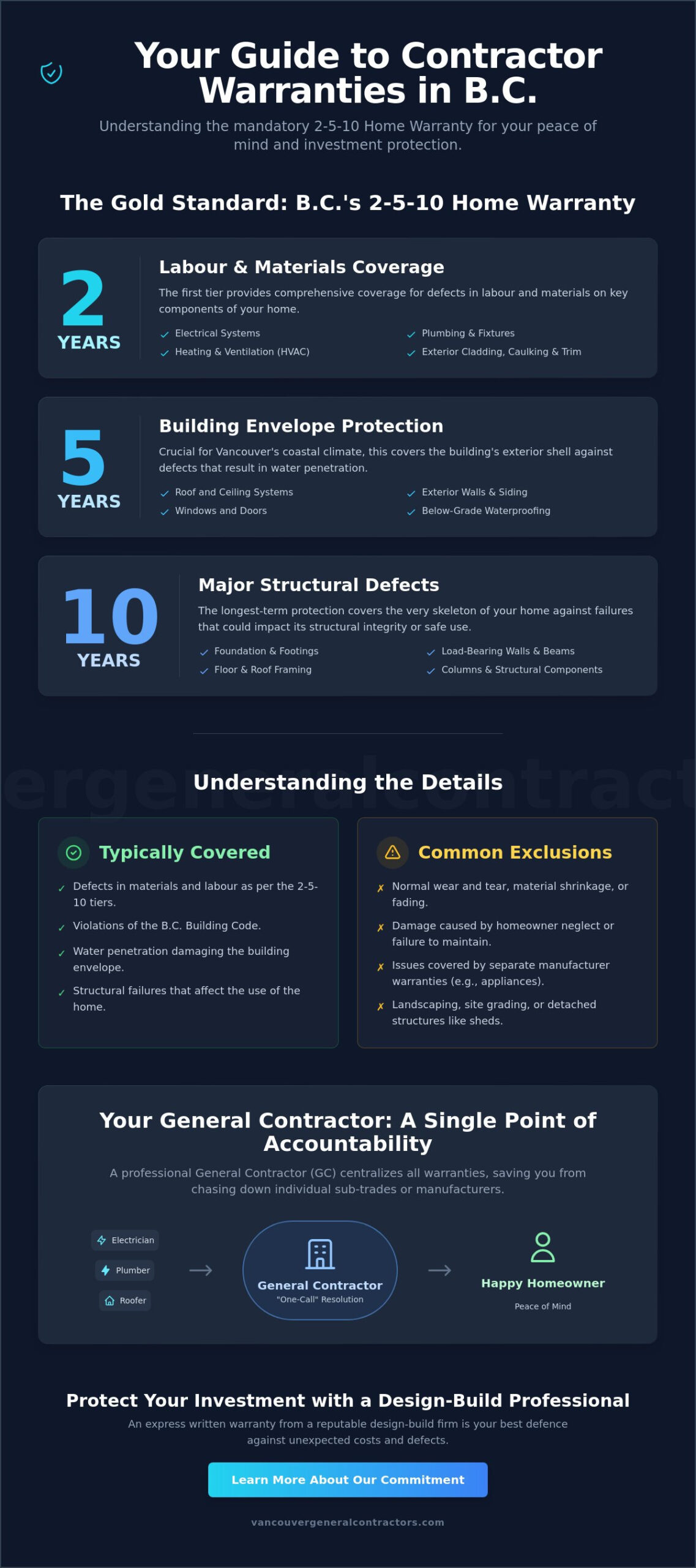
Think of your general contractor as the conductor of a complex orchestra. They manage dozens of sub-trades, from plumbers and electricians to roofers and tilers. A significant part of what does a general contractor’s warranty cover is the centralized management of these individual trade warranties. Instead of you having to track down a specific flooring manufacturer or a plumber who worked on your home six months ago, you have a single point of contact. This “one-call” benefit means your GC takes full responsibility for the project lifecycle. Most professional contracts also include a dedicated correction period in the first 12 months, where the GC proactively addresses any minor adjustments as the new structure settles into its environment.
The British Columbia Standard: Navigating the 2-5-10 Home Warranty
In British Columbia, the construction industry operates under some of the most stringent consumer protection laws in North America. The Homeowner Protection Act mandates that all new homes and significant structural changes be backed by British Columbia’s 2-5-10 Home Warranty. This framework, monitored closely by BC Housing, provides a tiered safety net that ensures your project remains a source of pride rather than a financial liability. As we move through 2026, regulatory standards have evolved to require even more rigorous documentation for building envelope integrity, particularly to combat Vancouver’s unique coastal climate challenges.
When you explore what does a general contractor’s warranty cover, you’ll find that this statutory insurance is non-negotiable for licensed residential builders. It ensures that every nail driven and every pipe laid is subject to a high level of accountability. If you are planning home additions Vancouver families can trust, understanding these tiers is the first step toward long-term security. This system provides a predictable path for resolving issues, moving the conversation away from conflict and toward professional resolution.
Breaking Down the 2-5-10 Tiers
The 2-5-10 system is designed to provide specific protection for different stages of a building’s life. The first tier covers defects in materials and labour for up to 2 years. This includes 12 months for detached homes and 24 months for major systems like electrical, plumbing, heating, and exterior cladding. The 5-year tier focuses on the building envelope, specifically protecting against unintended water penetration that could damage the structure. Finally, the 10-year tier covers the structural “bones” of the home, ensuring that load-bearing elements remain sound for a decade or more.
When Does 2-5-10 Apply to Renovations?
A common point of confusion for homeowners is whether these protections apply to remodels. While purely cosmetic updates might not trigger the Act, whole home renovations involving “substantial reconstruction” often do. If your project involves replacing a significant portion of the existing structure, the statutory warranty usually kicks in to protect the new investment. Even for smaller projects, a professional firm may offer voluntary warranty extensions that mirror these standards to provide total cost certainty. This level of commitment is why many choose to partner with a transparent expert before breaking ground, ensuring every aspect of the build is backed by a stable, long-term guarantee.
What a Comprehensive Warranty Actually Covers
While the statutory framework provides the legal foundation, a truly comprehensive warranty bridges the gap between regulatory requirements and your daily experience in your home. When you ask what does a general contractor’s warranty cover, you are looking for assurance that every detail, from the invisible structural beams to the polished finish of your cabinetry, is protected. A professional firm ensures that every installation not only meets but exceeds the BC Building Code, providing a level of quality that stands up to the test of time. This protection is a promise that your living environment will perform exactly as designed.
In a sophisticated kitchen renovation Vancouver homeowners expect structural integrity that supports heavy stone countertops and modern appliances without sagging or shifting. This coverage extends to your mechanical systems, including new HVAC runs, plumbing lines, and electrical circuits. If a pipe leaks or a circuit breaker trips repeatedly due to installation errors, the warranty ensures these issues are corrected promptly and professionally. It is about creating a high-end environment where you can live without the fear of hidden failures.
Labour and Installation Excellence
Professional craftsmanship is defined by the “good and workmanlike manner” standard in Canadian construction. This means the work must be performed with the skill and care expected of a seasoned expert. A major benefit of a robust warranty is the protection against latent defects; these are hidden issues, like a poorly sealed vapour barrier, that only become visible after the walls are closed. To ensure everything is performing as intended, top-tier contractors often include a post-completion walkthrough at the 12-month mark to address any minor settling or adjustments needed as the seasons change.
Material Performance and Manufacturer Coordination
What happens when high-end materials, like custom tile or engineered hardwood, fail prematurely? While manufacturers provide their own warranties for the product itself, your general contractor acts as the essential coordinator for these claims. They manage the logistics of replacement and ensure that colour and finish consistency is maintained during any repairs. Under a fixed-price model, the cost of the labour to remove and reinstall defective materials is absorbed by the contractor, shielding you from the financial burden of a manufacturer’s oversight. This level of service transforms a stressful material failure into a managed, predictable resolution.
Common Exclusions: What Your Warranty Typically Won’t Cover
While a professional warranty provides immense security, transparency requires a clear discussion about its boundaries. When homeowners ask what does a general contractor’s warranty cover, they must also understand what it does not. A warranty is designed to address defects in workmanship and materials; it is not a comprehensive insurance policy against every possible household mishap or the natural passage of time. Establishing these expectations early ensures a stable partnership and prevents confusion during the post-completion phase of your project.
Standard wear and tear is the most common exclusion in any construction agreement. Fading paint in high-sun areas, minor surface scratches on hardwood floors, or the natural shrinking of wood trim as it acclimates to your home’s environment are considered normal results of living in a structure. Similarly, damage caused by “Acts of God,” such as extreme weather events, floods, or earthquakes, falls outside a contractor’s control. It is also vital to distinguish between the warrantied item and secondary damage. If a warrantied plumbing joint fails, the contractor is responsible for the pipe and the necessary wall repair, but they typically do not cover non-warrantied items like furniture or electronics damaged by the water.
The ‘Maintenance Gap’ in Vancouver
Vancouver’s specific climate creates unique responsibilities for the homeowner. Our high humidity levels require active management through HRV (Heat Recovery Ventilator) systems to prevent condensation and mould. If a homeowner fails to operate these systems or neglects to clean their gutters, resulting in water backup, the building envelope warranty may be compromised. We recommend keeping a detailed maintenance log to prove you have upheld your end of the 2-5-10 coverage requirements. This proactive approach ensures your protection remains fully intact and your home continues to perform at its peak.
Third-Party Interventions
Your warranty is a direct agreement between you and your builder. Bringing in an outside handyman to modify a warrantied system, such as your electrical panel or HVAC unit, will almost certainly void the original coverage. This “alteration clause” also applies to DIY projects that might impact the structural integrity of your build. To maintain your security, ensure all post-completion modifications are cleared by your original design-build team. If you are ready to start a project built on this level of professional accountability, contact our transparent experts today to discuss your vision for a secure, high-end home.
The Vancouver General Contractors Advantage: Design-Build Accountability
The traditional construction model often leaves homeowners caught in a frustrating gap between architectural vision and site execution. When a defect arises, architects may blame the builder’s installation, while the builder points to a flaw in the design. This “finger-pointing” is the primary source of stress in major projects. Our Design-Build approach eliminates this conflict entirely by providing a single point of accountability. Because we manage both the design and the construction, there is no ambiguity regarding responsibility. When you ask what does a general contractor’s warranty cover in our world, the answer is simple; it covers the entire project lifecycle under one unified promise.
Our commitment to the Metro Vancouver community is built on a foundation of longevity and stable leadership. We don’t just finish a project and move on; we provide a fixed-price contract that includes comprehensive warranty documentation from day one. This financial transparency ensures that the cost of future repairs is already accounted for, protecting your home investment from the budget volatility that plagues the industry. By choosing a vetted, award-winning team, you are securing a partner who will be here to honour their commitments for the next decade and beyond.
Transparent Warranty Management
We believe that clarity is the best antidote to anxiety. To simplify future claims, we document every phase of construction with meticulous detail, creating a digital trail of your home’s evolution. This transparency is especially vital for whole home renovations, where new systems must integrate seamlessly with existing structures. Our process includes a proactive 12-month “Settling Check-in” to identify and resolve minor issues before they become significant problems. This disciplined methodology ensures your renovation remains a source of pride rather than a logistical burden.
Securing Your 2026 Project
In 2026, the Vancouver housing market demands a higher level of cost-certainty and warranty-security. Before you sign any agreement, review the warranty clause for specific language regarding labour sub-limits and material replacement costs. A professional contract should clearly outline the correction period and the process for emergency repairs. If a firm cannot provide these details in writing, they aren’t offering a true warranty. We invite you to book a consultation with our experts to discuss your project and discover how our design-build methodology provides the ultimate protection for your home investment.
Building a Legacy with Total Confidence
Understanding exactly what does a general contractor’s warranty cover is the final step in securing a successful Vancouver renovation. It is about more than just repairs; it is about absolute peace of mind. By leveraging British Columbia’s rigorous 2-5-10 standards and choosing a partner who offers a single point of accountability, you transform a complex construction project into a predictable experience. This proactive approach ensures your home remains a source of pride rather than a logistical burden for years to come.
Since 2011, we have built a legacy of excellence across Metro Vancouver. Our comprehensive Design-Build process ensures every detail is documented. Every promise is backed by a fixed-price guarantee. This methodology eliminates budget volatility and ensures your investment is protected by a team that stands behind its work. You deserve a stable partner who prioritizes long-term value and professional discipline throughout the project lifecycle.
Secure Your Home’s Future with a Fixed-Price Contract and Industry-Leading Warranty. Your vision deserves a foundation of trust and technical expertise that lasts a lifetime.
Frequently Asked Questions
Is a contractor’s warranty transferable if I sell my Vancouver home?
Yes, the 2-5-10 home warranty insurance is attached to the property itself rather than the individual homeowner. If you decide to sell your home within the coverage period, the remaining balance of the warranty automatically transfers to the new owner. This transferability provides a significant advantage in the Vancouver real estate market, as it offers potential buyers verified protection and enhances the resale value of your investment.
What is the difference between a one-year labour warranty and the BC 2-5-10 warranty?
A one-year labour warranty is typically a builder’s correction period for minor defects, while the 2-5-10 warranty is a comprehensive, statutory insurance policy. The 2-5-10 framework provides much broader protection, covering materials and labour for up to two years, the building envelope for five years, and the home’s structure for a full decade. This tiered system ensures long-term accountability that goes far beyond a simple twelve-month promise of quality.
How do I make a warranty claim if I notice a defect in my new basement suite?
You should first notify your general contractor in writing as soon as you discover a potential defect. Providing clear documentation and photos allows the builder to investigate and rectify the issue during their initial correction period. If the builder is unresponsive or the issue remains unresolved, you must then contact your 2-5-10 insurance provider to file a formal claim. It is vital to act quickly to ensure you remain within the specific coverage windows.
Does a general contractor’s warranty cover the cost of temporary housing during repairs?
No, standard construction warranties generally do not cover consequential damages such as temporary housing, lost wages, or moving costs. The warranty is designed to cover the direct cost of repairing or replacing the defective workmanship or materials. If a major repair requires you to vacate your home, you should consult your primary homeowner’s insurance policy, as living expenses are typically handled through that separate coverage rather than the builder’s warranty.
Can a contractor legally waive their warranty obligations in the contract?
No, a licensed residential builder in British Columbia cannot legally waive or “contract out” of their statutory obligations under the Homeowner Protection Act. For all new builds and substantial reconstructions, the 2-5-10 warranty is a mandatory requirement. Any clause in a renovation contract that attempts to eliminate these rights is legally unenforceable. You should always ensure your builder is licensed and in good standing with BC Housing before signing any agreement.
What happens to my warranty if the general contracting company goes out of business?
Your protection remains secure because the 2-5-10 warranty is a third-party insurance policy, not just a personal guarantee from the builder. Because the policy is issued by an independent insurance provider, your coverage stays in place even if the original construction firm ceases operations. This is a critical distinction when homeowners ask what does a general contractor’s warranty cover, as it ensures your investment is protected by a stable financial institution regardless of the builder’s future.
Does the warranty cover cosmetic cracks in drywall caused by the house settling?
Generally, minor hairline cracks resulting from the natural settling of a new structure are considered normal wear and tear and are excluded from formal warranty claims. However, if the cracking is excessive or suggests an underlying structural failure, it may be covered under the structural or labour tiers. Many professional GCs will address minor cosmetic settling cracks during a scheduled one-year post-completion walkthrough as a courtesy to maintain the aesthetic integrity of your home.
How long does a contractor have to respond to a warranty claim under BC law?
While BC law does not dictate a specific number of hours for an initial response, contractors are expected to address warrantied defects within a “reasonable time” after receiving written notice. If the contractor fails to act, the insurance provider will eventually step in to facilitate the repairs. Professional firms in Vancouver typically aim to respond to warranty inquiries within 48 hours to honour their commitment to client service and maintain their reputation for transparent project management.
More Uncategorized Guides






Comments are closed